Can Your Employer Legally Cut Your Pay?
By
Liz Fujiwara
•

A pay cut is legal only under certain conditions. For hiring managers, recruiters, and talent leaders, the issue is not just whether a company can reduce pay, but whether the reduction is prospective, clearly communicated, properly documented, non-discriminatory, and compliant with federal and state wage and hour laws. Employers must also ensure that any changes comply with employment contracts, company policies, and applicable notice requirements before they take effect.
Key Takeaways
An employer can generally reduce an employee’s pay rate or hourly wage for future work, but not for hours already worked at the agreed-upon rate, and they must still comply with federal and state minimum wage laws.
Employment contracts, employment agreements, or collective bargaining agreements may restrict whether an employer can unilaterally reduce compensation.
Pay cuts based on discrimination, retaliation, sexual harassment complaints, or other protected activity are illegal, and employees should document changes and consider speaking with HR, a labor agency, or an employment lawyer.
Can Your Employer Cut Your Pay Rate Or Hourly Wage?
In most at-will employment settings, an employer is legally allowed to reduce pay for future work, but the company does not have complete control. The pay reduction must comply with the Fair Labor Standards Act, state laws, minimum wage rules, overtime pay obligations, and any binding contract.
A pay cut can affect an hourly wage, salary, commission plan, bonus formula, or other regular compensation. The Fair Labor Standards Act (FLSA) does not prohibit pay cuts, but it requires that employees are not paid below the federal minimum wage after a reduction.
Key rules include:
The new pay rate must apply only to future hours, not past wages.
The employee must receive notice before working under the new rate.
Some states require written notice, while other states may allow verbal notice.
Employers must provide advance notice to employees before reducing their pay, and employees must consent to the new pay rate for it to be legal, often by choosing to continue working after clear notice.
What Is Considered A Legal Pay Cut?
A legal pay cut is a future-focused reduction in an employee’s pay that respects minimum wage, overtime, notice, and contract requirements. The employer must inform the employee before the affected work is performed.
A lawful reduction generally has these features:
It is prospective only, meaning the employee’s wages already earned remain payable at the agreed upon salary or agreed upon rate.
It is clearly communicated in writing, with the old rate, new rate, effective date, and reason.
It appears correctly on the paycheck, pay stubs, payroll records, and any required wage notice form.
It does not reduce wages below the applicable minimum wage.
It preserves overtime rules for non-exempt employees who work more than 40 hours in a week.
It follows any employment contract, employment agreement, commission plan, or collective bargaining agreement.
Employers may implement pay reductions due to economic downturns, company restructuring, job reassignment, or to avoid layoffs. Employers may reduce wages to address cash flow issues, allowing the business to remain operational instead of resorting to layoffs. A pay cut may occur if an employee is reassigned to a different role that carries less responsibility or is outside the scope of their previous position. Companies may also implement pay cuts as a necessary measure to reduce expenses when employees are not meeting performance expectations, which can be costing the company money.
For tech employers, a documented business rationale matters. A company reducing compensation across a department for cash preservation presents a different risk profile than a manager cutting one worker’s pay after a complaint.
When Is A Pay Cut Illegal Or Unlawful?
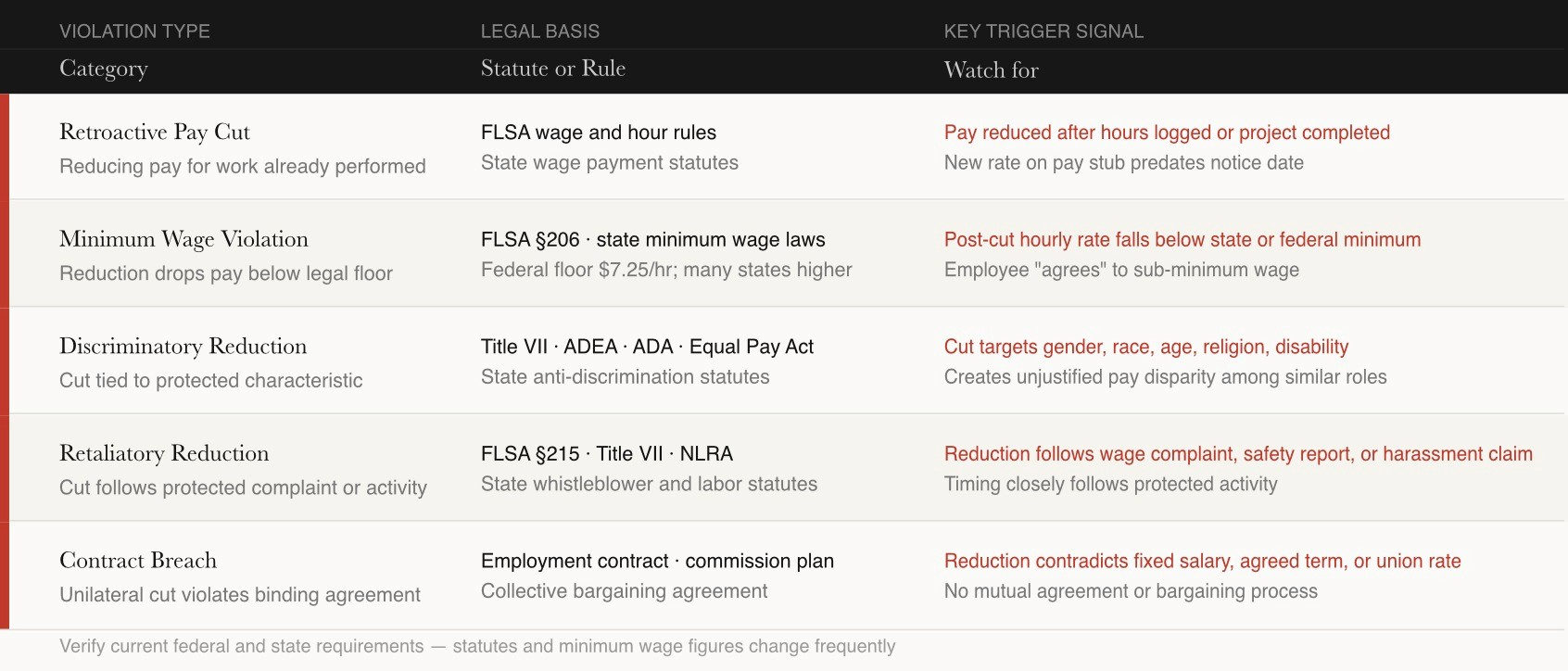
Even in at-will employment, important limits apply. A pay cut becomes illegal when it violates wage laws, discrimination laws, retaliation protections, or a binding agreement.
Common unlawful pay cuts include:
Retroactive cuts: An employer cannot pay a lower rate for hours, projects, or labor already completed. Retroactive wage theft claims can arise when the employee’s pay is reduced after the work is done.
Minimum wage violations: Employers cannot reduce an employee’s pay below the federal minimum wage, even if the employee agrees to the reduction. The current federal minimum wage is $7.25 per hour, and many states require a higher rate.
Discriminatory reductions: It is unlawful for an employer to reduce pay based on discrimination, such as gender or race, or as retaliation for reporting illegal activities. Reductions tied to age, religion, national origin, disability, or sexual harassment complaints can also create legal exposure.
Retaliation: A wage reduction after an employee reports unpaid overtime, safety violations, harassment, or another protected activity may violate federal or state law.
Contract breaches: A unilateral reduction that violates an employment contract, written commission agreement, or union agreement can be unlawful even if the new rate remains above minimum wage.
Employees can file a wage claim with the U.S. Department of Labor or their state labor department if they suspect unlawful pay cuts.
How Federal And State Laws Limit An Employer’s Ability To Reduce Pay
Federal protections set the wage floor, while state laws often impose stricter minimum wage, notice, and disclosure rules. The U.S. Department of Labor minimum wage map is a useful starting point, but employers should verify current state and local rules before making any pay reduction.
The FLSA controls federal minimum wage, overtime pay, and exemption standards. It does not ban a wage reduction, but it constrains how low pay may go and whether workers remain eligible for overtime.
Example Federal And State Requirements For Pay Rate Reductions
The table below is a high-level reference. Employers and employees should confirm current figures against state labor department schedules because minimum wage and notice statutes change frequently.
Jurisdiction | Minimum wage as of 2026 | Written notice for pay cut | Typical timing and disclosure |
Federal baseline | $7.25/hr | No general federal written notice rule | Must comply with FLSA minimum wage and overtime rules |
California | $16.90/hr | Yes | Written disclosure generally required before the change, with accurate pay stub details |
New York | $17.00/hr for NYC, Long Island, and Westchester; $16.00/hr for the remainder of state | Yes | Rate changes must be disclosed and reflected on wage statements |
Texas | $7.25/hr | No specific state pay-cut notice rule | Federal wage and overtime rules still apply |
For unionized workplaces, federal and state labor rules intersect with collective bargaining agreements. A company generally cannot reduce negotiated wage scales without bargaining through the union process.
Equal pay laws also matter. Targeted pay cuts can create legal risk when they produce unjustified disparities among workers doing substantially similar work.
How Employment Contracts, Offer Letters, And Policies Affect Pay Cuts
Contract documents often determine whether an employer can reduce an individual’s compensation. At-will status does not erase explicit promises about pay, benefits, position, or duration.
A formal employment contract that sets a fixed salary for one year usually requires mutual agreement before the employer can reduce wages. A written offer letter may reserve the company’s right to modify compensation, but vague language can be disputed. Bonus plans, equity plans, and commission policies may also define when money is earned and when changes can apply.
Good policies describe:
Who may approve a pay reduction.
How much advance notice will be provided.
Whether employee consent must be in writing.
How the company will document the new position, new salary, or new hourly wage.
How benefits, bonuses, and overtime eligibility will be handled.
In curated hiring environments such as Fonzi, compensation clarity is especially important because engineering and AI candidates often compare roles closely. Ambiguous pay language can damage trust before employment begins.
At-Will Employment And Pay Changes
Most private-sector jobs in the United States are at-will. That generally allows employers to change terms of employment, including pay, for almost any lawful business reason.
But at-will employment does not override wage statutes, overtime rules, anti-discrimination law, or contract promises. It also does not make every severe reduction safe. In many jurisdictions, state unemployment agencies consider a substantial and unilateral reduction in pay (often around 20% or more) as a valid reason to claim unemployment benefits under a constructive dismissal framework, particularly when paired with a demotion.
What Employees Should Do If Their Pay Is Reduced
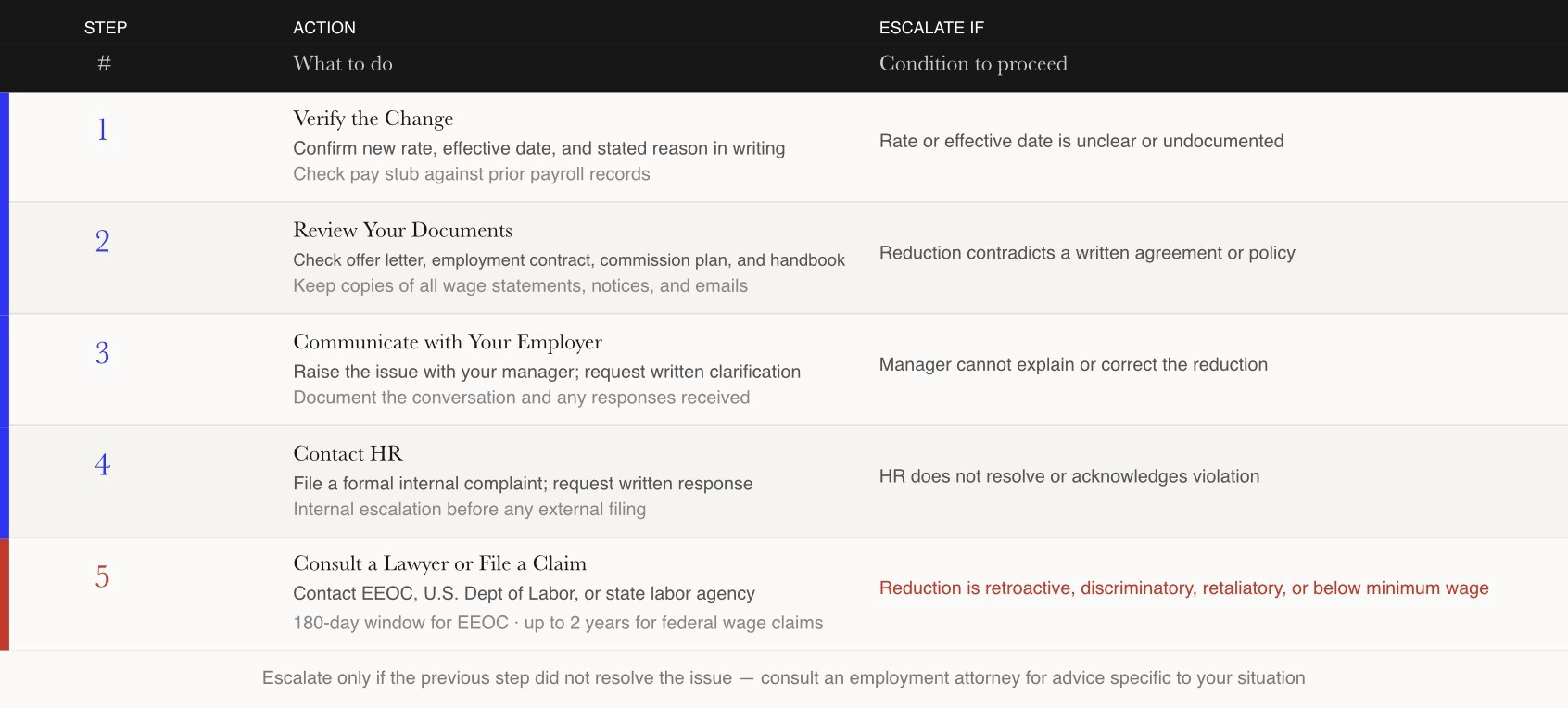
Employees should first verify the new pay rate, effective date, and reason for the pay cut. If you believe your employer layout changes violate your rights, the first step is to communicate with management to clarify the situation, as several states legally require advance notice before an employer can cut your hourly rate of pay.
Next, review your offer letter, employment contract, handbook, commission plan, and pay stubs. Keep copies of emails, notices, wage statements, and payroll records so you can determine whether the reduction was prospective or retroactive.
If discussions with your employer do not resolve the issue, the next step is to contact your Human Resources (HR) department for assistance in addressing the pay cut. If the pay cut is confirmed and you believe it is illegal, you should consult with an employment lawyer to explore your options and understand the legal steps you can take.
You typically have a limited time frame to file a claim if you suspect your employer has unlawfully reduced your pay rate. This is often 180 days to file a discrimination-based wage charge with the EEOC, or up to two years for standard federal wage claims. Employees may also contact the U.S. Department of Labor or a state labor department.
When A Pay Cut May Amount To Constructive Dismissal
Constructive dismissal, also called constructive discharge, occurs when an employer makes working conditions so unfavorable that a reasonable employee would feel forced to resign. Courts often examine the whole situation, not just one paycheck.
A severe pay cut can support a claim when it is sudden, targeted, unsupported by legitimate business reasons, or combined with a demotion, reduced responsibilities, worse hours, or loss of benefits. Employees considering resignation after a major reduction should get legal advice first, because quitting can affect remedies and unemployment eligibility.
Conclusion
Employers can usually reduce an employee’s pay rate only for future work, and only if the reduction complies with minimum wage rules, state notice laws, overtime obligations, and any binding agreement. Retroactive cuts, discriminatory or retaliatory reductions, and pay that slips below legal minimums should be addressed quickly.
Review your pay documentation, compare it against current federal and state requirements, and seek tailored advice from an employment lawyer or labor agency if you suspect a violation.
FAQ
Can my employer legally cut my pay rate or hourly wage?
Does my employer have to notify me before reducing my pay?
Can an employer lower my pay retroactively for work already done?
What should I do if my employer cuts my pay without warning?
When does a pay cut become grounds for a constructive dismissal claim?