Alternative Careers for Software Engineers
By
Liz Fujiwara
•

From 2020 to 2026, AI adoption, market cycles, and hiring freezes have pushed many experienced engineers to reassess their long-term career path. This article focuses on mid to senior software, AI, and infra engineers who want to stay technical, but not necessarily remain in pure feature delivery roles. It connects alternative careers for software engineers with concrete skills developed through software engineering, computer science, machine learning, and data experience.
Key Takeaways
Senior software engineers, including AI and machine learning specialists, have many career options beyond day-to-day coding, and skills like systems thinking, experimentation, analytical thinking, and communication transfer well into product, data, research, and business-focused roles.
AI is reshaping hiring and recruiting, but human judgment and structured processes still play a key role, and successful career changes depend on mapping existing engineering skills to a specific new role rather than starting from zero.
You can reduce the risk of a salary drop by targeting roles where your technical expertise is rare and commercially valuable.
How Engineering Skills Translate Beyond Traditional Software Roles
Software engineers are trained to debug complex systems, model trade-offs, read noisy signals in metrics, and collaborate across functions. Those abilities are not limited to software development. They overlap with mechanical engineering, electrical engineering, and civil engineering mindsets, where rigorous design, safety margins, reliability, and cost constraints shape every decision.
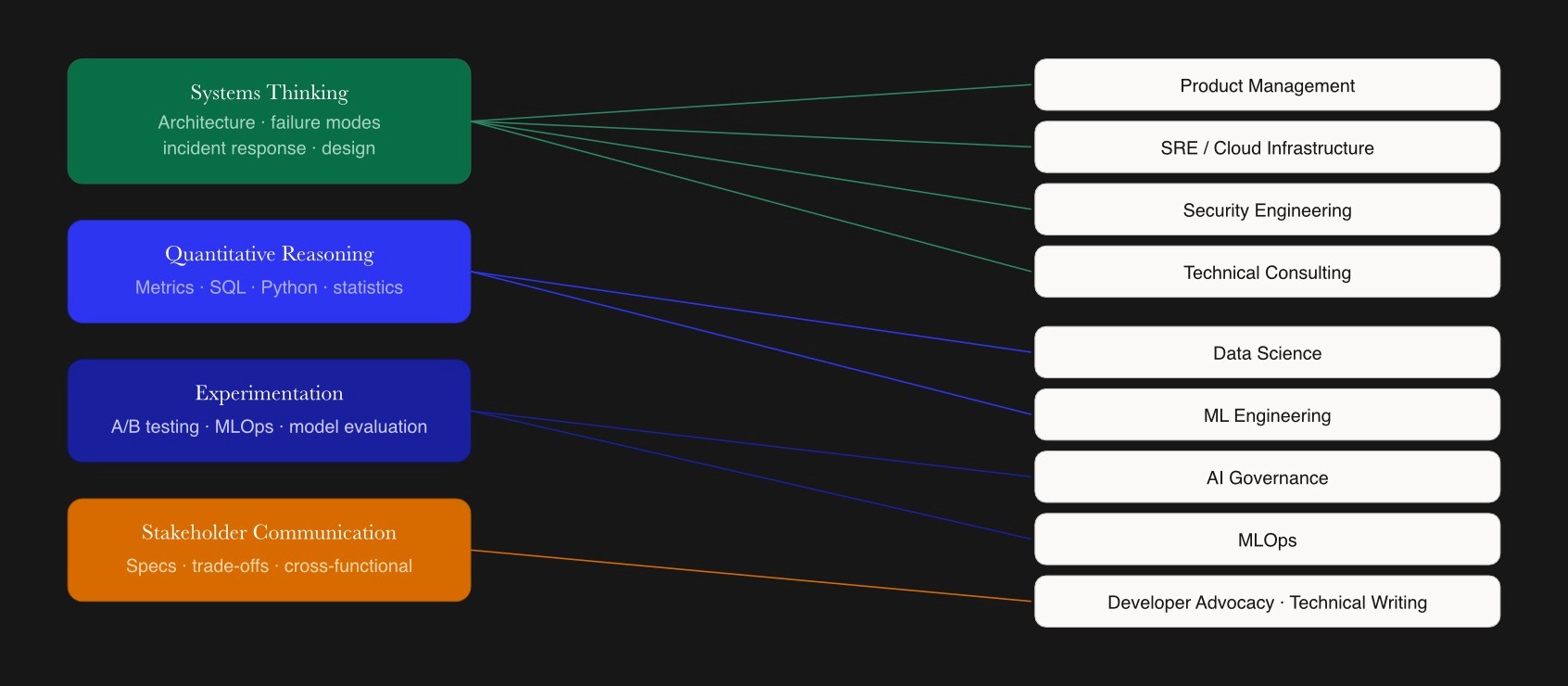
Systems thinking is often the most valuable transfer. A software developer who understands architecture, failure modes, and software design can move into product strategy, SRE, security, or consulting because those roles also require connecting systems, teams, and business goals.
Quantitative reasoning transfers into data science, data analysis, product operations, and strategy. Many engineers can transition into data jobs if they are proficient in tools like Excel, SQL, and Python, which are commonly used in data analysis and management.
Experimentation and diagnostics are also portable. Code review, incident response, test harnesses, and MLOps map directly to adjacent work in AI governance, model evaluation, privacy audits, and product experimentation.
Stakeholder communication becomes more important outside core implementation. Engineers who can explain technical standards, reduce costs, and solve business problems are useful in project management, sales engineering, product management, and customer-facing advisory roles.
High-Leverage Alternative Career Options for Software Engineers
The best alternatives are not random other jobs. They are roles that benefit from deep technical context, including ML, infrastructure, systems, and research experience, without forcing you to discard years of engineering experience. Some keep you close to code and architecture, while others move you toward strategy, people, customers, or business outcomes.
Product Management and Technical Product Leadership
Product manager and technical product manager roles are common next steps because many senior engineers already influence roadmap decisions informally. The role of a product manager involves owning the product vision, aligning it with business needs, and ensuring that what gets built solves customer problems, which is a natural fit for engineers.
Day to day, product work involves shaping strategy, writing specs, prioritizing projects, and managing trade-offs between delivery speed, technical debt, user value, quality, and revenue. A generalist PM may focus on customer workflows, an AI product manager may focus on model behavior and evaluation, and a data product manager may focus on pipelines, metrics, and decision systems.
Software engineers can transition into product management roles because they already understand technical trade-offs and can effectively communicate with developers, making them well-suited to bridge gaps between teams. Engineers excel in product management because they can ask the right questions early, anticipate challenges, and understand the feasibility of technical solutions.
To transition, volunteer as a feature owner, write PRDs, partner closely with sales or customer success, and take part in quarterly planning. In interviews, frame prior work around business metrics, customer impact, and direct impact rather than only technical difficulty.
Data Science, Machine Learning, and Applied Research Roles
This section is primarily relevant for software engineers without deep ML backgrounds. A data scientist focuses on insight generation, statistical modeling, experimentation, and product decisions. An ML engineer builds and deploys models in production. A research engineer translates research into reliable systems, often in AI labs or AI-focused companies.
Typical work includes experimentation, model training, offline evaluation, A/B testing, and translating research into shipped features. Software engineers with strong Python, statistics, or exposure to ML frameworks already possess much of the foundation for many data science roles.
Useful upskilling steps include completing a focused statistics refresher, building a public ML project with real data, contributing to open source libraries, and learning modern MLOps tooling. In major hubs such as San Francisco, London, and Berlin, compensation can be competitive with senior software engineering, although the strongest outcomes usually go to candidates who combine machine learning with production systems experience.
For existing ML engineers, the relevant alternatives are often AI governance and safety roles, MLOps infrastructure ownership, or technical product leadership for AI products, not a lateral move into ML engineering itself.
DevOps, SRE, and Cloud Infrastructure Engineering
Many midcareer developers shift into DevOps, site reliability engineering, or cloud infrastructure roles because they prefer systems design, reliability, and automation over product features. Daily work includes incident management, observability, capacity planning, infrastructure as code, CI/CD, and performance optimization across services and ML pipelines.
This path fits backend engineers, infra engineers, and ML engineers who already debug distributed systems or optimize resource usage for training jobs. Tools and domains to emphasize include Kubernetes, Terraform, AWS, Azure, GCP, Prometheus, Grafana, CI/CD, and GPU or accelerator clusters.
Cloud computing and AI are high-growth sectors that often welcome software engineering skills. SRE and infrastructure roles remain in high demand for SaaS, fintech, healthcare, AI infrastructure, and companies building the next generation of model-serving systems.
Security, Privacy, and Safety Engineering
Cybersecurity specialist and security engineer roles fit engineers who enjoy threat modeling, low-level details, and adversarial thinking. Modern AI safety and privacy work, such as red teaming LLMs or enforcing data governance policies, connects directly to familiar engineering practices like fuzzing, test harnesses, access control design, logging, and retention.
Key skills to build include secure coding standards, penetration testing basics, incident response, and understanding regulatory frameworks shaping the 2026 compliance environment, such as GDPR and the EU AI Act, including the May 2026 AI Omnibus provisional agreement compliance extensions. Engineers can enter through internal security reviews, security tooling, privacy reviews, or compliance projects.
This path can be especially interesting for engineers from electrical engineering or computer science backgrounds who already have systems, networking, and protocol depth.
Technical Consulting, Advisory, and Solutions Roles
Technical consultant, solutions architect, and sales engineer roles are strong options for engineers who enjoy working with customers and varied problem spaces more than feature delivery. These roles involve designing reference architectures, running technical evaluations, and translating complex requirements into practical solutions, especially in data, ML, cloud infrastructure, and manufacturing process optimization.
Strong communication, writing, and presentation skills matter as much as coding ability. To transition, join customer calls as a senior engineer, write external-facing technical content, and learn to frame solutions in terms of ROI, risk, adoption, and customer outcomes rather than only technology.
Curated marketplaces and match-based hiring platforms can help here because advisory, contract, and customer-facing roles are not always widely advertised.
Technical Writing, Developer Education, and Advocacy
Technical writer, developer advocate, and internal educator roles fit engineers who enjoy explaining complex systems more than implementing every detail. Outputs include documentation, API references, tutorials, conference talks, internal workshops, onboarding programs, and learning resources for engineers or data scientists.
Experience across computer science, data science, ML infrastructure, and software systems creates a strong foundation. Start by improving internal documentation, publishing blog posts or notebooks, speaking at meetups, and maintaining a public portfolio of talks and guides.
These paths can be attractive to former engineers managing burnout who still want to stay close to technology, but with a different pace and responsibility profile. Burnout is a common reason for engineers to consider a career change, as many experience stress and dissatisfaction in their roles.
Product Strategy, Operations, and Hybrid Business Roles
Business analyst, product operations, AI strategy lead, internal consulting, technical program management, data analytics, information security, technical recruitment, project management, technical sales, and entrepreneurship are all related jobs that can use engineering judgment. Engineers may also pursue a patent attorney path, industrial design, embedded systems development, or even their own company if they want broader ownership.
These jobs focus on metrics, prioritization, process design, and cross-functional alignment. A technical engineering background gives credibility when mapping constraints to business decisions across domains like fintech, healthcare, AI infrastructure, and enterprise software.
To transition, own cross-team initiatives, build dashboards for leadership, document decision frameworks, and participate in long-term planning cycles. Many professionals seek alternative careers for engineers to find more fulfilling work that better matches their evolving personal interests, shifting into technical tracks that emphasize creativity, communication, or broader product ownership.
Comparing Alternative Paths: Impact, Coding Involvement, and Transfer Difficulty
Senior engineers benefit from a structured comparison instead of making ad hoc decisions. The right career path depends on how much coding you want, how much ambiguity you tolerate, and whether you want to focus on research, reliability, customers, or business outcomes.
Role | Coding involved | Primary value delivered | Typical collaborators | Transition difficulty |
Product Manager | Low to moderate | Business outcomes, roadmap clarity, customer value | Engineering, design, sales, marketing, customers | Moderate |
Data Scientist | Moderate | Insights, experimentation, decision support | Product, analytics, engineering, business teams | Moderate |
ML Engineer | High | Production models, automation, AI systems | Research, data, infra, product | High |
SRE | Moderate to high | Reliability, uptime, performance, cost control | Infra, security, product engineering, ops | Moderate |
Security Engineer | Moderate | Risk reduction, trust, compliance | Legal, compliance, infra, product | Moderate to high |
Technical Consultant | Moderate | Customer success, architecture, adoption | Clients, sales, customer success, engineering | Moderate |
Developer Advocate | Low to moderate | Education, community, developer adoption | Engineering, marketing, community, product | Lower to moderate |
How AI Is Changing Hiring for Engineers Considering a Career Change
Companies integrated AI into recruiting pipelines, from resume screening to technical assessments and outreach. AI tools can assist with matching engineers to relevant roles based on skills and history, but they can also introduce bias or overweight keywords if used without human oversight.
AI-enabled sourcing and match-based models typically work by parsing structured profiles, project histories, role preferences, and skills lists, then matching candidates to a smaller set of targeted opportunities. Fonzi is one example of a curated marketplace that connects experienced software engineers with AI startups and tech companies, but the point is broader than any one platform.
The strongest hiring processes keep human interviewers in control of final decisions. AI works best when it reduces repetitive work so recruiters and hiring managers can spend more time in substantive conversations about projects, judgment, and fit.
Practical Steps to Navigate a Career Transition Out of Pure Software Engineering
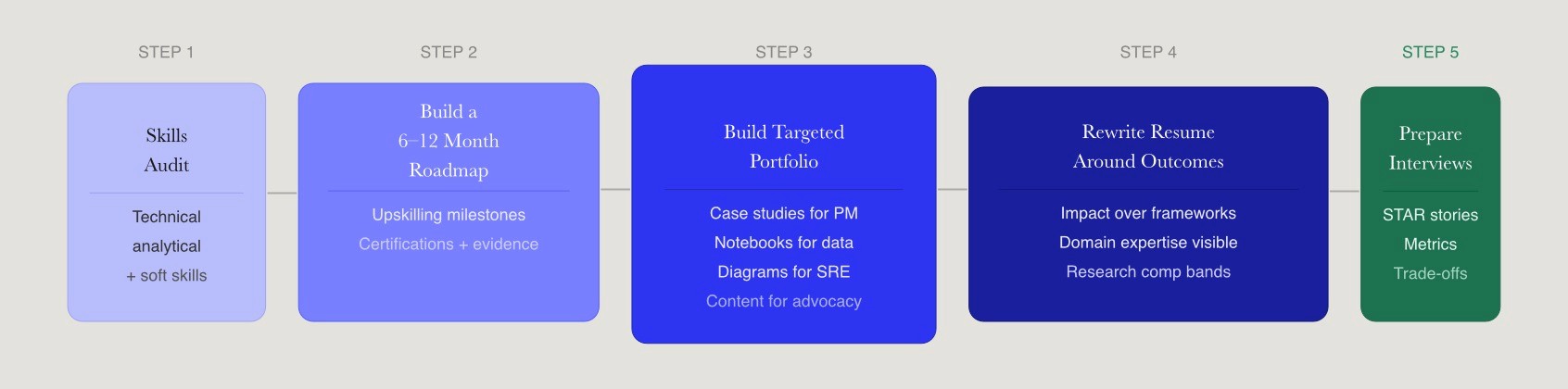
Treat a career change as a structured project, with milestones, feedback loops, and risk management. Start with a skills audit to identify your technical, analytical, and soft skills, then map them to potential new roles.
Build a 6- to 12-month roadmap that pairs targeted upskilling and industry-recognized certifications with concrete technical evidence to ease your career pivot.
Create a portfolio tailored to the new path. Use case studies for product management, notebooks and experiments for data science, architecture diagrams for SRE or security, and content samples for advocacy or writing.
Rewrite your resume around outcomes. Focus on cross-functional collaboration, domain expertise, business problems solved, systems improved, customers supported, and costs reduced instead of only languages and frameworks.
Prepare interviews around stories. Practice explaining impactful projects, quantitative results, decision trade-offs, and how you applied engineering judgment to overcome complex constraints. Research compensation bands before interviews so you do not accept an unnecessary salary cut.
Financial services, healthcare, manufacturing, consulting services, government and defense, and education technology are sectors heavily recruiting software engineers. Software engineers can leverage their technical aptitude, problem-solving skills, and system architecture knowledge into several rewarding, non-development-focused fields.
Many engineers transition into roles such as technical writing, consulting, or data science, leveraging their analytical and technical skills in new contexts. Engineers looking for broader ownership and creativity often find a natural next step in alternative careers for engineers like product strategy, operations, or entrepreneurship that align with their evolving personal interests.
Personal networks, former colleagues, open-source communities, and structured platforms can all surface better new jobs than mass applications. The best route depends on whether you enjoy working with code, clients, strategy, research, or education.
Conclusion
Software engineering skills remain highly valuable across many domains, from data and ML to strategy, security, consulting, and education, even as AI automates portions of coding work. The most resilient career options combine technical depth with communication, product sense, domain expertise, or customer understanding.
Choose one target path, identify one project that moves you closer to it this quarter, and start updating your public profile and network accordingly. If you prefer lower-noise processes, experiment with structured platforms or invite-only marketplaces alongside referrals and direct applications.
FAQ
What are the best alternative careers for software engineers who want to stop coding?
What engineering skills transfer well to non-engineering careers?
What are the top future-proof career paths for engineers pivoting out of traditional roles?
How do I transition from engineering to product management, consulting, or entrepreneurship?
Can I switch careers as an engineer without taking a pay cut?


