What Is Computer Simulation Technology?
By
Liz Fujiwara
•
Computer simulation technology is the use of computer simulations to study real-world systems, from aircraft and power systems to disease spread, politics, military studies, entertainment, and financial markets. A computer simulation combines a simulation model, which is the mathematical description of the system, with a computer program that executes that model over time. Modern computer simulation began during World War II, notably with the Manhattan Project, where it was used to model nuclear detonation processes using a Monte Carlo algorithm, and it expanded as computing power and software improved. Well-known examples include weather forecasting models, virtual crash tests for cars, and flight simulators used for pilot training.
Key Takeaways
Computer simulation technology replicates real-world systems inside a controlled virtual environment to analyze behavior, predict outcomes, and safely test scenarios.
A model consists of the equations used to capture system behavior, while simulation is the process of running those equations over time, often using approximation methods.
Major techniques and tools include Monte Carlo simulations, finite element analysis, discrete event simulation, agent-based modeling, MATLAB, Simulink, ANSYS, COMSOL, Python, and C++, and are used across industries to reduce physical prototyping, improve safety, and analyze performance.
Computer Models, Simulations, and How They Work
A model is a simplified digital representation of a system, while a simulation is the act of running that model on a computer. The relationship between simulation and modeling is that one does not build a simulation; instead, one builds a model or a simulator and then runs that model, which is referred to as running a simulation.
Computer simulations are built on five core architectural elements: variables, parameters, equations or rules, interactions between components, and a simulation engine. Mathematical modeling involves replicating a system’s properties using differential equations and algorithms based on foundational laws of physics, math, or biology. The simulation engine executes the equations over time in a computational software framework, which may be a custom simulation program, a commercial tool, or a larger computer science platform.
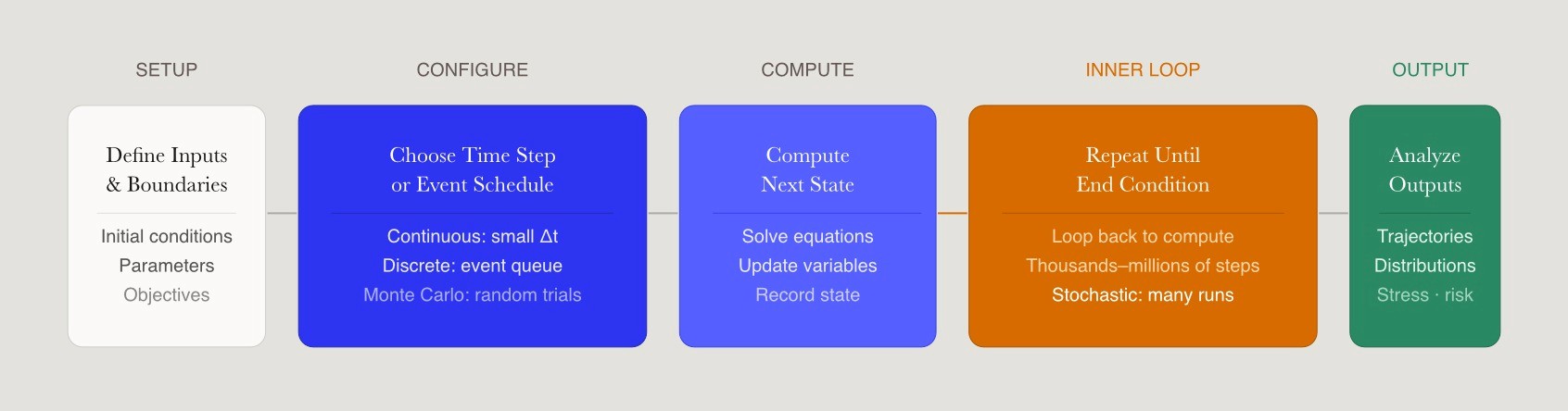
A typical process starts by defining inputs, initial conditions, and boundaries. Engineers then choose a time step or event schedule, compute the next state, repeat the calculation, and analyze outputs such as trajectories, probabilities, stress, failure rates, queue lengths, or other system performance metrics. This enables a user to determine feasibility, compare scenarios, and gain insight before making expensive real-world decisions.
There are several major kinds of computer simulations, including continuous, Monte Carlo, discrete, stochastic, deterministic, static, and dynamic simulations. Continuous simulations show results of a system over time, while Monte Carlo simulations use random numbers and events without regard to time. Deterministic simulations produce the same result from the same inputs, while stochastic simulations include random events and probability distributions, so reproducibility of results requires controlled seeds, documented inputs, and repeated runs that produce stable statistical conclusions.
Key Types of Simulation Models
Continuous time simulation models track how variables change at many small time steps, such as vehicle motion, chemical reactions, fluid flow, or climate behavior. Computational fluid dynamics (CFD) simulates liquid and gas movement to optimize designs and manage thermal loads.
Discrete event simulation (DES) jumps from one timestamped event to the next, tracking resource states like queue lengths and machine availability, making it efficient for complex system workflows. Agent-based models simulate individuals, vehicles, customers, patients, or cells that follow rules and create complex systems through interaction. Static models examine one snapshot, while dynamic simulations show how a system evolves over time.
How Computer Simulations Are Implemented
Simulation computing can be coded from scratch in Python, C++, Julia, MATLAB, or R, or built in software such as Simulink, ANSYS, Abaqus, COMSOL Multiphysics, Arena, Simul8, AnyLogic, OpenFOAM, SimPy, and FEniCS. Large projects often run on cloud platforms or high-performance computing clusters, especially weather forecasting, climate models, aerospace analysis, and large finite element meshes.
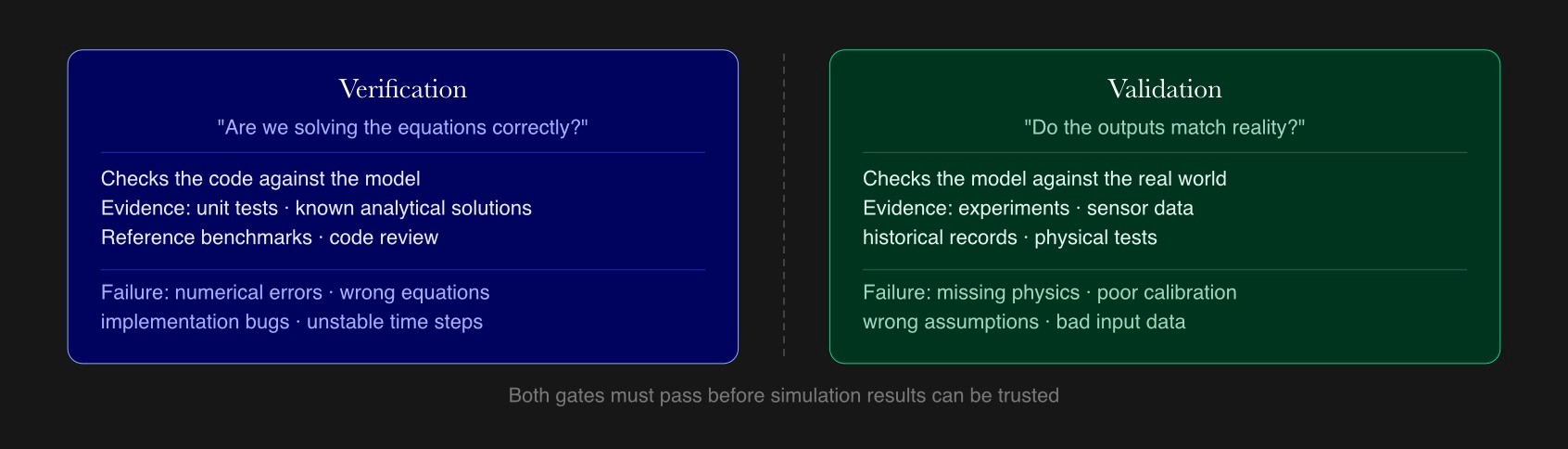
The reliability and trust in computer simulations depend on the validity of the simulation model, making verification and validation crucial in their development. Verification checks that the program solves the equations correctly, while validation compares outputs with data from experiments, sensors, historical records, or other sources.
Core Computer Simulation Techniques and Methods
Computer simulation technology is not one technique. It is a toolbox for analyzing physical systems, workflows, risks, policies, and other simulations where direct testing is slow, unsafe, or expensive.
Monte Carlo Simulations and Uncertainty Analysis
Monte Carlo simulation uses repeated random sampling to estimate a large number of possible outcomes. The method became prominent at Los Alamos in the 1940s, and Britannica provides a useful overview of the Monte Carlo method.
To create a Monte Carlo model, analysts assign probability distributions to uncertain inputs such as demand, material strength, component tolerances, investment returns, or wind speeds. The computer program then runs thousands or millions of trials and records the output distribution. This helps finance teams estimate risk, aerospace teams test reliability, and energy teams analyze power systems under uncertain supply and demand.
Finite Element Analysis and Structural Simulation
Finite element analysis divides a structure into many small elements and solves equations that approximate stress, strain, deformation, and heat flow. Finite element analysis (FEA) tests how structures and components deform under extreme conditions.
In engineering, computer simulations enable vehicle manufacturers to test safety features in new designs by creating virtual crash tests, which can save significant costs compared to physical prototypes. Other examples include bridge integrity checks, thermal analysis of electronics, and stress analysis of industrial parts. A typical FEA workflow includes CAD geometry, material data, meshing, boundary conditions, loads, solving, and post-processing with contour plots or animations.
Accurate FEA depends on mesh quality, material data, assumptions, and validation against physical tests. Overly simple computer models may miss local cracking, fatigue, buckling, or failure modes.
Discrete Event, Agent Based, and Hybrid Models
Discrete event simulation represents systems as sequences of events, such as arrivals, departures, service completions, breakdowns, and repairs. It is common in factories, airports, warehouses, clinics, and call centers because time jumps from event to event rather than advancing in tiny steps.
Agent-based models are useful when individual behavior matters, such as traffic, crowd movement, epidemic spread, and social networks. System dynamics uses stocks, flows, and feedback loops, a style formalized by Jay Forrester in the 1950s. Hybrid models combine continuous equations, discrete events, and agents, which is useful for smart grids, cities, hospitals, and logistics networks.
Virtual commissioning uses tools to test robotic control logic before installing physical hardware. This helps manufacturing teams debug automation, safety interlocks, and robot paths in the early stages of development.
Comparison of Major Simulation Techniques
Technique | Typical Use Cases | Key Strength | Example Industry Application |
Monte Carlo simulations | Risk, reliability, cost, uncertainty | Captures many possible outcomes | Value at risk in finance |
Finite element analysis | Stress, heat, deformation | Tests physical behavior in detail | Aircraft wing or car crash analysis |
Discrete event simulation | Queues, logistics, workflows | Finds bottlenecks and idle resources | Optimizing a factory line |
Agent based modeling | Epidemics, traffic, crowds | Shows emergent behavior | Disease spread across a city |
Large projects often link outputs from one model to inputs of another. For example, CFD may feed thermal loads into FEA, while DES may feed demand patterns into a staffing or scheduling model.
Applications of Computer Simulation Technology Across Industries
Computer simulation technology is now embedded in many sectors, from engineering and energy to healthcare and urban planning, in a global simulation software market valued at approximately $22.5B in 2026. Market estimates vary by source, but analysts consistently expect strong growth as organizations invest in digital modeling infrastructure and cloud-based tools.
Engineering and Product Design
Aerospace and automotive engineers use computer modeling and simulation to test aerodynamics, structural integrity, noise, vibration, control systems, fuel efficiency, and emissions before physical prototyping. Hardware-in-the-loop testing lets real controllers interact with simulated plants, which is especially useful for vehicles, aircraft, and robotics.
Digital twins are real-time, virtual replicas of physical assets that use data to optimize performance and predict failures. Digital twins of machines and vehicles support predictive maintenance by simulating wear, loading cycles, and failure modes over the full lifecycle, in a market projected to reach $150B by 2030.
Weather Forecasting, Climate, and Environmental Modeling
Weather forecasting is one of the most computationally intensive examples of computer simulation. Global and regional models solve equations of fluid dynamics on grids to predict wind, temperature, pressure, and precipitation.
The Weather Research and Forecasting model, known as WRF, is one widely used tool for short- to medium-range forecasting. Climate models go further by simulating the atmosphere, oceans, land, and ice to study long-term trends, sea level rise, and extreme events. Environmental simulations also include air quality models, wildfire spread, and volcanic plume dispersion.
Healthcare, Biology, and Public Health
Simulation functions as a vital, risk-free mechanism in medical sectors to protect patient safety while optimizing operational delivery. Healthcare simulation has evolved from physical mannequins to digital, AI-driven, and VR-based solutions for training and clinical planning.
Healthcare simulation can optimize hospital workflows to reduce emergency room wait times and forecast bed demand. In-silico drug discovery simulates molecular dynamics to screen drug compounds against diseases, reducing the traditional timeline and cost of testing. Simulation helps clinicians improve treatment outcomes, for example, by modeling tumor response to drug therapies before committing to a treatment plan. Surgical planning utilizes digital patient twins to allow surgeons to practice intricate procedures beforehand.
Agent-based epidemic models have been used to study Ebola, COVID-19, and the 2025 H5N1 monitoring initiatives. These simulated tests allow researchers to explore interventions that would be unethical or infeasible in humans.
Finance, Economics, Logistics, and Smart Cities
Financial institutions use Monte Carlo simulations and agent-based models to estimate portfolio risk, price derivatives, and assess market shocks.
Logistics and manufacturing teams use DES to test layouts, automation levels, staffing plans, and scheduling rules. Smart city and digital port projects combine traffic, energy, public transit, and communication models for resilience planning. Computer simulations are used to replicate real-world scenarios and test various outcomes, allowing researchers to analyze how systems might behave under different conditions without the risks and costs associated with real-life experiments.
Benefits, Limitations, and Best Practices in Simulation Modeling
Organizations invest in computer simulation technology because it reduces cost, lowers risk, speeds development, and enables safer analysis of extreme or rare events.
Benefits of Computer Simulation Technology
The largest benefit is fewer physical prototypes and fewer dangerous tests. Engineers can simulate crash forces, airflow, heat, vibration, control logic, and manufacturing processes before building hardware.
Computer simulations are widely used in various fields such as science, politics, military studies, and entertainment to model real-world elements and behaviors, allowing for safer and less expensive experimentation. They can also reveal hidden interactions that small-scale tests might miss.
Limitations and Sources of Error
Every simulation is an approximation. Results depend on assumptions, data quality, calibration, numerical methods, and the way equations are translated into a program.
Common problems include missing physics, poor input data, weak calibration, bad mesh choices, unstable time steps, and probability distributions that underestimate extreme events. Sensitivity analysis is important in computer simulations to ensure that the accuracy of the results is properly understood, as errors in key parameters can significantly affect the outcomes of the simulation.
Best Practices for Trustworthy Simulation Models
Good simulation work starts with a clear purpose and scope. Use the simplest model that answers the question, document assumptions, and keep the creation of model components modular.
Teams should verify code, validate against experimental or historical data, run sensitivity analysis, and report uncertainty rather than only one result. In 1952, John McLeod and a group of pioneering analog computer users founded the first Simulation Council, which was an organization known today as the Society for Modeling and Simulation International (SCS), marking a significant milestone in the formalization of the field. The publication of the Continuous System Simulation Language (CSSL) specification in 1967 by Simulation Councils, Inc. (SCi) represented a key advancement in unifying and standardizing digital simulation formats
Building Skills and Tools for a Career in Simulation and Modeling
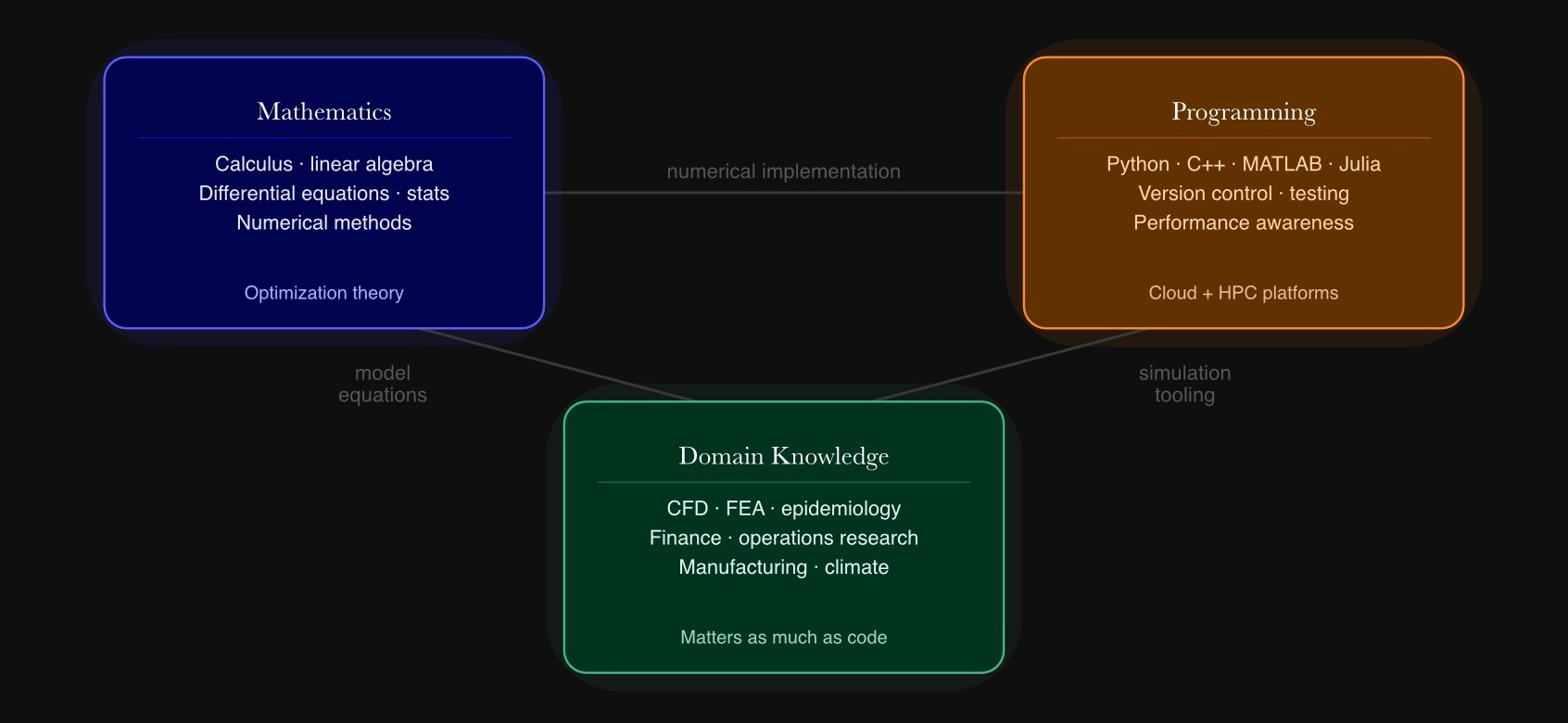
Simulation roles sit at the intersection of applied mathematics, software engineering, and domain knowledge such as mechanical design, power systems, epidemiology, or operations research. Broader software engineering demand is up 18% since May 2025, and simulation-focused roles sit within this growth as organizations invest more heavily in digital modeling infrastructure.
Core Skills for Simulation Engineers
Important foundations include calculus, linear algebra, differential equations, probability, statistics, numerical methods, and optimization. Engineers also need programming skills in Python, C++, MATLAB, Julia, or R, along with version control, testing, and performance awareness.
Domain knowledge matters just as much as code. CFD requires fluid mechanics, FEA requires structural mechanics, DES requires queuing theory, and medical simulation requires clinical context. Communication is also essential because stakeholders need clear explanations of assumptions, uncertainty, and trade-offs.
Simulation Tools and Software Ecosystem
Common commercial tools include ANSYS, Abaqus, COMSOL Multiphysics, CST Studio Suite, MATLAB, and Simulink. Open-source options include SimPy for DES, FEniCS for finite element work, OpenFOAM for CFD, and Mesa for agent-based modeling.
Cloud platforms now make high-end computing more accessible to smaller teams. Companies building advanced AI and simulation products may also work with specialized software engineers, and curated talent marketplaces such as Fonzi for software and AI specialists can be relevant when assembling these teams.
How to Build a Simple Computer Simulator from Scratch
Start by defining the system, boundaries, inputs, outputs, and objective. For a mass-spring damper system, the variables might be position and velocity, while the equations describe force, acceleration, damping, and motion.
Next, implement the model in code, test the simplest case, compare results with known data or reference solutions, then add complexity gradually. You might add randomness, feedback control, multiple interacting entities, or parallel computing only when the simpler version is correct and useful.
Conclusion
Computer simulation technology helps teams study complex systems safely, test scenarios quickly, and make better decisions without relying only on expensive real world experiments. The best results come from sound mathematical models, appropriate techniques, careful validation, and honest uncertainty analysis. If you want to get started, choose one simulation tool, build a small model, and practice comparing its results with real data.
FAQ
What is computer simulation technology and how does it work?
What are the most common use cases for computer simulation in engineering?
What tools and software do engineers use for simulation computing?
How do you build a computer simulator from scratch?
What skills do engineers need to work in simulation and modeling?


