What Does Nit Mean in Code Review?
By
Samara Garcia
•

If you've spent any time reviewing pull requests, you've probably seen a comment that starts with "nit:" before a note about spacing or a variable name. Most people get the gist, but the shorthand raises real questions once you're on the receiving end. Do you have to fix it? Will it block your merge? What do you do when a reviewer leaves ten of them?
This covers what nit means in code review, how to handle them as an author or reviewer, and when nit-picking helps versus when it just creates noise.
Key Takeaways
A nit in code review is a non-blocking, polish-level comment that suggests a minor improvement without stopping a pull request from merging.
Reviewers often use a prefix like “nit:” or “[nit]” to separate optional polish from required changes.
Nit comments usually target style, readability, consistency, formatting, and naming conventions, not functionality, security, or performance.
Too many nit comments can increase review latency, lower the signal-to-noise ratio, and hurt morale.
Teams should automate style issues through formatters, linters, pre-commit hooks, and CI/CD jobs.
What Does “Nit” Mean In A Code Review Or Pull Request?
A nit is shorthand for nitpick. In code reviews, it means a trivial, preference-based request that is non-blocking in nature, meaning it does not require mandatory resolution by the author. A reviewer might write, “nit: rename this variable to userCount for clarity,” to show the suggestion is optional and cosmetic.
The use of the “nit:” prefix in comments helps distinguish between essential feedback that must be addressed and optional suggestions that authors can choose to ignore. Many developers also label non-blocking suggestions with labels like [nit] to communicate that they are optional. Labeling nit comments clearly as non-blocking helps authors understand that these suggestions are optional and can be ignored if they choose.
Nit comments usually focus on readability, spacing, style, naming, or tiny refactors. Core logic, security vulnerabilities, performance regressions, bugs, and broken functionality should never be treated as a nit. Many teams document this convention in a style guide or contribution document so reviews stay consistent. The broader goal is better code health over time, without turning every code review into a debate about preferences.
What Qualifies As A Nit Comment In Code Reviews?
Nit comments live at the polish layer of a pull request. A nit comment should not change business logic, security posture, data handling, user-facing behavior, or a critical function.
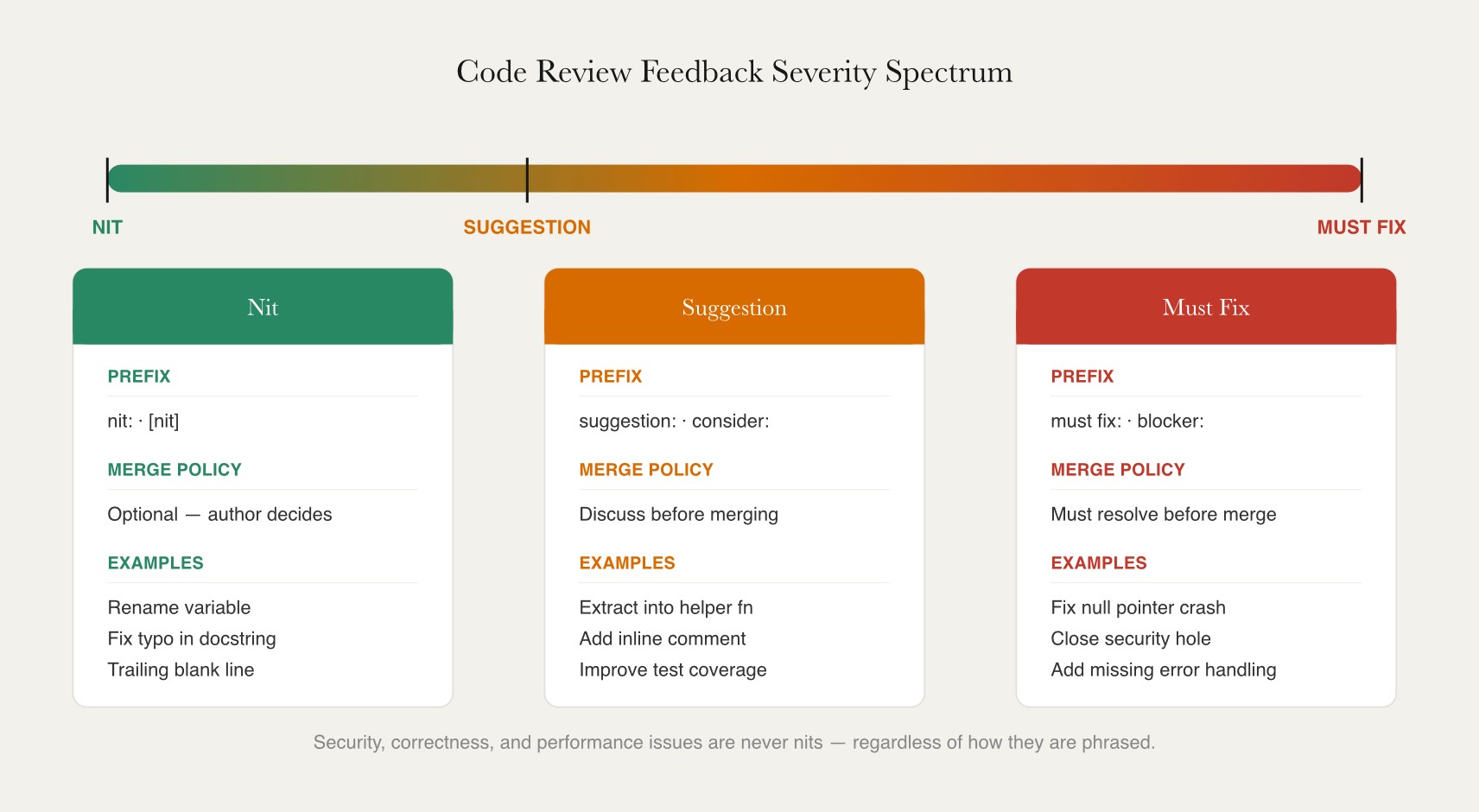
Common examples of nit comments include suggestions for style improvements, such as rephrasing documentation, adjusting formatting, or renaming variables for clarity. Nits typically target small typos, missed naming conventions, or minor logic simplifications to keep the codebase clean.
A nit comment might address:
Trailing spaces, an extra blank line, or inconsistent indentation.
A typo in a comment, docstring, or document.
A variable name like data could be more specific.
Import order that does not match the project style.
A small readability idea, such as simplifying a simple conditional.
Some teams also treat purely educational feedback as nitpicking when it is not required before merging. For example, a reviewer may share knowledge by noting a more idiomatic TypeScript or Python pattern. This can help junior developers notice team-specific preferences without making every suggestion feel mandatory.
Nit Comments vs Blocking Issues In Code Review
Developers often confuse nit comments with real issues, so this quick reference shows the difference between optional feedback and requests that should delay a merge.
Nit Comment (Non-blocking) | Blocking Issue (Must fix before merge) |
Typical impact: optional polish, readability, consistency | Typical impact: correctness, security, performance, user behavior |
Common examples: rename a variable, adjust import order, fix a typo | Common examples: fix a null pointer, close a security hole, and add missing error handling |
Reviewer phrasing: "nit:", "suggestion:", "[nit]" | Reviewer phrasing: "must fix:", "blocker:", "cannot merge until..." |
Merge policy: author may address now, later, or not at all | Merge policy: author must resolve before approval |
This distinction matters because a team should not block progress over an insignificant issue spotted on one line unless the issue has a major impact on maintainability, quality, or risk.
When Do Nit Comments Help Code Quality?
Nit comments can improve readability, reinforce consistency, and support overall code health. Resolving nits helps improve codebase consistency and long-term maintainability. Nits can also serve as helpful learning tools for junior developers by highlighting idiomatic syntax and team-specific preferences.
Useful nit comments often point to a concrete rule or convention. For example, “nit: can we rename user to userRecord for clarity in this loop?” helps future readers understand context faster. Another useful note is, “nit: move this helper into utils/date.ts to match similar functions.” These comments do not change behavior, but they can improve overall quality for future contributors.

The downside is noise. Excessive nit comments can lead to a loss of approximately 5.8 hours per developer per week due to inefficient review workflows, resulting in a 20-40% drop in team velocity. The median review cycle for engineers takes about 19 hours, and fixing nit comments can significantly slow down engineering velocity, even if those comments are labeled as non-blocking. When nit comments are overused, they can create a perception of micromanagement among developers, negatively impacting team morale and trust.
Examples Of Useful Nit Comments In Real Pull Requests
Here are a few practical examples of useful code review comments:
“nit: can we rename user to userRecord for clarity in this loop?”
“nit: typo in docstring, sentense should be sentence.”
“nit: this could be a ternary since both branches are simple.”
“nit: move this helper into utils/date.ts to match similar functions.”
“nit: extra blank line here, inconsistent with the rest of the file.”
On GitHub, GitLab, or Bitbucket, a reviewer can also group several optional polish points into one comment to reduce notification noise. That improves the signal-to-noise ratio and keeps the discussion focused.
Guidelines For Using Nit Comments As A Reviewer
Clear reviewer guidelines make the code review process faster, kinder, and more predictable. Effective code review depends on clear communication between reviewers and authors, with both roles responsible for keeping feedback constructive and actionable.
Use severity labels consistently. Prefix code review comments with “nit:”, “suggestion:”, or “must fix:” so authors can prioritize quickly. The Conventional Comments format is one simple convention teams can adapt.
A good rule is to avoid writing manual nit comments for anything a tool can fix. To keep nit feedback useful, teams should automate obvious style issues through formatters and linters, ensuring that reviewers focus on more significant concerns. Automating the detection of non-blocking style issues allows reviewers to concentrate on substantive concerns, thereby improving the efficiency of the code review process.
Some teams write these principles into onboarding guides. That helps new developers understand which comments are mandatory and which are optional.
Best Practices For Authors Responding To Nit Comments
How authors respond to nit comments has a real impact on team culture. Even small comments can either build trust or erode it if the discussion becomes defensive.
If a nit is quick to fix, such as a typo or missed formatting issue, address it in a follow-up commit. If the suggestion conflicts with another constraint, reply briefly and respectfully. For example: “Thanks, I will keep this name because it matches the API response field.”
Group multiple nit fixes into one commit rather than creating a commit for every tiny change. Referencing the pull request discussion also makes the history easier to follow. In distributed software development teams, responding within one business day helps keep review latency predictable.
Turning Frequent Nit Comments Into Team Improvements
Frequent nit comments are useful data. If the same requests appear across reviews, such as import sorting, logging style, docstring wording, or naming patterns, turn the pattern into a process improvement.
That might mean updating the style guide, adding a linter rule, or configuring an auto-formatter. Some teams review pull request history every quarter to see whether comments added value or should be automated.
Team-Level Strategies To Keep Nit Comments Under Control
Individual habits are not enough. A team needs explicit norms around nit comments to keep reviews efficient and respectful.
Define blocking, major, and nit-level feedback in contribution guidelines, with at least one example for each. Automated formatting tools integrated into a CI/CD pipeline can help reduce nitpicking by ensuring style choices are applied consistently. Using static analysis tools can catch issues like dead code and incorrect naming patterns before a pull request is opened.
Automating style enforcement through linters and formatters can eliminate nitpicky concerns before human review, allowing reviewers to focus on more critical issues such as security vulnerabilities and logic errors. Teams that implement AI-powered code analysis can extend automation beyond basic linting to catch architectural issues and potential bugs, improving overall code quality.
If a development team finds itself bogged down by endless nits, it is usually a clear symptom of inadequate tooling. The solution is not to ban feedback, but to automate repetitive checks and reserve human attention for design, architecture, domain logic, and maintainability.
Example Workflow For Reducing Nit Comments
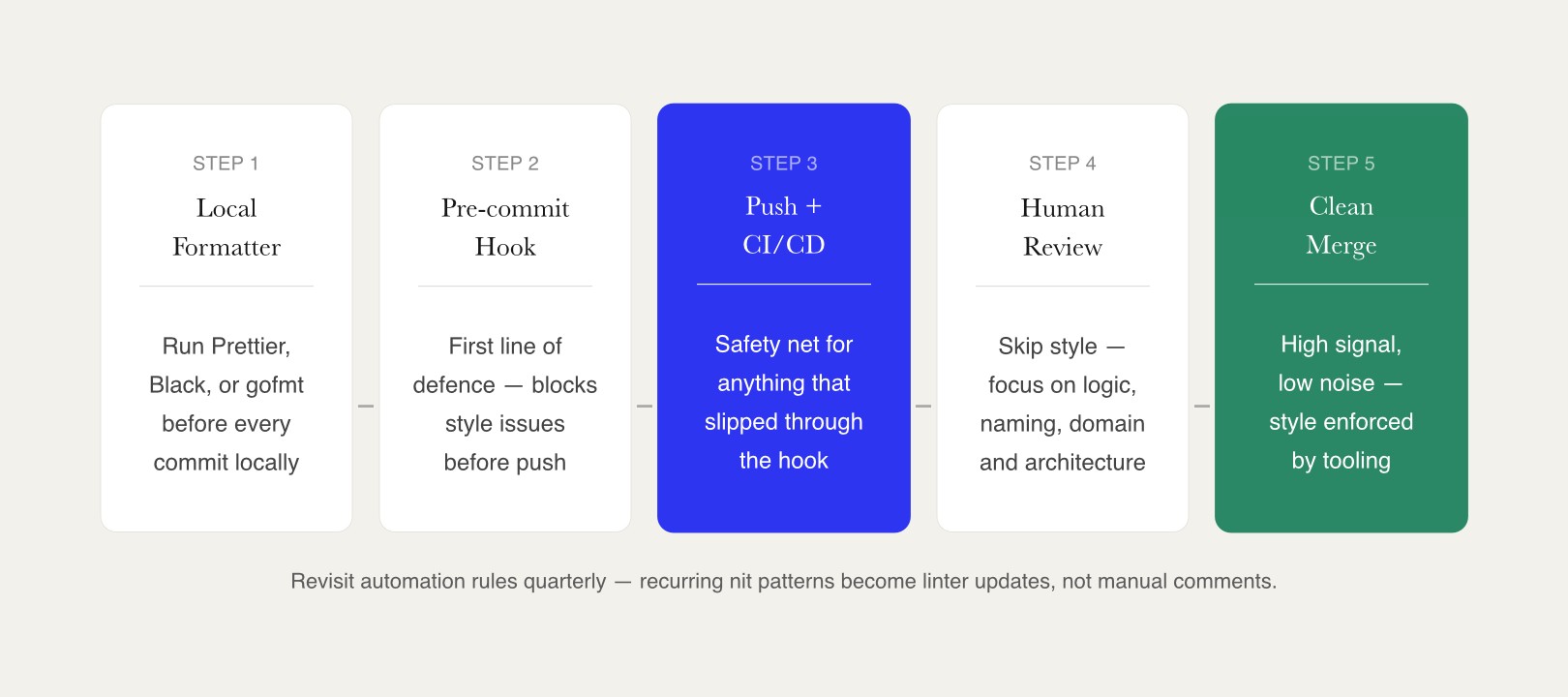
A practical workflow starts before the pull request. Developers run a formatter and linter locally, then push the branch. Pre-commit hooks serve as the first line of defense in automation, catching issues locally before code leaves a developer’s machine, while CI/CD jobs act as a safety net for any issues that slip through.
Reviewers then skip machine-enforceable style issues and focus on clarity, tests, naming, and domain modeling. Labels like “style”, “nit”, and “must fix” make review summaries easier to scan. Revisit the rules every few months so that new sources of repetitive nitpick feedback become tooling updates rather than manual comments.
Summary
A nit in code review is a non-blocking suggestion that focuses on minor improvements such as formatting, readability, naming, consistency, or code style rather than functionality, security, or performance. Reviewers often use labels like "nit:" to indicate that a comment is optional and should not prevent a pull request from being merged. This distinction helps teams prioritize critical issues while still encouraging small improvements that make code easier to maintain.
Used appropriately, nit comments can improve code quality, reinforce team standards, and help developers learn best practices. However, excessive nitpicking can slow reviews, create unnecessary noise, and hurt team morale. The most effective teams reduce repetitive nit comments through automation with formatters, linters, pre-commit hooks, and CI/CD checks, allowing reviewers to focus on higher-value feedback related to architecture, logic, testing, and maintainability.
FAQ
Is a nit comment something I am required to fix before my pull request can be merged?
How can I politely push back on a nit comment I disagree with?
Should I always prefix my minor feedback with “nit:” in code reviews?
Can automation completely replace nit comments in code reviews?
How many nit comments per pull request is too many?


