Meta’s restructuring began in late 2022 and has continued into 2026, affecting tens of thousands of employees across several rounds. By early 2026, the company had shifted from broad reductions to more targeted layoffs and role consolidations tied to AI technology, metaverse spending, and efficiency. This article explains what is happening, which meta layoffs employees are most exposed to, and how workers can plan their next move.
Key Takeaways
Meta is continuing multi-year job cuts after earlier waves in 2022, 2023, and 2024, with restructuring focused on AI technology and efficiency.
Roughly 8,000 jobs, or about 10% of Meta’s global workforce, are being cut in a major May 2026 wave.
Meta is spending billions on AI infrastructure and top talent while reducing headcount in recruiting, sales, support, global operations, and Reality Labs.
Some employees are being offered internal transfers, relocation, or retraining instead of immediate job losses.
Affected workers should review severance, protect personal documents, update career materials, and move quickly if visas are involved.
Timeline Of Meta Layoffs
Meta’s layoffs are not a one-month event. They are part of a multi-year reset that started after heavy hiring during 2020 and 2021, then moved into efficiency planning as user engagement on legacy platforms like Facebook showed signs of plateauing and new growth avenues became more urgent.
Year | Approximate impact | Primary affected areas |
November 2022 | About 11,000 employees, roughly 13% of staff | Broad business, tech, recruiting, and metaverse teams |
2023 | About 10,000 roles cut, plus thousands of open jobs canceled | Recruiting, business teams, Reality Labs, technical staffers |
2024 to 2025 | Smaller restructurings, including performance and team reviews | Sales, recruiting, experimental products, and some operations |
January to March 2026 | About 1,500 to 1,700 Reality Labs cuts reported | VR, AR, game studios, hardware, and software projects |
May 2026 | About 8,000 jobs cut, plus 6,000 open roles canceled | Integrity, cybersecurity, content design, sales, recruiting, support |
Public reporting from TechCrunch cited a 10% workforce reduction in 2026, or about 8,000 people, along with 6,000 canceled open roles. Some reports describe the figure as approximately 7,800 employees, depending on the account and timing.
Who Is Affected By Meta Layoffs In 2026?
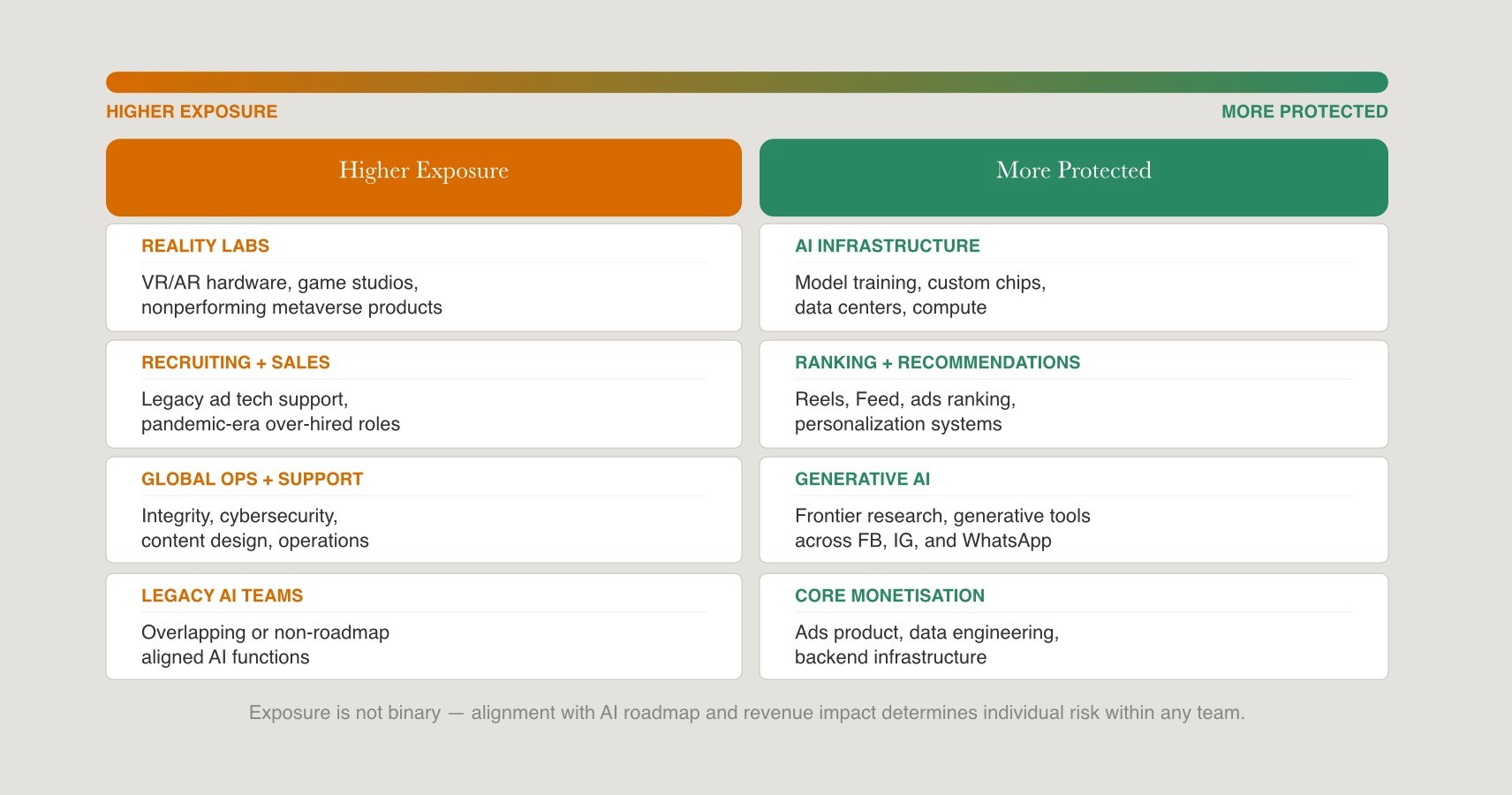
The 2026 round affects several divisions, including Reality Labs, sales, recruiting, integrity teams, cybersecurity teams, content design, and global operations. Meta is also canceling 6,000 open roles and reassigning about 7,000 employees to AI workflows.
Roles tied to older tools are more exposed. Parts of Reality Labs, legacy ad tech tools, and older internal AI teams are seeing job cuts or redeployments as Meta rationalizes overlapping efforts. Newer AI infrastructure, generative AI, recommendation systems, and core monetization teams are more likely to continue hiring.
The global footprint matters. Menlo Park, Seattle, London, Dublin, and Singapore may all see different processes because notice periods, severance, relocation options, and redeployment rules vary by country. In Washington state,GeekWire reported 1,395 local cuts, about 20% of Meta’s regional workforce.
Impact On AI And Reality Labs Employees
AI roles are not automatically safe. Frontier research, model infrastructure, ranking, recommendations, ads, Reels, and generative tools remain priority areas, but legacy or supporting AI functions face pressure if they do not align with Meta’s current roadmap.
Reality Labs remains one of the clearest pressure points. Employees in VR hardware, AR devices, first-party game studios, and nonperforming metaverse products are more exposed when projects are delayed, reduced, or canceled. The rest of the company is being judged through a similar lens: does the work support core revenue, AI infrastructure, or future growth?
Meta is also implementing tracking software on employee devices to collect internal data for AI training purposes, according to reports cited in coverage of the restructuring. That detail has added anxiety for staffers who already view the layoffs and corporate restructuring as major signals about Meta’s future direction in AI development.
AI Spending, Job Cuts, And Meta’s Bet On The Future
Meta is cutting jobs while spending billions on AI. The company previously discussed plans to invest between $115 billion and $135 billion in AI by 2026, and later raised full-year 2026 capital expenditure guidance to $125 billion to $145 billion, largely for AI infrastructure, custom chips, networking, GPUs, and data centers.
Cost category | 2023 emphasis | 2026 emphasis |
Headcount | Reducing pandemic-era expansion | Cutting about 10% of the workforce and canceling open roles |
AI infrastructure | Growing investment | Major priority, with billions for compute and model training |
Reality Labs | Still strategic but costly | More selective, with weaker projects cut |
Operating expenses | Broad efficiency push | More automation, consolidation, and fewer overlapping teams |
Meta is prioritizing AI systems that power ranking, recommendation, ads, and generative tools across Facebook, Instagram, and WhatsApp. Leadership appears to agree that the company’s next decade depends on better AI products, even if that means painful reductions now.
Why Profitable Companies Still Cut Jobs During AI Booms
The paradox is that profitable tech companies can cut staff while still investing aggressively. Meta, Amazon, Google, and other industry leaders are trying to protect margins while funding expensive AI infrastructure.
Automation and process consolidation reduce the need for some operational, support, and program roles, even as product complexity grows. That is why the tech industry is seeing companies cut workers while demand remains high in other areas.
Labor advocates worry that productivity narratives can become a way to justify wide job cuts while budgets for AI hardware, acquisitions, and cloud agreements keep increasing. For many employees, the difficult part is that the business may be healthy, but their specific role may no longer fit the new operating model.
What Meta Employees Can Expect If Their Role Is At Risk
Meta layoffs typically begin with a notification email, calendar invite, or manager and HR meeting. Access to internal systems may change quickly, and some workers receive instructions about equipment, expenses, final pay, and benefit documents within days or weeks.
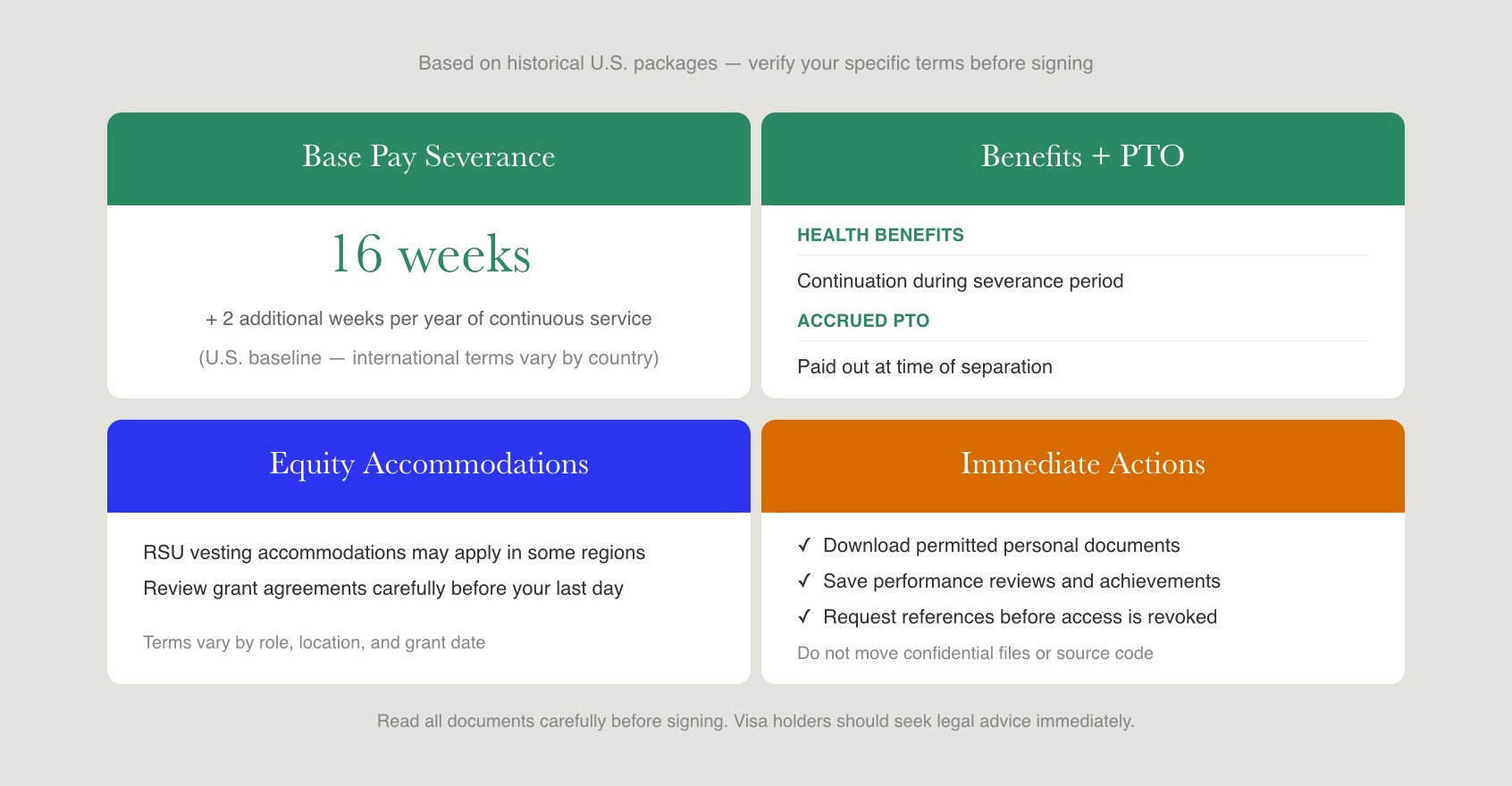
Past U.S. packages have often included 16 weeks of base pay plus two additional weeks per year of continuous service, health benefits continuation, accrued PTO payout, and equity-related accommodations in some regions. Exact 2026 terms can vary by location, role, and company policy, so each person should read the documents carefully before signing.
Affected employees should download permitted personal documents, save performance reviews, document achievements, and ask managers or peers for references. They should not move confidential files, source code, or internal materials. If a role is at risk, it helps to block time immediately for resume updates, recruiter outreach, and financial planning.
Strategies For Staying Or Moving Internally At Meta
Employees who want to stay should look for internal mobility paths in AI infrastructure, integrity, core ads, data engineering, security, and large-scale backend systems. Some employees will be offered alternative positions or relocation options, but those opportunities may move quickly.
A practical approach is to talk with managers before final lists are locked, especially if a team is under review. Employees can also train in machine learning platforms, data pipelines, and AI product evaluation to make their experience easier to map to Meta’s growth areas.
How To Rebound In A Market Reshaped By AI
The job market for tech employees is crowded because recent layoffs at major companies have created a significant influx of talent. Many skilled people are entering the market at the same time, and creating a competitive but active job search environment.
The first step is to reposition experience clearly. Highlight large-scale systems, experimentation, privacy, ads, infrastructure, product metrics, or AI-adjacent work. A former Meta person should make the career story easy to read for startups, established companies, and AI-forward teams.
Demand still exists for strong software engineers, product managers, data scientists, and data engineers. Curated talent platforms such as Fonzi can sometimes help ex-Meta talent connect with vetted AI startups and smaller tech companies, but warm introductions, alumni groups, and direct hiring manager outreach still matter.
Summary
Meta’s 2026 layoffs are part of a broader restructuring effort that began in 2022 as the company shifted resources toward AI while reducing spending in lower-priority areas. The latest round is expected to affect roughly 8,000 employees, or about 10% of Meta’s workforce, with additional open roles canceled. Teams in recruiting, sales, support, global operations, integrity, cybersecurity, and Reality Labs have been among the most affected, while AI infrastructure, generative AI, and core monetization teams remain strategic priorities.
Despite strong profitability, Meta is cutting jobs while investing heavily in AI infrastructure, data centers, chips, and top technical talent. Employees whose roles are at risk should review severance packages, save permitted career records, update resumes, and explore both internal mobility opportunities and external job markets. For many former Meta employees, experience in large-scale systems, machine learning, data engineering, and product development remains highly valuable, particularly as startups and established companies continue expanding their AI initiatives.
FAQ
How many Meta employees are expected to be affected by layoffs in 2026?
Are AI and machine learning roles at Meta safe from layoffs?
What severance should Meta employees reasonably expect in 2026?
How long does it typically take laid-off Meta employees to find a new role?
Can former Meta employees move directly into AI startups or smaller tech companies?