AI systems are moving from single LLM calls to goal-driven AI agents that plan, act, and coordinate across tools and teams. That shift is useful, but it also makes reliability harder because autonomous agents can make mistakes or go off-track, necessitating the design of checkpoints, dashboards, and approval gates. This guide is for software engineers, ML engineers, and architects who already ship AI features and now need more robust agentic AI systems across OpenAI, Anthropic, Google Cloud, AWS, Microsoft Foundry, and open source stacks.
Key Takeaways
Agentic design patterns give engineers reusable blueprints for reasoning, planning, tool use, and collaboration across single-agent and multi-agent AI systems.
Start with simpler workflow patterns like controlled flows and routing before adopting more autonomous multi-agent systems.
Reflection, planning, tool use, and human oversight are core patterns for improving output quality in production AI systems.
Agentic workflows use iterative loops where the AI can self-correct, collaborate with other agents, and execute tasks systematically.
Combining multiple patterns is normal, but every added loop or agent increases latency, cost, and debugging work.
What Agentic Design Patterns Are And Why They Matter
An agentic AI system is an AI-driven process that accepts a goal, reasons over context, uses external tools, and executes multi-step workflows with memory and feedback. Agentic design patterns are framework architectures that give artificial intelligence the ability to act as autonomous, goal-oriented agents rather than simple prompt-and-response systems.
In practice, agentic design patterns define how an AI system breaks complex tasks into steps, how it incorporates new information, how it generates outputs, and how it decides whether to continue, stop, or escalate to a human. Patterns provide a shared vocabulary for choosing how much control to give a single agent, multiple agents, or a human reviewer.
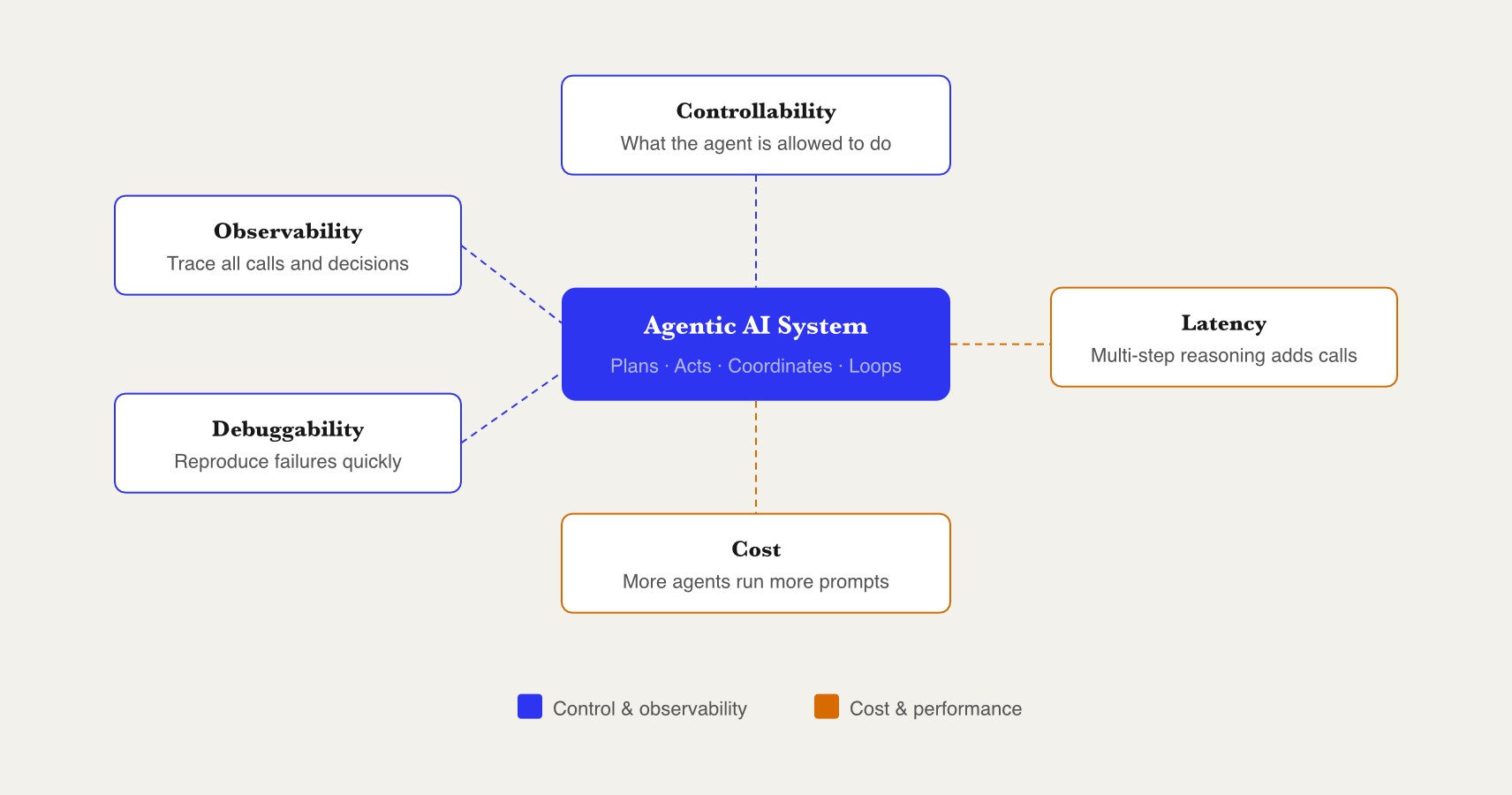
Engineers usually care about five properties:
Controllability, or what the agent is allowed to do.
Observability, or whether prompts, tool calls, responses, and decisions can be traced.
Debuggability, or how quickly failures can be reproduced.
Latency, because multi-step reasoning adds model calls.
Cost, because more agents run more prompts, tools, and evaluations.
Non-agentic systems usually use a single model call or simple retrieval augmented generation. Agentic patterns include the planning pattern, reactive pattern, reflection pattern, tool-use pattern, multi-agent collaboration, and human-in-the-loop orchestration. These design patterns are vendor-neutral and can be implemented on Vertex AI, Microsoft Foundry, AWS Bedrock, LangChain, LlamaIndex, or standard Python, Node.js, and Go services.
In User Experience (UX) design, implementing agentic design patterns fundamentally alters how data layers map to frontend presentation views. Moving beyond static forms, this shift requires software engineers to architect backend layers capable of exposing real-time execution states, handling asynchronous approval gates, and streaming deterministic logs to ensure complete system observability.
Foundational Agent Patterns For Single-Agent AI Systems
These patterns are the safest on-ramp to agentic AI because they keep one agent constrained. They work well when the task is valuable enough for automation, but not so open-ended that the agent must dynamically plan across many unknowns.
Controlled Flow Pattern
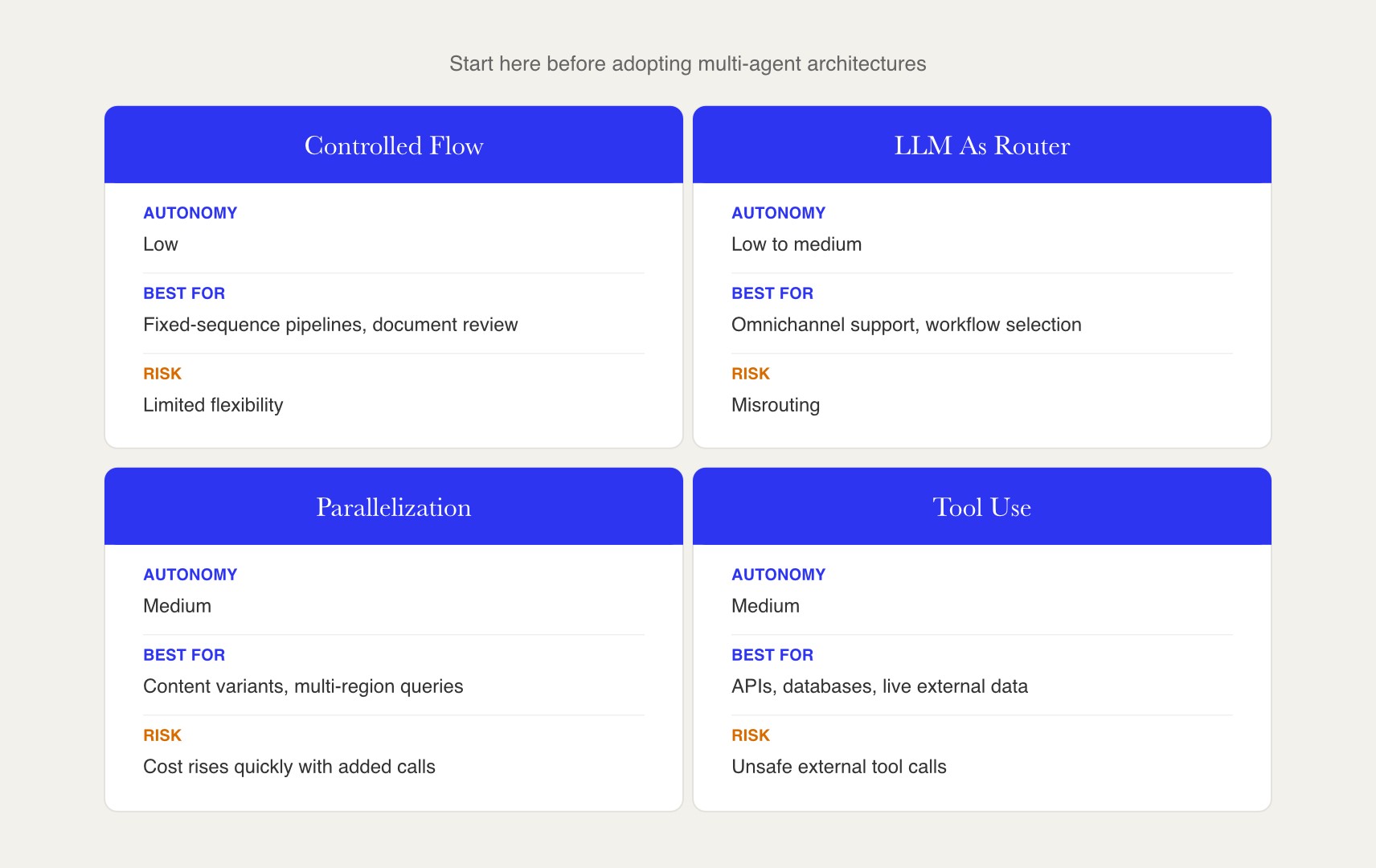
The controlled flow pattern uses a fixed sequence where each LLM call sits in a predefined step. A 2026-era document review pipeline might classify a document, extract fields, summarize risks, validate results, and send clean output to downstream processes.
This pattern represents low autonomy and high debuggability. It is a good fit for enterprise systems where auditors need to know exactly which step failed.
LLM As Router Pattern
In the router pattern, one agent classifies a request and sends it to the right workflow, model, or service. For example, 2026 SaaS products often route support tickets to billing, technical troubleshooting, refund, or escalation flows.
The router can handle a complex query by selecting a specialized path instead of forcing one prompt to do everything. The main risk is misrouting, so teams should log confidence scores and fallback behavior.
Parallelization Pattern
Parallelization runs independent calls at the same time, then merges results with custom logic or a synthesis model. This is useful for content variants, regional compliance checks, or multi-region data queries.
The same task can be sent to different prompts for diverse perspectives, then merged into a single answer. It can improve quality, but the cost rises quickly as more agents or model calls are added.
Tool Use Pattern
The Tool Use Pattern enables AI agents to interact with external systems such as APIs, databases, and enterprise applications, allowing them to fetch current data and perform actions beyond their internal knowledge. This pattern is particularly useful for tasks like customer support, document processing, and IT operations, where answers depend on up-to-date information.
Tool use can include querying PostgreSQL for customer history, calling vector search for external data, retrieving stock prices, or triggering a Stripe refund through an API. Using these AI agent design patterns ensures that production systems dynamically query live infrastructure and external APIs rather than relying on a static, frozen training dataset, so robust tool use requires clear permissions, input validation, and guardrails to prevent unintended actions by the AI agent.
Function calling in OpenAI, tools in Anthropic, Lambda integrations in AWS, and Google Cloud services all support this agent pattern. The important engineering work is not the SDK call; it is permissions, idempotency, rate limits, and safe defaults.
Reflection And Critique: Making A Single AI Agent More Reliable
Reflection and critique patterns improve output quality without requiring multi-agent systems. The Reflection Pattern adds a review step where an AI agent evaluates and refines its own work before producing a final response.
Typically, the model generates an answer, then checks it against predefined criteria to improve accuracy, consistency, and reliability. In enterprise settings, reflection is often used to reduce hallucinations and standardize responses. A code-generation assistant, for example, might write code, run tests, perform static analysis, and review the results before returning the final output.
The Planning Pattern helps an AI agent break complex objectives into structured steps before execution. By separating planning, execution, and review, it improves transparency, control, and adaptability. For both planning and reflection, teams should define clear rubrics, stop conditions, and iteration limits to prevent unnecessary loops, higher costs, and poor user experiences.
Multi-Agent Patterns: From Single AI Agent To Agentic AI Systems
Multi-agent patterns coordinate multiple specialized AI agents, each with its own tools, prompts, constraints, and context windows. The Multi-Agent Pattern structures an AI system as a coordinated team of specialized agents, allowing for the decomposition of complex problems into smaller, manageable sub-tasks assigned to dedicated agents with specific skills.
Coordinator Pattern
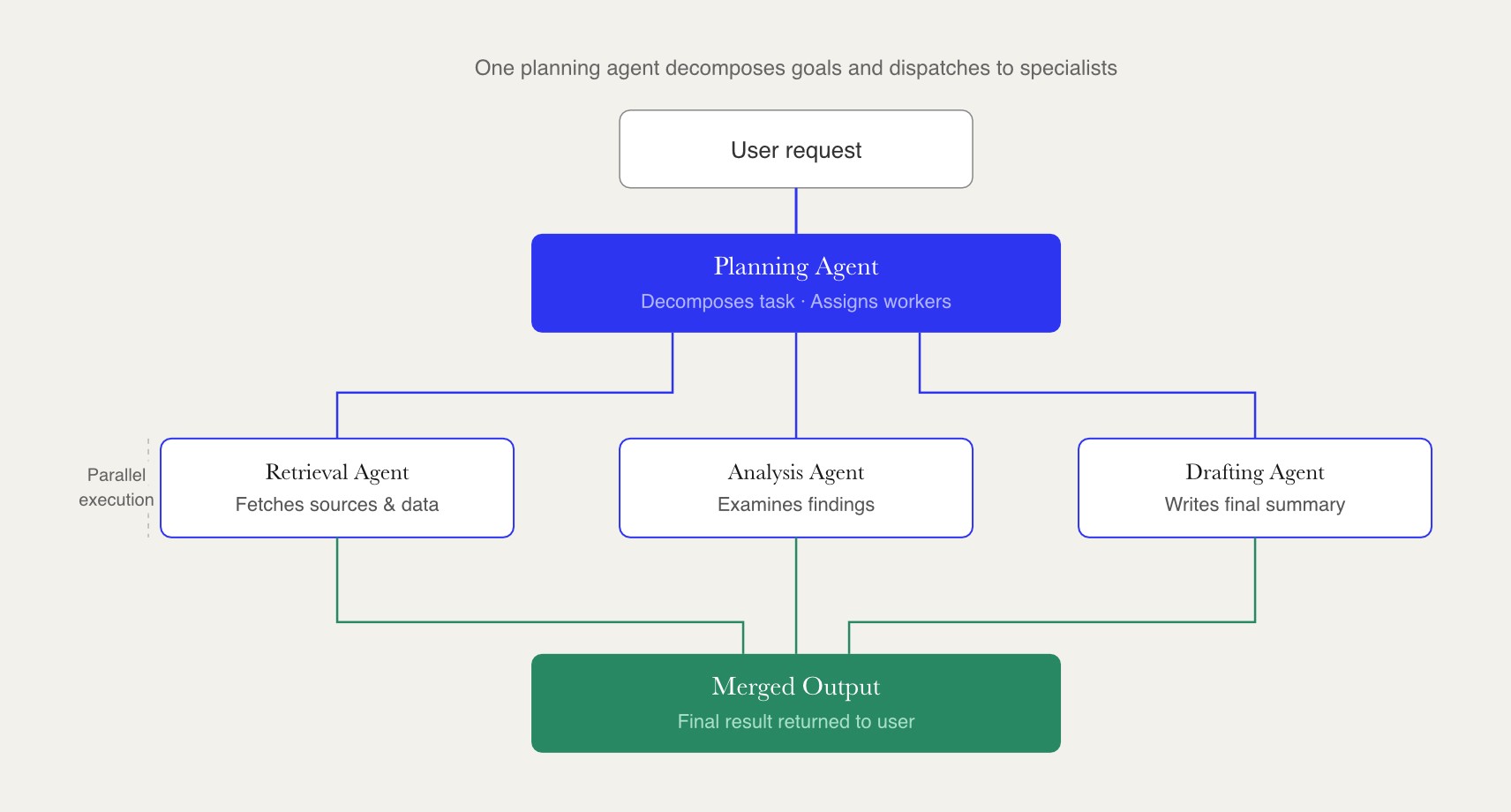
A coordinator uses a planning agent to decompose a request, perform task assignment, and dispatch work to a worker agent or several worker agents. In a 2026 research assistant, one agent may retrieve sources, another may analyze findings, and another may draft the final summary.
This multi-agent pattern works well when one agent cannot reliably handle complex domains alone. It also makes maintainability easier because agents specialized by role can be tested separately.
Sequential, Parallel, Hierarchical, And Swarm Patterns
Sequential multi-agent systems pass outputs through a fixed order, which is common in regulated workflows like KYC or underwriting. Parallel multi-agent architectures let different agents run concurrently, such as pricing, risk scoring, and explanation generation in a loan decision pipeline.
Hierarchical task decomposition uses a root agent to break complex objectives into manageable subtasks handled by subagents at multiple levels. This helps solve complex problems such as large codebase refactors or multi-quarter product planning.
A swarm pattern uses decentralized coordination where agents communicate directly with each other rather than through a central coordinator, sharing state and outputs across the group dynamically. Swarms can produce multiple perspectives, but they are costly, noisy, and harder to debug than coordinator workflows.
In a multi-agent system, each agent operates with its own tools, constraints, and scope, enabling tasks to be handled independently and in parallel when necessary, which improves scalability and reliability. The Multi-Agent Pattern enhances the performance of AI systems by allowing specialized agents to collaborate through either collaborative or hierarchical workflows to achieve a final goal, improving the overall system’s maintainability.
ReAct And Human-In-The-Loop: Guardrails For Multi-Step Autonomy
The Reason and Act pattern lets a model reason, act, observe, and repeat. In simple terms, react agents alternate between selecting an action, using a tool, and adjusting based on the result the model observes.
ReAct is often combined with planning and tool use to power modern 2026 developer copilots that browse repositories, call CI systems, and update state. For debugging, log concise reasoning summaries, tool calls, and observations rather than relying on opaque transcripts.
Human-in-the-loop inserts approval gates where people approve, edit, or override before the agent proceeds. Design must include checkpoints where the agent pauses for user approval before taking high-stakes actions. The autonomous agent executes low-risk tasks seamlessly but requires user approval before executing high-impact, irreversible actions.
Human-in-the-loop checkpoints should trigger before destructive database operations, external API mutations, or outbound transactions that exceed a defined compliance threshold. User interfaces must clearly communicate why an agent made decisions, incorporating features like progress bars and logs of the agent’s actions.
Some teams use talent marketplaces like Fonzi to find engineers who have built ReAct and human-in-the-loop architectures, especially when internal teams are strong on product engineering but new to agentic AI design.
Comparing Agentic Design Patterns: Tradeoffs, Risks, And When To Use Each
Agentic design is a set of tradeoffs, not a maturity ladder. The right pattern depends on determinism, acceptable latency, compliance needs, available tools, and how much exploration the task requires.
Pattern Comparison Table
Pattern | Autonomy Level | Best For | Main Risk |
Controlled Flow | Low | Document QA workflows and fixed sequence reviews | Limited flexibility |
Router | Low to medium | Omnichannel support agents and workflow selection | Misrouting |
Tool Use | Medium | Customer data lookups and operational actions | Unsafe external tool calls |
Reflection | Medium | Quality assurance, reports, and code review | Extra latency and cost |
Single-Agent ReAct | Medium to high | Dynamic tasks with several tools | Harder traces and loops |
Coordinator Multi-Agent | High | Long-horizon planning and specialized workstreams | Coordination overhead |
Swarm | Very high | Exploratory research and creative problem solving | Cost, noise, and debugging difficulty |
Use deterministic patterns first in production, such as controlled flows, routing, and tool use with reflection, and reserve swarm architectures for exploratory work where diverse outputs justify the cost and complexity.
A practical selection rule is simple: use one agent when the domain is narrow, multiple specialized agents when specialization improves reliability, and human approval when the action affects money, security, legal exposure, or sensitive data. Combining multiple patterns is normal, such as a coordinator that uses parallelization, reflection, and human-in-the-loop gates for high-risk actions.
Implementation Guidelines: From Prototype To Production Agentic AI System
Production agentic AI systems need more than prompts. They need measurable goals, safe tools, evaluation data, observability, and rollback paths.
Start with these steps:
Define target latency, task success rate, cost per successful task, and output quality thresholds.
Choose the simplest initial pattern that can meet the goal.
Create evaluation datasets from historical tasks, ground truth labels, and human preference data.
Add custom logic for business rules, spending limits, access control lists, and rate limiting.
Start with read-only tools, then limited write access, then full automation with rollback and kill switches.
Security should be designed before launch. Use strict tool schemas, scoped permissions, sandboxed execution for code, prompt, and log governance, and red-team tests for prompt injection and security vulnerabilities. This is especially important when prompts or traces include sensitive data.
Observability, Testing, And Evaluation For Agentic Patterns
Log every step with correlation IDs, including prompts, model IDs, tool calls, responses, errors, human approvals, and outcomes. Today, engineering teams use specialized observability tools for LLMs to trace executions and validate the reliability of their agentic workflow design patterns in production.
Create a failure taxonomy that includes hallucination, tool misuse, missed constraints, latency timeout, bad routing, and invalid action selection. Then map recurring failures back to orchestration choices, not just model quality.
A/B test different agentic patterns and parameter settings before moving traffic. For example, compare a simple router against a ReAct agent, or compare one reflection pass against two passes, then measure success rate and cost.
The Agent-E web agent work showed that hierarchical planning and better observation can improve web task success by roughly 10 to 30 percent over prior WebVoyager-style agents. That lesson applies broadly: better architecture and feedback loops often matter as much as the base model.
Many 2026 startups and enterprises hire specialized agentic AI engineers through platforms like Fonzi to accelerate productionization, but the core checklist remains the same: control tools, observe behavior, evaluate results, and add autonomy gradually.
Hiring Engineers Who Can Build Agentic AI Systems
As organizations move beyond simple chatbot implementations and begin building production agentic AI systems, demand is growing for engineers who understand orchestration, tool use, evaluation frameworks, observability, and multi-agent architectures. Building reliable agentic workflows requires more than prompt engineering. Teams need engineers who can design scalable systems, manage AI infrastructure, implement human oversight mechanisms, and balance reliability, latency, and cost.
Finding this talent can be challenging because experienced agentic AI engineers often combine skills from software engineering, machine learning, distributed systems, and product development. Through Fonzi, companies can connect with pre-vetted AI engineers, machine learning specialists, platform engineers, and technical leaders who have experience building modern AI applications using technologies such as OpenAI, Anthropic, vector databases, retrieval systems, agent frameworks, and production inference infrastructure.
Fonzi's Match Day helps hiring teams meet qualified candidates faster by delivering curated introductions to engineers who match specific technical requirements. Whether you're building single-agent workflows, multi-agent systems, AI copilots, or enterprise automation platforms, accessing specialized talent can help accelerate development while reducing the risk that comes with deploying increasingly autonomous AI systems.
Summary
Agentic AI design patterns provide reusable frameworks for building AI systems that can reason, plan, use tools, and complete multi-step tasks beyond a single LLM prompt. Common patterns include controlled workflows, routing, tool use, reflection, planning, ReAct, and multi-agent collaboration. Engineers should start with simpler, more deterministic patterns and gradually add autonomy, since each additional agent, feedback loop, or tool increases complexity, latency, cost, and debugging effort. Reflection, planning, and human oversight are especially valuable for improving reliability and reducing errors in production environments.
As AI systems become more autonomous, successful implementations depend on balancing flexibility with control. Multi-agent architectures can divide work among specialized agents, while human-in-the-loop checkpoints help manage high-risk actions involving money, security, or sensitive data. Production-ready agentic systems require strong observability, evaluation frameworks, tool permissions, security controls, and continuous testing. The most effective teams focus on measurable outcomes, introduce autonomy gradually, and combine patterns strategically to create AI workflows that are reliable, scalable, and aligned with business goals.
FAQ
How do I decide between a single-agent ReAct system and a multi-agent coordinator pattern?
What metrics should I use to evaluate an agentic AI system in production?
How can I keep agents from taking unsafe or expensive actions with external tools?
When is a swarm or free-form multi-agent pattern worth the complexity?
How often should I update prompts and tools for my agents as models evolve?