How Many LeetCode Problems Should You Do to Prepare?
By
Samara Garcia
•

Many candidates today fixate on LeetCode problem counts when preparing for coding interviews at companies like Google, Meta, and early-stage startups. The question of how many LeetCode problems to solve comes up in every forum, study group, and Reddit thread. But the real hiring focus is problem-solving ability, communication, and adaptability, not whether you solved 200 or 2,000 problems. Different people need different amounts of practice based on their background, available time, and prior exposure to algorithms and data structures. This article will give you concrete ranges, a reality check, and a practical plan instead of a one-size-fits-all number.
Key Takeaways
There is no magic LeetCode number. Your target depends on your experience, interview goals, and how well you master core problem-solving patterns.
Prioritize quality over quantity by focusing on common interview topics, reviewing mistakes, and revisiting challenging problems instead of endlessly solving new ones.
Pair LeetCode practice with mock interviews and communication skills to build the reasoning and confidence interviewers evaluate during technical interviews.
How Many LeetCode Problems You Actually Need: Clear Ranges For Different Goals
LeetCode problems are coding exercises designed to test algorithms, data structures, and problem-solving skills, making them one of the most common ways software engineers prepare for technical interviews. The number of problems you should solve depends on your target role, experience level, and how deeply you engage with each one.
For junior roles at smaller companies or startups with limited prep time, 30 to 60 well-chosen problems focused on arrays, hashing, and common patterns can be enough. For Big Tech or well-funded startups, most candidates benefit from solving around 75 to 150 problems with strong understanding, while those rebuilding their fundamentals or transitioning careers may need closer to 150 to 250.
A minimum of around 40 problems helps build familiarity with the platform and common interview patterns. More important than the total count is how you study each problem. Review solutions, revisit difficult questions, and practice explaining your reasoning instead of solving each problem only once. Candidates who master core patterns and communicate their approach clearly often outperform those who simply accumulate a higher problem count.
Topic Distribution: How To Spread Your LeetCode Practice Across Core Areas
Solving 100 LeetCode problems all in arrays or strings is far less useful than solving 90 with balanced coverage across core areas. It is advisable to master common algorithmic patterns such as arrays and dynamic programming, since most Big Tech-style interview loops lean heavily on arrays, hashing, trees, graphs, and dynamic programming. These topics deserve extra weight in your study plan.
Here is a suggested topic distribution for three common problem count targets:
Topic | 75 Problems | 100 Problems | 150 Problems |
Arrays and Hashing | 10 | 15 | 20 |
Two Pointers and Sliding Window | 8 | 10 | 14 |
Linked Lists | 5 | 7 | 10 |
Stacks and Queues | 5 | 7 | 10 |
Trees and BSTs | 8 | 12 | 18 |
Graphs | 8 | 10 | 16 |
Dynamic Programming | 10 | 15 | 25 |
Recursion and Backtracking | 7 | 8 | 12 |
Binary Search | 6 | 8 | 12 |
Heaps and Priority Queues | 5 | 5 | 8 |
Other (Intervals, Tries, Greedy, Bit Manipulation) | 3 | 3 | 5 |
Quality Over Quantity: How To Get Maximum Learning From Each LeetCode Problem
Quality matters much more than quantity when solving LeetCode problems. Depth in problem solving is more effective than breadth of problems. An ex-FAANG hiring manager reported rejecting candidates who solved more than 500 problems and hiring people who solved fewer than 100, because what mattered was how deeply each problem was studied. Practicing 100 problems deeply enhances problem recognition. Mastery sticks, while random exposure fades quickly. Fewer mastered problems outperform endless grinding in technical interviews.

Here is a repeatable workflow to get maximum value from each problem:
Read the problem and restate it in your own words. Identify what data structures and concepts apply before writing any code.
Start with the brute force solution, then explore different approaches and optimize. Carefully analyze time and space complexity for each approach.
If you cannot solve a problem in 30 to 40 minutes, read the editorial or a high-quality discussion post, then close it and reimplement the solution from scratch. This builds real knowledge, not just familiarity.
Write down the "pattern label" for each problem, such as sliding window, two pointers, topological sort, or bottom-up dynamic programming. This habit of labeling trains your brain to recognize patterns faster.
Revisiting tough problems after 3 to 5 days without looking at your code locks knowledge into memory and forces true recall.
Teaching others helps deepen your understanding of problems. Even explaining a solution out loud to yourself counts.
This kind of reflective practice trains the structured reasoning interviewers expect during coding interviews, even when the problem looks new. Space complexity and optimizations become second nature when you consistently discuss trade-offs after each solve.
Suggested LeetCode Study Plans: 4, 8, and 12 Week Roadmaps
Different people have different preparation windows. A person waiting on an interview in four weeks needs a compressed sprint. Someone balancing a full-time job might spend eight weeks. And a career transitioner with weaker CS fundamentals might benefit from a full 12-week course of study. Each plan below maps to a total problem count with rest and review built in. These plans assume you already know at least one interview-friendly language such as Python, Java, or C++. Pure language learning will require extra time in parallel.
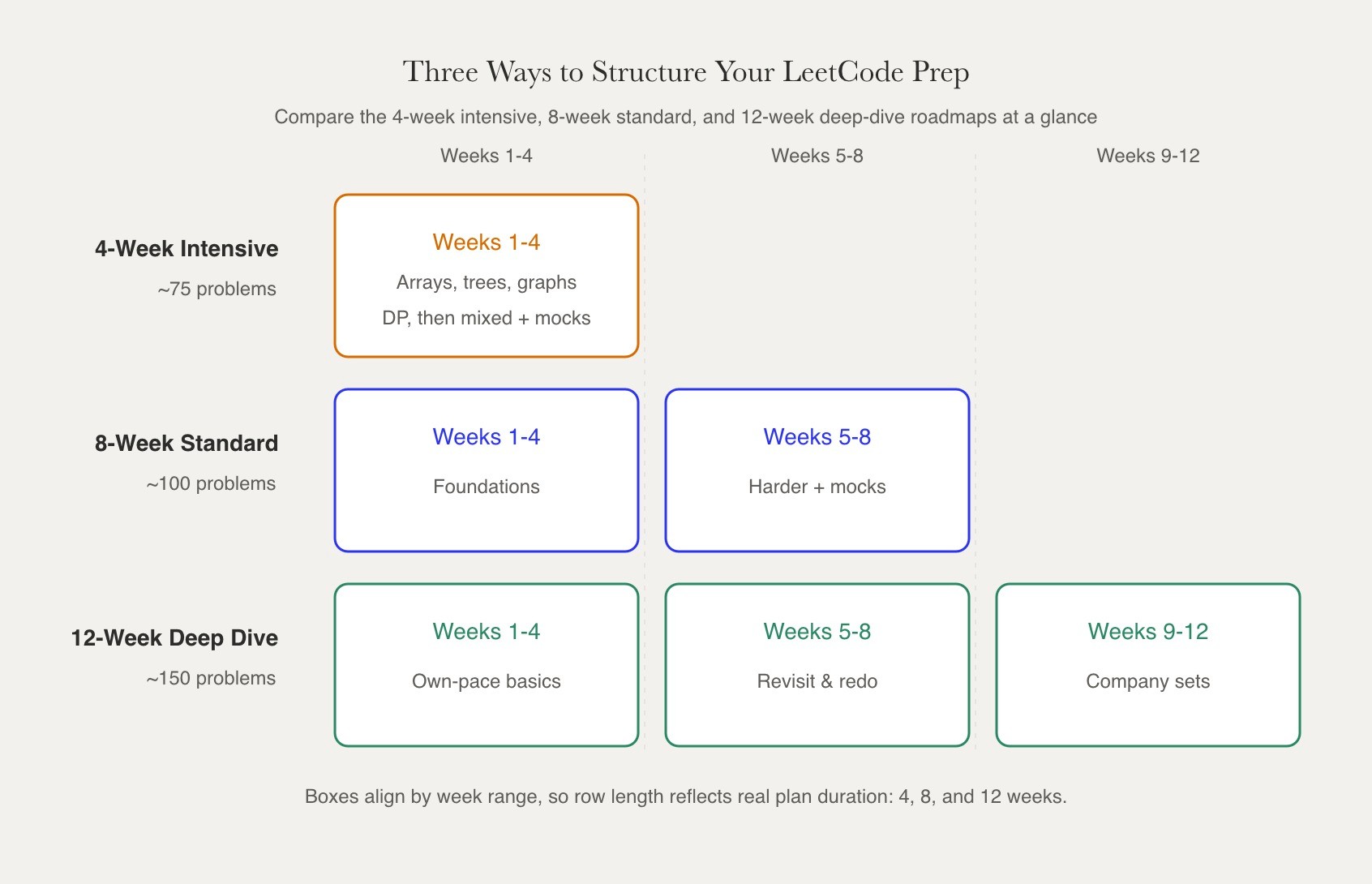
4 Week Intensive Plan (Around 75 Problems)
This compressed schedule works for candidates with an upcoming interview in about a month. The focus is smart prioritization, not trying to cover everything.
Week 1: Arrays, hashing, and two pointers (about 20 problems). Build your foundation here.
Week 2: Trees, binary search, and stacks (about 20 problems). Push into medium difficulty.
Week 3: Graphs and dynamic programming basics (about 20 problems). Spend extra effort on hard problems in these areas.
Week 4: Mixed practice and mock interviews (about 15 problems plus 2 to 3 mocks).
Solve about 3 to 4 problems per day for 5 days per week. Keep one day for a long mock interview and one day for rest or light review. Simulate mock interviews to practice under timed conditions, which is key for dealing with pressure on interview day.
8 Week Standard Plan (Around 100 Problems)
This plan suits most candidates because it balances steady progress with a sustainable workload, reducing burnout while building strong coding skills.
Solve 2 problems per weekday and 3 to 4 on one weekend day. Leave one weekend day for revision and non-LeetCode preparation such as system design or behavioral questions.
Weeks 1 to 4 cover foundational topics at medium difficulty. Weeks 5 to 8 expand into harder mediums and some hard problems in graphs and dynamic programming.
Schedule at least one mock interview per week starting in week 5. Use platforms, peers, or services that connect engineers and startups to get real feedback.
12 Week Deep Dive Plan (Around 150 Problems)
This longer, more sustainable plan suits career transitioners or those with weaker CS fundamentals who are curious about building a solid base.
Solve 1 to 2 problems on weekdays and 3 on weekends, with dedicated time for revisiting old problems, implementing data structures from scratch, and reading algorithm theory as needed.
In the last 4 weeks, integrate company-specific LeetCode problem sets and run frequent timed sessions that simulate a full 45 to 60 minute coding round.
This plan gives you time to explore ideas at your own pace without pushing yourself to the point of burnout.
How To Track Progress And Know When You Are Ready For Coding Interviews
Tracking your progress matters more than guessing whether you have done enough. Maintain a spreadsheet of problems solved by topic and difficulty. Include columns for whether you solved it alone, what pattern it used, and record how long you spent per problem to track progress over time. Regularly reviewing this data highlights weak areas for proactive focus.
Over a few weeks, you should see more problems solved without help, faster times on familiar patterns, and fewer edge cases or off-by-one bugs in your code.
Here are clear signs you are interview-ready:
You recognize common patterns within a few minutes of reading a new problem.
You can solve most medium difficulty problems in 30 to 35 minutes, including handling edge cases and explaining your thought process.
You stay calm when stuck, exploring different approaches rather than freezing under pressure.
You can walk through trade-offs, time and space complexity, and optimizations clearly during a conversation.
LeetCode contest ratings start everyone at 1500 by default; moving meaningfully above that baseline is what reflects real problem-solving proficiency beyond raw problem count.
Common Mistakes With LeetCode Problem Counts And How To Avoid Them
Understanding how much LeetCode to do is only half the equation. Many candidates grind LeetCode in ways that actively hurt their preparation. Here are the most common pitfalls and how to avoid them.
Grinding easy problems for stats. Some people solve hundreds of easy problems just to increase their account stats, without improving real interview performance. This creates an illusion of progress but develops shallow problem-solving ability. Focus on medium problems instead, which map closely to actual interview questions.
Switching topics randomly. Jumping from arrays to graphs to bit manipulation each day leads to weak pattern recognition. Group your practice by topic for at least a few days at a time to build real fluency in each area.
Never revisiting problems. If you solve a problem once and never return, you will forget the solution within weeks. Use spaced repetition and review problems on a schedule, as this directly aligns with how your brain retains complex algorithms and concepts over time.
Ignoring communication practice. Many candidates can code a solution but struggle to explain their reasoning. Interviewers in tech interviews weigh communication heavily. Pair your LeetCode sessions with short voice-based explanations or practice with AI-powered mock interview tools to build that skill.
Skipping hard problems entirely. If you aim for top companies, you need exposure to at least a few hard problems in graphs, dynamic programming, and backtracking. You do not need many, but zero is the wrong number.
Turn Interview Preparation Into Real Opportunities with Fonzi
LeetCode is one part of interview preparation, but solving more problems doesn't automatically lead to more job offers. Once you can consistently solve medium-level problems, explain your reasoning, and perform well in mock interviews, the next step is getting in front of companies that are actively hiring. That's where a structured hiring process becomes more valuable than continuing to increase your problem count.
Fonzi helps software engineers connect with startups and AI companies looking for strong technical talent. Through its recurring Match Day, engineers create a single profile and are introduced to multiple hiring teams in one hiring cycle. Instead of applying to dozens of companies individually, qualified candidates can receive interview requests from several employers whose technical needs align with their experience. After building a solid interview foundation through deliberate LeetCode practice, Match Day provides a direct path to putting those skills into real technical interviews with fast-growing companies.
Summary
Most candidates will be in good shape for coding interviews after roughly 75 to 150 well-chosen LeetCode problems with balanced topic distribution and consistent review. Interviewers care about your thinking, clarity, and adaptability more than any specific LeetCode count. The success you are after comes from depth and deliberate practice, not from chasing a number on your profile.
Pick a study plan from this article, commit to a daily schedule, and book a mock interview or real screening with a company or marketplace like Fonzi when you hit your target range. Consistent, deliberate practice is more likely to improve your interview performance than simply increasing your problem count.
FAQ
How many LeetCode problems should I do per day?
Is LeetCode alone enough to pass coding interviews?
Should I focus on easy or medium LeetCode problems?
How do I handle burnout from doing too much LeetCode?
When should I stop adding new LeetCode problems and just review?


