Culture fit interviews are one of the most misused parts of tech hiring. Too often, they are reduced to vague gut checks about whether someone "seems like a fit," producing little useful signal and introducing significant bias. When done well, culture fit interview questions test specific, observable alignment with how a team actually works, from decision-making style to communication norms. This matters especially for engineering and AI roles, where collaboration habits, risk tolerance, and management style have an outsized impact on team performance and long-term outcomes.
Key Takeaways
Culture fit interview questions are structured, behavioral prompts tied to documented company values, used to predict how a candidate will actually work day to day.
Cultural fit interview questions explore alignment with core values and organizational culture, not surface-level personality traits or shared hobbies.
Effective culture fit assessments include behavioral and open-ended questions that assess values and work preferences alignment, while leaving room for culture add traits that improve team diversity.
Hiring for cultural fit reduces turnover and boosts engagement, but only when questions are specific, consistent, and mapped to real working norms.
What Culture Fit Really Means In Modern Tech Teams
Culture fit means aligning with a company's core values, decision-making norms, and collaboration habits. It is not about hiring people who share the same background, personality traits, or social interests. Employees with good culture fit share beliefs and behaviors with the company in ways that are observable and relevant to daily work, such as how they handle conflict, communicate across teams, or make trade-offs under pressure.
Organizations are increasingly shifting from hiring for culture fit alone to also hiring for culture add. Culture add refers to the different perspectives a candidate brings that strengthen the team beyond simple alignment. A good hire reinforces the organization's values while contributing something new, whether that is cross-disciplinary thinking, a different communication style, or experience navigating ethical complexity in AI.
Concrete anchors of workplace culture include company values like ownership, transparency, and bias toward shipping. They also include the work environment (remote-first versus hybrid), management style (coaching versus directive), and feedback culture. Companies like Netflix, Stripe, and GitLab have codified these values publicly and integrated them into their interview process, making it far easier to assess culture fit consistently.

Why Culture Fit Interview Questions Matter For Engineering And AI Roles
Technical roles demand more than the right skills. Engineering and AI work involves navigating ambiguity, making trade-offs between speed and reliability, and communicating across functions. A candidate's ability to operate within a specific work culture, not just write good code, determines whether they will succeed over time.
Common failure modes in tech hiring include shipping velocity mismatches, misaligned attitudes toward experimentation versus caution, and incompatible expectations about autonomy. Poor culture fit leads to unhappy employees and higher turnover, especially in senior engineer, staff, and ML lead roles where replacement costs are steep. Culture fit interviews can reduce employee turnover by surfacing these misalignments before a hiring decision is made.
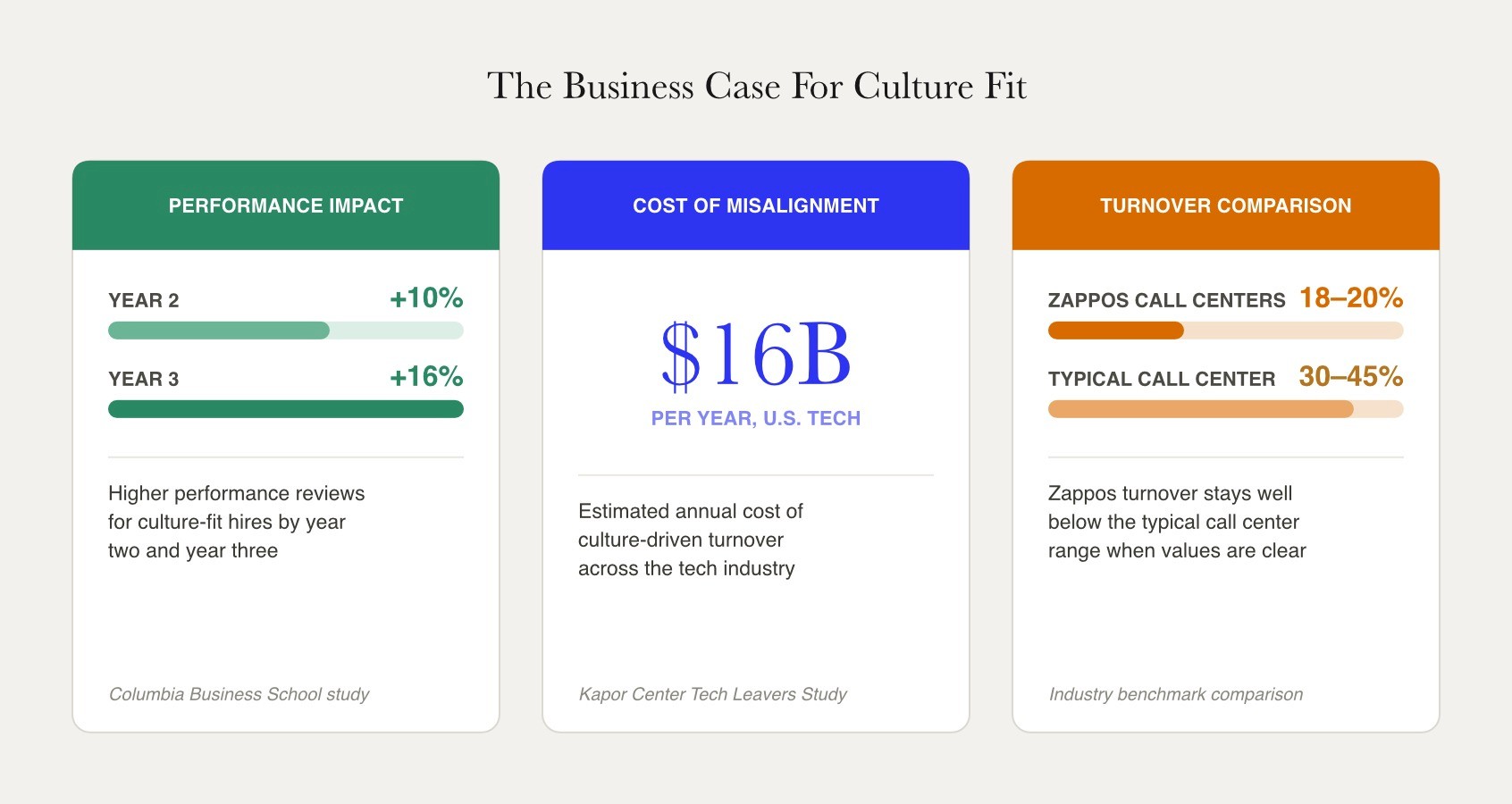
The data supports this. A Columbia Business School study found that employees hired through a formal culture-fit measurement system showed about 10% higher performance evaluations by year two and roughly 16% higher by year three. Separately, the Kapor Center's Tech Leavers Study estimated that culture-driven turnover costs the U.S. tech industry approximately $16 billion annually. Companies with strong cultures see better employee performance, and alignment with a company's core values can enhance team harmony and employee retention.
Consider Zappos, which has an 18-20% turnover rate in call centers, well below the typical call center rate of 30-45%. Hiring for culture fit can reduce employee turnover rates significantly when the values are clearly defined and consistently evaluated. Platforms like Fonzi can help surface candidates who already align with certain engineering culture traits such as ownership and async communication, but interviewers remain responsible for validating fit in context.
Defining Your Culture Before You Write A Single Interview Question
High-quality culture fit questions come only after a company has clearly articulated its values and operating principles. If your team cannot describe the organization's culture in concrete behavioral terms, your interview questions will default to vague impressions.
Start by identifying 5 to 7 concrete company values and behaviors that show up in daily decisions. Examples include "default to open," "disagree and commit," "bias toward small experiments," or "treat documentation as first-class work." These should reflect your actual work culture, not aspirational statements on a career page. Culture fit questions should align with company values that are practiced, not just posted.
Next, summarize how your team works across these dimensions:
Work environment: remote, hybrid, or in-office
Management style: coaching versus directive, open door policy versus formal reviews
Decision-making: top-down versus distributed
Feedback culture: continuous versus periodic
Pace: fast-paced environment versus deliberate and measured
Partner with engineering leaders and senior ICs to write 1 to 2 sentences per value that describe what good culture fit and culture add look like in real project examples. A strong company culture is built on specificity, not slogans. Your mission statement should connect to how staff members actually experience daily work, and employees understand what is expected only when values are documented.
The Golden Rules For Effective Culture Fit Interview Questions
These principles keep culture fit interviews fair, predictive, and legally defensible.
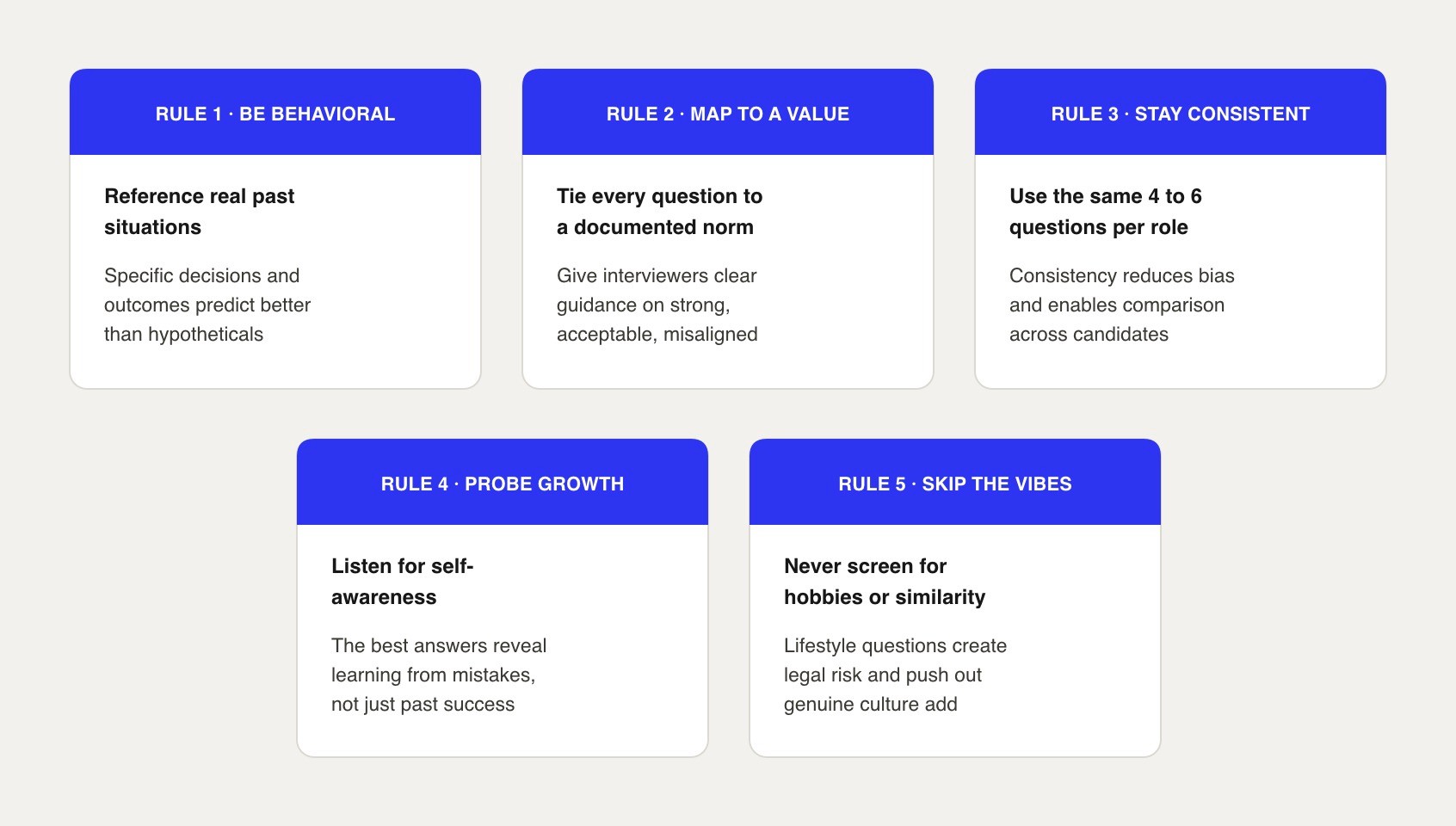
First, use behavioral interview questions that reference specific past situations, decisions, and outcomes. Behavioral interview questions focus on real-world examples of past behaviors, which are far more predictive than hypothetical prompts. Focus on concrete scenarios rather than hypothetical preferences during interviews. Probing for specific details, timelines, and outcomes helps interviewers distinguish rehearsed responses from genuine experience.
Second, every culture fit question should map directly to a documented company value, norm, or aspect of the work environment. Cultural fit assessments help identify candidates who align with company values only when interviewers have clear guidance on what "strong," "acceptable," and "misaligned" answers look like.
Third, keep the same 4 to 6 core culture fit questions for a given role family, whether backend engineers, ML researchers, or infrastructure leads. Consistency reduces unconscious bias and enables comparison across potential hires.
Fourth, train interviewers to probe for self-awareness, personal growth, and a learning mindset. The best answers reveal how a candidate learned from mistakes, not just how they succeeded. Effective culture fit assessments include behavioral and open-ended questions that explore how candidates think, not just what they have done.
Finally, never use fit interview questions to screen for hobbies, social similarity, or vague "vibes." Questions about lifestyle, socializing after work, or personality preferences create legal risk and push out candidates who could be a genuine culture add.
Core Culture Fit Question Themes For Technical Roles
When hiring engineers and AI professionals, culture fit questions should cover a defined set of domains. Culture fit helps build stronger teams and supports common goals when evaluation is systematic rather than improvised. Below is a map of themes, with signals that indicate alignment and warning signs of misalignment.
Theme | Signals of Good Fit | Warning Signs |
Collaboration and communication | Gives specific examples of cross-team work; adjusts style for different stakeholders; welcomes feedback | Overemphasizes solo work; vague on how they work with team members; avoids conflict |
Ownership and accountability | Takes responsibility beyond their task; owns mistakes; follows through on outcomes | Blames others; passive when describing ambiguity; unclear on who owned what |
Dealing with ambiguity and risk | Comfortable deciding without complete information; shares examples of trade-offs and failed experiments | Needs full specs before acting; avoids decisions; unwilling to risk professionally |
Quality versus speed | Balances maintainability with delivery under tight deadlines; knows when speed matters more | Always sacrifices quality or always over-engineers; no examples of balancing both |
Feedback and conflict | Gives and receives feedback constructively; reflects on disagreements; demonstrates personal growth | Avoids conflict entirely; defensive about mistakes; unable to handle stress from critique |
Ethics and integrity (AI roles) | Proactively considers fairness, bias, downstream impact; questions assumptions | Dismisses ethical concerns; ships without reflection |
Learning and growth | Continuously learns new tools and domains; mentors others; shows curiosity | Static skillset; defensive; not invested in personal growth |
Adapt the weight of each theme by role. Product engineers need stronger signals on cross-functional communication. ML researchers need evidence of experimentation norms and ethical thinking. Hiring managers should align interviewers so each panel member covers different themes, avoiding duplication.
20 Culture Fit Interview Questions That Actually Reveal Alignment
These questions are designed for engineering and AI roles. Each targets a specific aspect of culture, and the best answers include concrete detail, self-awareness, and connection to the candidate's personal values.
Collaboration and communication
Describe the best engineering team culture you have experienced. What made it special?
Strong responses name specific rituals and behaviors, not perks.
How do you prefer working with cross-functional stakeholders who have competing priorities?
Listen for adaptability and respect for different perspectives.
Tell me about a time you had to align team members who disagreed on a technical direction.
Candidates should demonstrate soft skills when handling conflict and collaboration.
Decision-making and ownership
Describe a decision you made with incomplete data. What was the outcome?
Look for comfort with ambiguity and accountability.
Tell me about a time you pushed back on a deadline because of quality concerns.
A strong fit will show conviction tied to the organization's values around quality.
What does ownership mean to you in the context of your current job?
Misalignment sounds like describing only task completion rather than impact.
Tell me about a time you had to balance shipping quickly with maintaining quality standards. How did you decide where to draw the line?
A strong fit will describe a specific trade-off with real stakes; misalignment sounds like defaulting to one extreme with no awareness of the cost.
Management style and feedback
Describe the management style that brings out your best work.
Asking about a candidate's preferred work environment reveals their productivity and what drives job satisfaction.
Tell me about feedback from your current manager that changed how you work.
Candidates should demonstrate adaptability and willingness to grow.
How do you stay organized and prioritize when your team is under pressure?
Look for evidence of a work style that matches your pace.
Work environment and values
In what setting do you do your best deep work?
This probes alignment with your remote, hybrid, or in-office norms.
What does work-life balance mean to you, and how have you maintained it in a fast-paced environment?
Listen for realism, not idealism.
How do you define success for yourself in a new job?
Strong answers connect personal values to the company's core values, not just career advancement.
Ethics, learning, and growth
Describe a time an AI model or system you worked on had unintended consequences. What did you do?
This tests ethical thinking under pressure.
What is a skill you recently developed outside your core expertise?
Look for curiosity and personal growth.
How do you handle stress when a project you own is failing?
Look for resilience and self-awareness, not bravado.
Culture add and perspective
How do you approach culture fit versus culture add when hiring for your own team?
Reveals whether the candidate values inclusion.
What is something about your last job or work culture that you would change?
Honest critique signals maturity.
Describe a time you brought a perspective that changed how your team approached a problem.
Candidates should demonstrate understanding of company values while showing they can contribute new thinking.
Tell me about a risk you took professionally that did not work out. What did you learn?
This reveals work ethic, resilience, and growth mindset.
Job seekers who can articulate these themes clearly tend to be the right candidate for teams that value transparency and accountability. When reviewing responses, look for alignment with your defined success criteria, not for personality similarity.
Sample Evaluation Rubric For Culture Fit Answers
Scoring culture fit answers with a consistent rubric removes the guesswork that leads to bad decisions. Use a structured rubric to evaluate candidate responses for cultural compatibility, and ensure every interviewer captures both a rating and brief evidence notes.
The rubric should translate your organization's values and work norms into observable behaviors. Below is an example across five dimensions.
Dimension | Strong Fit | Mixed | Misaligned |
Collaboration | Names specific cross-team examples; adjusts communication for audience | General statements about teamwork; few specifics | Focuses only on solo contributions; dismissive of others |
Ownership | Describes impact beyond assigned task; owns failures | Takes ownership when prompted but not proactively | Deflects blame; passive in ambiguity |
Feedback and growth | Reflects on criticism constructively; shows change over time | Accepts feedback but limited evidence of growth | Defensive; avoids feedback; no learning examples |
Pace and quality | Balances speed with standards; gives trade-off examples | Leans heavily one way without flexibility | Rigidly slow or recklessly fast; no awareness of trade-offs |
Ethics and integrity | Raises ethical concerns proactively; considers downstream impact | Aware of ethics when asked but does not initiate | Dismisses ethical issues; "just ship it" attitude |
Hiring managers can use this rubric to resolve disagreements between interviewers. If one interviewer flags misalignment and another sees strong fit on the same dimension, the evidence notes make calibration possible. This also helps distinguish genuine culture add from actual culture risk. A candidate who challenges your current norms constructively may be exactly what your team needs, while a candidate who simply does not share the same values may create friction.
Some AI-assisted tools can aggregate and visualize rubric scores across candidates, but human reviewers must interpret patterns and make final trade-offs. A rubric is only as good as the interviewers who use it honestly.
Where AI Helps With Culture Fit, And Where It Does Not
Since around 2020, AI has been increasingly applied to resume screening, candidate matching, and structured interview workflows. Culture fit is a sensitive part of this trend because it involves subjective judgment about values and behaviors.
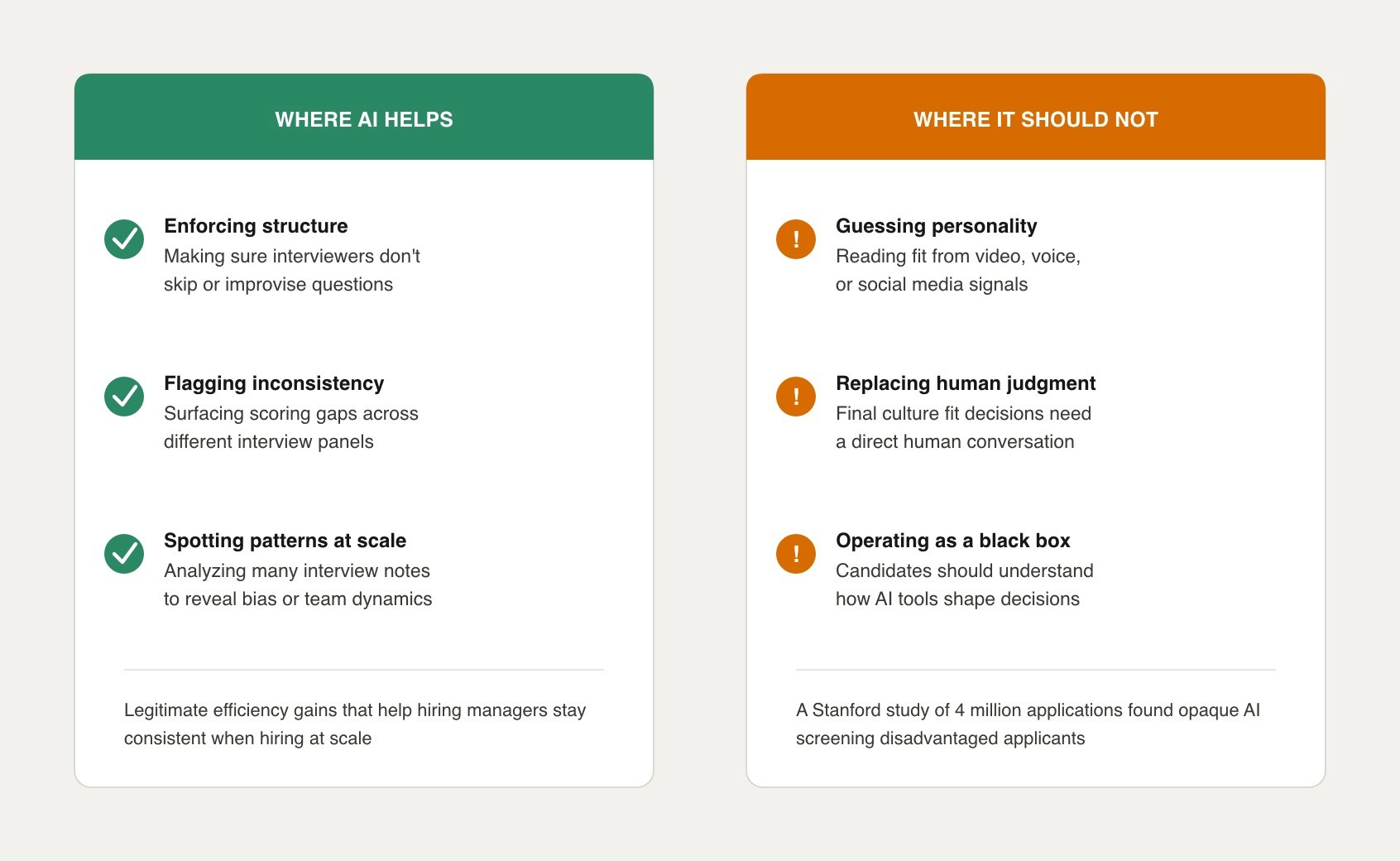
AI can support culture fit assessment in specific ways: enforcing structured interview questions so interviewers do not skip or improvise, flagging inconsistent scoring across interview panels, and analyzing patterns across many interview notes to identify where team dynamics or scoring biases emerge. These are legitimate efficiency gains that help hiring managers maintain consistency, especially when hiring people at scale.
However, using opaque AI models to guess a candidate's personality or cultural fit from video, voice, or social media signals is risky and often unreliable. A Stanford study analyzing 4 million applications found that AI screening tools rejected Black and Asian applicants at disproportionately higher rates. Regulatory scrutiny in the US and EU is increasing, and the ethical stakes are real.
Curated marketplaces like Fonzi can pre-filter for certain work preferences and values based on explicit candidate input, which shortens the hiring process while keeping culture fit evaluation transparent. But final culture fit decisions must rest on human judgment informed by direct conversation, not on black-box predictions. Candidates should understand how any AI-assisted tools are used, and interviewers must retain the ability to override algorithmic recommendations.
Build a Fairer Hiring Process with Fonzi
Strong culture interviews start with strong candidate evaluation. Fonzi uses AI to automate resume and phone screening, helping ensure candidates are assessed based on their skills and experience rather than subjective factors. This creates a more consistent hiring process while reducing administrative work and mitigating recruitment bias.
Once candidates are screened, Fonzi's Match Day connects companies with a curated pool of qualified engineers, allowing hiring teams to focus on meaningful conversations about collaboration, communication, and culture add instead of spending time filtering resumes. The result is a faster, more structured hiring process that combines objective technical evaluation with thoughtful human decision-making.
Putting It All Together In Your Hiring Process
A typical fast-growing tech company should integrate culture fit questions into every stage of hiring for engineering and AI roles, not relegate them to a single round.
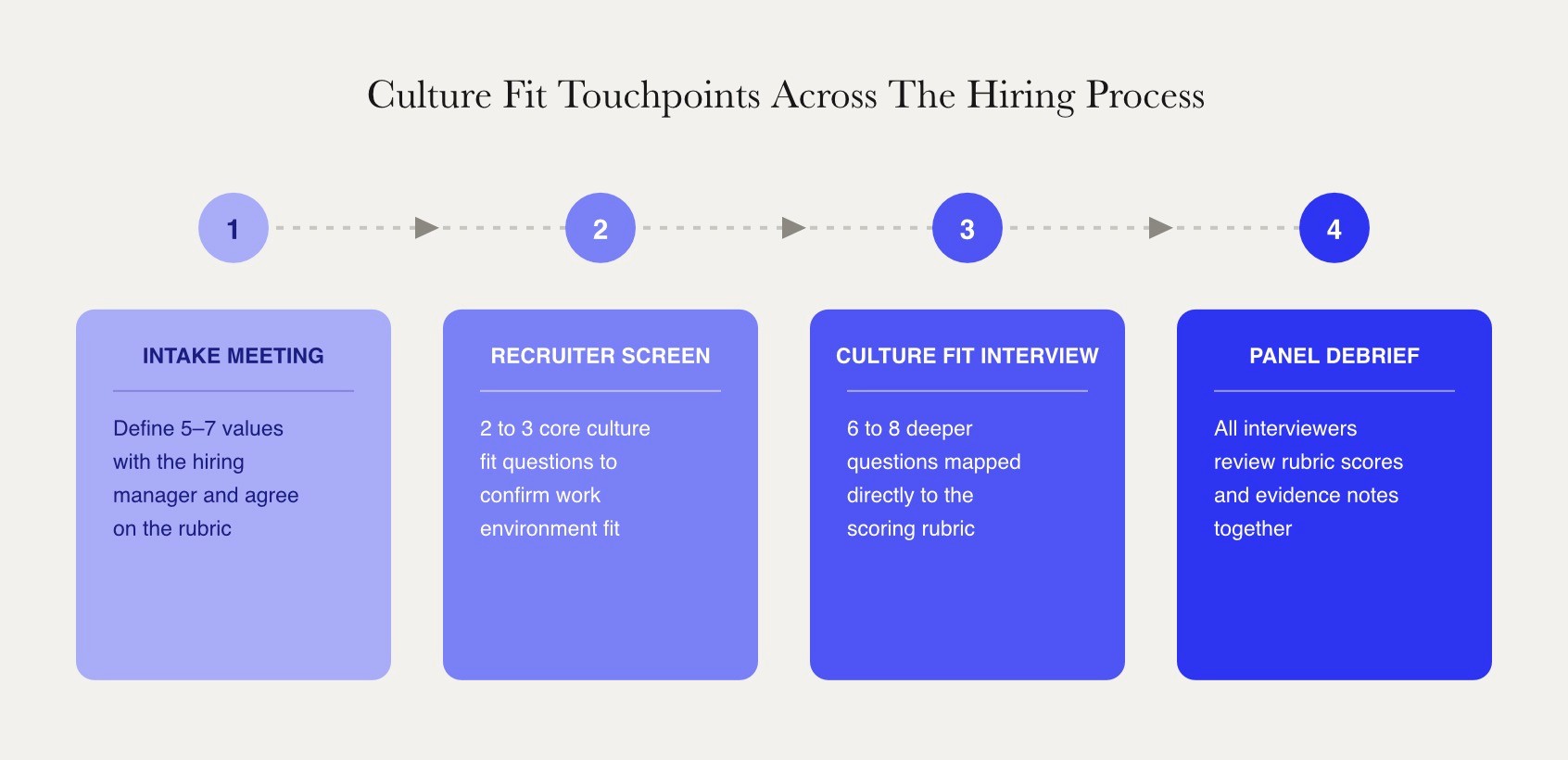
The sequence works as follows: during the intake meeting, define 5 to 7 values with the hiring manager and agree on the rubric. In the initial recruiter screen, use 2 to 3 core culture fit questions to assess culture at a high level and confirm work environment preferences. In a dedicated culture fit interview round, a designated "culture interviewer" uses 4 to 6 deeper questions mapped to the rubric. In the panel debrief, all interviewers review rubric scores and evidence notes together.
Give candidates space to interview your company back. Let them ask about management style, team dynamics, expectations for personal growth, and what successful teams look like internally. Candidates who ask sharp questions about your culture are often the ones most likely to thrive or to flag honest mismatches before they become costly.
Iterate on your culture fit question set quarterly. Use hiring outcomes, performance data from formal reviews, and candidate feedback to refine what you ask and how you score it. If a question consistently fails to distinguish between strong and weak cultural alignment, replace it. If interviewers cannot agree on what a good answer sounds like, the value behind the question needs clearer definition.
Summary
Culture fit interviews are most effective when they measure how candidates align with a team's documented values, communication style, decision-making, and ways of working rather than relying on subjective impressions. Well-designed behavioral questions, paired with structured scoring rubrics, help hiring teams evaluate collaboration, ownership, adaptability, and ethics while reducing bias and making hiring decisions more consistent.
Strong culture fit assessments also leave room for culture add, recognizing candidates who bring valuable new perspectives while sharing the organization's core values. Combined with thoughtful human evaluation and structured interview processes, these interviews help companies build stronger engineering teams, improve long-term retention, and make more informed hiring decisions.
FAQ
How many culture fit questions should we ask in a single interview?
Should we change culture fit questions for remote or hybrid engineering teams?
How transparent should we be about our culture challenges during interviews?
What if a strong candidate constructively challenges parts of our culture?
How can we keep external recruiters aligned with our culture fit expectations?