As sales and marketing teams rely on increasingly complex technology stacks, GTM engineering has emerged as a critical function for connecting data, automating workflows, and improving revenue operations. Rather than relying on manual processes, companies now use GTM engineers to build scalable systems that help sales, marketing, and customer success teams work more efficiently.
This guide explains what GTM engineers do, the skills they need, how they support go-to-market teams, and what hiring managers should look for when building this function.
Key Takeaways
Growth engineers design systems that integrate sales, marketing, and product, using data enrichment, firmographic data, and AI tools to generate pipeline and reduce friction.
The GTM engineering function evolved from RevOps and growth marketing foundations but focuses on building and owning integrated GTM systems rather than isolated campaigns or reports.
Growth engineering blends software engineering, data science, and product design, making it a specialized software engineering discipline that requires hybrid profiles.
From Growth Hacking to Growth Engineering: How the Role Evolved
In the early 2010s, "growth hackers" ran scrappy, one-off experiments on landing pages and email sequences. Today, growth and GTM engineers build durable, observable systems for GTM teams. Growth engineering is a specialized software engineering discipline that alters traditional software development priorities, focusing on metrics rather than just features. Growth engineering combines data analysis, product engineering, and marketing into a single function that revenue teams depend on daily.
RevOps, sales ops, and growth marketing roles at companies like Intercom, Notion, and Segment gradually absorbed more engineering responsibilities. API integrations, workflow automation, and data modeling stretched these roles beyond their original scope and set the stage for a distinct growth engineer role.
Recent 2025 and 2026 job descriptions use "growth engineer" and "GTM engineer" interchangeably while emphasizing different anchor teams. "GTM engineer" appears more frequently in outbound- or RevOps-adjacent organizations, while "growth engineer" is common in product-led growth teams. Over 100 GTM engineer job listings appear monthly since 2023, and data shows that postings with "GTM Engineer" grew approximately 205 percent year over year from 2025 to early 2026. The tech stack grew more complex across the last decade, and GTM engineering emerged to address the complexity of modern sales systems that no single ops person could manage alone.
What Growth Engineers Actually Do for Go To Market Teams
Growth engineers are builders who design, automate, and scale systems that connect product, marketing, sales, and customer success workflows. GTM engineers connect sales, marketing, and product teams through integrated data pipelines rather than manual handoffs. Their work is best understood through concrete responsibility clusters that hiring managers can map directly to their org chart.
One core responsibility is to build systems that turn raw firmographic data, usage signals, and data enrichment sources into actionable GTM signals like PQLs, churn risk alerts, or upsell candidates. GTM engineers automate data flow to enhance decision-making processes across the entire customer journey. Growth engineers handle integrations and workflow orchestration across modern systems like Salesforce, HubSpot, or Attio, product analytics platforms, sales engagement tools, and data integration tools such as Zapier, n8n, Workato, or Clay. Clay has emerged as the dominant orchestration platform, appearing in roughly 84 percent of GTM engineering stacks surveyed in early 2026.
Growth engineers increasingly use AI to automate CRM updates, classify sales calls, personalize outbound campaigns, and enrich lead data. They also work closely with marketing and customer success teams to surface product usage insights, identify expansion opportunities, and reduce manual reporting through automated workflows. According to the Pedowitz Group's analysis of B2B marketing tech stacks, a typical B2B team uses 35 to 45 tools, and enterprise teams often exceed 60.
Core Responsibilities Across Sales, Marketing, and Customer Success
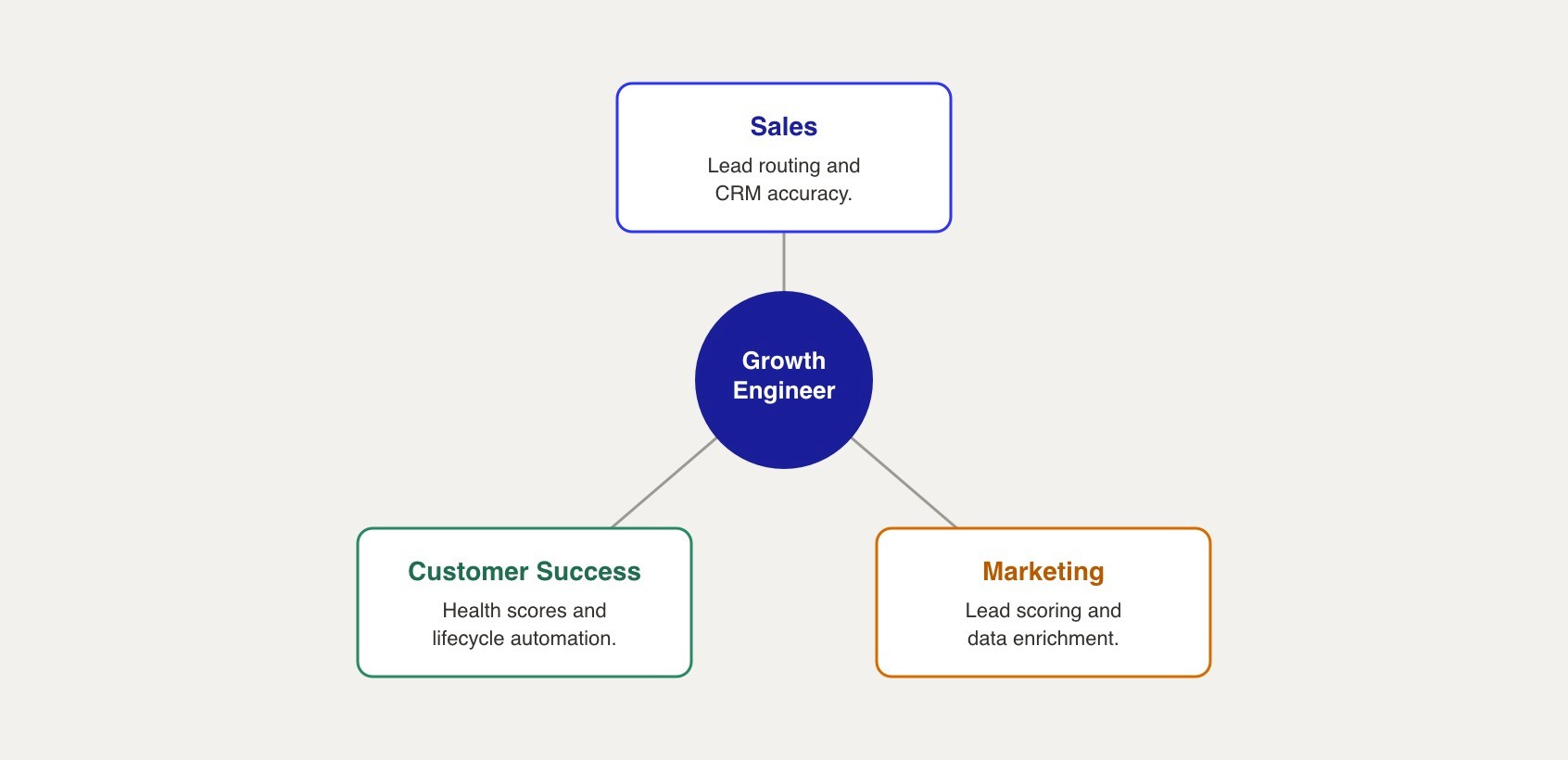
GTM engineers automate workflows across the entire customer lifecycle. They improve lead routing, CRM accuracy, and sales insights, build lead scoring and data enrichment systems for marketing, and create customer health scores and lifecycle automations for customer success. By reducing manual work and connecting data across teams, they help improve forecasting, efficiency, and revenue growth.
Example Growth Engineering Projects That Directly Impact GTM
Growth engineers build AI-powered systems that automatically update CRM records from sales calls, enrich lead data for smarter prospecting, personalize marketing campaigns at scale, and alert customer success teams to expansion or churn opportunities. These automations improve pipeline quality, forecasting, and revenue efficiency while reducing manual work.
How Growth Engineering Relates to GTM Engineering, RevOps, and Growth Marketing
Many companies use titles like GTM engineer, growth engineer, GTM ops engineer, and sales systems engineer for similar work, making it difficult to define the role. While responsibilities often overlap, the distinctions are becoming clearer.
Operations teams focus on process, reporting, and governance. Growth marketing drives demand generation and experimentation. Growth engineers build the technical infrastructure that powers both, including API integrations, workflow automation, CRM systems, and AI-powered automations. As SaaS companies have matured, this role has evolved into a dedicated engineering function responsible for building scalable revenue systems rather than simply managing operations.
GTM Engineering vs RevOps: Tactical Execution vs Governance
RevOps typically owns forecasting, territory design, compensation rules, and CRM governance. GTM engineering owns the technical build-out of integrations, automations, and advanced routing logic. GTM engineers are usually hands-on with APIs, writing code, and workflow platforms, while RevOps leaders focus on business requirements, measurement, and cross-functional alignment.
In smaller companies, a single person may wear both hats. But as organizations grow past roughly 80 to 150 employees, separating a GTM engineering function often improves speed and reliability. The key distinction is that RevOps defines what should happen; growth engineering teams build the technical architecture to make it happen consistently.
Growth Engineering and Growth Marketing: Systems vs Channels
Growth marketing typically owns campaigns, creative, ad spend, SEO, and experimentation frameworks. Growth engineers build the data, routing, and measurement infrastructure that makes experiments reliable. For example, a growth engineer building a lead-scoring and lifecycle framework in 2026 gives growth marketers a trusted system for testing LinkedIn, Google Ads, or content syndication performance.
The most effective GTM organizations treat growth engineers as embedded partners on growth squads, not as ticket-taking back-office support. Growth engineering emphasizes rapid iteration based on user feedback, building the infrastructure that allows growth teams to run A/B tests and validate marketing hypotheses against real-world user data.
Data, AI Tools, and System Design: How Growth Engineering Actually Drives Outcomes
Growth engineering impact comes from the combination of data strategy, AI tools, and thoughtful system design, not from isolated scripts or one-off automations. GTM engineers integrate systems to ensure data flows seamlessly across the GTM stack, and data-driven decision-making is fundamental to growth engineering. Reliability, observability, and clear ownership are as important as the underlying technology choices since GTM teams need systems they can trust in daily technical execution.
Foundations: Clean Data, Firmographics, and Enrichment
Poor CRM hygiene and inconsistent enrichment remain the main constraints on GTM engineering at most companies. Growth engineers typically design data models that combine firmographic data (company size, industry, funding, location), technographic data, and product usage events into unified account and contact profiles. They build well-modeled data pipelines using product analytics instrumentation and enrichment providers, enforcing validation rules and setting up automated refresh schedules to avoid decayed records.

Specific use cases include routing inbound leads by segment and territory using lead data and generating account-level health scores for customer success. GTM engineering automates workflows to streamline revenue processes by removing the need for manual data cleanup. Growth engineering enables automated and data-driven user acquisition and retention at scale.
Applying AI Tools Across the GTM Funnel
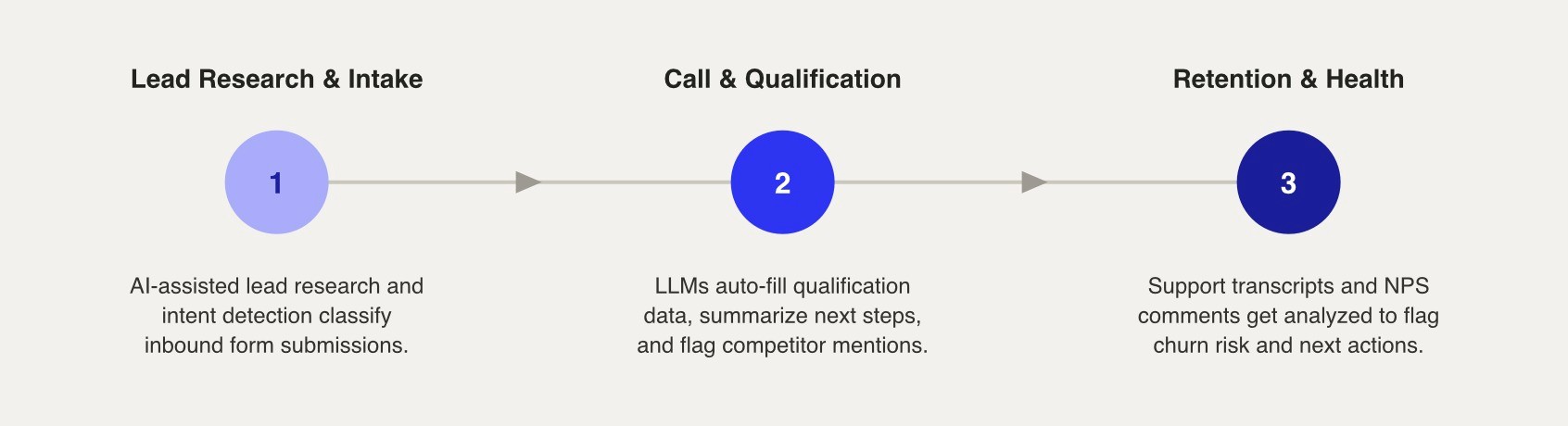
Concrete AI applications include upstream use cases such as AI-assisted lead research, intent detection in email replies, and automatic classification of inbound forms based on free-text fields. These upstream AI applications reduce the manual triage work reps would otherwise do on every inbound lead, letting SDRs spend more time on qualified conversations instead of sorting raw form submissions.
Mid-funnel, LLMs process call recordings to auto-fill qualification frameworks, summarize next steps, and detect competitor mentions, then sync this data back into CRM and sales enablement tools. Downstream, customer success applications include analyzing support transcripts and NPS comments to flag churn risk, cluster themes, and suggest follow-up tasks for CSMs.
Growth engineers are responsible for prompt design, evaluation metrics, monitoring for drift, and building safe failure modes. For example, low-confidence inferences trigger human review rather than automated CRM updates. This is where AI-powered systems must be built with care to avoid damaging customer relationships or corrupting pipeline stages.
Manual GTM vs Growth-Engineered Systems
The following table compares manual workflows to systematized approaches across key GTM stages. It illustrates where growth engineering adds the most value for revenue growth.
GTM Stage | Manual Approach | Growth-Engineered Approach | Impact on GTM Teams |
Lead Qualification | Manual review via spreadsheets; inconsistent criteria | Automated enrichment, scoring, and routing with consistent rules | Faster response, fewer unqualified leads, better SDR focus |
Outbound Prospecting | Human list building, manual personalization, generic cold emails | Automated prospect enrichment, dynamic templates, AI-generated sequences | Higher outbound velocity, less rep burnout, more money spent on high-fit targets |
Opportunity Management | Sellers manually fill fields; delayed or inconsistent updates | Call recording analysis and signal inference auto-fill stage and qualification fields | Improved forecast accuracy, fewer missed handoffs |
Customer Success Health | Regular manual check-ins; reactive response | Automated alerts for usage drops and ticket spikes; health scores and expansion triggers | Proactive retention, earlier risk detection, better resource allocation |
Deal Cycle Tracking | Spreadsheet-based pipeline reviews | Automated deal cycle analytics with real-time pipeline stage updates | Right metrics visible to leadership, faster coaching interventions |
The pattern is consistent: growth engineering reduces repetitive manual steps, improves data quality, and speeds GTM feedback loops.
Find Experienced Growth Engineers with Fonzi
Hiring for GTM engineering is challenging because the role sits at the intersection of software engineering, RevOps, data, and AI. The strongest candidates understand APIs, automation, CRM architecture, and data pipelines, but they also know how sales, marketing, and customer success teams operate. Traditional job boards often make it difficult to identify these hybrid profiles, leaving hiring teams to sort through hundreds of applications with little signal.
Fonzi helps companies connect with pre-vetted software engineers who have experience building AI-powered automations, data infrastructure, workflow orchestration, and scalable revenue systems. Through Fonzi's recurring Match Day, companies can review a curated group of experienced engineers at the same time, accelerating hiring for GTM engineering, growth engineering, and RevOps-adjacent roles. Instead of spending weeks sourcing candidates individually, hiring managers receive introductions to engineers whose technical skills and experience align with their GTM strategy, making it easier to build the systems that support long-term revenue growth.
Summary
Growth engineering has become a key function for modern go-to-market teams, combining software engineering, data, and automation to connect sales, marketing, and customer success systems. Instead of managing campaigns or reports, growth engineers build scalable infrastructure that improves data quality, automates workflows, powers AI-driven insights, and helps revenue teams operate more efficiently.
As companies grow, dedicated GTM engineers play an increasingly important role in integrating CRM platforms, AI tools, and data pipelines to improve lead routing, forecasting, customer success, and overall revenue operations. Organizations looking to scale their go-to-market efforts should prioritize hiring engineers with a mix of technical, data, and business expertise who can build reliable systems that support long-term growth.
FAQ
When is the right time for a fast-growing tech company to hire its first growth engineer or GTM engineer?
How technical does a growth engineer need to be compared with a traditional software engineer?
How should we measure the success of a newly created growth engineering function?
What are common pitfalls when hiring for growth engineering for the first time?
Should growth engineers report into engineering, product, or revenue leadership?