Top Healthtech Careers at Startups and Growing Companies
By
Samara Garcia
•

Healthcare technology has become one of the most exciting fields for software engineers, AI specialists, and machine learning practitioners. From clinical decision support and medical data platforms to telehealth and healthcare automation, technology is reshaping how care is delivered and managed.
Whether you're interested in joining a startup or a fast-growing healthtech company, the opportunities continue to expand across engineering, AI, infrastructure, and data. This guide explores the most in-demand healthtech roles, the skills employers value, and how to prepare for a successful career in the industry.
Key Takeaways
AI engineers, ML researchers, infra engineers, and LLM specialists are increasingly central to healthcare technology jobs at both early and growth-stage healthtech companies.
Modern healthtech hiring blends traditional evaluation with AI-assisted screening, coding assessments, and structured interview loops that test domain knowledge.
Candidates who understand healthcare data, privacy constraints, and real-world clinical workflows gain a meaningful edge in senior roles.
The Healthtech Landscape: How Startups and Growth Companies Hire Technical Talent
The healthcare industry includes telehealth platforms, remote patient monitoring systems, AI diagnostics, drug discovery accelerators, and value-based care analytics companies. Health technology bridges healthcare operations and technological innovation, blending data science, software engineering, and clinical care into unified products. U.S. healthcare AI spending reached $1.4 billion in 2025, nearly triple 2024 levels, with roughly 22% of healthcare organizations deploying domain-specific AI tools.
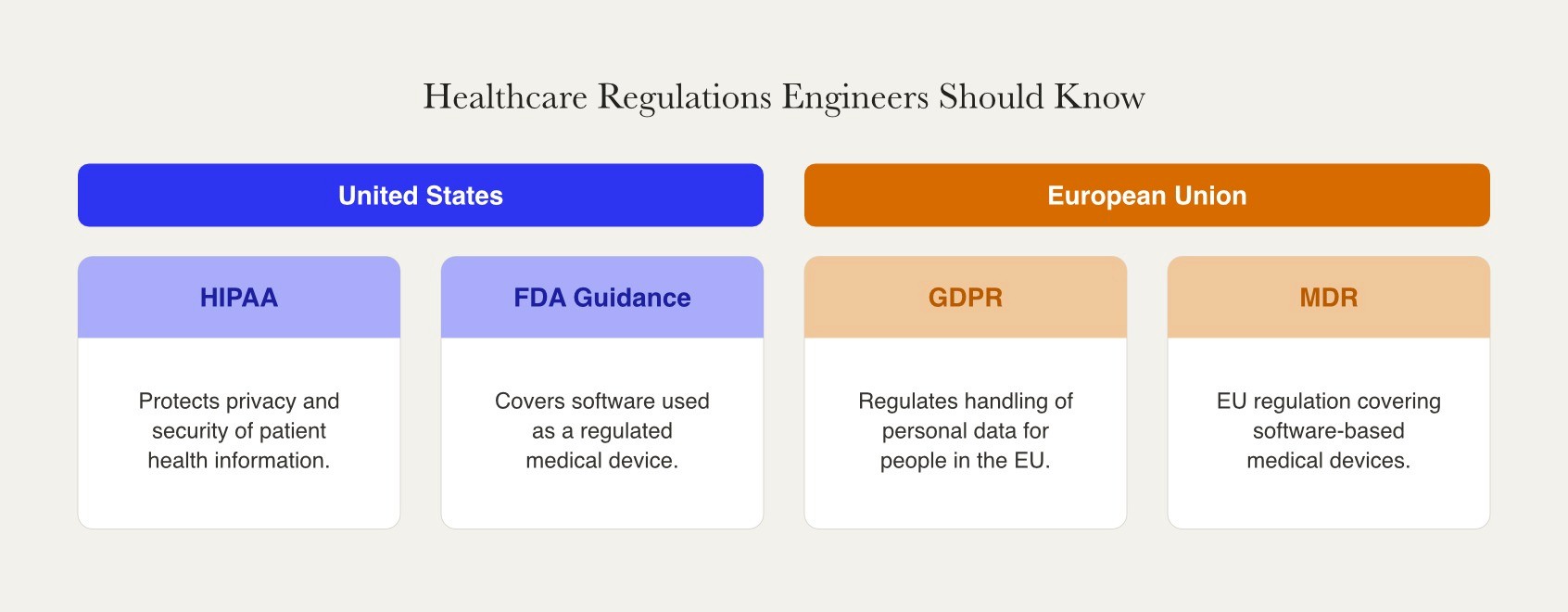
Healthcare technology companies differ from general tech firms in regulatory exposure. Understanding healthcare regulations such as HIPAA, GDPR, FDA software guidance in the U.S., and MDR in the EU is essential. Sales cycles with payers and health systems can span months to years, shaping how technical teams build and iterate. Health tech jobs are projected to grow 13% by 2031, while the computer science and technology field is expected to grow 15%.
Typical company stages break down as follows:
Seed and Series A startups build initial AI products, early data pipelines, and proof-of-concept models with lean teams.
Series B to Series D companies scale data infrastructure, professional services, compliance tooling, and customer success operations.
AI and machine learning roles are now embedded across product, data, and engineering teams rather than isolated research groups. Healthtech employers increasingly value experience with electronic health records, claims data, FHIR APIs, and medical device data alongside strong AI skills. Many companies also use structured hiring pipelines with calibrated interviews and technical assessments.
Core Healthtech Careers for AI Engineers, ML Researchers, and Infra Specialists
Healthtech careers now span machine learning research, applied AI engineering, data infrastructure, and customer-facing technical leadership. Emerging careers in health tech include AI and ML specialists, and health technology roles can span from patient-facing support to backend data analytics. Below are several concrete roles common at healthtech startups and growth companies.
Machine Learning Engineer, Clinical Models. This role ships production models for risk prediction, triage, readmission forecasting, or diagnostic support using EHR and imaging data. Engineers handle class imbalance, label noise from clinical documentation, and missing patient data. They work closely with diagnostic records and patient files, often referencing medical coding systems like ICD-10 and SNOMED. Professionals are needed to analyze clinical data to improve patient outcomes, and health data scientists are in high demand for analyzing complex medical data. Advanced analytics is a key skill for health data scientists working in these positions.
LLM Engineer for Clinical Workflows. This 2024 to 2026 emerging role focuses on retrieval-augmented generation over clinical guidelines, drafting patient messages, and summarizing long health records with strong guardrails. It requires deep familiarity with natural language processing, prompt engineering, hallucination mitigation, and safety evaluation on de-identified clinical corpora. The intersection of artificial intelligence, healthtech, machine learning, and natural language processing defines this role, which supports healthcare professionals and medical professionals making informed decisions from complex treatment plans and patient care documentation.
Data Platform or Infra Engineer for Healthcare Data. This role builds secure pipelines, data lakes, and large-scale backend services that handle PHI, FHIR resources, streaming vitals, and audit logging for regulators. Security verification is critical, as is protection against malicious bots targeting patient portals. Teams maintain policies for encryption, network segmentation, and data lifecycle management. Some stacks include Rails and Sidekiq for background job processing alongside standard cloud infrastructure.
Senior Client Partner, AI Solutions. This customer-facing role bridges engineering and sales, helping health systems and other healthcare organizations deploy AI solutions. It combines technical knowledge with stakeholder management, cross-functional coordination, and the ability to translate machine learning capabilities into measurable business outcomes.
Healthtech Product Engineer and Software Engineer. These roles build the core application layer, including patient portals, clinician dashboards, and claim adjudication tools. Technical proficiency in software development is necessary for med tech software engineers, with data entry workflows and software analytics integrated throughout.
Comparing Senior Healthtech AI Roles Across Functions
The table below contrasts responsibilities, core skills, and interview focus areas for four key roles.
Role | Primary Scope | Key Technical Skills | Typical Interview Emphasis |
ML Engineer, Clinical Models | Risk scoring, diagnostic support, readmission prediction using EHR and imaging data | Time-series modeling, survival analysis, big data analytics, Python, PyTorch, handling noisy labels | AUROC/calibration evaluation, system design for clinical deployment, edge case analysis |
LLM Engineer, Clinical Workflows | Chart summarization, guideline retrieval, patient communication drafts | Prompt engineering, RAG pipelines, embeddings, safety filters, LangChain, big data healthtech integration | Hallucination mitigation, offline evaluation on clinical corpora, guardrail design |
Infra / Data Platform Engineer | Secure pipelines, PHI handling, real-time streaming, audit logging | Cloud (AWS/GCP/Azure), Kubernetes, Kafka, FHIR/HL7 ingestion, security service configuration, RBAC | HIPAA-aligned pipeline design, encryption at rest, data lineage, compliance frameworks (SOC 2, HITRUST) |
Senior Client Partner | Deployment scoping, pilot leadership, outcome measurement, brand partnerships | Healthcare operations, medical billing, deal cycles, stakeholder management, GRC (governance, risk, and compliance) efforts | Case study on pilot rollout, business impact modeling, cross-functional negotiation, product roadmap influence |
Navigating the Healthtech Job Market: Channels, Signals, and Career Strategy
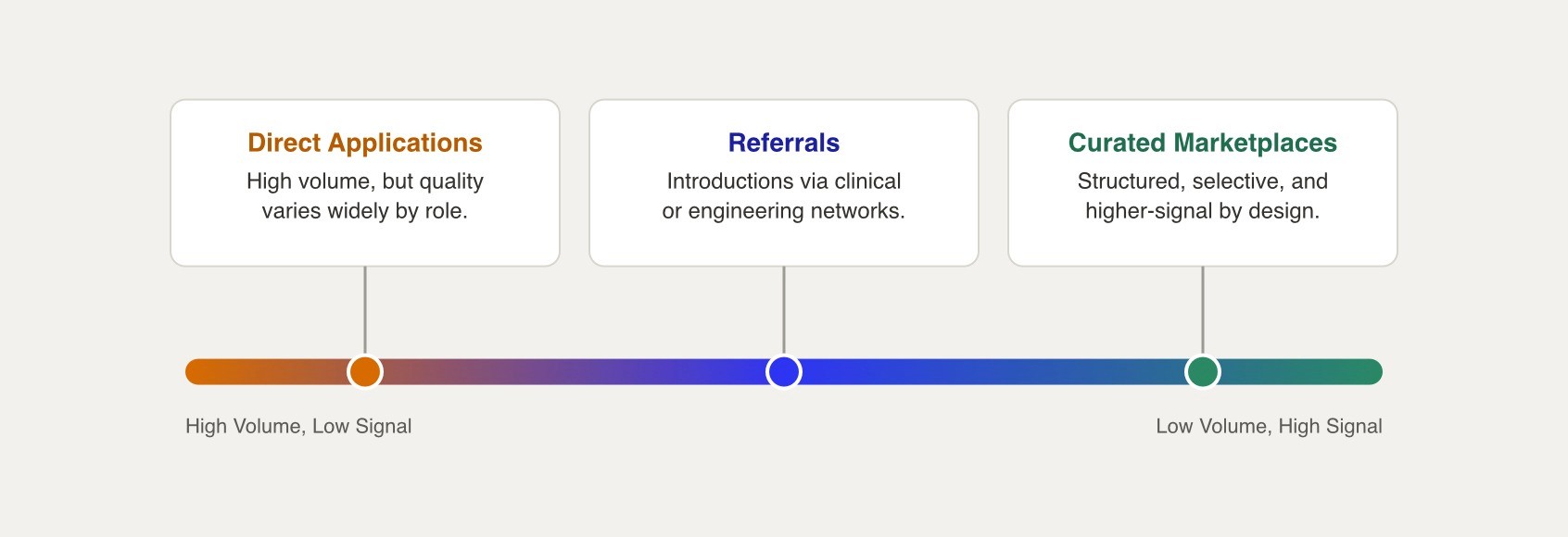
Senior AI professionals in 2026 face both a large volume of inbound messages and significant variance in quality when it comes to healthtech jobs. The three main channels are direct applications to healthtech companies, referrals through clinical or engineering networks, and structured channels like curated marketplaces or selective recruiting firms. Job prospects in healthtech remain strong given the projected market size approaching $657 billion.
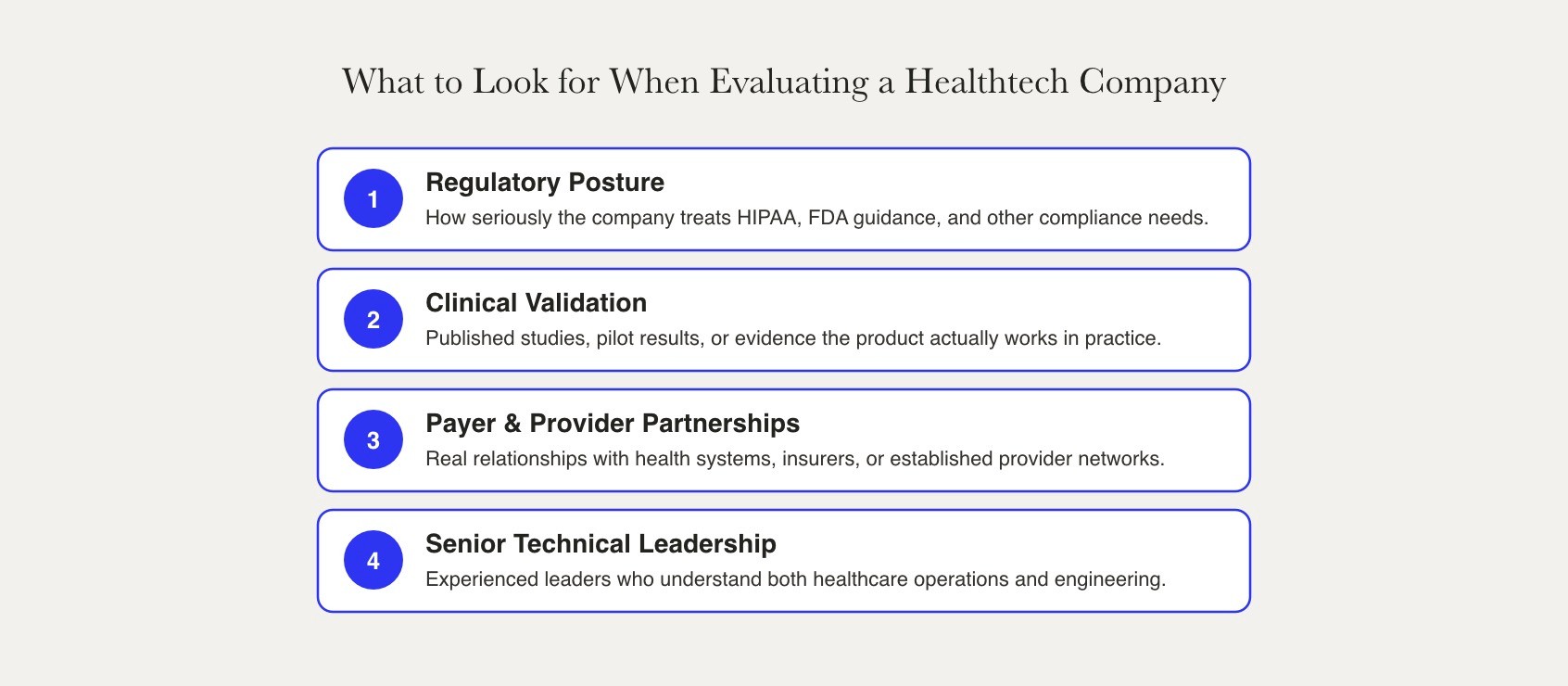
When evaluating a company, look for regulatory posture, evidence of clinical validation, payer or provider partnerships, and the presence of senior technical leadership with healthcare experience. Understanding the business model (SaaS for providers, risk-bearing value-based care, payer analytics, or information technology consulting) shapes technical roadmaps and the kind of data science or infrastructure work required. High-quality startups provide clarity on level, scope, compensation ranges, and interview structure by the second conversation.
Position yourself for leadership tracks (head of ML, director of data platform, principal LLM engineer) by seeking roles that include hiring responsibilities, cross-functional initiatives, governance over AI safety, and the ability to run internal audits and manage a risk register. International opportunities also exist: remote roles working with U.S. healthcare data from Europe, Canada, or Latin America are increasingly common, though compliance requirements around data residency and legal structures may apply.
How AI Is Changing Healthtech Hiring and Healthcare Technology Jobs
Healthtech companies increasingly use AI to source, screen, and match candidates based on technical skills and experience with healthcare technologies such as FHIR, electronic health records, and clinical data systems. AI also supports coding assessments, resume ranking, project matching, and interview summaries, helping recruiters identify qualified candidates more efficiently.
Curated marketplaces like Fonzi use AI to connect experienced engineers with relevant healthtech opportunities while reducing application noise. Despite these advances, AI works best as a decision-support tool. Most companies keep final hiring decisions with recruiters and hiring managers, who evaluate technical depth, communication skills, and the ability to work in highly regulated healthcare environments.
Find High-Signal Healthtech Opportunities with Fonzi
Healthtech startups often receive hundreds of applications for AI, machine learning, and software engineering roles, making it difficult for experienced candidates to stand out. Fonzi offers a more focused approach by matching pre-vetted AI engineers, ML researchers, infrastructure engineers, and software developers with healthtech companies hiring for specialized technical talent. Instead of applying to dozens of companies, candidates create one profile and are introduced to roles that align with their experience, technical expertise, compensation expectations, and career goals.
Fonzi's recurring Match Day allows selected engineers to be reviewed by multiple healthtech startups and growing AI companies at the same time. This can lead to several interview requests within a single hiring cycle while providing direct access to founders, CTOs, and hiring managers building products in areas such as clinical AI, healthcare data infrastructure, telehealth, and medical automation. For engineers looking to move into healthtech, Match Day offers a faster, higher-signal alternative to traditional job boards and crowded application pipelines.
Summary
Healthtech offers strong opportunities for AI engineers, ML researchers, infrastructure engineers, and software developers building products across telehealth, clinical AI, healthcare data, and medical automation. Success in the field requires strong technical skills combined with an understanding of healthcare data, privacy, and regulatory requirements. Companies increasingly use AI-assisted hiring and structured interview processes, making both technical expertise and domain knowledge important differentiators.
Whether you're targeting an early-stage startup or a scaling healthtech company, focusing on high-impact AI and data skills, gaining familiarity with healthcare workflows, and leveraging curated hiring platforms can help you find specialized roles more efficiently. As demand for healthcare technology continues to grow, engineers who can build secure, reliable, and clinically relevant systems will remain among the most sought-after candidates.
FAQ
How much healthcare domain knowledge do I need before applying to healthtech AI roles?
Which tech stacks are most common for healthtech machine learning jobs in 2026?
How do compensation levels in healthtech compare to big tech for senior AI roles?
Can I move from a generic AI role into a healthtech role without prior regulated industry experience?
What signals show that a healthtech company takes AI safety and ethics seriously?