Remote and Startup Fintech Jobs Worth Knowing About
By
Samara Garcia
•

Fintech continues to be one of the fastest-growing sectors for software engineers, driven by advances in AI, digital payments, cloud infrastructure, and cybersecurity. Companies are hiring engineers to build secure, scalable financial products that power everything from digital banking to fraud detection. This guide explores the fintech job market, the most in-demand roles, the skills employers look for, and how to prepare for a career in the industry.
Key Takeaways
Remote and startup fintech jobs are concentrated in hubs like New York and San Francisco, but fully distributed teams now hire globally for AI and data roles.
AI engineers, infra specialists, and data scientists are central to how top fintech companies build products, manage risk, and personalize financial services.
Hiring processes increasingly use AI for sourcing and screening, so candidates need portfolios, public work, and clear signaling to stand out in automated funnels.
Structured hiring models, including curated marketplaces and match-based platforms, help senior candidates bypass noisy inbound pipelines and reach serious teams faster.
The Current Landscape of Fintech Jobs for AI and ML Talent
Demand for AI and machine learning skills across financial services has grown steadily between 2020 and 2026, driven by fraud prevention, credit scoring, and personalization. According to the AI Index Report 2026, AI-related skills now appear in roughly 13.2% of information sector job postings, up from 7.8% in earlier years. Machine learning professionals are in high demand due to the rise of AI-native fintech platforms. Demand for specialized roles in fintech also includes data analysis, compliance, and cybersecurity, where cybersecurity specialists protect financial platforms against data breaches and cyber threats.
Top fintech companies in payments, lending, wealth management, and core banking infrastructure now treat data science and ML as first-class product functions. Common job titles include Senior Machine Learning Engineer, Staff Data Scientist, LLM Engineer, MLOps Engineer, and Applied Research Scientist in Risk. At a growth-stage startup, a staff data scientist may own product metrics end to end, from data ingestion to model deployment and performance monitoring. At a large bank, a similar title often maps to narrower scope, such as model validation or a single credit risk domain.
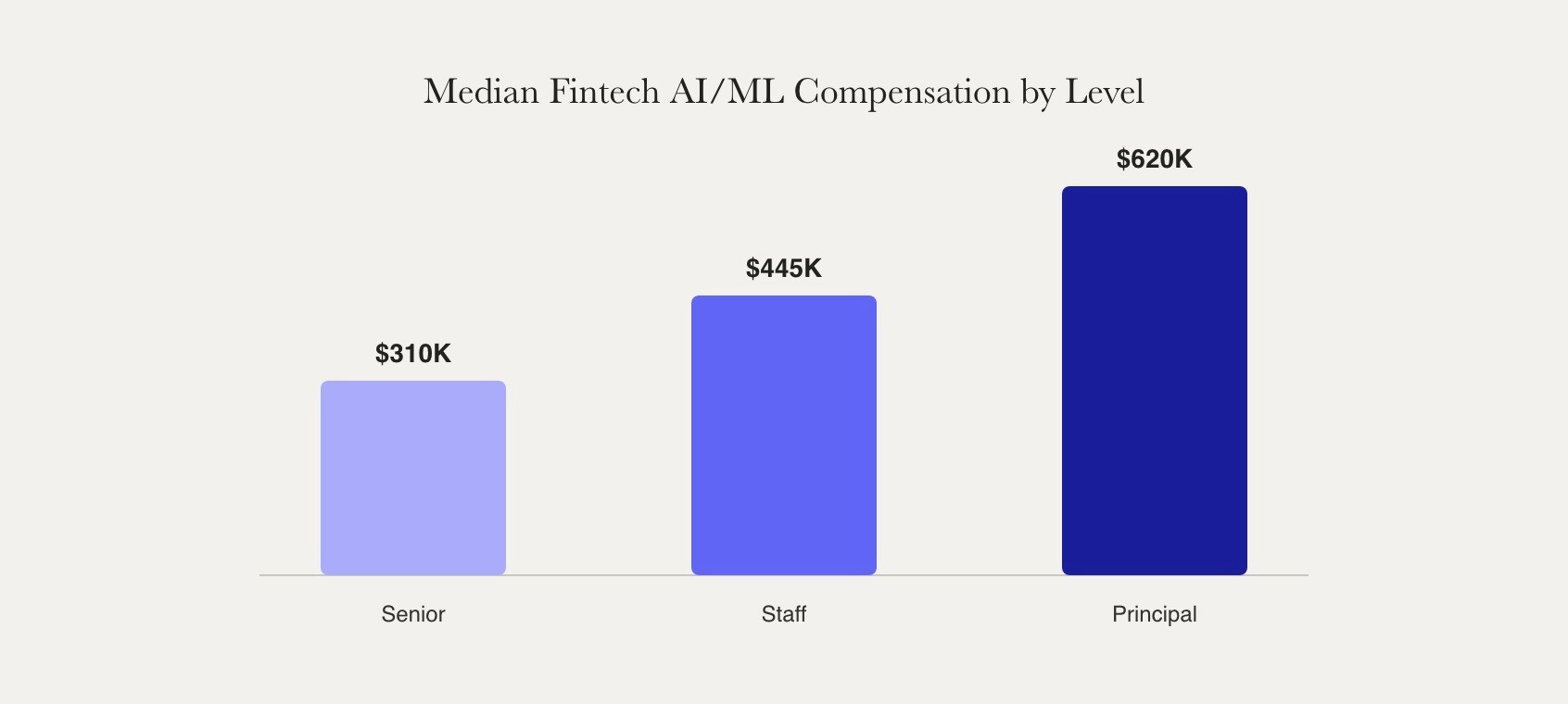
Compensation for senior engineers and data scientists in U.S. fintech reflects this demand. According to the FutureProofing AI Talent Index Q2 2026, median total compensation for a senior AI/ML engineer is approximately $310,000, rising to $445,000 at staff level and $620,000 for principal or applied research roles. Remote fintech salaries vary widely based on seniority, specialization, and company stage.
Key Fintech Job Clusters Relevant to AI Practitioners
The following table summarizes the main clusters of fintech jobs that heavily use artificial intelligence and machine learning, along with the most common senior technical roles and regional patterns.
Fintech Cluster | Example Work | Common Senior Roles | Regional Notes |
Consumer payments and neobanks | Fraud detection, dynamic pricing, payment processing | Fraud Data Scientist, ML Engineer (Risk) | New York, San Francisco, remote |
SMB lending and credit | Underwriting models, alternative data, collections | Senior Data Scientist (Credit), MLOps Engineer | Charlotte, Chicago, remote |
Trading and wealth management | Algorithmic execution, portfolio optimization, investing insights | Quant Developer, Research Scientist, LLM Engineer | Dense in New York |
Core banking and infrastructure APIs | KYC/AML workflows, ledger systems, security, identity | Platform Engineer, AI Risk Leader | Hubs plus remote for engineering |
Insurtech and RegTech | Risk quantification, automated claims, insurance pricing, compliance | ML Engineer (NLP), Model Risk Analyst | US and EU, hybrid and remote rising |
Analysts in fintech build credit-scoring algorithms to optimize user journeys and prevent fraud. Many startups now blend B2B SaaS with regulated financial services, which changes requirements for reliability, latency, and auditability that AI and infra engineers must meet. Employers favor hybrid professionals with skills in both engineering and compliance, reflecting the regulatory complexity of this industry.
Remote and Startup Fintech Roles Worth Close Attention
For this article, startup fintech refers to companies with smaller teams where employees often own broader responsibilities and work closely with technical leadership. Compared with larger organizations, these roles typically offer greater ownership and faster career growth.
High-Impact AI and Data Roles
The strongest demand is for data scientists, LLM engineers, MLOps engineers, and AI product engineers. These professionals build fraud detection systems, AI-powered financial tools, production ML infrastructure, and scalable data platforms that support core fintech products.
Revenue-Oriented Technical Roles
Fintech startups also hire technical product managers, implementation consultants, and business development professionals who combine technical expertise with customer-facing responsibilities. These roles help bridge engineering, product, and commercial teams while driving product adoption and growth.
Geographic Patterns for Remote-Friendly Fintech Jobs
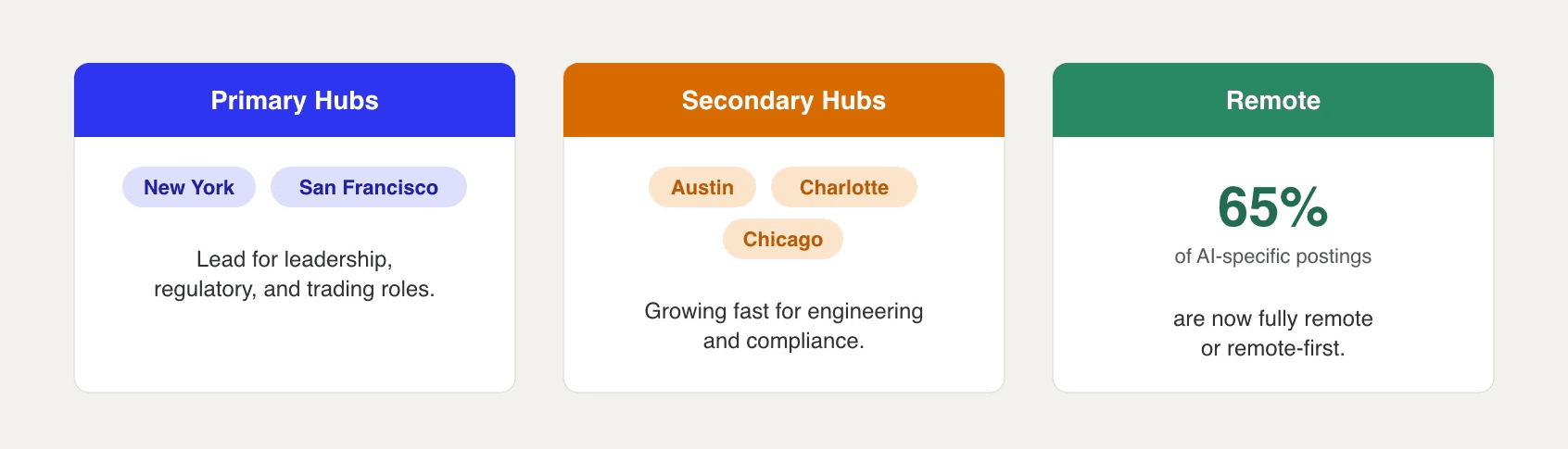
Fintech hiring remains concentrated in New York and San Francisco for leadership, regulatory, and trading functions. Secondary hubs are growing rapidly. Austin has numerous fintech job openings, and fintech roles in Austin include compliance and sales positions alongside engineering. Remote fintech jobs are available across various locations in the U.S., with approximately 65% of AI-specific job postings now listed as fully remote or remote-first.
How AI Is Reshaping Fintech Hiring and Candidate Evaluation
Recruiting teams at fintech companies have adopted artificial intelligence tools for sourcing, resume screening, candidate matching, and outreach. When used responsibly, AI can help reduce bias in recruitment by focusing on relevant skills and experience rather than subjective factors, while uncovering qualified candidates who might otherwise be overlooked. The most effective fintech companies keep final hiring decisions with experienced recruiters and hiring managers, using AI to augment human judgment rather than replace it.
Common AI-Driven Tools and Workflows in Fintech Recruiting
Applicant tracking systems now integrate language models to summarize resumes, extract key skills, and auto-generate outreach messages for passive candidates. Some fintech firms use coding assessment platforms with AI-based analysis of solution quality and problem-solving approaches. Many fintech companies use AI chatbots to answer common candidate questions before recruiter conversations. Larger financial services groups may experiment with automated video interview scoring, though these systems require human oversight to manage bias.
How Candidates Can Adapt to AI Filtered Pipelines

Structure your resume with clear section headings, explicit job titles, and unambiguous skill lists. Mention core skills and tools relevant to fintech jobs: Python, SQL, Kubernetes, Spark, Ray, Flink, feature stores, vector databases, RAG pipelines, and real-time model monitoring. Use concrete performance metrics in experience descriptions, such as reductions in fraud loss, improvements in approval rates, or latency reductions in payment processing systems. Keep your LinkedIn profile up to date with standardized titles and company names, since many sourcing systems crawl public data to rank candidates. Senior candidates should also rely on warm introductions, curated marketplaces, and direct outreach to hiring managers, not just open applications.
Preparing for Remote Fintech Interviews as a Senior Technical Candidate
Interview processes in fintech are increasingly standardized, but still vary between trading-focused firms, consumer apps, and B2B infrastructure providers. Remote interviewing is the default, so expect multi-stage video calls, online collaboration tools, and asynchronous take-home exercises. Senior and staff-level candidates are evaluated on both depth of expertise and ability to influence cross-functional stakeholders such as product managers, compliance, and business development.
The following table maps common AI-intensive fintech roles to their primary responsibilities and interview focus areas.
Role Title | Typical Responsibilities | Interview Focus | Example Metrics |
Senior Data Scientist (Fraud) | Build fraud classifiers, feature engineering, model monitoring | Case study on fraud detection, fairness, explainability | Fraud loss reduced by X%, false positive rate |
Credit scoring models, alternative data integration, backtesting | System design for scoring pipeline, data quality | Approval rate improvement, default rate reduction | |
LLM Engineer (Support Automation) | Chat-based customer experience, compliance document processing | RAG architecture design, latency, privacy constraints | Resolution rate, customer satisfaction score |
Feature stores, deployment pipelines, drift detection, security | Infra design, reliability, cost optimization | Model deployment frequency, inference latency | |
Partner Implementation Consultant | API integrations, data mapping, client onboarding | Technical communication, integration troubleshooting | Client go-live time, integration success rate |
Use this table to target your preparation toward the specific role cluster you are pursuing, and to anticipate the types of questions and scenarios interviewers will prioritize.
Find Higher-Signal Fintech Opportunities with Fonzi
Breaking into top fintech startups through traditional job boards can be slow and competitive, especially for experienced engineers applying to AI, infrastructure, and machine learning roles. Fonzi offers a more targeted approach by connecting pre-vetted software engineers with startups actively hiring for specialized technical talent. Instead of submitting dozens of applications, candidates build one profile and are matched with companies based on their experience, technical skills, compensation expectations, and preferred type of work.
One of Fonzi's standout features is Match Day, a recurring hiring event where a curated group of engineers is introduced to multiple fintech startups and AI companies simultaneously. Rather than waiting weeks for individual applications to be reviewed, candidates can receive multiple interview requests during a single hiring cycle and engage directly with founders, CTOs, and hiring managers. For engineers pursuing remote fintech jobs or early-stage startup opportunities, Match Day offers a faster, higher-signal path to companies building the next generation of financial technology.
Summary
Fintech continues to be a strong destination for AI, ML, infrastructure, and software engineers, with remote and startup opportunities growing alongside demand for secure, data-driven financial products. While hiring remains concentrated in hubs like New York and San Francisco, many fintech companies now recruit globally for specialized technical roles and offer broader ownership, competitive compensation, and faster career growth.
As AI transforms both fintech products and recruiting, candidates need more than technical skills to stand out. Strong portfolios, measurable project impact, and clear resumes help navigate AI-assisted hiring, while structured hiring platforms like Fonzi connect experienced engineers with high-quality startup opportunities through curated matching and recurring Match Day events, reducing competition and speeding up the hiring process.
FAQ
How much prior finance domain experience is necessary for senior AI roles in fintech?
How can I assess whether a fintech startup has a serious AI roadmap and not just marketing language?
What is the best way to catch up on regulatory topics relevant to fintech AI systems?
How different are interview processes between fintech startups and traditional banks?
Can I build a long-term research-oriented career inside fintech, or is it all applied work?