How to Prepare for a Whiteboard Coding Interview
By
Samara Garcia
•

Whiteboard interviews remain a common part of the hiring process for software engineers, AI specialists, machine learning practitioners, and infrastructure engineers. While the format has evolved, the goal is the same: to evaluate how candidates approach complex problems, communicate their thinking, and make sound technical decisions under pressure.
Today's whiteboard interviews go far beyond basic coding exercises. Depending on the role, they may include algorithms, system design, ML workflows, or architecture discussions that test both technical knowledge and problem-solving skills. This guide explains what to expect, how to prepare, and the strategies that help candidates perform at their best.
Key Takeaways
In 2026, whiteboard coding interviews are defined as live, observed sessions (physical or virtual) where potential candidates solve algorithmic or design challenges in real time. According to a Karat survey, 79% of U.S. companies still use live technical interviews as their primary method.
The primary evaluation axis is structured problem-solving ability and communication under constraints, not syntax recall or memorized patterns.
Modern whiteboard formats are increasingly hybrid, spanning physical boards, digital canvases like Miro or FigJam, and shared coding pads, and they often integrate system design and ML-focused coding questions.
A strong preparation strategy blends targeted algorithm practice, systems thinking, domain depth in ML and LLMs, and deliberate rehearsal of your thought process out loud.
Understanding Modern Whiteboard Interviews in Technical Hiring
A whiteboard interview is a live session where a candidate solves a technical or design problem in real time, observed by one or more interviewers. Using a physical whiteboard or digital tool is common in whiteboard interviews, and variations now include virtual canvases (Miro, Excalidraw, FigJam) and shared coding pads where autocompletion is typically disabled. Alternatives to whiteboard interviews include online collaboration tools, but the core format persists.
Companies conduct whiteboard interviews across multiple job interview stages. For AI engineers and LLM specialists, an early round might focus on algorithmic screening, while later stages involve system design or ML pipeline architecture. Common question categories include:
Data structures and algorithms (graphs, trees, dynamic programming, hash maps)
Distributed systems and infra (sharding, caching, consensus tradeoffs, GPU cluster management)
ML model design and evaluation (feature preprocessing, A/B testing, offline vs. online evaluation)
LLM-centric scenarios such as retrieval-augmented generation workflows or ranking system design
Despite criticism, many large employers including Google, Meta, Microsoft, and leading AI labs still rely on some variant of whiteboard interviews to normalize evaluation across teams. Remote interviews have shifted whiteboarding toward tools like Miro, Excalidraw, FigJam, and in-browser coding environments, but the evaluation criteria of problem-solving, clarity, and tradeoff reasoning remain similar regardless of the medium.
What Whiteboard Coding Interviews Actually Measure
Whiteboard interviews are not quizzes with a single correct answer. They are structured observation of how you think. Interviewers look for clear communication and structured thinking in candidates, not perfect syntax or memorized solutions. Candidates explain their thought processes during whiteboard interviews, and that narration is a large part of what is scored.
Key dimensions interviewers typically evaluate include:
Problem-solving skills: Can you parse a problem statement, extract constraints, and decompose it into subproblems?
Communication skills: Do you articulate your reasoning clearly and check in with the interviewer?
Tradeoff modeling: Can you reason about speed vs. memory, latency vs. throughput, or cost vs. scaling?
Collaboration style: Do you ask clarifying questions and absorb feedback?
Resilience: Stress management is assessed as candidates solve problems under observation.
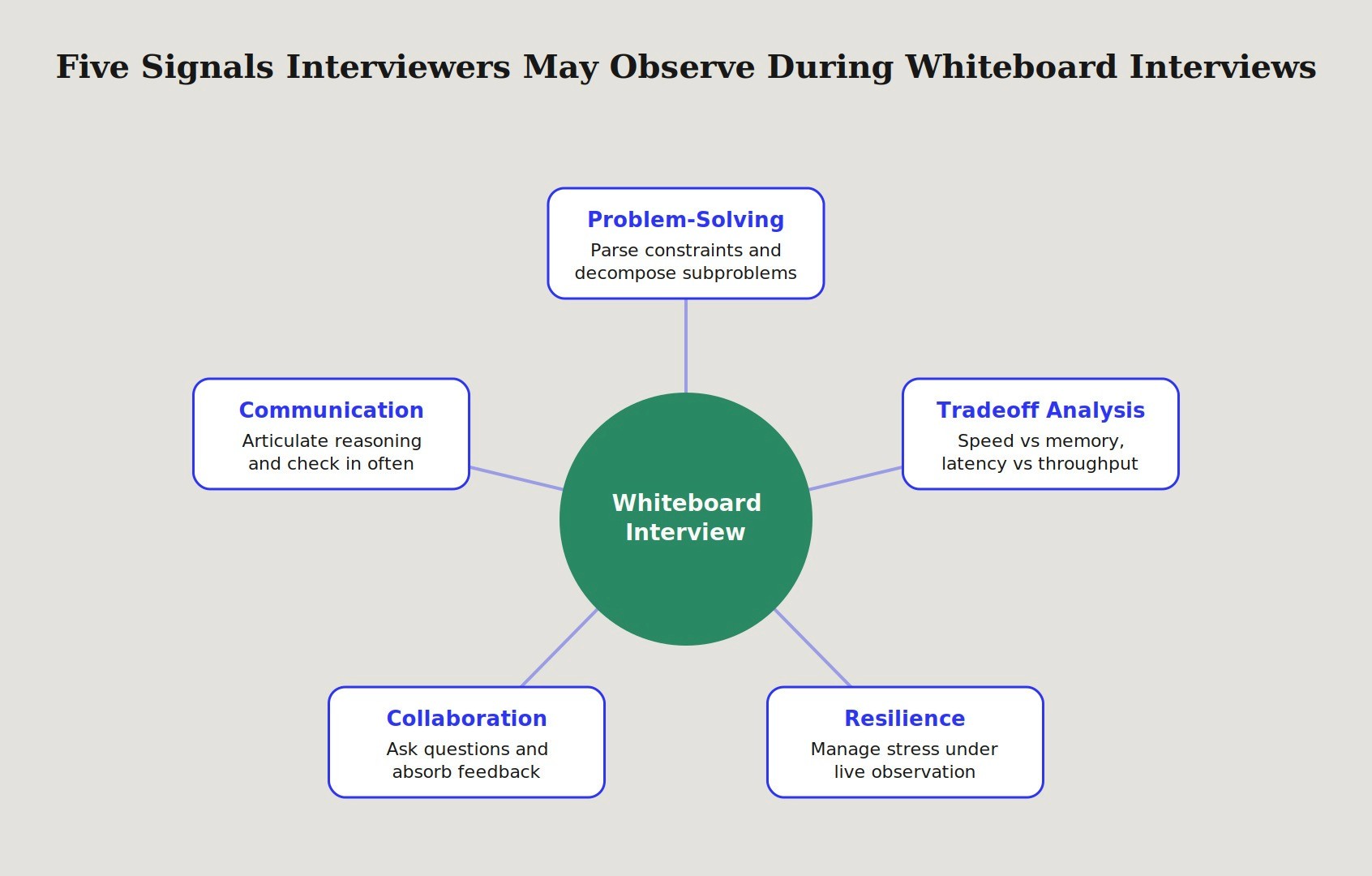
Whiteboard interviews evaluate how candidates solve problems in real time, emphasizing reasoning, communication, and iteration over writing large amounts of code. For AI and ML roles, interviewers often focus on how you think about data, compute constraints, and trade-offs rather than the final solution alone.
However, whiteboard interviews have limitations. They can favor confident communicators, create artificial pressure, and overlook skills like debugging, collaboration, and long-term design work. A single whiteboard interview should be viewed as just one signal, not a complete measure of engineering ability.
Core Technical Skills to Refresh Before a Whiteboard Coding Interview
Senior candidates usually know the fundamentals, but a whiteboard challenge demands fast, explicit recall under a time constraint. You will be writing code or pseudocode without syntax highlighting, so practicing without an IDE helps candidates prepare for whiteboard interviews effectively. You must be ready to discuss time and space complexity during the conversation with your interviewer.
Algorithm and data structure areas to review with senior depth:
Arrays and strings: sliding windows, two pointers, substring problems
Hash maps and sets: collision tradeoffs, counting, caching use cases
Trees and graphs: traversal, shortest paths, topological sort, cycle detection
Heaps and priority queues: scheduling, streaming, merging
Dynamic programming patterns: memoization vs. bottom-up, typical interview variants
Systems and infra topics relevant to AI and ML roles include request routing, caching strategies, sharding, consensus tradeoffs (CAP theorem), and designing data pipelines for model training and inference at scale. These questions assess your ability to describe architecture decisions and identify bottlenecks.
ML-specific topics that appear in whiteboard or virtual whiteboard interviews include feature preprocessing flows, offline and online evaluation schemes, A/B testing for models, and high-level architectures for retrieval-augmented generation or ranking systems. Candidates should also be prepared to talk about monitoring for data drift, selecting appropriate model evaluation metrics, and designing feedback loops for production systems.
Focus on being able to derive approaches from first principles. Understanding why a particular data structure or metric is chosen matters more than memorizing dozens of rare algorithms. Depth of reasoning beats breadth of pattern matching.
Building a High-ROI Practice Plan for Whiteboard Interviews
Senior engineers should treat interview prep as a bounded, strategic program, not an endless grind through problem sites. Preparing for whiteboard interviews can be time-intensive for companies and candidates alike, so a focused 2 to 4 week plan maximizes return on your investment.
A sample weekly structure might alternate between:
Solo problem drills (30 to 45 minutes): work through algorithmic and coding questions with a timer
Mock interviews: stage mock interviews with friends or peers who can give honest feedback
System design or ML design sessions: practice longer prompts such as designing a large-scale vector search service, an experiment platform for ranking models, or a monitoring system for GPU clusters

Practice with a real whiteboard before interviews, or use a digital canvas in full-screen mode. Narrate every step aloud to simulate the stress and ergonomics of the real interview. Record your practice sessions to identify strengths and weaknesses in your communication and problem-solving. Research the company to anticipate interview questions, since engineering blogs, conference architecture talks, and open-source system designs often provide problems that more closely resemble production engineering challenges than traditional interview books.
Preparing for Remote Whiteboard and Hybrid Interview Formats
Since 2020, many companies have permanently adopted remote interviews, so candidates should treat virtual whiteboard fluency as a core skill. The tools and setups vary, but common configurations include shared coding environments like CoderPad (which simulates real development work for candidate evaluation), virtual whiteboards like Miro or FigJam, and screen sharing via Zoom, Google Meet, or Teams.
Test your full setup at least a day before the interview. Check webcam placement, audio quality, and tablet or stylus usage if applicable. Practice switching between code and diagrams smoothly. If you are using a trackpad or mouse, practice drawing clean diagrams ahead of time.
Communication adaptations for remote formats are essential. Over-communicate which part of the board you are referring to, check regularly that the interviewer can see the content, and pause to solicit feedback. Describe your diagrams verbally, for example by saying "in the upper-left diagram, the request flows from the API gateway to the cache layer." Some curated marketplaces and structured hiring platforms provide consistent information about which tools a given company uses, reducing surprises in remote interviews and helping you access the right resources ahead of time.
Using AI Tools and Structured Hiring Platforms Without Undermining Your Preparation
Many candidates now use AI coding assistants and LLMs such as GitHub Copilot or ChatGPT for daily work. This is a normal part of modern software engineering, but whiteboard interviews typically restrict external tools and prioritize your own reasoning and explanation. Some developers avoid whiteboard interviews because the format feels detached from job skills that involve heavy tool usage, but the format persists because it provides a controlled signal on individual reasoning.
Productive ways to use AI during prep include generating variant questions, having an AI critique your solution outlines, or simulating an interviewer asking "why this approach" and "what about this edge case" at each step. This helps you identify pain points in your explanations and sharpen your ability to talk through tradeoffs.
On the hiring side, AI is increasingly used to screen resumes and identify strong candidate matches. At the same time, 71% of engineering leaders believe AI is making technical skills harder to assess. Platforms like Fonzi help reduce low-signal interviews by better matching candidates and companies, but AI should support, not replace, thoughtful technical interviewing.
Whiteboard Coding vs Take-Home and Live-Coding Tasks
Whiteboard interviews are one tool in a larger assessment toolkit, and senior candidates often face a mix of formats across the interview process. Understanding the strengths and limitations of each helps you prioritize preparation time and evaluate which processes to engage with.
Format | Strengths | Limitations | Best For |
Whiteboard Interview | Evaluates real-time problem-solving, communication, and system thinking; allows interviewers to assess how a person reasons under pressure | May not reflect real working conditions accurately; elevated stress; can miss talented candidates unwilling to participate | Early-stage algorithmic screening; system design rounds; roles requiring rapid reasoning |
Take-Home / Home Assignment | Take-home projects allow candidates to work in real environments; better for assessing depth, craftsmanship, and UX design sensibility | High time cost; risk of unpaid labor; difficulty verifying who did the work; less visibility into thought process | Mid-stage rounds; roles emphasizing implementation quality and projects portfolio |
Live Coding (Collaborative Editor) | Observes actual coding habits; closer to real development work; good for seeing debugging and incremental building | Noisy; tooling-dependent; may not capture system design or architecture skills | Mid to late rounds; roles requiring strong day-to-day coding fluency |
In most cases, the best hiring processes combine multiple formats to achieve a balanced signal. Understanding these differences helps you set expectations and decide which interview loops are worth your time.
Find Your Next Engineering Role with Fonzi
Once you feel ready for technical interviews, the next step is finding opportunities where those skills matter. Fonzi's Match Day connects software engineers, AI engineers, ML practitioners, and infrastructure engineers with companies actively hiring for technical roles. Instead of spending hours applying across multiple job boards, you can join a curated hiring event where employers are already looking for qualified candidates.
Whether your interviews focus on whiteboard coding, live coding, or system design, Match Day allows you to connect with companies seeking engineers who can demonstrate strong technical reasoning, communication, and problem-solving skills.
Summary
Whiteboard interviews evaluate how candidates think through technical problems, communicate their reasoning, and make sound design decisions under pressure, whether on a physical whiteboard or a virtual collaboration tool. Success depends less on memorizing solutions and more on demonstrating structured problem-solving, discussing trade-offs, and adapting to interviewer feedback across algorithms, system design, and role-specific topics like AI and machine learning.
The best preparation combines targeted algorithm practice, mock interviews, system design exercises, and rehearsing explanations out loud. While whiteboard interviews remain a common part of technical hiring, they are only one measure of engineering ability, so candidates should focus on building strong fundamentals, communicating clearly, and treating each interview as an opportunity to showcase their overall technical reasoning rather than perfect code.
FAQ
How far in advance should a senior AI or ML engineer start preparing for a whiteboard interview?
How should I handle a whiteboard interview that uses a language I rarely write in day-to-day?
What is the best way to talk about using AI coding assistants during a whiteboard interview?
How can I tell if a company's whiteboard process is calibrated for senior candidates?
What should I do if a whiteboard interview goes poorly despite strong overall experience?


