20+ Distributed Systems Interview Questions You Should Know
By
Samara Garcia
•

Distributed systems power many of the world's largest applications, from cloud platforms and social networks to fintech services and AI infrastructure. As companies build software that must scale across regions, handle massive traffic, and remain reliable in the face of failure, knowledge of distributed systems has become a core skill for senior software engineers.
This guide covers the distributed systems interview questions you're most likely to encounter, the concepts they test, and practical strategies for preparing for system design interviews.
Key Takeaways
Distributed systems interviews focus on core concepts like consistency, replication, fault tolerance, sharding, and consensus algorithms that power scalable applications.
Strong candidates explain architectural trade-offs clearly, balancing consistency, availability, latency, scalability, and reliability in line with the system's requirements.
Practicing real-world system design questions and communicating your reasoning are just as important as understanding the underlying theory.
Core Concepts: Foundational Distributed Systems Interview Questions
Interviews usually begin with basic definitions to confirm you understand what a distributed system is and why distributed architecture exists. A distributed system consists of independent computers working together, connected by a network, coordinating tasks to appear as a single coherent system to end users. Examples include Google Search spanning data centers worldwide, Amazon S3 storing objects across multiple servers, and Apache Kafka clusters processing distributed processes in parallel.
A typical question is: "What are the key characteristics of a distributed system?" Strong answers mention:
Transparency (users do not see location, replication, or failure details)
Fault tolerance (the system keeps working despite component failures)
Concurrency (multiple nodes handle requests simultaneously)
Scalability (horizontal scaling involves adding more machines to a system seamlessly)
Heterogeneity (different hardware, networks, and geographic conditions)
Another common prompt is: "What are the main challenges in distributed systems?" Focus on partial failures (where one node fails while others continue), network latency that can significantly impact distributed system performance (especially as geographical distance increases), clock skew and ordering of events, data consistency issues such as stale reads, and debugging complexity across services. Key topics in distributed systems interviews include system architecture and fault tolerance, so ground your answers in these areas.
As a simple example, consider a messaging app that keeps conversations in sync across phone and web clients. When a user reads a message on one device, the same data must appear on the other. Network partitions or offline clients must be handled without message loss or duplication, illustrating how transparency, consistency, and fault tolerance interact in even a familiar product.
Data Consistency, CAP Theorem, and Distributed Databases
Almost every distributed systems interview touches data consistency, the CAP theorem, and how modern databases handle trade-offs. Understanding the differences between SQL and NoSQL databases is important in distributed environments because different database systems make different consistency and availability trade-offs depending on their architecture and configuration.
A classic question is: "Describe the CAP theorem and its implications for a distributed database." The CAP theorem states three properties: consistency, availability, and partition tolerance. Consistency ensures all nodes see the same data at the same time. Availability guarantees every request receives a response, not necessarily the latest data. Partition tolerance means the system continues to operate despite network failures. A distributed system can only achieve two of the three CAP properties simultaneously. Since network partitions are inevitable, the choice between consistency and availability becomes critical during those events. Systems like Google Spanner aim for strong consistency (CP), while Amazon DynamoDB's underlying design favors eventual consistency and high availability (AP), though the modern service also offers optional strongly consistent reads.
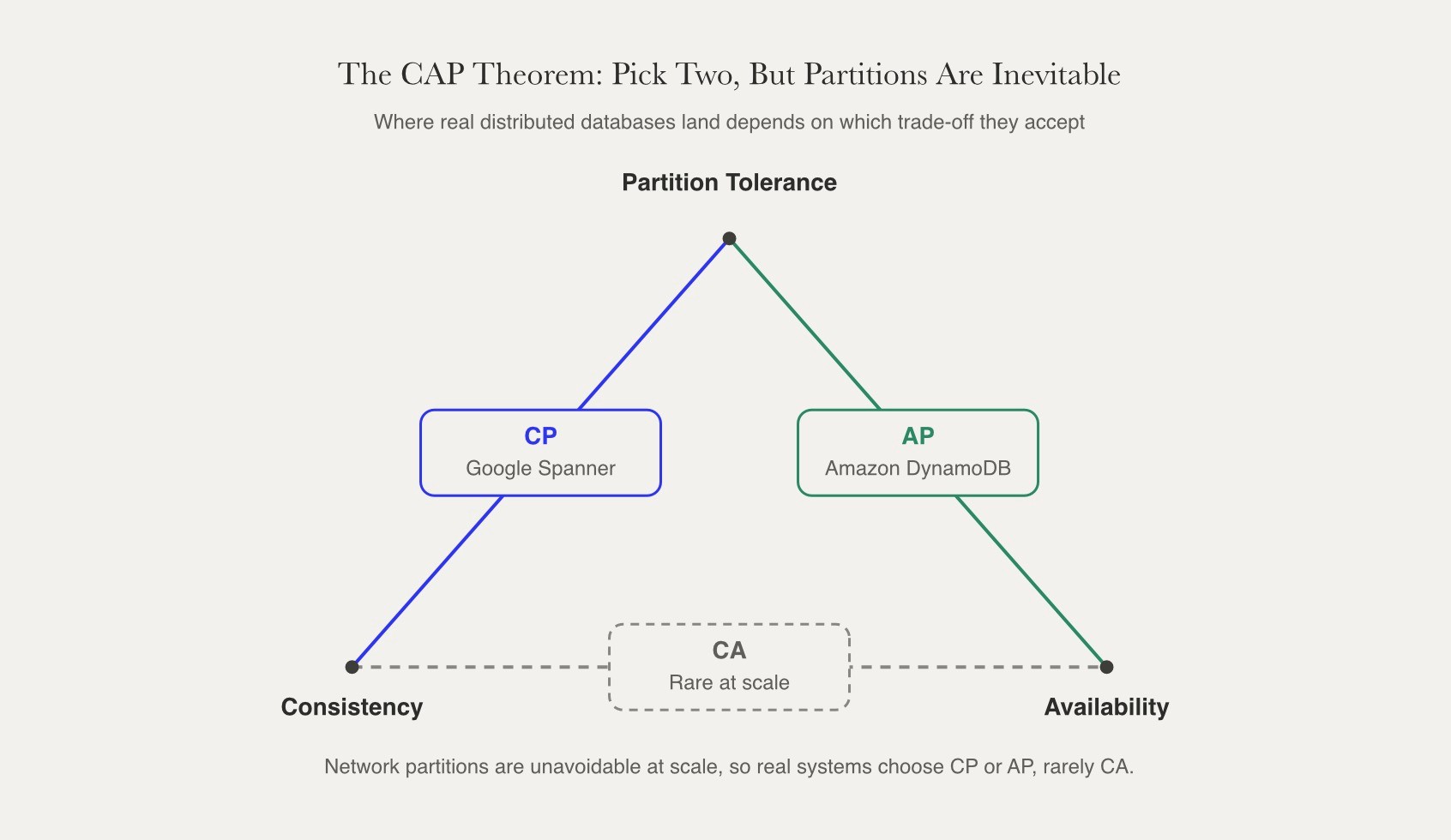
Interviewers often ask: "What is eventual consistency?" Eventual consistency is a key concept in distributed databases. It means replicas converge to the same data over time, but reads may temporarily return stale results. Social media timelines and distributed caches are real-world examples where brief staleness is acceptable. Other consistency models, such as read-your-writes and monotonic reads, offer middle ground. Each consistency model should be matched to product requirements.
Understanding data partitioning is crucial in distributed systems. Sharding partitions data across multiple nodes in a database, and sharding enhances performance by distributing workload across shards. Sharding improves scalability by allowing easy addition of new shards, though sharding can complicate application logic due to data distribution, and rebalancing shards can be resource-intensive and complex.
Interviewers may also ask: "When would you choose a strongly consistent distributed database over an eventually consistent one?" Cloud architectures, financial ledgers, and payment systems require ACID guarantees where consistency ensures correctness, while analytics dashboards or content feeds can tolerate BASE (Basically Available, Soft state, Eventually consistent) behavior. Maintaining data consistency is about matching the consistency model to the use case, not picking one model for everything.
Data Replication, Data Integrity, and Distributed Caches
Efficient data replication and caching strategies are central to high-performance distributed systems, so interviewers often ask targeted questions in this area. Data replication enhances accessibility and reliability in distributed systems, and replication strategies impact consistency, performance, and reliability trade-offs.
When asked "What are different strategies for data replication?", contrast these approaches:
Synchronous replication ensures strong data consistency across nodes but adds write latency because every replica must confirm.
Asynchronous replication allows faster updates with eventual consistency, though data may be lost if the primary fails before replicas catch up.
Semi-synchronous replication waits for at least one replica to confirm writes, balancing durability and speed.
Leader-follower (historically called master-slave) replication is a common pattern where one leader handles writes and follower nodes replicate its changes.
For a question like "How do you ensure data integrity when replicating data across regions?", mention checksums, version numbers, or vector clocks for causal ordering, idempotent updates (idempotency ensures that repeating a network request does not result in duplicate data), anti-entropy protocols, and conflict resolution strategies such as last-write-wins or CRDTs.
When asked to design a distributed cache, discuss cache topology, consistent hashing, eviction policies (LRU, LFU, TTL), and cache invalidation. Mention common technologies like Redis Cluster, Valkey, Memcached, and CDNs, and explain how caches reduce latency and protect databases from traffic spikes. Interviewers also expect you to address cache consistency, including how cached data stays accurate and fresh enough for your application's requirements.
Consensus Algorithms and Coordination Primitives
Senior distributed systems interviews often test consensus algorithms like Paxos and Raft, along with coordination tools such as ZooKeeper and etcd. A common question is, "What is a consensus algorithm and why is it needed?" Consensus allows distributed nodes to agree on a shared state despite failures, supporting leader election, log replication, and consistent metadata.
Raft is generally easier to understand and implement, using leader election and log replication, and powers tools like etcd, Consul, and Kafka's KRaft mode. Paxos is more complex but remains an important foundational algorithm used in systems like Google Chubby.
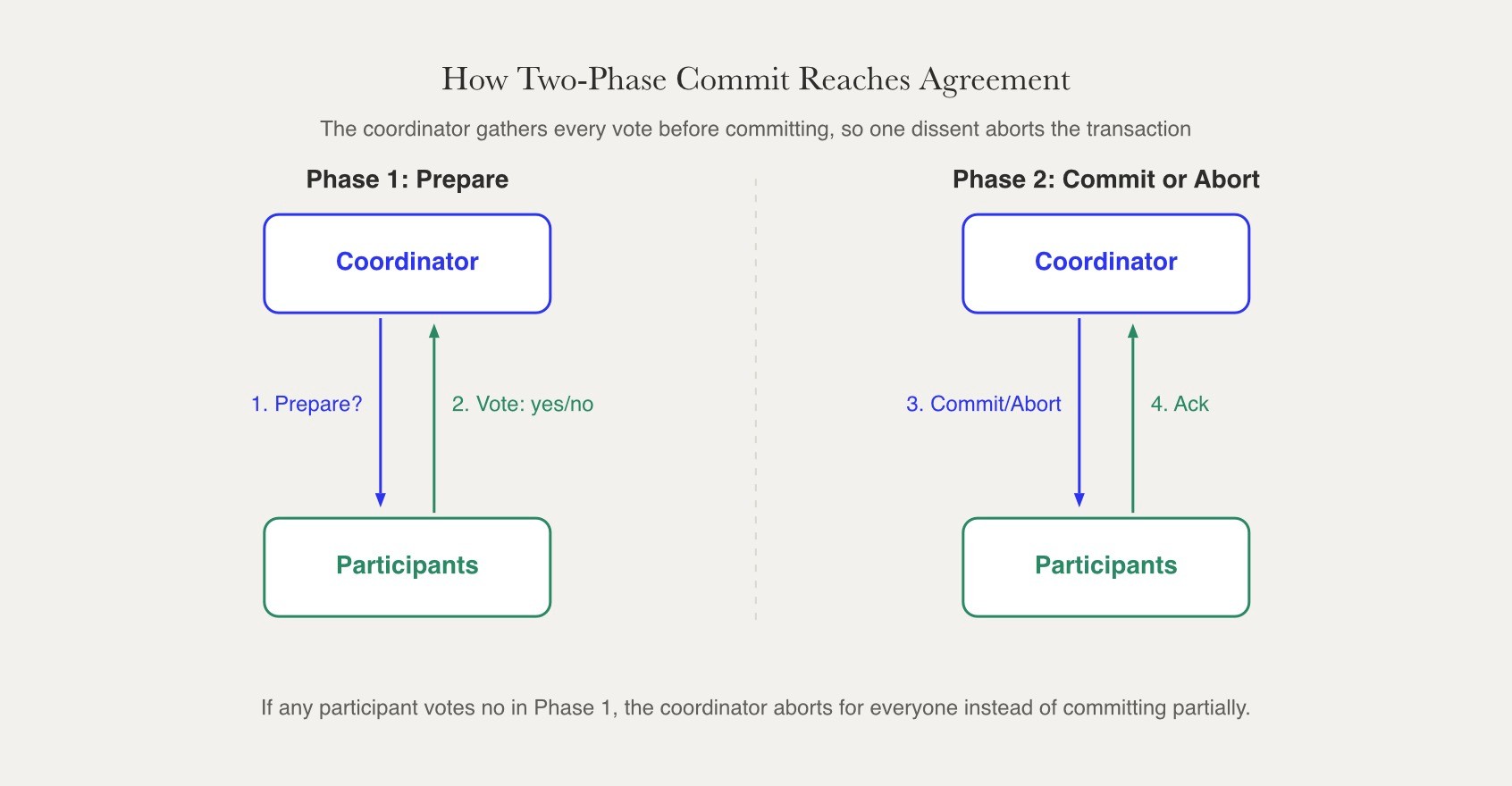
A practical question is: "How would you implement distributed locks?" Candidates should mention ZooKeeper ephemeral nodes (ZooKeeper remains valid for general service coordination and distributed locks), Redis-based locks with SET NX and expirations, and fencing tokens to avoid split-brain or race conditions where two clients believe they hold the same shared resource. The Two-Phase Commit (2PC) is a consensus protocol used in distributed transactions. During the commit phase, the coordinator collects votes, and then a final decision is made to commit or abort across all participants.
Service discovery is essential for enabling services in a distributed system to locate one another. Interviewers may ask about ZooKeeper, etcd, or service registries with health checks that microservices use to find each other. Consensus algorithms also help systems achieve agreement on which node is the current leader, preventing conflicts during failover.
Fault Tolerance, Failure Detection, and Reliability Patterns
Partial failure is the default mode in a distributed system. When one node goes down while others continue operating, the system must detect, respond to, and recover from that failure. Fault tolerance, the ability of a distributed system to keep functioning despite node failures, is a central interview topic that involves detecting failures and managing service continuity.
For the question "How does a distributed system handle failures?", cover:
Redundancy is a common tactic for achieving fault tolerance. Replicate components so no single server becomes a single point of failure.
Replication maintains multiple copies of data for fault tolerance. If one node goes down, other nodes serve requests.
Automatic leader failover, where a new leader is elected if the current master node fails.
Degraded modes, where the system sheds non-critical features to preserve system reliability and stay available.
Checkpointing allows systems to restart from the last saved state after a crash.
Failure detection relies on heartbeats, timeouts, and gossip protocols, balancing fast failure detection with avoiding unnecessary failovers. Reliability patterns such as circuit breakers, retries with exponential backoff, and idempotent operations help systems recover safely from failures without overwhelming dependent services.
Interviewers also expect you to understand built-in fault tolerance, such as HDFS block replication and quorum writes, as well as observability through distributed tracing, structured logging, and metrics dashboards. These tools help detect issues, diagnose failures, and keep distributed systems reliable in production.
System Design Style Questions: Caches, Queues, and Distributed File Systems
Many distributed systems interviews shift into system design, where theory gets applied to an end-to-end design prompt. Designing distributed systems requires a clear understanding of architectural choices and trade-offs. Distributed systems can be evaluated through scenario-based design questions and theoretical deep-dives. Common design scenarios in interviews include creating a URL shortener or a rate limiter, but infrastructure-focused roles go deeper.
"Design a distributed key-value store." Start with the API (get, put, delete), then cover data partitioning via consistent hashing, replication strategy (leader-follower with configurable consistency levels), failure recovery, and monitoring. Explain how clients obtain data through read paths and how writes propagate to replicas. API versioning is important for maintaining compatibility in microservices architecture, so mention versioned endpoints.
"Design a distributed queue like Kafka." Discuss partitions for parallelism, ordered logs, leader-follower replication for partition data, consumer groups, and offset management. Cover delivery guarantees (at-least-once versus exactly-once). For metadata and controller coordination, describe KRaft (Kafka's built-in Raft-based mode), not ZooKeeper, reflecting Kafka 4.0's architecture.
"Design a distributed file system." Include a metadata service (similar to how the Google File System and HDFS use a master node for file-to-chunk mapping), chunk servers that store fixed-size blocks as data nodes, replication of each distributed file across storage systems, client-side caching, and strategies for appends and rebalancing. Interviewers often ask specifically about a distributed file system similar to Google File System (2003) or HDFS in Apache Hadoop, so cite those by name.
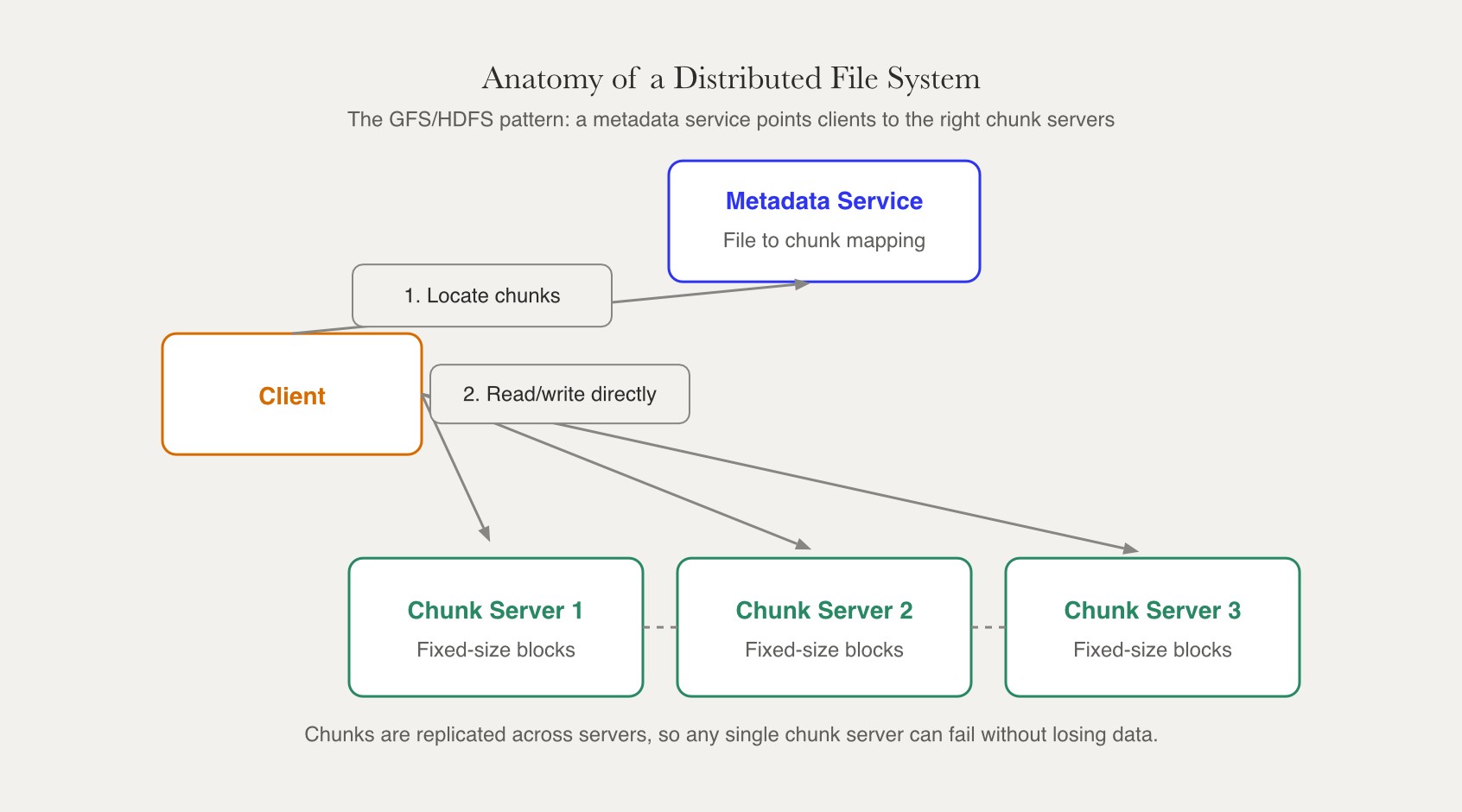
For each design question, ground your discussion with CAP theorem trade-offs, data consistency choices, and realistic metrics such as requests per second or terabytes of daily storage volume. A deep understanding of scaling trade-offs is necessary during distributed systems interviews.
Comparing Key Distributed Systems Concepts
The following table serves as a mental map you can reference during a distributed systems interview to structure answers clearly. When an interviewer asks a question, identify which concept row it falls under and use the trade-offs column to frame your reasoning.
Concept | What Interviewers Test | Typical Trade Offs | Example Technologies |
CAP Theorem / PACELC | Reasoning about consistency vs availability under partitions | CP vs AP; latency vs consistency outside partitions; tunable quorum (R+W>N) | Cassandra, DynamoDB, Google Spanner |
Data Replication | Durability, write latency, consistency guarantees | Sync vs async vs semi-sync; leader-follower vs multi-leader | PostgreSQL streaming, MongoDB, Cassandra |
Consensus Algorithm | Agreement under failures, leader election, safety | Complexity, latency under failure, implementation difficulty | Paxos, Raft (etcd, Consul, KRaft) |
Distributed Caching | Latency reduction, throughput, cache coherence | Invalidation vs staleness; eviction policies; topology choices | Valkey, Redis Cluster, Memcached, CDNs |
Sharding / Partitioning | Scale, data access patterns, operational overhead | Hot spots, cross-shard queries, rebalancing cost | Vitess, CockroachDB, DynamoDB |
After identifying the relevant row, walk through the trade-offs column to show the interviewer you are reasoning about constraints, not just listing technologies.
Ready for Your Next Backend or Infrastructure Role?
Preparing for distributed systems interviews takes significant effort, from understanding consistency models and replication strategies to practicing system design and explaining architectural trade-offs. Once you've invested the time to build those skills, the next step is finding companies where that expertise is valued.
If you're exploring opportunities in backend engineering, infrastructure, platform engineering, cloud engineering, distributed systems, or AI infrastructure, Fonzi's Match Day is designed to help you connect with companies hiring for those roles. Rather than spending hours searching through job boards and submitting applications one at a time, you can participate in a Match Day and get introduced to multiple startups and high-growth companies looking for experienced engineers. It's an efficient way to put your interview preparation to work and discover opportunities that align with your technical background and career goals.
Summary
Distributed systems interviews test your understanding of the core concepts behind building scalable, reliable applications, including consistency, replication, fault tolerance, sharding, caching, and consensus algorithms. Beyond knowing the theory, interviewers expect you to explain architectural trade-offs, reason through real-world failures, and apply these concepts in system design scenarios such as distributed databases, caches, queues, and file systems.
The best preparation combines mastering foundational concepts with practicing end-to-end system design questions and clearly communicating your decision-making process. Candidates who can justify trade-offs between consistency, availability, latency, and scalability, while demonstrating practical knowledge of modern distributed architectures, are best positioned for backend, infrastructure, and platform engineering interviews.
FAQ
How much distributed systems knowledge is required for a mid-level backend interview?
How should I practice distributed systems interview questions without current on-the-job experience?
Which textbooks or resources are useful for distributed systems interview prep in 2026?
How deeply do I need to know Paxos or Raft for typical industry interviews?
How are distributed systems interviews different from generic system design interviews?


