Is the NeetCode System Design Course Worth It?
By
Samara Garcia
•

NeetCode System Design is one of the most talked-about add-ons within NeetCode Pro, aimed squarely at software engineers preparing for a system design interview. The course bundles foundational architecture concepts with classic interview questions in a video-plus-diagram format. This review breaks down what the system design course actually covers, where it falls short for modern interviews, and who it is genuinely worth the investment for.
Key Takeaways
NeetCode System Design is a strong starting point for beginners and mid-level engineers. It explains core system design concepts clearly and prepares you for common interview questions with structured lessons and diagrams.
The course is best used as a foundation, not a complete system design curriculum. Senior candidates should supplement it with advanced resources, mock interviews, and deeper study of distributed systems and architectural trade-offs.
You'll get the most value by combining NeetCode with hands-on practice. Pair the lessons with whiteboarding, building small projects, and mock interviews to develop the communication and decision-making skills expected in real system design interviews.
What NeetCode System Design Actually Covers
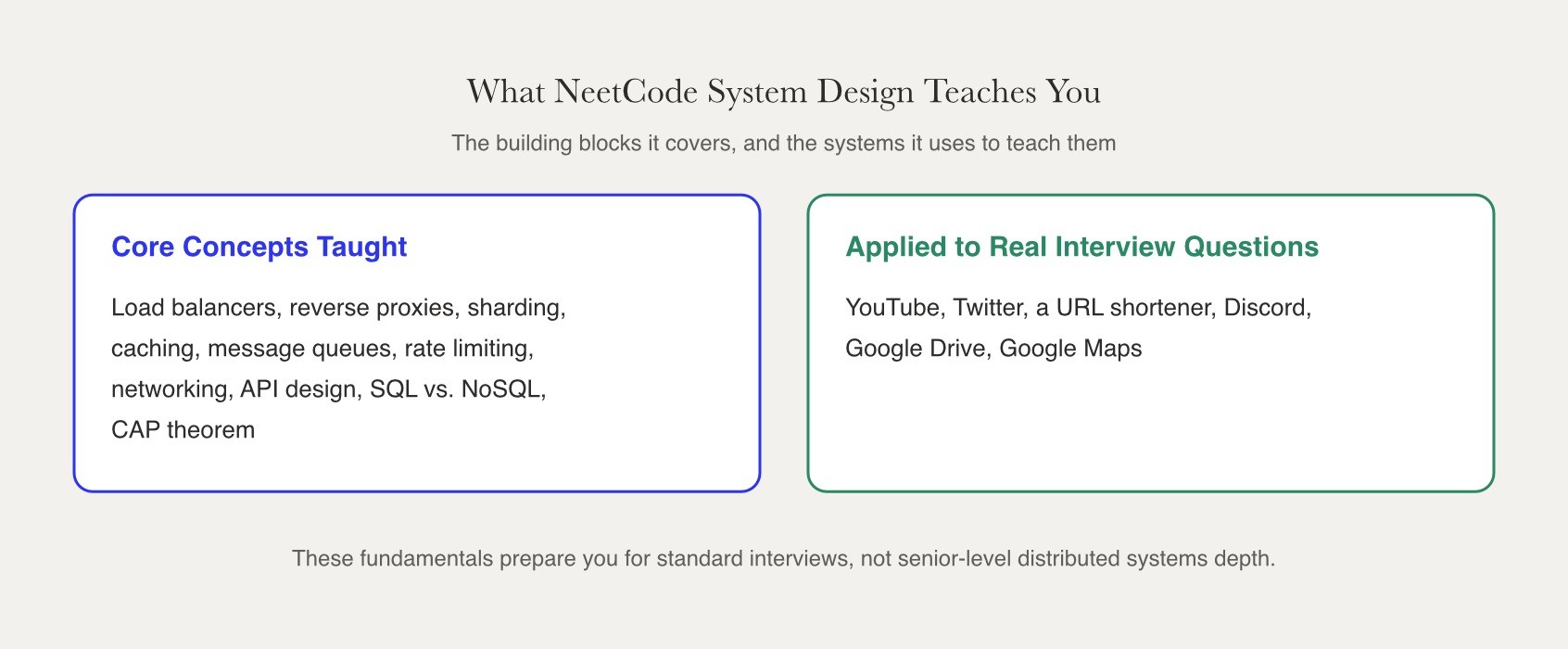
NeetCode System Design is included with NeetCode Pro and focuses on interview preparation rather than comprehensive software architecture training. Across its beginner and interview tracks, it introduces core concepts like load balancers, reverse proxies, sharding, caching, message queues, rate limiting, networking, API design, SQL vs. NoSQL, and the CAP theorem through clear video lessons and diagrams.
The course applies these concepts to common interview questions such as designing YouTube, Twitter, a URL shortener, Discord, Google Drive, and Google Maps. Its biggest strength is making complex ideas approachable without overwhelming beginners, making it a natural next step for engineers already using NeetCode for coding interview prep. While not a complete system design curriculum, it provides a strong foundation for junior and mid-level candidates preparing for interviews.
Where NeetCode System Design Falls Short For Modern Interviews
NeetCode System Design works well as a "System Design 101," but it is not a complete curriculum for senior or highly specialized distributed systems roles at top tech companies like Meta or Stripe. System design interviews evaluate architecture, scalability, and trade-offs, and the depth required at these companies goes beyond what NeetCode currently offers.
Limited Coverage of Trade-Off Analysis
System design interviews are ambiguous and rarely have a single correct answer. Understanding trade-offs is crucial in system design interviews, yet NeetCode Pro lacks deep dives into trade-offs and edge cases. While the course introduces topics like consistency versus availability, it does not spend enough time on rigorous analysis of latency versus throughput, cost versus resilience in cloud-native designs, or when to choose vertical scaling (using more powerful hardware) versus horizontal scaling (adding more machines to a cluster). Effective study should focus on understanding why technologies are chosen in system design, and this "why" layer often feels thin.
Gaps in Advanced Distributed Systems Topics
Topics like event-driven architectures, stream processing, distributed consensus (for example, Raft or Paxos), and large-scale data-intensive applications are either glossed over or only lightly touched. NeetCode helps candidates develop architectural intuition and trade-off analysis skills at a foundational level, but engineers targeting roles that require designing systems at massive scale will find limited coverage of fault tolerance, geo-distributed services, or real-time data pipelines.
Weaker Interview Framework Compared to Alternatives
A structured interview framework helps define requirements and estimate scale, but NeetCode spends less time teaching a repeatable interview approach. Compared to structured frameworks found in Grokking the System Design Interview, which explicitly walk through requirements gathering, back-of-the-envelope estimates, and bottleneck analysis, NeetCode's guidance is more informal. Top candidates relate designs to business goals during interviews, and the course could do more to help learners frame architectural decisions in business terms.
Comparing NeetCode Pro With Other System Design Platforms
When comparing NeetCode Pro to other system design platforms, the differences become clearer. Here is a side-by-side view:
Feature | NeetCode Pro | Grokking the System Design (DesignGurus / Educative) | Free Resources (GitHub System Design Primer, YouTube) |
Price (USD) | ~$99/year; ~$497 lifetime | ~$139/year (Educative Standard); lifetime options available | Free |
Depth of Coverage | Moderate. Covers standard interview problems and core infrastructure | Deeper. Includes real-world case studies, structured frameworks, advanced topic coverage | Varies widely. Some excellent, some incomplete |
Best For | Junior to mid-level engineers needing both coding and system design prep | Mid to senior engineers targeting large tech companies | Budget-conscious learners who can self-organize |
Interactive Review | No built-in mock interviews or live feedback | Some interactive elements; text-heavy | None |
Trade Off Analysis | Lighter; introduces concepts but limited depth | Stronger; explicit trade-off discussions and follow-up questions | Depends on source |
No Built-In Practice or Feedback Mechanisms
The course does not provide built-in live mock interviews or systematic feedback loops, so candidates need to pair it with peer mocks, mentorship, or platforms that offer interactive review. System design interviews evaluate architecture and scalability thinking through follow-up questions and curveballs, and passive video watching does not prepare you for that pressure.
Additionally, behavioral interviews increasingly expect candidates to tell stories about systems they have built or operated. NeetCode offers only indirect help here. Learners must consciously turn their design practice into experience-based narratives about ownership, trade-offs, and collaboration. This practical insight is something many engineers overlook until late in their preparation.
How To Use NeetCode System Design Within A Bigger Study Plan

NeetCode System Design is worth it if you treat it as the foundation layer in a broader plan, especially over a 4 to 8 week preparation window, with NeetCode Pro serving as an ideal starting block for junior and mid-level roles.
A Concrete Weekly Routine
Here is one approach that helps build momentum across a preparation cycle:
Days 1-3: Watch videos and work through NeetCode modules. After each lesson, practice sketching designs on paper or a whiteboard. Do not just watch passively. Active learning improves retention for system design concepts.
Day 4: Complete a timed walkthrough of a system design interview question without looking at the solution. Practice explaining your reasoning out loud, as if presenting to an interviewer. Asking clarifying questions is crucial in system design interviews, so include that step even in solo mock sessions.
Day 5: Apply what you learned through a small project feature, like building a URL shortener with PostgreSQL and Redis, or adding a message queue to an existing app. Moving from theory to practice requires mastering reusable system design patterns, and building a real project cements those concepts.
Consistency beats cramming. A steady rhythm of learning, designing, and building adds depth that binge-watching cannot replicate.
Layering In Advanced Resources
After NeetCode Pro, explore deeper materials like Designing Data-Intensive Applications by Martin Kleppmann for distributed systems insight. Move into Grokking the System Design Interview for stronger frameworks around high-level architectures and bottleneck analysis. These additional resources fill the gaps in advanced topic coverage that NeetCode leaves open, including edge cases around scalable solutions, stream processing, and cost engineering.
Setting Up Feedback Loops
To refine past designs and improve under pressure, set up feedback loops by recording yourself during a solo mock or timed walkthrough, then reviewing the recording for clarity and missed trade-offs. Peer mocks with other engineers offer live feedback that solo study cannot replicate. Structured technical screening processes on talent marketplaces like Fonzi can help benchmark your readiness against real interview standards. This kind of live practice also sharpens your ability to handle follow-up questions about traffic spikes, new features, or failure scenarios.
Prepare for Real System Design Interviews with Fonzi Match Day
Learning system design is only part of the interview process. The next step is demonstrating those skills in conversations with hiring managers who care about how you reason through trade-offs, communicate architectural decisions, and respond to follow-up questions.
Fonzi's Match Day connects experienced software engineers with companies actively hiring for backend, platform, infrastructure, and AI engineering roles. Instead of submitting applications one by one, you build a single profile and can receive interview requests from multiple companies during each hiring event. It's an opportunity to put the concepts you've practiced through resources like NeetCode into real interview settings and get in front of teams evaluating system design alongside coding ability, making the transition from study to interviews much more efficient.
Summary
NeetCode System Design is a worthwhile, efficient way to build foundational system design skills, especially when paired with deeper books, courses, and live practice. It simplifies core ideas and delivers clear explanations that help many candidates get comfortable with designing systems for the first time. The value depends on your target level. Junior and mid-level candidates see the most direct benefit, while senior candidates will use it mainly as a refresher before moving to advanced resources and past designs review.
Map out a multi-resource study plan this week. Decide whether NeetCode fits as your starting point based on your current skill level and target role. Then schedule your first week of focused system design practice, commit to one timed walkthrough, and start building the architectural thinking that top tech companies are looking for.
FAQ
How much time should I spend on NeetCode System Design before switching to other resources?
How does NeetCode Pro compare in price to Grokking the System Design Interview?
Is NeetCode System Design useful for non-backend engineers like frontend or mobile developers?
Do system design courses help with behavioral interviews?
Is the NeetCode system design interview track different from the coding interview track?


