Blind 75 vs LeetCode 75: Which List Should You Use?
By
Samara Garcia
•

With over 3,800 problems on LeetCode, curated lists like Blind 75 and LeetCode 75 became popular because they cut through thousands of LeetCode questions and give candidates a focused path for coding interviews. These lists are especially popular among software engineers preparing for FAANG, Big Tech, and startup technical rounds. Both cover essential topics such as arrays, strings, linked lists, trees, graphs, and dynamic programming, but they are designed with different philosophies. This article will help you identify which list fits your background, time, and target companies, not promote one as universally superior.
Key Takeaways
Blind 75 and LeetCode 75 teach many of the same core interview patterns, but they serve different purposes. Blind 75 is ideal for focused interview review, while LeetCode 75 provides a more structured learning path for building fundamentals.
Choose the list based on your experience and timeline. Candidates with a strong algorithms background or limited prep time often benefit from Blind 75, while beginners or those with several months to prepare may find LeetCode 75 easier to follow.
Your success depends more on how you study than which list you use. Focus on understanding patterns, reviewing mistakes, and practicing mock interviews rather than simply checking off completed problems.
What Is Blind 75? Origins, Structure, And Core Focus
The Blind 75 was created by Yangshun Tay, a former Meta Staff Engineer, and first circulated on the forum Blind around 2020. Blind 75 consists of 75 carefully selected coding interview problems organized around core topics such as arrays, linked lists, trees, graphs, binary search, sliding window, and dynamic programming. Rather than covering every possible question type, it focuses on the algorithmic patterns most commonly tested in interviews at companies like Google, Meta, and Amazon.
Built around the 80/20 principle, the list helps candidates reduce decision fatigue by prioritizing the problems that provide the greatest interview value. Many versions avoid LeetCode Premium questions to remain fully accessible, and most study plans recommend solving 1 to 2 problems per day with regular review over 6 to 12 weeks.
What Is LeetCode 75? Official Study Plan And How It Is Organized
LeetCode 75 is an official study plan published by LeetCode around 2022, designed as a structured 75-question path rather than a crowdsourced list. It was created to help candidates become interview-ready in 1 to 3 months and includes a badge on completion.
The plan is split into levels that start with easy problems and gradually move into medium and selected hard problems, so it functions as a curriculum rather than just a checklist. It emphasizes progression, daily streaks, and in-platform tracking, which is helpful for learners who want a more guided experience than the classic Blind 75 spreadsheet approach. LeetCode 75 also covers fundamental interview categories (arrays, strings, linked lists, trees, graphs, sliding window, dynamic programming) but is tailored to the site's current problem set and difficulty ratings, reflecting more up-to-date difficulty and employer relevance.
Many candidates start with LeetCode 75 when they are newer to data structures and algorithms, then move to broader playlists or pattern-based lists as they gain confidence. The plan can be accessed on LeetCode's free tier for most problems, though some editorial solutions and company-tagged content may require premium access.
Blind 75 vs LeetCode 75 For Interview Prep
This is the core comparison. The table below makes the similarities and differences close and clear for busy candidates who need to spend their time wisely.
Dimension | Blind 75 | LeetCode 75 |
Origin | Community-curated by Yangshun Tay; refined via Blind, GitHub, Reddit | Official curation by LeetCode, launched 2022 |
Structure | Fixed 75 problems grouped by topic buckets (e.g., Arrays, Trees, DP) | 75 problems organized in progressive levels with daily unlocks |
Tracking Tools | External spreadsheets, NeetCode dashboard, or manual tracking | Built-in progress tracking, streaks, badge on completion |
Topic Coverage | ~14 core patterns; strong on classics, may miss newer trends | Broad coverage with trending problems; more modern question selection |
Difficulty Ramp | Mixed difficulty within each topic; no deliberate easy-to-hard ramp | Designed to start easier and progress toward medium-hard |
Premium Dependency | Most variants avoid premium-locked problems | Free tier covers most content; some editorials behind paywall |
Best Use Case | Fast revision close to interview dates; candidates with DSA basis | Building fundamentals over 1 to 3 months; guided pacing for beginners |
Blind 75 shines for high-signal revision when you are close to your interview day and need to cover important questions quickly. LeetCode 75 shines for building fundamentals and consistency if you have more weeks before applications. There is substantial overlap in problem types, so learning one list improves performance on the other, but the individual questions differ, and LeetCode 75 reflects more recent problem design trends, including many other LeetCode questions that have entered rotation since 2022.
Which List Should You Use? Choosing Based On Time, Level, And Target Roles
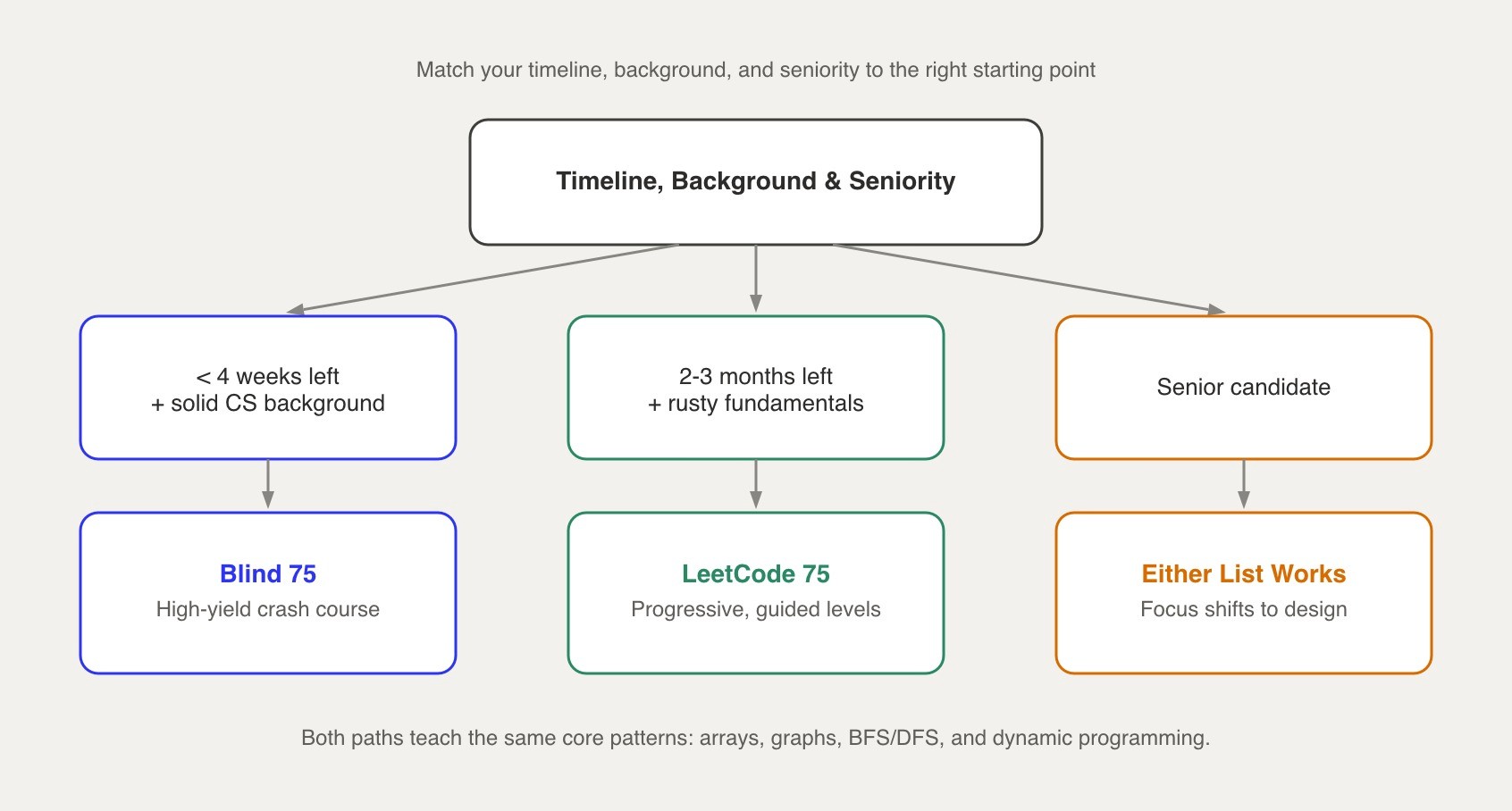
The best way to choose depends on three main factors: existing algorithm knowledge, available preparation time, and the type of coding interviews you are targeting (for example, new grad, senior backend, data engineer at companies like Google or Facebook).
If you have less than 4 weeks before interviews and a solid CS background from your last job hunt, prioritize Blind 75 plus focused review. The list is applicable as a high-yield crash course because it distills the most common patterns into a manageable number of problems. For junior and mid-level roles, many candidates treat working through Blind 75 as a practical baseline for interview preparation. If you have 2 to 3 months and feel rusty on data structures, start with LeetCode 75 Level 1 and work through the progressive difficulty. This approach is especially valuable during any job hunt where you have time to improve before the first phone screen.
Front-end or full-stack roles may benefit from fewer extremely hard graph or dynamic programming problems and more practice with easy to medium problems that stress clarity, edge cases, and clean solutions involving strings and characters. Senior candidates can use either list as a baseline warm-up, then quickly move to system design, large-scale data modeling, and domain-specific problems, since most onsite loops for staff roles include heavier design components. Candidates often supplement their preparation with system design and behavioral interview prep to cover the full interview loop.
Topics And Patterns You Must Master Regardless Of The List
Both Blind 75 and LeetCode 75 are valuable because they teach the core data structures and algorithm patterns that appear repeatedly in coding interviews. The goal is not to memorize solutions but to recognize patterns you can apply to new problems.
Focus on mastering topics like arrays, hashing, linked lists, trees, BFS and DFS on trees and graphs, binary search, sliding window, heaps, recursion, backtracking, and dynamic programming. Many interview questions reduce to a small set of reusable patterns, even if they look different on the surface.
As you practice, label the pattern used for each problem and write a summary of your approach. Building this habit strengthens problem-solving skills and makes it easier to adapt to unfamiliar interview questions.
Combining Blind 75, LeetCode 75, And Additional Resources Into A Study Plan
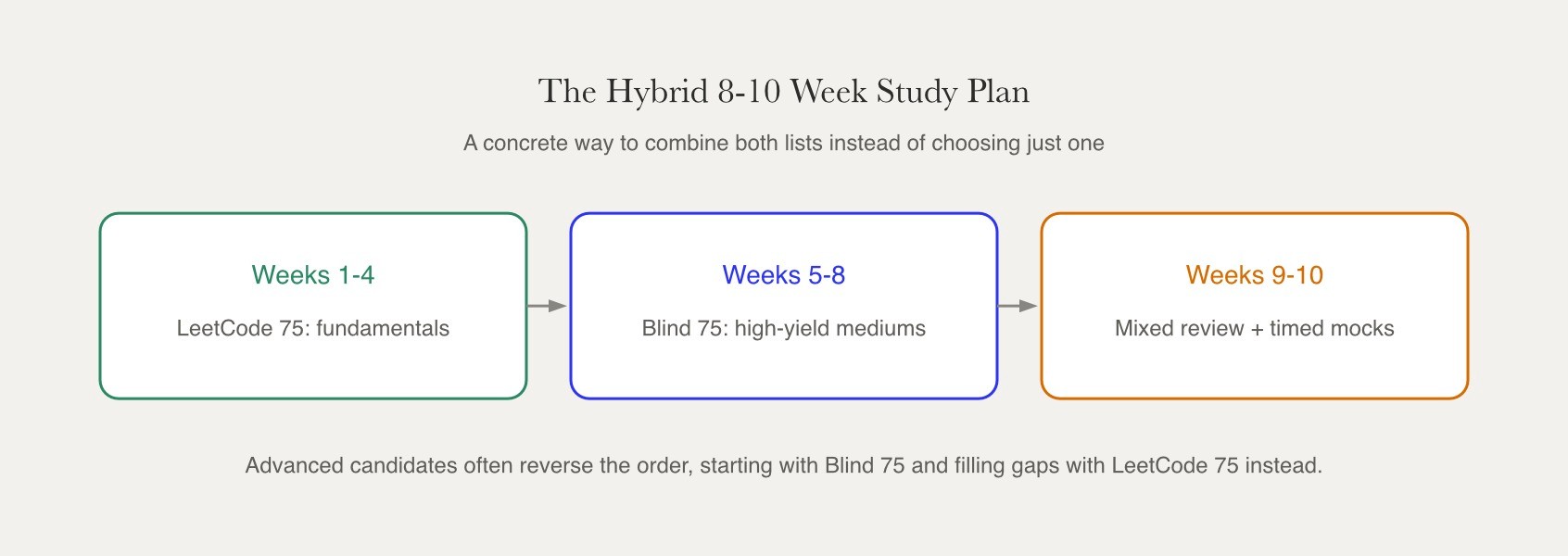
Many successful candidates do not choose between the two lists. Instead, they build a hybrid plan that fits their schedule and weaknesses, which is the best way to achieve broad coverage.
A concrete example of an 8 to 10 week plan looks like this: spend 3 to 4 weeks on LeetCode 75 for fundamentals, 3 to 4 weeks on Blind 75 for high-yield medium problems, then 1 to 2 weeks of mixed review and timed mocks using questions from both lists. More advanced candidates can reverse this order, starting with Blind 75 and filling remaining gaps with LeetCode 75 problems in areas they struggle with, such as graph traversal or dynamic programming on grids.
Updated versions like Grind 75 or NeetCode 150 provide more extensive coverage beyond Blind 75 and are worth exploring once you have finished a baseline list. Many developers transition to pattern-based tracking platforms for advanced preparation after Blind 75, using tools that schedule problem reviews on a regular basis. You can also supplement with books like "Cracking the Coding Interview" or tailored mentorship from networks and marketplaces, as long as those additions do not distract from consistent daily problem solving.
Adjust the plan to your constraints. If you have a full-time job or family, aim for 60 to 90 minutes per day rather than sporadic weekend marathons. Daily consistency matters more than total hours per week. Agree on a schedule with yourself, write it down, and pay attention to which topics need extra focus.
Put Your Interview Preparation to Work with Fonzi
Whether you choose Blind 75, LeetCode 75, or a combination of both, the goal isn't simply to finish a study list. It's to become confident solving technical problems and communicating your approach in real interviews. Once you can consistently solve medium-level problems and explain your reasoning, the next step is connecting with companies that are actively hiring.
Fonzi helps software engineers move from interview preparation to real opportunities. Through its Match Day, candidates create one profile and are introduced to multiple startups and AI companies hiring for software engineering roles. Instead of submitting dozens of applications after completing your coding prep, qualified engineers can receive interview requests from multiple employers in a single hiring cycle. After mastering the interview patterns taught by Blind 75 or LeetCode 75, Match Day provides an efficient way to turn that preparation into conversations with companies looking for strong technical talent.
Summary
Blind 75 and LeetCode 75 are two of the most popular coding interview study lists, covering many of the same core data structures and algorithms but serving different purposes. Blind 75 is best for focused interview review and pattern recognition, while LeetCode 75 offers a structured, beginner-friendly learning path with progressive difficulty. Choosing the right list depends on your experience level, preparation timeline, and interview goals.
Regardless of which list you use, success comes from mastering fundamental patterns like arrays, graphs, BFS, DFS, dynamic programming, and binary search rather than memorizing solutions. Many candidates combine both lists, using LeetCode 75 to build fundamentals and Blind 75 for targeted review before interviews, alongside mock interviews and system design practice for more comprehensive preparation.
FAQ
Is Blind 75 enough to pass FAANG / Big Tech coding interviews in 2026?
Should I finish all 75 problems on one list before starting the other?
How many Blind 75 or LeetCode 75 problems should I solve per day?
Do I need LeetCode Premium to use Blind 75 or LeetCode 75?
How should I balance coding interview practice with system design preparation?


