Trending Ad Tech Jobs in New York and Beyond
By
Samara Garcia
•

Advertising technology has evolved into a highly technical industry where AI, machine learning, cloud infrastructure, and real-time data processing power modern digital advertising. From real-time bidding platforms and ad exchanges to privacy-focused measurement and connected TV, ad tech companies are building systems that operate at massive scale.
For software engineers, AI specialists, and infrastructure professionals, the sector offers opportunities to solve complex engineering challenges with real-world impact. This guide explores the most in-demand ad tech roles, the skills employers value, and how AI is shaping careers across the industry.
Key Takeaways
Programmatic advertising, connected TV, and AI-powered marketing platforms are creating strong demand for software engineers, machine learning specialists, and data infrastructure talent.
Modern ad tech companies rely on expertise in machine learning, distributed systems, real-time data processing, privacy technologies, and large-scale cloud infrastructure.
Hiring is becoming more structured through AI-assisted screening and curated talent platforms, but technical depth, real-world project experience, and strong communication remain the biggest differentiators.
Core Ad Tech Job Categories Hiring in New York and Globally
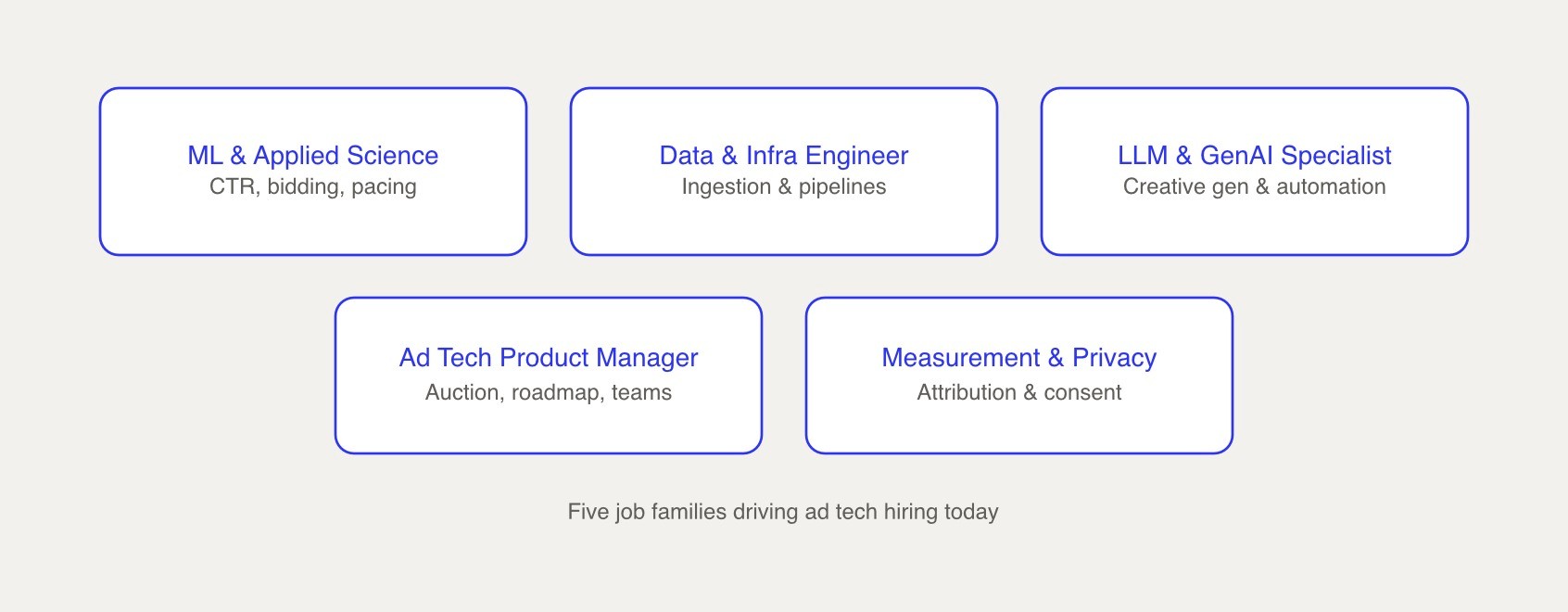
Ad tech is no longer limited to ad operations. Today it employs AI engineers, ML researchers, infra engineers, data platform specialists, and senior product managers in large numbers. Sales roles acquire new clients and drive revenue, ad operations manages the implementation and performance of advertising campaigns, and product management defines the roadmap for ad tech platforms. Technical Solutions positions build and debug ad tech infrastructure. Below are the key job families, with a focus on New York but with notes on remote and global hiring.
Machine Learning Engineer and Applied Scientist Roles in Ad Tech
ML engineers in DSPs, SSPs, and ad networks work on CTR prediction, conversion modeling, bidding strategies, pacing, and supply quality in sub-100 ms environments. Since 2023, leading teams have adopted gradient-boosted trees, wide-and-deep models, transformers for user and creative embeddings, and bandit-based experimentation to optimize campaigns and maximize revenue. Programmatic roles focus on buying and optimizing digital ad space using automated systems, and ML engineers are central to that process.
Experience with large sparse feature spaces, feature stores, and online learning pipelines is valued at adtech companies like StackAdapt, Nexxen, and others with New York offices. Common toolchains include Python, Scala, Spark, Flink, TensorFlow, PyTorch, Kafka, Redis, and Kubernetes, with Rust and Go emerging in latency-critical paths. Compensation in NYC for senior ML engineers in ad serving often aligns with FAANG-adjacent ranges. For example, Roku lists a senior machine learning engineer role in ad serving at $195,000 to $510,000 total compensation.
Data and Infra Engineer Roles Behind Programmatic and CTV
Data and infra engineers design log ingestion, feature pipelines, identity graphs, and real-time analytics supporting billions of daily ad events at global scale. New York employers expect experience with stream processing at scale using platforms such as Kafka, Pulsar, Flink, or Beam, plus warehouses like BigQuery, Snowflake, or Redshift.
CTV and video advertising have specific infra challenges, including SSAI logs, VAST, SIMID, and OMID events, and cross-device identity across set-top boxes, smart TVs, and mobile. Infra roles often partner with ML teams on low-latency online feature stores and with privacy teams on consent and data retention policies. Candidates coming from core infra or fintech data platforms can transition effectively if they map their experience to auction throughput, latency, and compliance requirements, making big data and analytics skills directly portable.
LLM-focused Roles in Creative, Ops, and Optimization
Ad tech companies increasingly hire ML and LLM specialists to build tools for creative generation, workflow automation, campaign optimization, and performance analysis. Practical applications include generating ad copy variants, building natural language query interfaces over campaign data, and classifying or tagging creatives at scale. Smartly.io, which managed €2.5 billion in ad spend in 2025, is one example of a platform investing heavily in automation and creative intelligence.
Experience with generative AI frameworks is necessary for these roles. Hiring managers value retrieval-augmented generation, prompt engineering at production scale, evaluation frameworks for generated text or images, and guardrail design under brand safety constraints. Relevant tools include OpenAI APIs, Claude, Llama-based models, vector databases, LangChain, and Semantic Kernel. Many of these roles sit at the intersection of ML, infra, and product, and often report into platform engineering rather than classic marketing teams.
Ad Tech Product Manager Roles with Technical Depth
The ad tech product manager reasons about auction mechanics, privacy regulations, and ML system capabilities while coordinating with engineering, advertisers, agencies, and publishers. In New York, senior product manager roles frequently own surfaces like the bidder UI, targeting tools, measurement suite, or connected TV inventory marketplace. Mediaocean, which supports over $150 billion in annual media spend, exemplifies the scale at which product managers operate across campaigns, clients, and platforms.
Typical responsibilities include defining metrics like win rate, effective CPM, and incremental reach, prioritizing infra investments, and coordinating go-to-market with partner teams. Employers prefer PMs who can discuss feature stores, experimentation design, and multi-tenant multi-region system constraints. Engineering candidates interested in PM tracks should highlight experience leading cross-functional projects and defining technical tradeoffs that affected business outcomes.
Specialized Roles in Measurement, Privacy, and Identity
Safari and Firefox already block third-party cookies by default. Google dropped its Chrome cookie-deprecation plan in 2024 and confirmed in 2025 it will not add a consent prompt either. The industry is shifting away from third-party cookies to first-party data and AI-driven optimization, with ongoing ATT changes in iOS and regional privacy laws driving a wave of roles focused on attribution, identity, and consent management. Data privacy regulations like CCPA and GDPR remain central to these positions.
Jobs in incrementality measurement, modeled conversions, clean rooms, and probabilistic identity graphs attract both data scientists and backend engineers. Oxagile, with over 20 years of AdTech experience, is one of many firms building privacy-preserving solutions. New York ad tech companies working with finance, retail, and CPG brands often build privacy-preserving data joins using secure enclaves, MPC, or differential privacy techniques. Candidates with experience in regulated industries such as fintech or health tech can present that background as a good fit for ad tech privacy and measurement problems.

How New York Compares to Other Ad Tech Hubs
New York has a distinct ad tech profile rooted in its long agency history, proximity to major brand advertisers, and density of media owners and broadcasters. While other cities lead in specific dimensions, NY remains uniquely positioned for roles that combine technical depth with commercial proximity.
New York City and the Rise of Connected TV and Convergent TV
From 2022 to 2026, CTV and convergent TV spending in the United States accelerated, with IAB projecting +13.8% growth for CTV ad spend in 2026. This has driven hiring at New York-based companies like Cadent, which reaches 100 million households with its advertising solutions, and other TV-focused platforms. These roles blend streaming video infrastructure, deterministic and probabilistic identity, and cross-screen measurement that spans linear and digital media. Engineers with experience in video delivery, SSAI, or streaming analytics can find an especially strong fit in the NY ad tech ecosystem. Remote and hybrid hiring for these teams has grown significantly since 2020.
Comparison Across Major Hubs and Remote Roles
San Francisco Bay Area continues to host infra-heavy and platform-focused ad tech and marketing tech roles. London and Berlin emphasize privacy, measurement, and regulatory compliance. Los Angeles leans into entertainment-driven ads, digital media, and creator platforms. Remote-first companies distribute ML and infra roles globally, while client-facing functions remain concentrated in cities like New York.
Dimension | New York | San Francisco Bay Area | London / Berlin | Remote |
Main focus | Measurement, identity, CTV, product, partnerships | Infra, platform scale, frontier AI | Privacy, measurement, regulatory compliance | ML engineering, infra, data pipelines |
Typical company stage | Growth to enterprise | Startup to enterprise | Mid-stage to enterprise | Varies widely |
ML research vs. production | Production-heavy with applied research | Balanced research and production | Applied research emphasis | Production-heavy |
Hybrid/remote expectations | Hybrid preferred for senior roles | Hybrid or on-site common | On-site or hybrid | Fully remote, timezone constraints |
Key verticals | Finance, CPG, media, retail | Technology, internet, consumers | Regulatory, publishing, brands | Cross-vertical |
Many senior candidates maintain New York connections even when based elsewhere, due to its density of decision makers, investors, and partners across the advertising industry.
Skills, Tech Stacks, and Career Trajectories in Modern Ad Tech
Ad tech rewards engineers who combine strong systems thinking with statistical intuition. Hiring in 2025 and 2026 reflects this blend, and the information technology landscape in the field increasingly demands both depth and breadth.
Core Technical Skills for AI and Infra Roles in Ad Tech
Proficiency in Python and TypeScript/Node.js is essential for most senior positions. Strong knowledge of SQL and data visualization tools is advantageous, and technical aptitude ranges from Excel proficiency to SQL and JavaScript coding skills, depending on role seniority. Typically, 6 to 8 years of experience in marketing technology is required for senior positions, and a Master's degree in a related field is preferred at many employers. Hands-on experience with A/B testing platforms is important for demonstrating impact in experimentation-driven environments. Key roles in ad tech require analytical skills and familiarity with programmatic advertising.
Domain Knowledge: Auctions, Targeting, and Measurement
Senior candidates are evaluated on understanding of first-price auctions, bid shading, floor prices, and supply path optimization. Industry knowledge of programmatic advertising and policy compliance is essential. The shift toward privacy-centric behavioral targeting, with contextual signals and modeled audiences supplementing deterministic identifiers, is reshaping how engineers think about solutions for advertisers. Analytical thinking is critical for understanding performance metrics in ad tech roles. Familiarity with standards such as OpenRTB, VAST, and TCF can shorten ramp-up time. Certification courses from organizations like IAB signal expertise to recruiters and can differentiate candidates in a dynamic market.
Career Paths: From Senior IC to Principal or Product Leadership
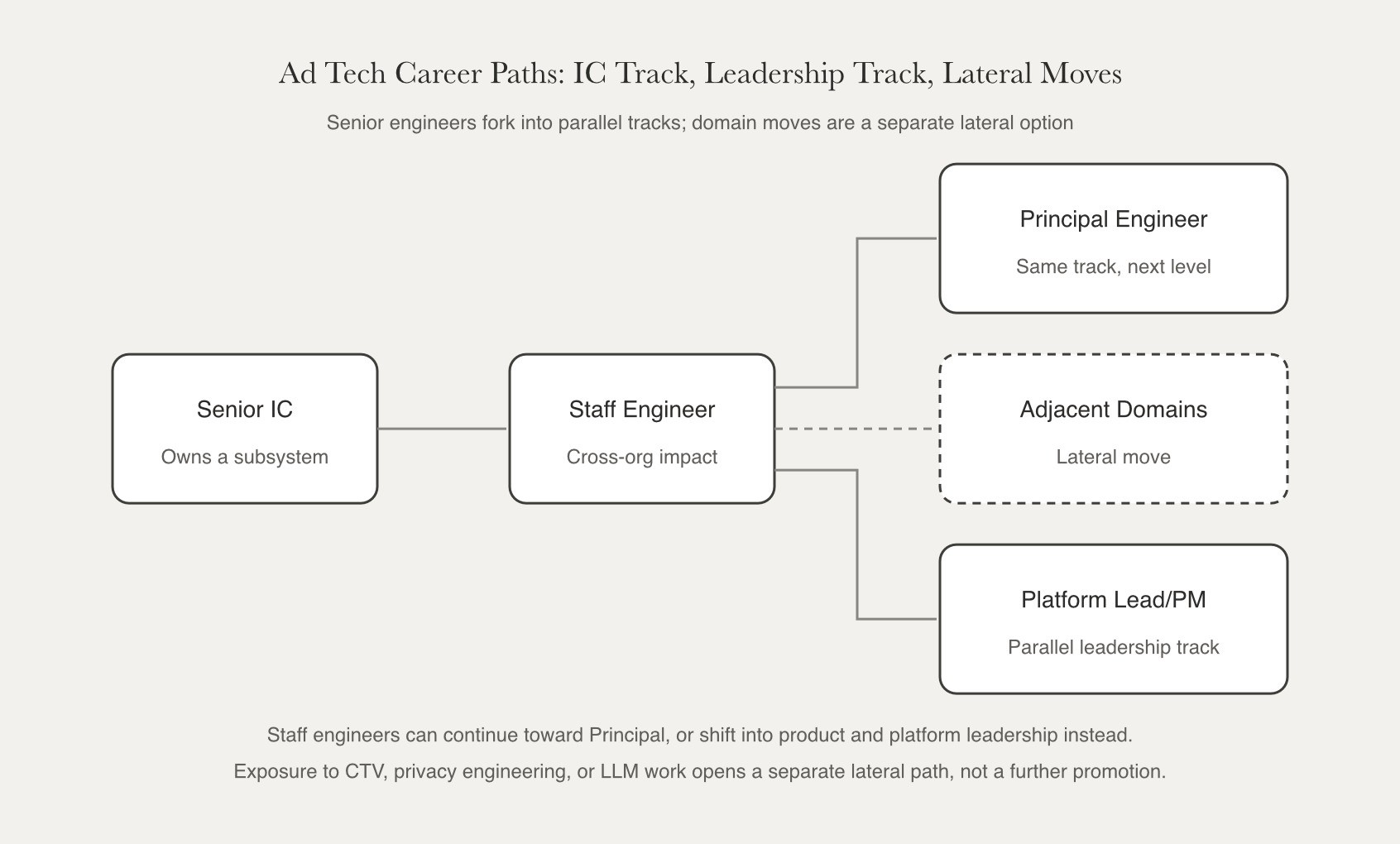
Many ML and infra engineers in New York ad tech companies progress from senior to staff or principal roles by taking ownership of core subsystems such as the bidder, logging pipeline, or identity graph. Some transition into product manager or platform lead roles once they consistently shape roadmaps and influence cross-org priorities. Career progression is often tied to measurable business metrics like revenue lift, cost savings, or monetization improvements. Exposure to connected TV, privacy engineering, or LLM applications can open paths to adjacent domains such as streaming platforms, retail media, or marketing automation, expanding one's future options.
Using Your Background to Pivot into Ad Tech
Engineers from fintech, gaming, recommendation systems, and large-scale consumer platforms often have directly transferable experience in auctions, ranking, fraud detection, or personalization. Rewrite resumes in ad tech language, mapping prior work to concepts like real-time bidding, campaign optimization, and user-level modeling. GroundTruth, which has received over $176 million in funding, is one example of a company that values cross-domain skills and innovation. Curated talent marketplaces like Fonzi can help surface opportunities where a candidate's background aligns with specific ad tech business models or technical stacks. Do not undersell cross-domain skills such as experimentation design, security, privacy-by-design, or developer platform building.
How AI Is Reshaping Hiring for Ad Tech Roles
Ad tech companies increasingly use AI to support sourcing, resume screening, and candidate matching, helping recruiters identify engineers with experience in areas like machine learning, distributed systems, streaming infrastructure, and privacy technologies. While AI speeds up the early stages of hiring, senior technical interviews still focus on system design, architecture, technical tradeoffs, and communication, with human judgment driving final decisions.
Candidates can improve their visibility by using clear descriptions of their technical skills, architectures, and project outcomes on resumes and professional profiles. Documenting meaningful work through case studies, technical blogs, or open-source contributions also helps demonstrate expertise beyond automated screening. The strongest hiring processes combine AI-assisted efficiency with experienced hiring managers who evaluate technical depth, collaboration, and long-term fit.
Find High-Impact Ad Tech Talent with Fonzi
Hiring for ad tech requires more than finding strong software engineers. Companies need candidates who can build low-latency systems, production ML pipelines, real-time data infrastructure, and AI-powered advertising platforms while understanding the unique challenges of auctions, measurement, privacy, and large-scale distributed systems. Traditional job boards often generate high application volume but make it difficult to identify engineers with this combination of technical depth and domain expertise.
Fonzi helps ad tech companies connect with pre-vetted AI engineers, machine learning specialists, infrastructure engineers, and backend developers who are experienced in building high-performance systems. Through Fonzi's Match Day, hiring teams can review a curated pool of experienced engineers at the same time, accelerating hiring for roles across programmatic advertising, connected TV, measurement, privacy, and AI-driven optimization. Rather than spending weeks sourcing candidates individually, companies gain direct access to engineers whose skills align with the technical demands of modern ad tech, while candidates can connect with multiple high-growth companies through a single hiring event.
Summary
Ad tech, especially in New York, offers a dense concentration of roles where AI engineers, ML researchers, infra specialists, and product managers can work on high-scale, high-impact systems that optimize campaigns and solve business-critical problems for brands, marketers, and publishers worldwide. Understanding auctions, measurement, connected TV, and shifting privacy regulations and identity standards is the key differentiator for senior candidates. Map your existing experience to ad tech concepts, identify a focused set of target companies, and engage with human-centered, structured hiring channels that respect your expertise and connect you with the right teams.
FAQ
Is it realistic to work remotely for a New York ad tech company in a senior technical role?
How does compensation in New York ad tech compare to big tech or fintech roles?
Are there meaningful research opportunities for ML and LLM specialists in ad tech?
How important is prior advertising industry experience for senior technical candidates?
Which niches within ad tech are most promising for long-term growth between 2026 and 2030?