What Is a Forward Deployed Engineer?
By
Samara Garcia
•

Since 2023, enterprise AI adoption has created a surge in forward-deployed engineering roles at OpenAI, Google, Anthropic, and the major consultancies. The models, vector databases, agent frameworks, and orchestration tooling are mature enough for real production use. The bottleneck in 2026 is getting working systems into complex customer environments, such as regulated industries, legacy infrastructure, procurement constraints, and security reviews. Forward-deployed engineers own that last mile. For senior AI, ML, and infra practitioners, it's a role worth understanding whether you're thinking about your next move or building out a team.
Key Takeaways
A forward-deployed engineer is a senior software engineer embedded with customers to translate complex AI and software into production outcomes.
The forward-deployed engineer role differs from traditional software engineering, professional services, solution engineering, and consulting because FDEs own deployed systems, not only advice or architecture.
The FDE model was coined at Palantir and has expanded across OpenAI, Google, Anthropic, Scale AI, Databricks, Snowflake, and enterprise AI startups.
Strong FDEs combine software development, data engineering, customer engagement, creative problem solving, systems thinking, business acumen, and fluency with AI agents and coding.
Candidates should prepare with production case studies, customer-facing project experience, and interview practice around ambiguity, multi-agent systems, and MCP integrations.
Defining the Forward Deployed Engineer Role
A Forward Deployed Engineer (FDE) is a software engineer who embeds directly with customers to configure existing software platforms to solve specific problems, focusing on delivering tailored solutions rather than generic capabilities. In practice, this means building software, writing code, integrating systems, and maintaining production deployments inside a specific customer environment. The customer’s specific constraints matter as much as the base platform.
Forward-deployed engineers combine software engineering, product thinking, and customer collaboration. They work closely with product managers, ML researchers, infra teams, and enterprise clients to turn technical capabilities into real business value, often in high-stakes production environments.
The role originated at Palantir Technologies, where engineers embedded directly with customers to solve complex operational and data challenges. The model was later expanded to companies like Databricks, Snowflake, OpenAI, and Anthropic.
Titles vary across companies, including forward-deployed engineer, applied AI engineer, or customer-embedded engineer. What matters most is the actual responsibility: owning deployments, working directly with users, solving production issues, and delivering successful outcomes.
Key Differences from Traditional Software Engineers
Traditional engineers usually build generalized new features for many customers. Forward-deployed engineers build specialized configurations, integrations, and workflows for one customer or a small set of accounts, often under external deadlines tied to pilots, renewals, audits, or go-lives.
Engineering rigor still matters. The difference is that success is measured through customer outcomes, adoption, reliability, product market fit, and renewal, not only code quality or sprint velocity. A consultant may recommend a design, while an FDE is expected to create, deliver, operate, and improve the working system.
Where Forward Deployed Engineering Came From and How It Went Mainstream
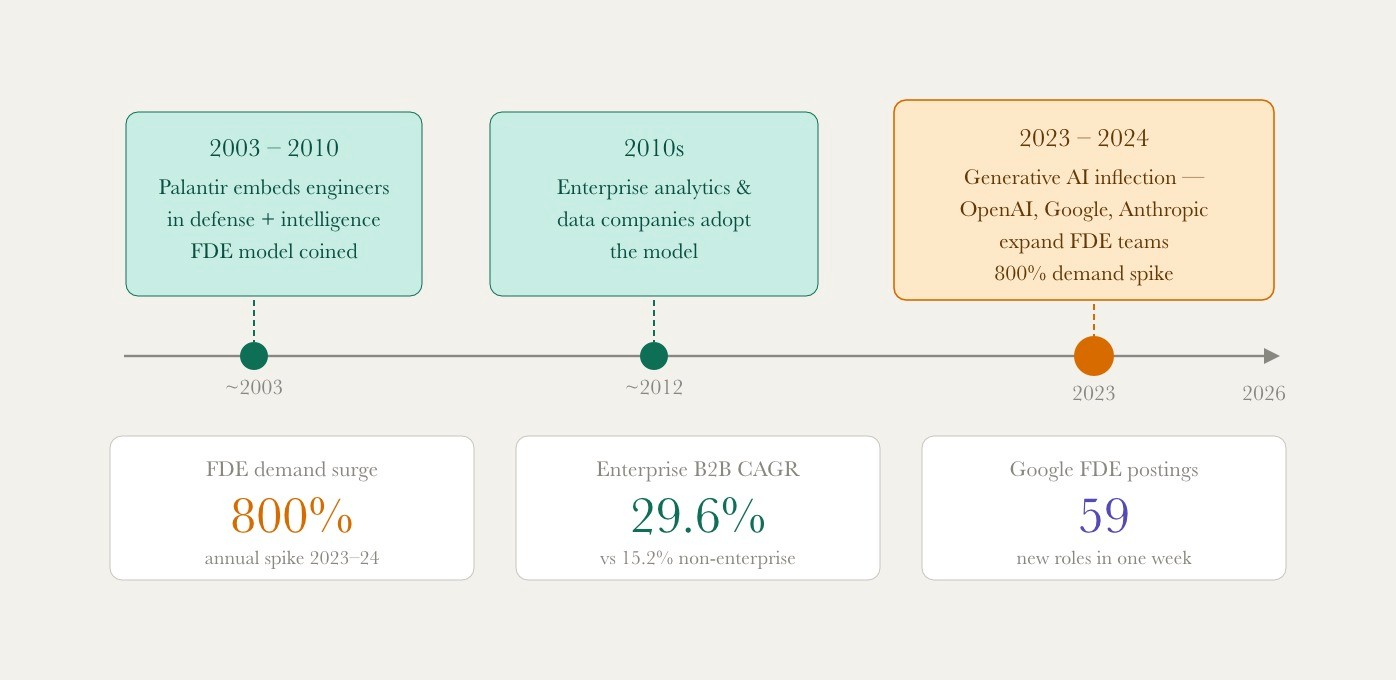
Forward-deployed engineering began at Palantir around 2003 to 2010, when embedding engineers inside defense and intelligence agencies helped solve operational data problems in the field. During the 2010s, similar patterns appeared in enterprise analytics and data companies that needed to deploy complex software into banks, insurers, public agencies, and healthcare organizations.
The inflection point came during 2023 and 2024, when the enterprise shift toward generative AI made messy software integrations the main blocker. The demand for forward-deployed engineers (FDEs) has surged as they are seen as crucial for integrating and customizing software solutions for enterprise customers, particularly in the context of AI deployment. Some market reports cited an 800% spike in annual demand for FDE roles, with openings across New York, London, Munich, Singapore, and other AI hubs.
This growth reflects a larger business shift. The average compound annual growth rate (CAGR) for enterprise-focused B2B companies is 29.6%, compared to 15.2% for non-enterprise companies, highlighting the increasing importance of roles like FDEs in driving this growth. Major tech companies, including Google and OpenAI, are expanding their forward-deployed engineering teams significantly, with Google posting 59 new FDE positions in just one week, indicating a strong market demand for this role. Forward Deployed Engineers are increasingly recognized as strategic assets in enterprise AI companies, as they facilitate rapid integration and customization of software solutions to meet the unique needs of enterprise customers.
Core Skills and Competencies for Forward Deployed Engineers
Forward-deployed engineers work at the intersection of software, data, AI, and customer operations. The role requires a mix of software development, systems thinking, business understanding, and strong communication skills, along with growing fluency in AI agents and modern coding workflows.
Success in this role also depends on handling ambiguity effectively. Engineers often work in complex client environments with shifting priorities, unclear requirements, and legacy systems, requiring adaptability, problem-solving, and the ability to collaborate closely with customers to deliver practical solutions.
Forward Deployed Engineer vs Other Engineering Roles
Dimension | Forward Deployed Engineer | Backend Software Engineer | ML / LLM Engineer | Solutions Architect or Consultant |
Primary focus | Customer-specific production outcomes | Reusable backend systems | Models, evaluation, pipelines | Architecture and advice |
Environment | Customer stack plus company platform | Internal services | ML infrastructure and data | Client discovery and planning |
Customer exposure | Very high | Low to medium | Medium | High |
AI / ML depth | Applied, production-oriented | Variable | High | Variable |
Systems ownership | End-to-end deployment | Service ownership | Model or pipeline ownership | Often limited implementation |
Success metrics | Adoption, uptime, outcomes | Reliability, velocity, scale | Quality, latency, evals | Client alignment, delivery |
Travel expectation | Medium to high | Low | Low to medium | Medium to high |
The most important difference is the responsibility boundary. An FDE not only explains capabilities. The person is expected to solve technical problems, ship the system, gather feedback, and help the company learn what the next era of the platform should support.
Technical Skill Stack for Modern Forward-Deployed Software Engineers
Common tools include Python, TypeScript, JavaScript, JVM languages, Docker, Kubernetes, CI/CD systems, AWS, GCP, Azure, observability stacks, and secure networking inside customer VPCs or on-prem environments. AI-heavy roles add LLM APIs, RAG pipelines, vector stores, evaluation frameworks, agentic deployment frameworks, Agent SDKs, Model Context Protocol (MCP) integrations, and sometimes tools such as Claude code.
The best engineers do not collect buzzwords. They show production experience with real workloads, such as deploying an LLM agent into a constrained workflow, reducing latency, improving reliability, or helping customers achieve measurable business outcomes.
Non-Technical Skills: Where Forward Deployed Engineers Differentiate
Senior FDEs are valued for extracting real requirements from stakeholders who do not speak in systems terms. They write design docs for mixed audiences, explain tradeoffs in plain language, and prioritize which issues to fix first when every team believes its problem is critical.
Domain curiosity also matters. An engineer may move from healthcare to finance to logistics and still need to make sense of local processes quickly. Of course, this path often attracts ex-founders, tech leads, and engineers who already bridge product management, development, and users inside their current company.
How to Prepare for a Forward Deployed Engineer Role
Experienced AI, ML, and infra engineers should prepare in two ways: build relevant capabilities and shape a credible narrative. The goal is to prove that you can ship complex systems into high-stakes environments, not that you can name every framework in the industry.
Building a Forward Deployed-Ready Portfolio
Prioritize a few detailed project narratives in your software engineer portfolio. Strong examples include integrating an LLM agent into an existing workflow, migrating a critical data pipeline under downtime constraints, building customer-facing internal tools, or leading deployments across security and operations teams.
Document measurable outcomes whenever possible, such as latency improvements, reduced error rates, cost savings, adoption metrics, or user feedback that influenced the final solution. Curated platforms that specialize in software engineers and AI talent, such as Fonzi, often use these concrete signals to match candidates with forward-deployed engineering roles more effectively.
Navigating an AI-Augmented Hiring Landscape
Many companies use AI behind the scenes to parse resumes, map projects to roles, and flag fit for customer segments. Write clear, specific descriptions of your work so both automated filters and human reviewers understand your impact.
Final decisions for senior forward-deployed roles are still made by humans. Trusted referrals, vetted communities, and curated marketplaces can help avoid poorly defined roles, but the strongest advice is simple: make your judgment, communication, and delivery record easy to evaluate.
Fonzi and Forward Deployed Engineering
Fonzi helps AI companies hire forward-deployed engineers faster through structured, skills-based hiring that focuses on real technical ability instead of resume pedigree alone. The platform helps eliminate recruitment bias by evaluating candidates through verified experience, technical signals, and practical engineering work rather than relying heavily on background, network, or brand-name companies.
For engineers pursuing forward-deployed roles, Fonzi helps match skills to a job by connecting candidates with AI startups and enterprise teams looking for production-focused engineers who can deploy systems, integrate AI workflows, and work directly with customers. Through Match Day, companies can meet vetted AI, ML, infrastructure, and software engineering talent in a more efficient and transparent hiring process designed around speed, quality, and real-world capability.
Summary
A forward-deployed engineer (FDE) is a customer-embedded software engineer who turns complex AI and software platforms into working production systems inside enterprise environments. Where most engineers build generalized internal products, FDEs work directly with customers: deploying integrations, solving operational problems, and adapting systems to the realities of regulated, legacy-heavy environments. The role originated at Palantir and has since expanded across OpenAI, Anthropic, Google Cloud, Databricks, and Snowflake as enterprise AI adoption has picked up.
The job combines software development, AI systems knowledge, infrastructure, customer communication, and business problem-solving. On any given engagement you might be working with LLM agents, RAG pipelines, Kubernetes, vector databases, and orchestration frameworks while managing ambiguous requirements and high-stakes deployments. Technical depth matters, but so does the ability to communicate clearly, understand what a customer actually needs, and ship something that holds up in production.
FAQ
How much AI and ML depth is required to be a forward-deployed engineer?
Do forward-deployed engineers always travel and work on customer sites?
How does compensation for forward-deployed engineers compare to other senior engineering roles?
Can experience as a forward-deployed engineer help me transition into product management or founding a startup?
How can I find high-quality forward-deployed engineer opportunities without generic job boards?