How to Score High on the Codesignal General Coding Assessment
By
Samara Garcia
•

The CodeSignal General Coding Assessment has become a standard technical screen for software engineers, AI engineers, ML researchers, and infrastructure candidates. Companies use it to evaluate coding ability, problem-solving, and implementation speed under strict time pressure. For many candidates, a strong GCA score determines whether they advance to technical interviews or get filtered out early in the hiring process.
The assessment focuses less on advanced theory and more on practical coding fundamentals like arrays, strings, hash maps, matrix traversal, and debugging. Success depends on writing clean code quickly, managing time effectively, and practicing realistic CodeSignal-style questions. This guide breaks down the format, scoring system, preparation strategies, and the techniques that help candidates perform well on the GCA.
Key Takeaways
The CodeSignal GCA consists of 4 questions that must be completed within a 70-minute time limit, with scores ranging from 200 to 600.
A score of 540 or higher on the 200-600 scale is typically a good score for senior roles, while higher scores can help with competitive AI and infra positions.
The exam rewards clear logic, fast implementation, strong edge cases, and the ability to submit working code before perfect optimization.
Effective CodeSignal GCA practice blends CodeSignal practice, LeetCode-style questions, and full-time mocks.
Understanding the CodeSignal General Coding Assessment Format and Scoring
The CodeSignal GCA is a standardized general coding assessment used by many tech companies to pre-screen candidates before deeper interviews. According to CodeSignal’s assessment overview, test takers work in the browser-based CodeSignal IDE rather than a local setup.
The assessment features questions that increase in difficulty, including straightforward implementation tasks, matrix manipulation, and advanced algorithmic challenges. The CodeSignal General Coding Assessment typically includes four questions with varying difficulty levels, ranging from easy to hard, and the assessment questions follow a strict, predictable difficulty gradient.
Verify proctoring requirements before the session, since webcam access, microphone checks, ID verification, room scans, and screen sharing are now common in modern video-interview-introduction and technical assessment processes. Close unrelated tabs, silence notifications, and create a quiet environment before the assessment begins.
Treat the session like a production incident: stay calm, prioritize problems, and avoid panicking over a failing test case. Simple preparation, including hydration, a short walk, or breathing exercises, can help reduce stress and improve focus during the assessment.
Typical Question Breakdown in the GCA
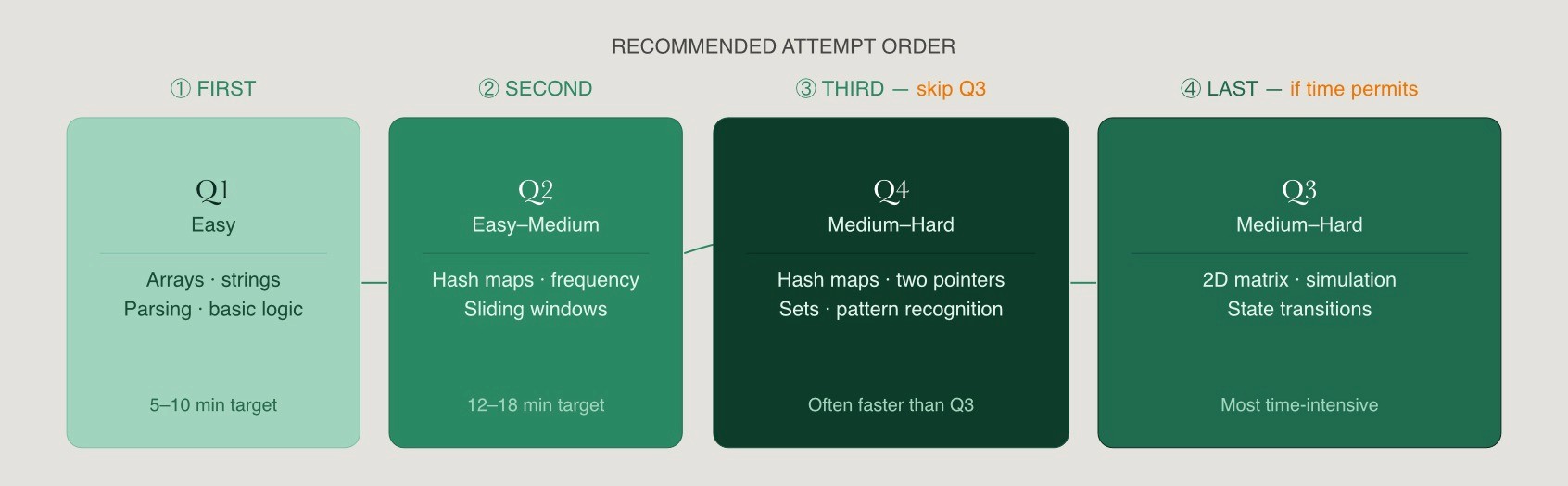
Question 1 and Question 2 in the assessment are categorized as easy, focusing on basic problem-solving skills such as array manipulation and string parsing. An experienced person should usually solve Q1 in 5-10 minutes and Q2 shortly after, assuming the description is read carefully.
Question 3 is usually implementation-heavy, often involving a 2D array, matrix traversal, simulation, or state transitions. Questions 3 and 4 are considered medium to hard, often involving complex data structures and algorithms, such as manipulating 2D matrices and detecting patterns.
Question 4 is often medium-hard, with hash maps, sets, sliding windows, two-pointer logic, or pattern recognition. Trees and simple graphs may exist, but advanced traversal algorithms are rarely required. Candidates typically complete the easiest tasks first, working through questions in the order of Q1, Q2, Q4, and then Q3 if time permits.
The time limit is intentionally tight, with very few candidates finishing all four questions. The advantage comes from quickly deciding whether Q3 or Q4 offers the better path to partial progress.
GCA Rules, Proctoring, and Allowed Resources
For a certified codesignal assessment, follow the rules exactly. You may be prompted to sign in, verify ID, share a camera view, and take the test in one sitting in a quiet environment. Use Google Chrome if the setup page recommends it, and check access, camera, and system permissions before the exam.
CodeSignal allows syntax reference searches, such as checking standard library details for a programming language, but not AI coding assistants, external help, or searches for full solution logic. Multiple submissions per question are allowed, and candidates can submit their solutions as many times as needed during the assessment, with the highest score being kept as the final submission.
The assessment allows candidates to move between tasks, but they must submit their work before leaving a task to ensure their code is saved. You can choose a preferred language at the start, but switching languages mid-test is rarely helpful unless a major issue appears.
How Companies Use the CodeSignal GCA
Many AI-first companies and major tech employers use the CodeSignal general coding assessment as a standardized filter before technical interviews, including for AI engineers and ML researchers. It is usually one component in a broader process that may include ML case studies, architecture reviews, research discussions, or LLM system evaluation.
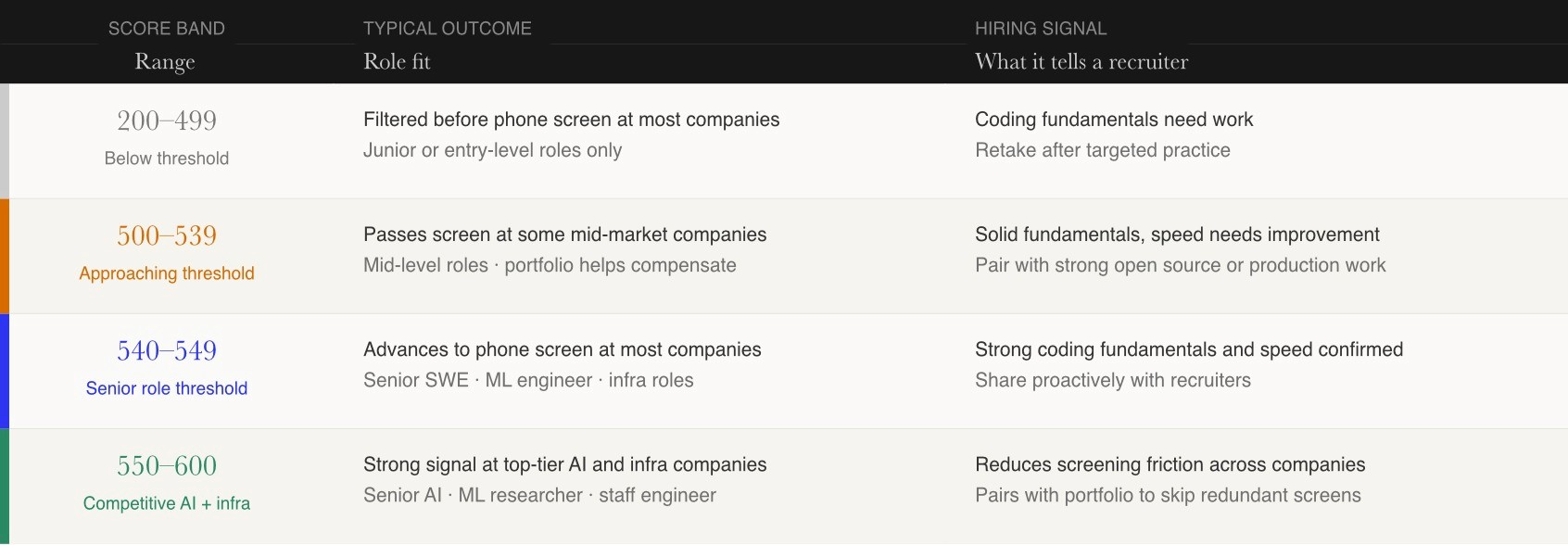
Companies often benchmark candidates against historical score distributions. A score around 540 or higher can be strong for senior roles, while 550+ is often treated as a clearer signal for advancing to a phone screen or later stage. Candidates are scored primarily on their correctness, code quality, implementation, and speed, although official scoring is driven heavily by test cases passed.
CodeSignal’s Industry Coding Framework can appear alongside or instead of the GCA for product-style engineering roles, where incremental feature building matters more. Curated marketplaces such as Fonzi may use standardized CodeSignal assessment results to match candidates with AI startups faster, reducing duplicated assessments across a job search.
Structured Hiring, AI Tools, and Human Judgment
Modern hiring uses structured assessments, skill signals, and AI tools to manage volume. This can reduce reliance on proxies such as school, company pedigree, or network access.
AI-driven interviewers and ranking tools can create a helpful summary message about performance, code quality, and problem-solving patterns. Still, human reviewers should interpret tradeoffs, debugging behavior, research depth, and real-world development experience, especially for senior candidates.
In structured hiring processes, a strong CodeSignal GCA plus a portfolio, publication record, or infra project can shorten time-to-offer because recruiters can figure out baseline coding ability quickly.
Score Validity Windows and Retakes in Practice
Even though CodeSignal does not hard-expire results, many employers want recent test results, usually from the last 6-12 months. If you are invited to a new assessment by a company, check whether an existing certified score can be reused.
Because attempts are limited, do not treat the GCA as a free diagnostic. Plan 1-2 weeks of targeted practice, then take the assessment soon after preparation, since submitting it early in the process can improve callback rate from potential employers.
How AI and ML Practitioners Can Prep
Senior AI and infrastructure engineers often know the concepts but may be out of practice with timed coding assessments. Success on the GCA depends on improving three areas: coding fundamentals, time management, and familiarity with the platform environment. Focus on arrays, strings, hash maps, matrix traversal, and common patterns like sliding windows and recursion. For AI and ML specialists, strong debugging and clean implementation matter more than advanced ML theory.
Practice directly in CodeSignal to get comfortable with the IDE, submissions, and pacing. A strong routine combines CodeSignal practice with LeetCode easy and medium problems focused on arrays, strings, grids, and hash maps. During the assessment, prioritize working solutions first, manage time carefully, and avoid getting stuck optimizing too early.
Two-Week Plan for Experienced Engineers
Days | Topic | Practice Source | Daily Time |
1-2 | Arrays, strings, parsing | 2 CodeSignal General practice questions, 4 LeetCode easy | 60 min |
3-4 | Hash maps, sets, lookup tables | 4 LeetCode easy/mediums | 75 min |
5-6 | Sliding windows, two pointers | 2 CodeSignal questions, 3 LeetCode mediums | 75 min |
7-8 | 2D matrix traversal | 4 matrix problems, review failed tests | 90 min |
9-10 | Simulation and state transitions | CodeSignal-style implementation tasks | 90 min |
11-12 | Q4-style pattern detection | Medium problems with pruning and clean modeling | 90 min |
13-14 | Full mock and review | 70-minute mock GCA plus post-mortem | 90 min |
Writing Robust Code Under GCA Constraints
Experienced engineers often lose points through edge cases, constraint mistakes, or messy implementation. Treat each task like a small production function: clarify input and output, name invariants, test minimal cases, and keep code readable.
Using a concise programming language like Python helps candidates code solutions significantly faster than more verbose languages like Java or C++. Python programming is usually the best choice for ML researchers unless Java or C++ is your daily tool. Avoid external frameworks such as NumPy or PyTorch, because the assessment environment is focused on standard language support.
Reading Prompts Carefully and Designing Before Coding
Spend 1-2 minutes restating the prompt, checking examples, and identifying input limits. Before coding, note whether order matters, whether memory is constrained, and whether the output format has subtle elements.
Small helper functions can prevent errors, especially for boundary checks in a matrix or validation logic in a string problem. A short plan, such as “parse, transform, aggregate,” can save more time than immediate coding.
Debugging, Custom Tests, and Partial Credit
Use custom tests to reproduce failures with the smallest input: empty array, one element, duplicate values, minimal grid, or conflicting conditions. Temporary prints are fine during debugging, but remove noisy output before final submission.
Partial scoring rewards incremental correctness. A basic solution that passes visible tests and smaller hidden cases is better than a blank file. If a later attempt regresses, CodeSignal keeps the highest-scoring submission, so early working submissions reduce worry.
Integrating the GCA Into Your Broader AI Career Strategy
A strong CodeSignal general coding assessment score is useful, but it is only one part of a senior AI, ML, or infra profile. Use it as baseline proof of general coding, then let research papers, open source work, architecture notes, or production systems show higher-order skills.
In 2026, companies often pair a strong GCA result with ML case studies, design interviews, LLM-focused system evaluations, or research presentations. Structured hiring processes, including curated marketplaces like Fonzi, can reduce repeated generic screens by sharing verified assessments and portfolios with multiple companies.
Positioning Your GCA Score With Employers
Treat a certified score as a data point you can share proactively. Include the score, date, language, and whether proctoring was used when contacting recruiters or updating a hiring platform profile.
Be transparent if an older score may not reflect current ability. If the score is recent and high, it can help a recruiter move you past a redundant screen and toward the conversations that matter for the position.
How Fonzi Helps Engineers Navigate CodeSignal Hiring Processes
Fonzi matches AI engineers, ML researchers, and infrastructure candidates with companies that evaluate technical depth beyond a single assessment score. CodeSignal results factor in, but so does production experience, open source work, and real role fit, which means strong candidates aren't filtered out because their background doesn't look right on a resume screener.
The practical difference is less repeated screening friction. Fonzi aligns candidates with companies that have already indicated what they're looking for technically, so the process moves faster and the conversations that happen are more relevant. Match Day is the main event format: a structured session where engineers with AI, ML, and infrastructure backgrounds meet multiple companies in one place, with recruiter review and portfolio signals in the mix alongside any assessment results.
Summary
The CodeSignal GCA is a standard screen for software engineers, AI engineers, ML researchers, and infrastructure candidates. The format is 70 minutes, four questions, covering arrays, strings, hash maps, matrix traversal, and debugging. Scores run from 200 to 600; 540+ is the threshold that tends to move candidates forward at competitive companies.
Preparation that works: LeetCode easy and medium problems for the underlying patterns, full timed mocks in the actual CodeSignal environment for pacing and IDE familiarity, and a pass through your weak spots in debugging and edge case handling before the session. The IDE and scoring system are different enough from LeetCode that practicing in the real environment specifically is worth the time. Most serious companies treat the GCA score as one input alongside production experience, research work, open source contributions, and live interviews rather than a standalone filter.
FAQ
How often can I retake the CodeSignal General Coding Assessment?
What CodeSignal GCA score is competitive for senior AI or ML roles?
How is the GCA different from company-specific CodeSignal assessments?
Can I use AI coding assistants during the GCA?
How should I balance GCA prep with research or production interview preparation?