Anthropic Interview Process: What Each Stage Screens For
By
Samara Garcia
•

The Anthropic interview process tests senior software engineers on production-grade coding, system ownership, and their stance on AI safety across six interview rounds plus reference checks, commonly over four to six weeks. Most prep guides still describe an algorithm-heavy loop that no longer matches what candidates report. Much of that advice also predates July 2025, when Anthropic replaced its request that candidates avoid AI assistants during the application process with stage-by-stage guidance on its candidate AI guidance page.
Key Takeaways
The Anthropic interview process for senior software engineers runs a recruiter screen, a hiring manager conversation, a CodeSignal assessment, live coding, system design, and a culture and values round. Engineering loops commonly take four to six weeks, and the stages test technical depth, reasoning, and mission alignment together rather than any one in isolation.
Anthropic's current candidate AI guidance sets different rules for applications, take-home assessments, and live interviews, a real change from the earlier request that candidates avoid AI assistants during the application process, which most circulating advice still assumes.
The CodeSignal assessment is a single problem that escalates across four levels, closer to extending a small production system than solving isolated puzzles, and a single failing test at one level blocks every level after it.
Anthropic Software Engineer Interview Stages: Sequence for Senior Engineers
This sequence is based on Anthropic's public documentation plus recent candidate reports on forums. The exact order can shift by team and role, and infrastructure or research engineering loops sometimes add or reorder stages.
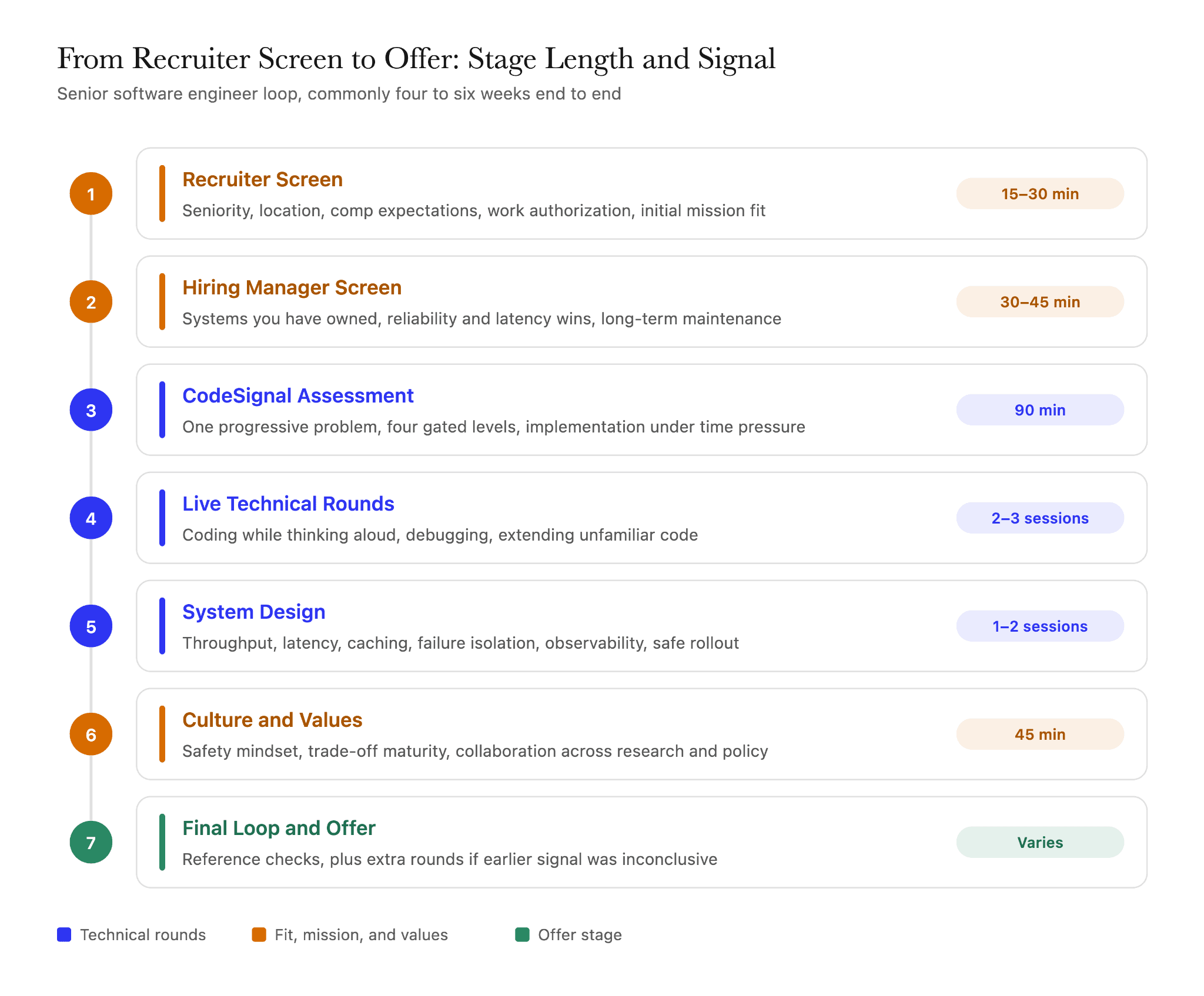
Here is the common path for a senior software engineer:
Recruiter screen (15 to 30 minutes): Validates seniority, location, compensation expectations, work authorization, and initial mission fit.
Hiring manager screen (30 to 45 minutes): Probes systems you have owned, reliability or latency improvements you drove, and how you think about long-term maintenance and AI safety.
CodeSignal assessment (90 minutes): A progressive coding problem across four levels, testing your ability to implement, extend, and handle new requirements under time pressure.
Live technical rounds (2 to 3 sessions): Coding under observation, debugging, and sometimes extending existing code in shared environments such as Colab and CodeSignal.
System design (1 to 2 sessions): Designing infrastructure relevant to AI workloads, APIs, or data pipelines, with emphasis on quantifying assumptions.
Culture and values conversation (45 minutes): Scenario-based questions on safety, trade-offs, and collaboration across research, product, and policy boundaries.
Final loop and offer: Reference checks, occasionally additional rounds if earlier signal was inconclusive.
Engineering loops commonly run four to six weeks, and research or team-matched roles can run longer.
Recruiter and Hiring Manager Screens: Establishing Fit Early
The recruiter call and hiring manager screen serve different purposes, and senior candidates should treat both as substantive. The recruiter validates whether location, timeline, and compensation expectations are viable. Compensation can vary significantly at the highest levels. Compensation at the top of the range can be striking: H-1B filings reviewed by Business Insider in June 2026 list base salaries under Anthropic's Member of Technical Staff title running from roughly $134,000 to $1.38 million, before equity or bonuses. That title covers everyone from newly hired researchers to executives, so read the ceiling as evidence of spread rather than a senior engineering benchmark, and note that figures vary by location, level, and specialization.
The hiring manager conversation goes deeper. They want to understand the scope of production systems you've owned, how you improved reliability or latency, and how you led teams through ambiguous technical decisions. Frame your experience around systems you personally built or rescued, rather than a resume list of technologies. Treat the examples you raise here as the ones you may be asked to defend later, so lead with systems you can go deep on.
Anthropic's CodeSignal Assessment: What It Actually Tests

Anthropic uses a CodeSignal assessment for most software engineer roles. Unlike a set of isolated algorithm questions, this is a single progressive problem built across four levels of complexity, and each level unlocks only after the previous level's test cases pass, so a single failing test blocks every level after it.
Candidate reports describe problems like building a mini banking system, an in-memory database, a task scheduler, or a URL crawler. Each level introduces new requirements that force you to extend your earlier solution: adding features, handling additional edge cases, or meeting performance constraints. This is closer to writing production code than solving a textbook puzzle, with a standard 90-minute time limit.
What separates a strong performance from a weak one:
Correctness first. Pass all tests at each level before attempting to optimize. If you get stuck on level two, you cannot reach levels three or four.
Readable code. Use clear naming, consistent methods, and thoughtful data structures. CodeSignal grades correctness automatically, so treat readability as practice for the live rounds that follow.
Edge case discipline. Anticipate boundary conditions, empty inputs, and concurrent operations rather than relying on the visible tests alone.
Standard LeetCode prep will not cover this format. Practice implementing small services from a spec in Python, since coding stages generally run in a shared Python environment inside CodeSignal's browser interface. Run at least one full timed practice session in that interface rather than relying on your day-to-day editor, shortcuts, and tooling.
Live Coding Rounds: From Writing Code to Explaining Trade-offs
Live coding rounds follow the CodeSignal assessment and test how you write code while thinking aloud, debugging, and collaborating with the interviewer. Tasks tend to be realistic: extending an existing codebase, integrating with an API, building a small concurrency primitive, or cleaning up flawed logic. The bar for senior engineers includes strong decomposition, clear naming, and the ability to articulate trade-offs between simplicity, performance, and extensibility.
What Anthropic rewards in these rounds:
Proactively proposing tests and discussing failure modes before the interviewer asks.
Considering how the solution would behave in production, not just the happy path.
Asking clarifying questions when requirements are deliberately underspecified.
To prep, practice coding in CodeSignal's browser editor and in a shared document without autocomplete or heavy tooling. Working through open-source code reviews is a good way to build the habit of reading and extending someone else's code under time pressure. Focus on clear verbal explanation of each design choice; the person on the other side of the screen is evaluating how you think, not just whether your code compiles.
System Design At Anthropic: What the Prompts Look Like
System design at Anthropic sits in the context of large-scale AI systems, even when the role is general backend or infrastructure. Prompts often involve designing a low-latency API that fronts a large model, building a feature-flagging or experiment system, or architecting a pipeline for evaluation and logging. Each one tests how you reason about throughput, latency, caching, failure isolation, and observability.
Senior candidates are expected to scope assumptions explicitly, estimate orders of magnitude for operations per second or storage, and describe how the system evolves over time, including how you would roll out changes safely. The round is typically conducted in a shared document rather than a diagramming tool, so practice describing architecture in structured text and simple sketches, and lead with assumptions and constraints before drawing anything.
To prepare, revisit your own war stories from scaling systems, refresh on queue-based architectures and backpressure, and practice verbalizing tradeoffs out loud. Experience with model serving, inference latency, or data pipeline reliability carries real weight here.
Can You Use AI in Anthropic Interviews? The Policy by Stage
Anthropic's current candidate guidance sets separate rules for three contexts. When applying, write the first draft of your resume and application answers yourself, then use Claude to polish how you communicate it. During take-home assessments, work without Claude unless told otherwise. During live interviews, use no AI assistance unless told otherwise. This replaced the earlier request that candidates avoid AI assistants during the application process, and many competing guides still describe the older policy.
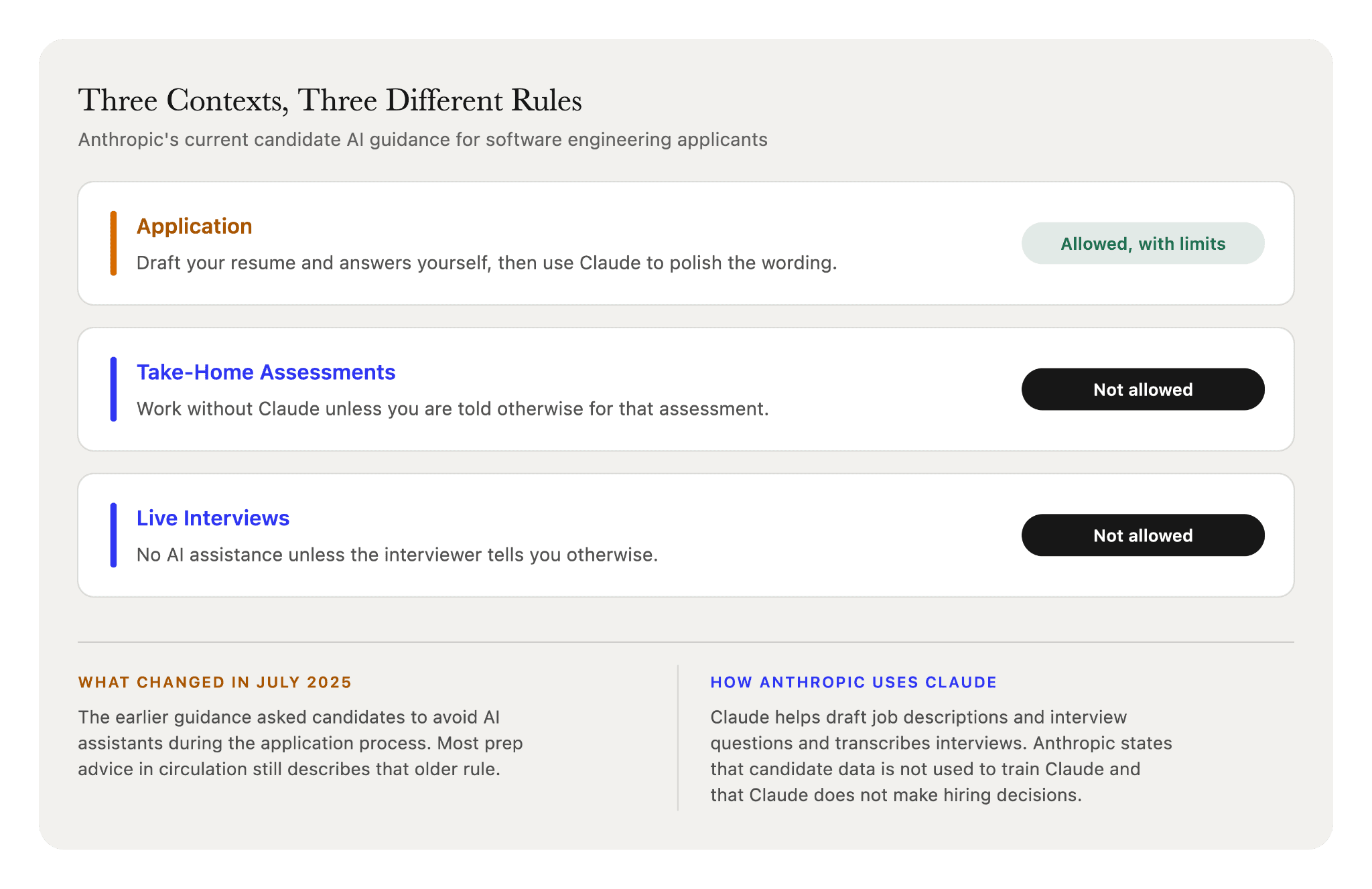
Anthropic is interested in how engineers integrate AI into their workflow responsibly, not whether they can use it as a shortcut. Be ready to discuss how you would use Claude in real engineering workflows, such as exploring alternatives, checking understanding, or generating test scaffolding, while demonstrating mastery of the core skills yourself. The same guidance notes that Anthropic uses Claude in parts of its own hiring workflow, including drafting job descriptions and interview questions and transcribing interviews, while stating that candidate data isn't used to train Claude and that Claude doesn't make hiring decisions.
Answering "Why Do You Want To Work At Anthropic?" as a Senior Engineer
This question appears in early screens and late-stage interviews, and a generic answer about AI being interesting or transformative lands poorly. Interviewers have heard it hundreds of times.
Reference Anthropic-specific work: Claude releases, model interpretability research, Constitutional AI, and public safety policies. Connect these to your own engineering experience. If you've built reliable tooling for evaluation at scale, improved latency for a customer-facing API, or enforced compliance constraints that slowed shipping velocity, say so, and explain why that experience draws you to Anthropic's specific problems. Steer clear of stock mission statements, overemphasis on equity upside, or vague admiration for "frontier models." Reading the company's blog, model cards, and policy announcements is a good starting point for forming a specific, honest answer.
Anthropic Interview Questions on Culture, Collaboration, and Safety
Later-stage interviews assess how a senior software engineer collaborates across research, product, and policy boundaries. Anthropic interview questions in this round tend to be multi-layered, following up on how you reason about ethics and safety rather than accepting a first answer. They probe for a safety mindset: habits like thinking about failure modes, adversarial use, privacy risks, and prioritizing mitigations even when they slow short-term velocity.
Questions may explore conflict resolution, influencing without authority, mentoring more junior engineers, and navigating ambiguous requirements. Prepare three to four concrete stories from real incidents, postmortems, or long-term reliability projects. Candidates who perform well technically still get rejected in this round, so prepare for it with the same seriousness as the coding stages. Maturity in how you talk about trade-offs matters as much as the trade-offs themselves.
How to Prepare for Each Stage: A Focused Track for Senior Engineers
Senior candidates rarely have free weeks to devote to prep. Here is a focused track:
CodeSignal practice (3 to 5 sessions): Time yourself against the full 90-minute limit.
Live coding rehearsal (2 sessions): Pair with a peer. Practice narrating your thought process while solving problems with no autocomplete.
System design refresher (2 sessions): Run mock sessions covering interfaces, scaling, and rollout strategies.
Anthropic research (2 to 3 hours): Read the company's blog, recent model cards, and safety publications. Prepare your answer to "Why Anthropic" with specific references.
Story alignment (1 session): Map your best examples of careful rollout, cross-team collaboration, and solving problems under uncertainty to the themes Anthropic screens for.
As a bonus, articulate your own AI development philosophy, including when and how you would use tools like Claude in day-to-day engineering.
Summary: Preparing for the Anthropic Interview Process
The Anthropic interview process rewards production-grade engineering, thoughtful system design, and a mature view of AI safety over puzzle-solving speed. The Anthropic CodeSignal assessment is one problem across four levels in 90 minutes, and each level stays locked until the previous one passes, so correctness at every level matters more than reaching the last one. Read Anthropic's candidate AI guidance before you start, since the rules differ for applications, take-home assessments, and live interviews. Map your own experience against each round, narrow down to a small set of concrete examples you can tell well, and schedule targeted practice for CodeSignal and system design before your loop starts.
Candidates who know what each stage screens for avoid the two common preparation mistakes: over-indexing on algorithm drills and under-preparing for the values round.
FAQ
How long does the Anthropic CodeSignal assessment usually take, and how should I pace myself?
How deeply should I read Anthropic's research papers before my interview loop?
Will system design interviews at Anthropic always involve AI or ML components?
Should I expect pair programming during live coding rounds?
How much should I talk about AI tools like Claude during interviews that are not explicitly about AI use?