TypeScript Skills That Top AI Startups Hire For
By
Samara Garcia
•

At AI startups, TypeScript is the application layer between Python model stacks and users. The TypeScript skills that get senior engineers hired there run to schema design at the model boundary, orchestration of inference calls, and validation of output before it reaches a database or a screen. Most of these roles span front end, backend APIs, and integration with AI services, so framing yourself only as a "front-end engineer" misses the scope companies expect.
Key Takeaways
AI startups treat TypeScript as the application layer around Python-based model stacks, spanning frontend, backend APIs, and AI service integration, not as a pure frontend credential.
On Fonzi, roles listing TypeScript skew overwhelmingly senior and cluster around AI Engineering ahead of traditional Full Stack or Back End roles, typically paired with Python, React, and infrastructure like Postgres, Rust, Go, and Node.
Interviews for these roles weight founder and product conversations as heavily as technical rounds, often more heavily than formal system design, so strong candidates prepare for both equally.
Where TypeScript Shows Up in AI Startup Roles
Roughly a quarter of open engineering roles on Fonzi as of August 2026 list TypeScript, with AI Engineering as the largest group, ahead of Full Stack and Back End, and Forward Deployed Engineering close behind. While thousands of TypeScript developer positions are open nationwide, the AI startup segment treats the language differently from the broader software market.
AI Engineering roles use TypeScript to build the layers that sit on top of Python models: chat orchestration systems, tool calling and chaining for agentic workflows, evaluation dashboards, and wrappers around Python model APIs. Engineers in these positions define type contracts for model inputs and outputs, serialize and deserialize JSON from Python services, and build front-end interfaces for feedback collection. Full stack TypeScript developer and Back End roles apply the language to API gateways, Node-based services, shared validation logic, and React front ends, most often alongside Python and React. Typical stack combinations include React, TypeScript, Node, and Python, or Next.js, TypeScript, Python, and Postgres.
Traditional "frontend only" TypeScript positions focus on UI components, CSS, browser performance, and design system work. They do not involve model boundary design, inference orchestration, or validation of model output, and at AI-native companies, pure frontend-only roles are rare.
Core TypeScript Skills AI Startups Actually Assess
TypeScript in AI Application Architectures
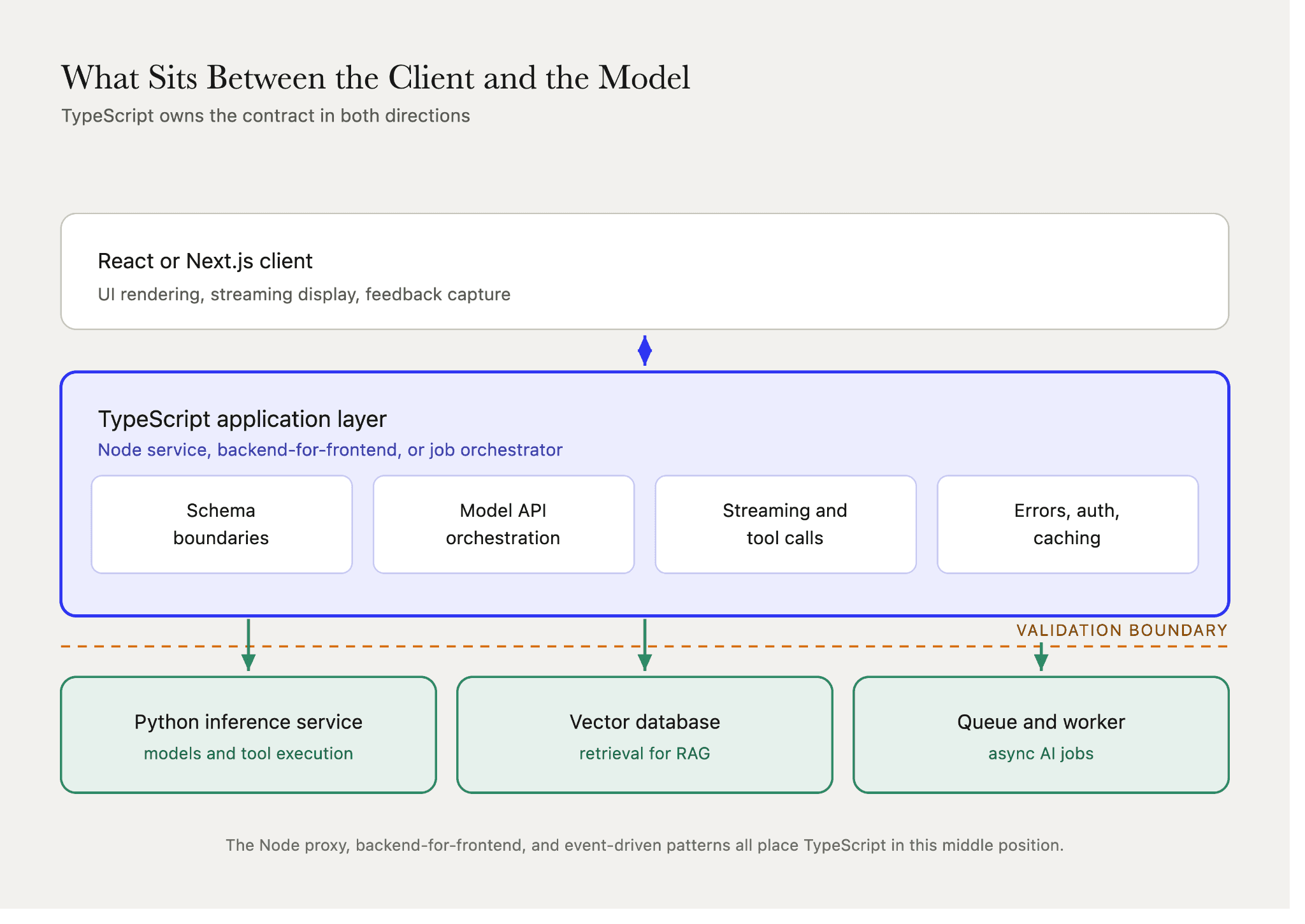
In most AI startups, TypeScript lives in the same architecture as Python, vector databases, and message queues, and it often defines the contract between those elements. Its type system models complex systems effectively, which is why it serves as the bridge between model services and the rest of the stack, and type-safe API designs prevent incorrect usage of application data across these boundaries. Common architectural patterns where TypeScript is central include:
Node API proxying to Python inference services. The frontend calls a TypeScript/Node.js endpoint, which forwards requests to Python model servers, validates responses, and normalizes streaming or tool calls back to the client.
React client plus TypeScript BFF. The client uses React or Next.js and fetches through a backend-for-frontend service that applies authentication, caching, validation, and model API orchestration.
Event-driven flows. A user action triggers an AI job via a queue. A Python worker processes it while a TypeScript service handles job state, result delivery, error handling, and observability.
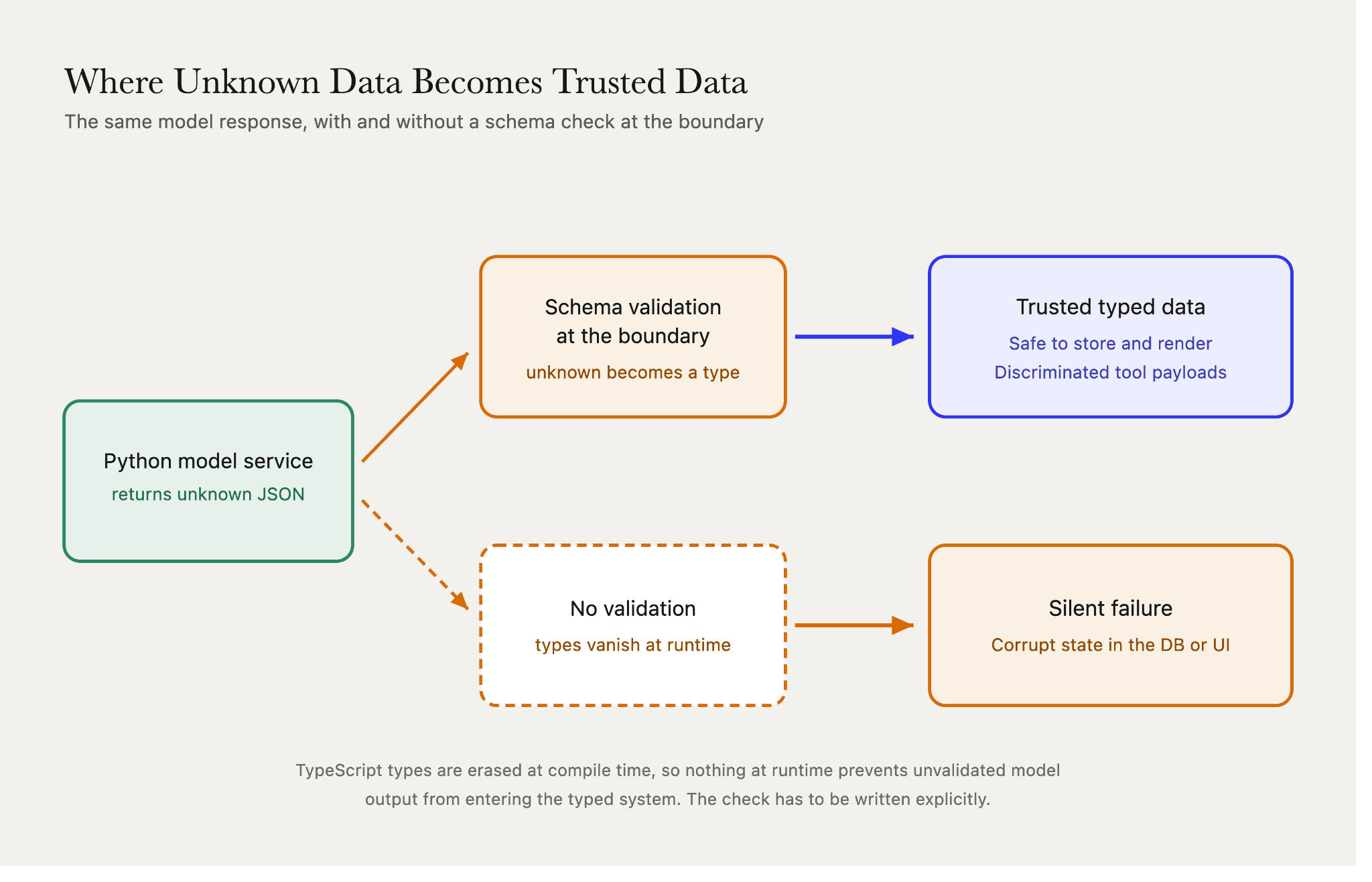
TypeScript types model LLM inputs and outputs, tool invocation schemas, and streaming responses, which matters for security and observability in production AI systems, since untyped model output that reaches the UI or database without validation creates silent failures. Consider two concrete scenarios:
AI-Assisted Code Review Tool: Uses a React front end for diff visualization, paired with a TypeScript backend that dispatches requests to Python models, aggregates outputs, and streams suggestions back.
Customer Support Copilot: Uses TypeScript to orchestrate agent workflows, query vector stores for retrieval-augmented generation, validate model answers, and log feedback metrics.
In both cases, TypeScript is not rendering pages. It is the application layer ensuring model output reaches users safely.
Traditional Front End vs AI Application Layer TypeScript
Senior candidates are judged on their ability to operate across the full scope of AI application work, not only on building UI components. The following table clarifies how expectations shift.
Aspect | Traditional Front End TypeScript | AI Application Layer TypeScript |
Responsibilities | UI components, styling, state management, client-side performance, accessibility | Schema boundaries, model API orchestration, inference handling, streaming, tool invocation, error and safety validation |
Main Integrations | Design systems, UI libraries (React, Angular, Vue), bundling tools, browser APIs | Python model services, external LLM APIs, vector databases, Node.js backend services, event queues |
Data Modeling Focus | Component props, local state, event handlers, context types | Model input/output schemas, shared client-server types, typed error cases, conditional types encoding AI-centric flows |
Typical Interview Coding Tasks | Responsive component behavior, CSS architecture, rendering optimization, lazy loading | Typing complex model responses, writing generic API clients, validating unknown external input, building safe tool invocation layers |
Interview Process Patterns for Senior TypeScript Roles
Based on the same August 2026 role analysis, the median interview process runs four rounds, with roughly half including either a take-home or a live coding session [verify at fonzi.com]. That structure reflects what AI startups value in senior engineers: founder or CEO conversations appear more often than formal system design rounds, connected to the expectation that senior engineers shape product direction, weigh trade-offs around cost versus quality, and ship AI features at speed. These are not culture-fit chats. They test whether you can align on product goals and articulate how you would earn trust with a team you haven't worked with before.
What a TypeScript Coding Test Looks Like at an AI Startup
Common technical rounds include a TypeScript-focused coding interview, a pairing session on a React or Node codebase, and a discussion of prior architecture decisions around AI or data-heavy features. Some companies explicitly require candidates to use AI coding tools during the technical interview, and evaluators look for tool literacy, judgment in accepting or overriding suggestions, the ability to verify generated code for type safety, and skill in debugging hallucinated output. For a closer look at what interviewers are watching for in that setup, Fonzi has broken down how engineers who use AI tools get evaluated in technical interviews.
System Design Rounds for AI Application Layers
System design, when present, often centers on designing an AI-enabled application layer, with prompts like "design a retrieval-augmented generation pipeline with a TypeScript orchestration layer" or "architect a tool-calling agent with typed schemas and fallback logic," rather than generic microservices questions.
How to Prepare: Code, Product, and Founder Conversations
Since founder rounds appear more often than system design rounds, allocate preparation time accordingly. Many candidates over-index on whiteboard architecture and under-invest in the conversations that actually determine hiring decisions.
For coding rounds:
Practice TypeScript problems that go beyond basic syntax: generics, mapped types, conditional types, discriminated unions, template literal types, and strict null handling.
Refactor a JavaScript prototype into TypeScript with increasing strictness.
Build a small Node plus React demo that calls a hosted model API, validates responses with a schema validator, and tests boundary cases.
For founder or CEO discussions:
Articulate your career journey showing ownership of ambiguity, not just code quality.
Prepare examples of shipping AI features under uncertainty, including trade-offs you made and how you measured outcomes.
Be ready to discuss failure modes of model output, how you handle them, and what view you take on cost versus reliability.
For AI tool usage:
Rehearse workflows involving tools like Copilot or Claude Code.
Know where they help, where they fail, and how you maintain code correctness.
Be specific about mistakes you made using these technologies and what checks you now apply.
Questions worth asking interviewers:
How does your team split work between TypeScript and Python?
How do you validate model outputs?
Where do your shared types live, and how do they stay in sync between client and server?
What does senior ownership look like on your team?
What operations do you expect this position to cover beyond writing code?
Using Market Signals to Target the Right TypeScript Roles
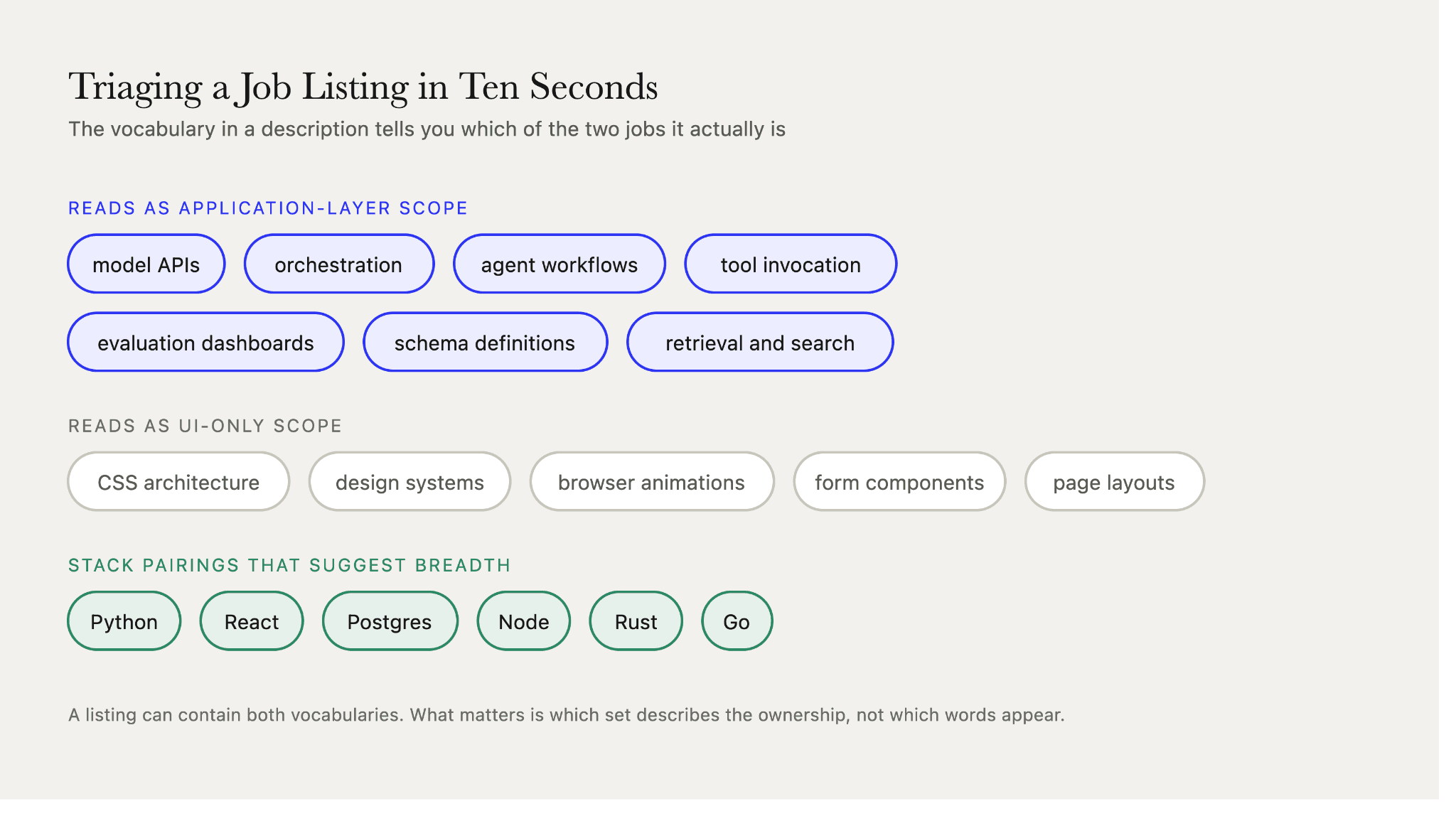
Senior TypeScript developers should read role descriptions across AI Engineering, Full Stack, Back End, and Forward Deployed Engineering to learn how the language is used in each, since its function varies widely: an AI Engineering listing that mentions tool invocation, evaluation dashboards, and Python services is a different job from a frontend listing focused on form components and page layouts. Identify roles where TypeScript is clearly connected to Python, React, Postgres, Rust, Go, and Node, since those pairings suggest broader scope than UI-only work. Distinguish between positions that keep TypeScript confined to UI work and those that give ownership of the entire AI application workflow from API design to front-end integration: a listing that mentions model APIs, orchestration, agent workflows, search, or schema definitions is an application-layer role, while one focused on CSS, design systems, and browser animations is not.
Remote-focused job boards are worth scanning for scope as much as volume, since the space is active but not every listing carries the same level of end-to-end ownership. Align your preparation and portfolio projects with the specific mix of TypeScript and adjacent technologies you see in your target roles, and treat contributions to open-source shared type libraries, schemas, or validation logic as strong signals that you can build reliable, cross-stack TypeScript systems.
How Fonzi Shortens the Search for Application-Layer TypeScript Work
Finding a TypeScript role that actually matches this profile is hard from the outside, since job titles rarely signal whether a listing means UI work or full application-layer ownership, and reading through descriptions one company at a time is slow. Fonzi is a curated AI engineering hiring marketplace that connects companies with pre-vetted AI and software engineers, and because listings are already scoped, engineers spend less time filtering out roles that only touch TypeScript at the UI layer.
Fonzi also runs Match Day, where companies meet batches of pre-vetted AI and software engineers, which gives engineers a faster way to reach several relevant AI startups at once instead of applying company by company. This does not replace reading a job description carefully, but it does shorten the distance between recognizing this profile in yourself and finding a company that is actually hiring for it.
Summary
TypeScript at an AI startup is rarely a frontend-only skill. It is the layer that carries model input and output safely between Python services and the people using them, which is why senior hiring draws on schema design, orchestration, and validation as much as component work. The TypeScript skills worth deepening are the ones at that boundary. Preparation should split between coding practice, comfort with AI-centric architectures, and founder-level conversations about product and impact, since founder or CEO rounds appear more often than formal system design rounds in these processes.
Review your current projects and target roles against that boundary, and prioritize the ones where TypeScript gives you end-to-end ownership of an AI feature rather than just its interface.
FAQ
How different is a TypeScript AI Engineering role from a traditional front-end role?
Do I need prior machine learning experience to succeed in these TypeScript roles?
How should I showcase my TypeScript skills for AI-focused startups?
What is the best way to prepare for take-home or live coding sessions?
How important is location, for example, being in San Francisco, for these roles?