Vibe Coding Cleanup Specialist: Inside the Specialization Rescuing AI Codebases
By
Samara Garcia
•

A startup validates its AI-built prototype, picks up real users, and watches the code start breaking in ways nobody predicted. A vibe coding cleanup specialist is the senior engineer brought in after that prototype ships, to make the system survive contact with real users and real security scrutiny. The job means reading modules you did not write and working out what the AI meant to build. Plenty of senior engineers question whether it needs a title of its own, and that objection deserves a serious answer.
Key Takeaways
A vibe coding cleanup specialist is not a new profession. It is a specialization of senior engineering work focused on turning messy, AI-generated prototypes into maintainable, secure systems that can survive real users.
The work is brownfield refactoring and architecture triage, not greenfield feature building. That distinction is the single most decision-relevant fact for anyone weighing whether to take one of these roles.
Demand for this kind of cleanup work is real right now, but the title itself will likely fold back into standard senior or staff engineer roles within a few years. The underlying skills are what last, not the label.
What Is a Vibe Coding Cleanup Specialist, in Practical Terms?
Vibe coding means building software through natural language prompting: a developer describes the behavior they want, an LLM generates the corresponding code, and the developer iterates on the output, usually with minimal upfront design or architecture planning. That approach lowered the barrier to shipping an MVP, which is why startups adopted it aggressively for early prototypes. It also tends to produce messy architecture and hidden bugs once real users show up.
A vibe coding cleanup specialist transforms those AI-generated prototypes into production-ready applications. The role sits at the intersection of refactoring, security hardening, and architecture triage. Typical responsibilities include removing dead or duplicated code that AI tools generate by default, aligning naming conventions and style with team standards, hardening API and data access layers that were built as quick stubs, adding observability where none exists, writing or fixing tests the original vibe coders never created, and restructuring monolithic files into modular, readable components. In most organizations, this is not a new career ladder. It is a specialization of senior backend, staff, or platform engineering work, repackaged for a specific type of mess.
Why Vibe Coding Cleanup Work Emerged: AI Prototypes, Deadlines, and Technical Debt
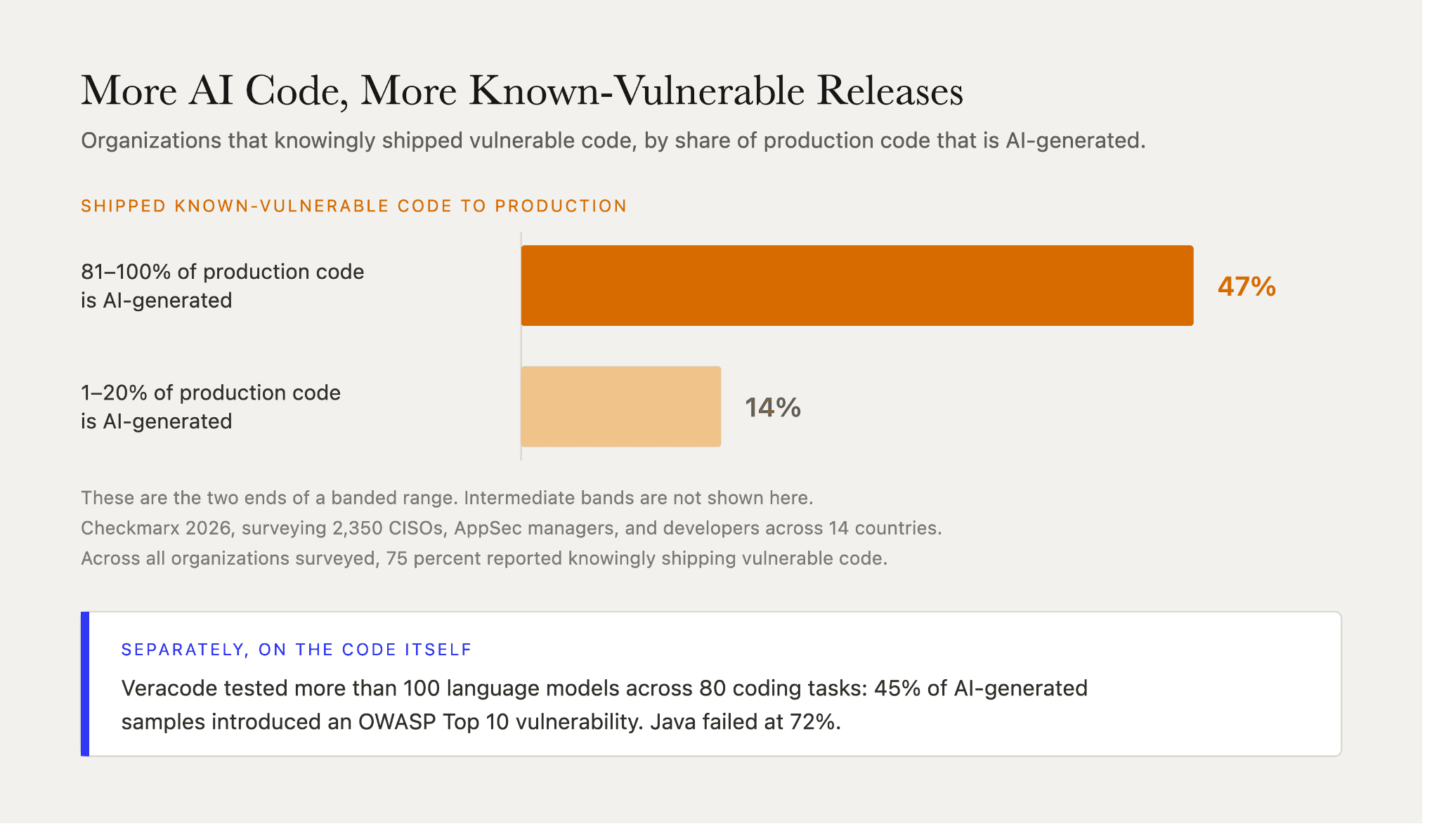
The 2024 to 2026 rush to ship AI prototypes created a predictable pattern. Product managers and founders accepted vibe coding for MVPs because speed mattered more than code quality at the validation stage, and maintenance costs exploded months later. Google reported more than 25% of its new code was AI-generated as of its Q3 2024 earnings call, and now puts AI-generated code at roughly 75% of its production code, a figure cited in New Relic's 2026 State of AI Coding report. That volume comes with a cost: Veracode's 2025 GenAI Code Security Report, which tested more than 100 large language models across 80 coding tasks, found that 45% of AI-generated code samples introduced OWASP Top 10 vulnerabilities, with Java failing at 72%.
The pressure to ship compounds the problem. Checkmarx's 2026 Future of Application Security Report, based on 2,350 CISOs, AppSec managers, and developers across 14 countries, found that 75% of organizations had knowingly deployed vulnerable code into production, with reasons splitting fairly evenly between compensating controls believed sufficient (30%), deadline pressure (27%), and flaws not detected until after deployment (27%). AI-generated code compounds it: organizations where 81 to 100 percent of production code is AI-generated ship known-vulnerable software nearly three times as often as those at 1 to 20 percent, at 47 percent against 14 percent. This pain created real, if temporary, demand for cleanup work focused on untangling technical debt built up from overusing AI assistants. "Vibe coding cleanup specialist" is partly a marketing label attached to what used to be called a rescue project or stabilization phase. The work itself is not new. What changed is the volume of codebases that need it at the same time.
What a Vibe Coding Cleanup Specialist Does Day to Day
The engineer typically enters after a vibe-coded prototype has been built quickly and validated with real users, at the point where it is handed off for stabilization rather than at the point where it was originally designed. The first days involve reading unfamiliar AI-generated modules, mapping data flows, and identifying where the system is most fragile. Daily work includes inferring what undocumented code was supposed to do, adding logging and error handling to silent failure paths, writing unit and integration tests for untested critical paths, refactoring brittle data flows and replacing inefficient queries with indexed lookups, and resetting stakeholder expectations around scope and timelines.
AxonBuild's security audit of AI-built apps reviewed 26 AI-built applications in mid-2026 and found confirmed critical issues in nearly all of them: broken access control that let some users reach other customers' data, unprotected metered AI endpoints, and logging and auditability that scored worst of any category measured. Typical tech stack touchpoints include TypeScript and Node backends, Python data pipelines, React frontends, and cloud infrastructure where CI/CD and observability are missing or misconfigured entirely. Cleanup work usually ends with review gates for AI-generated code and codified architecture boundaries that did not exist before, which is the difference between treating a symptom and improving the underlying process.
Vibe Coding Cleanup Specialist Job Description: Common Requirements
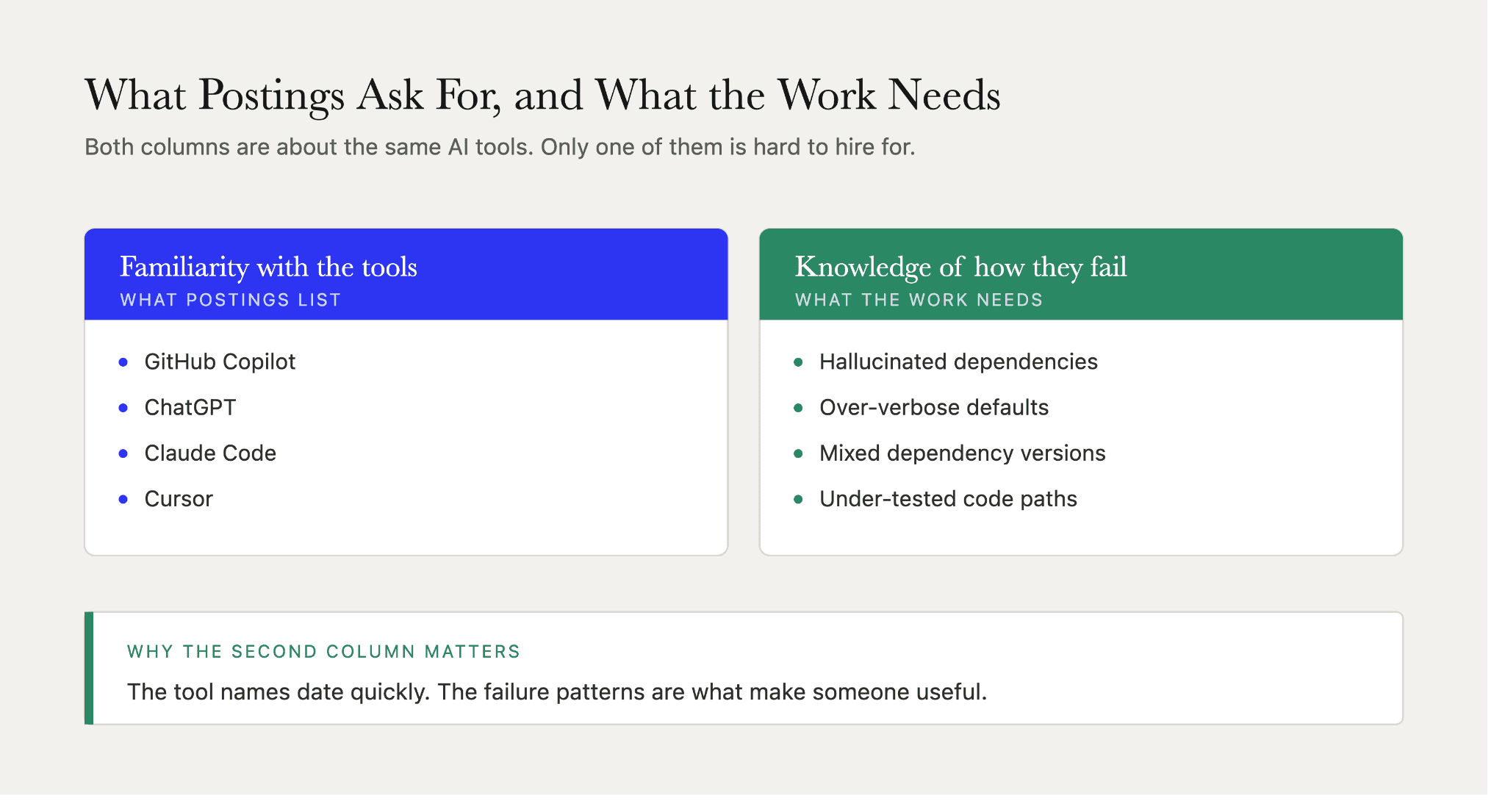
Postings in 2026 typically ask for 5 to 10 years of software engineering experience, with emphasis on legacy code migration, refactoring, stability, and security work. Common requirements across postings include strong refactoring skills and experience with large, unfamiliar codebases, familiarity with multiple AI coding tools and their typical output patterns, the ability to quantify and communicate technical debt to non-technical stakeholders, secure coding practices around input validation and secrets management, monitoring and observability setup, and the ability to design testable boundaries around AI-generated components. Where stated requirements often diverge from the real work is in the AI tooling section: postings list familiarity with Copilot, ChatGPT, Claude Code, and Cursor, but the more valuable knowledge is understanding how those tools typically fail, including hallucinated dependencies, over-verbose defaults, mixed dependency versions, and under-tested paths.
Many listings use adjacent titles. "Senior Software Engineer," "AI Platform Engineer," "Production Readiness Engineer," "AI Code Refactoring Engineer," and on the agency side "vibe code fixer" or "AI code rescue" often describe the same cleanup-heavy responsibilities in the body of the posting. The job is the same regardless of whether the title mentions "cleanup" explicitly.
Core Skills and Tooling: From Refactoring to CI/CD Hardening
What the work actually requires, as distinct from what postings list, comes down to a few categories.
Reading and restructuring unfamiliar code. AI prototypes are often a patchwork of whatever the original author prompted. Comfort with multiple languages and frameworks is not optional. Doing this work means navigating TypeScript, Python, SQL, and cloud infrastructure configs within the same project, because vibe coders rarely constrain their AI agent to a single tech stack.
Security tooling. The recurring failure classes are broken object-level authorization, where a signed-in user can reach another account's records by changing an ID, along with secrets committed to Git history and authentication flows that were never designed past the demo. The tooling includes SAST scanners, dependency and license auditing (tools like CodeQL, Bandit, Snyk), and manual review of authorization flows.
CI/CD and observability. Most vibe-coded prototypes deploy manually or not at all. The cleanup specialist sets up automated testing, staged deployments, and monitoring.
Clean code as a discipline. The emphasis on clean code in this context means readability, small focused modules, and consistent patterns to replace the fragmented boilerplate code that AI tools produce by default. The goal is that new engineers can onboard without spending days deciphering the system.
Using AI tools for cleanup. Cleanup work increasingly uses the same class of AI tools that produced the problem. The differentiating skill is directing agent-based refactoring at repository scale while maintaining human review discipline, rather than avoiding AI tools altogether. Senior engineers who do this well use AI for repetitive tasks like renaming, extracting functions, and generating test scaffolds, but verify every change against the architecture plan.
Skepticism from Senior Engineers: Should This Job Even Exist?
The most common objection is straightforward: if you hadn't vibe coded your MVP into a mess, you wouldn't need a cleanup specialist. That criticism is often accurate at a project level. Teams that treat AI code as a rough draft, review it before merging, and maintain minimal architecture boundaries typically don't end up needing rescue projects.
But organizations still end up with messy systems for a mix of reasons: business pressure to ship before competitors, hiring gaps that left junior developers building with AI tools unsupervised, and genuine inexperience with how these tools fail. New Relic's 2026 State of AI Coding report, a survey of 200 US technology leaders at mid-market and enterprise companies, found that 62% say their teams often trust AI-generated code enough to ship it without line-by-line verification, and 74% report that at least a quarter of their AI-generated code needs significant rework. The result is predictable, and it points to a real moral hazard: companies may lean into vibe coding more heavily knowing cleanup roles and services exist, effectively externalizing the risk instead of building discipline.
Some engineers describe the work as becoming permanent janitors for code that should never have shipped as it did. Anyone considering these roles should vet whether the company is also improving its development process, not just repeatedly paying for cleanup. If there's no plan to introduce testing, review gates, or architecture standards after the engagement ends, the mess will regenerate.
Vibe Coding Cleanup Specialist Salary in 2026
Because the title is not standardized, pay for this work tracks senior and staff engineer compensation bands rather than a distinct scale of its own. Current benchmarks for senior software engineer salaries and freelance senior engineer hourly rates are a reasonable starting point for comparison, with contract and freelance work generally pricing at a premium over permanent roles because the engagements are urgent and require rapid context absorption. Permanent in-house roles at AI product companies usually land at standard senior engineer pay. Short-term cleanup engagements can command higher effective rates for the same reason rescue projects always have: the work is time-boxed, the risk is concentrated, and the client needs someone productive on day one.
Engineers should compare offers against local benchmarks for seniority rather than the novelty of the job title. A "Vibe Code Cleanup Specialist" role paying senior engineer wages is a senior engineer role, and it should be evaluated as one.
Who Is Hiring Vibe Coding Cleanup Specialists Right Now
The main categories of employers break down into three groups:
Seed to Series C AI startups that rushed AI prototypes to market, validated product-market fit, and now need the code stabilized before scaling. These are the most common clients for cleanup services.
Agencies and boutique consultancies selling "vibe code fixer" or "AI code rescue" offerings as packaged engagements. These firms hire senior engineers on contract and deploy them to multiple projects.
Enterprises experimenting with internal AI tooling where leadership underestimated the follow-up engineering effort. Hiring spikes often follow large internal AI initiatives.
Direct hire roles differ meaningfully from consulting or fractional work. A full-time position at a startup means living with the codebase long-term, while a fractional engagement means moving between projects, which builds breadth but also means repeatedly walking into the hardest phase of each system. Before accepting a role, look at the company's actual tech stack, incident history, and current architecture, and treat hiring software engineers for a growing team as a two-way evaluation. If the entire project has no tests, no CI/CD, no documentation, and the founders expect one engineer to fix everything in six weeks, that's a sign of indefinite firefighting rather than a scoped engagement.
Example Engagement Flow: From Broken MVP to Maintainable System
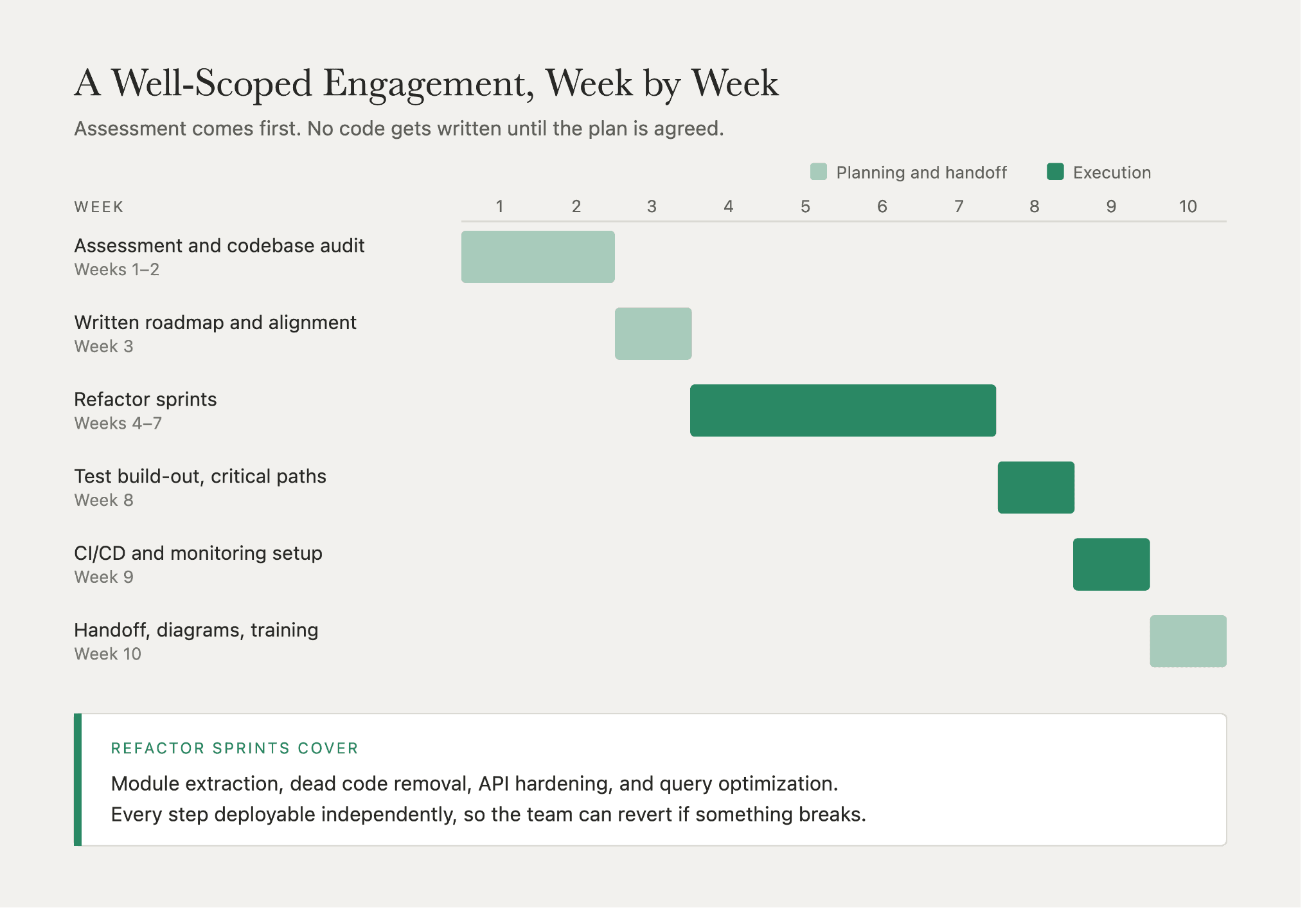
A well-scoped engagement starts with an assessment period, not with writing code. The engineer reviews the existing system for one to two weeks: mapping data flows, cataloging security gaps, measuring test coverage, and documenting what the code actually does versus what the team thinks it does.
After the assessment, the specialist produces a written stabilization plan agreed on before work begins, including a prioritized technical debt backlog and estimated effort per item. The absence of a written plan is the clearest signal an engineer is walking into indefinite firefighting.
Time-boxed cleanup sprints follow that plan: assessment and codebase audit in weeks one and two, a written roadmap and stakeholder alignment by week three, refactor sprints (module extraction, dead code removal, API hardening, query optimization) through week seven, test build-out for critical paths through week eight, CI/CD and monitoring setup through week nine, and handoff with updated architecture diagrams and team training by week ten. Best practice throughout is small, reversible changes rather than large rewrites, so each step is deployable independently, and the team can revert if something breaks.
The table below is an illustrative example of what a before-and-after comparison might look like, not a measured client outcome. The figures are rounded to show the general direction of improvement.
Metric | Before Cleanup | After Cleanup |
Production error rate | ~50 errors per day | ~10 errors per day |
Deploy frequency | Once per week (manual) | Multiple times per day (automated) |
Test coverage | ~15% | ~75% |
Time to onboard a new engineer | 5+ days | 1 day |
Security vulnerabilities (critical) | 12 open | 0 open |
In healthy organizations, the cleanup phase is time-boxed and leads to an ongoing engineering model, not an endless bailout mode. Some companies retain specialists for governance of AI-generated contributions, but that responsibility should eventually fold into normal engineering practice.
How Long Will the Vibe Coding Cleanup Specialist Title Survive?
The title is unlikely to persist as a standardized job role over the next three to five years. The more probable outcome is convergence back into existing titles like Principal Engineer, Staff Engineer, or Reliability Lead, as companies mature their use of AI-generated code and adopt guardrails, better prompting standards, and coding practices that reduce the need for a separate cleanup label. The underlying skills are durable even if the marketing label fades. Large-scale refactoring, rescue projects, and AI-aware architecture will remain valuable, and engineers who can read a broken system, identify the key risks, and lead it in the right direction will always find work. The vibe is temporary. The competence is not.
How to Decide if Vibe Coding Cleanup Work Fits Your Career
A short self-assessment for engineers considering this work:
Do you enjoy reading and fixing code you did not write? This is the core part of every engagement. If you prefer greenfield development, this will feel frustrating.
Are you comfortable with stakeholder pressure on broken systems? Founders and PMs will ask for speed. You will need the control and authority to push back.
Do you find satisfaction in architecture, testing, and process improvement? The difference between a good cleanup and a mediocre one is whether the team builds better software afterward.
Are you interested in how AI tools fail? Understanding the failure modes of Claude Code, Copilot, and similar tools is what separates this role from generic refactoring.
Marketplaces like Fonzi can expose engineers to multiple AI-heavy startups, which can be a way to explore cleanup-style work without committing to one problematic codebase long-term.
If you take one of these roles, negotiate for influence over process changes, not just the responsibility to clean up the results of future vibe coding. A role where you only fix bugs and never change how the team produces code is a role with no exit.
Traditional Senior Engineer vs Vibe Coding Cleanup Specialist
The two roles overlap heavily. The table below highlights where they diverge in practice.
Dimension | Traditional Senior Engineer | Vibe Coding Cleanup Specialist |
Primary focus | New feature development and system design | Brownfield refactoring and stabilization of existing AI-generated code |
Codebase entry point | Involved from the design phase | Enters after prototype is built and validated |
AI prototype exposure | Occasional (reviews, pair programming) | Constant (entire engagement centers on AI output) |
Technical debt interaction | Manages incrementally alongside features | Primary job is reducing accumulated tech debt |
Typical success measures | Feature velocity, system uptime, architecture quality | Error rate reduction, test coverage increase, deploy frequency, onboarding speed |
Time horizon | Ongoing team membership | Often time-boxed (4 to 12 weeks per engagement) |
Process influence | Shapes team norms over time | Must establish review gates and standards rapidly |
The cleanup specialist is a specialization of senior engineering work, not a separate profession. The trade-offs come down to whether you want to build new things or rescue existing ones.
How Fonzi Can Help Engineers Find Cleanup and Senior Roles
Finding a cleanup engagement or a full-time role built around this kind of work is its own hiring problem. Companies that need this work done well have trouble screening for it, because resumes rarely show whether a candidate can read an unfamiliar AI-generated codebase, triage its real risks, and communicate a credible stabilization plan to non-technical stakeholders. Traditional recruiting pipelines are built around greenfield feature work and standard algorithm interviews, which don't test any of that.
Fonzi is a curated AI engineering hiring marketplace that connects companies with pre-vetted AI and software engineers, including the kind of senior, refactoring-heavy talent this work requires. Engineers get evaluated on demonstrated skill rather than on whether a resume happens to signal brownfield experience, which is hard to convey in a bullet point and easy to miss in a keyword screen. Fonzi also runs Match Day, which puts you in front of several AI startups and high-growth tech companies at once rather than one opaque application at a time, and a number of those companies are hiring specifically for stabilization work on prototypes they have already validated.
Summary
A vibe coding cleanup specialist is a specialization of senior engineering work, and the skills behind it outlast the label: large-scale refactoring, security hardening, and architecture triage. Compensation tracks senior and staff engineer bands, so read any offer at that level no matter what the title on it says. The good version of this work ends with a development process that stops producing the mess. The version that ends with cleaner code and the same habits has treated a symptom.
Start with your own team: audit how you currently review AI-generated code and find the one guardrail that would prevent the most rework. That is the highest-leverage change available, whatever your job title says.
FAQ
Can junior engineers move into vibe coding cleanup work?
How do I showcase cleanup projects on my CV?
Does the vibe coding cleanup specialist salary justify the stress?
How do I avoid becoming the permanent "janitor" for AI-generated code?
Is this a new job role or just a rebranding of existing engineering work?