Why Strong Software Engineers Still Get Rejected
By
Samara Garcia
•

A candidate passes three rounds with a Big Tech panel, gets positive signals from every interviewer, and then receives a vague "we decided to move forward with other candidates" email. Mid-level and senior software engineers with years of production experience, real project ownership, and strong technical knowledge still get rejected at the final stage, and the reasons are usually invisible from where the candidate sits.
Software engineers get rejected for reasons that often have nothing to do with whether they can do the job: a single flagged round, a committee designed to avoid bad hires more than to catch good ones, and headcount decisions made after the loop ended.
Key Takeaways
Interviewers optimize for minimizing risk and fit, which is why strong technical performance alone does not guarantee an offer.
Rejection often reflects a single flagged interview rather than your overall performance, since hiring committees are structurally biased toward avoiding a bad hire over capturing every good one.
Headcount freezes, role reshaping, and internal transfers cause late-stage rejections that no amount of interview preparation could have changed.
How Technical Interviews Actually Decide Outcomes
Technical interviews compress years of engineering work into 45- to 60-minute windows. A coding interview tests whether you can problem-solve under artificial pressure. A system design session evaluates architectural thinking in a fraction of the time you would normally spend on a real design. A behavioral screen asks you to summarize complex past experiences in two-minute stories. The interview format is structurally hostile to nuance.
Interviewers in these sessions are not only checking whether the final answer compiles. They evaluate signals such as how you approach ambiguity, how clearly you talk through your thinking, how you respond to hints, and how you manage your own time. Mistakes during interviews can lead to rejection even when the final solution is correct, because the process of arriving at it matters as much as the output.
The typical sequence for a software engineer role looks like this:
A recruiter screen to assess resume fit, level, and basic communication.
An online assessment or coding test, often timed.
One or two coding interviews focused on data structures, algorithms, and problem-solving fundamentals.
A system design interview for senior roles, testing scalability and tradeoff reasoning.
A behavioral or leadership loop covering collaboration, ownership, and culture fit.
A final hiring committee or bar raiser review, where written feedback from all rounds is compared.
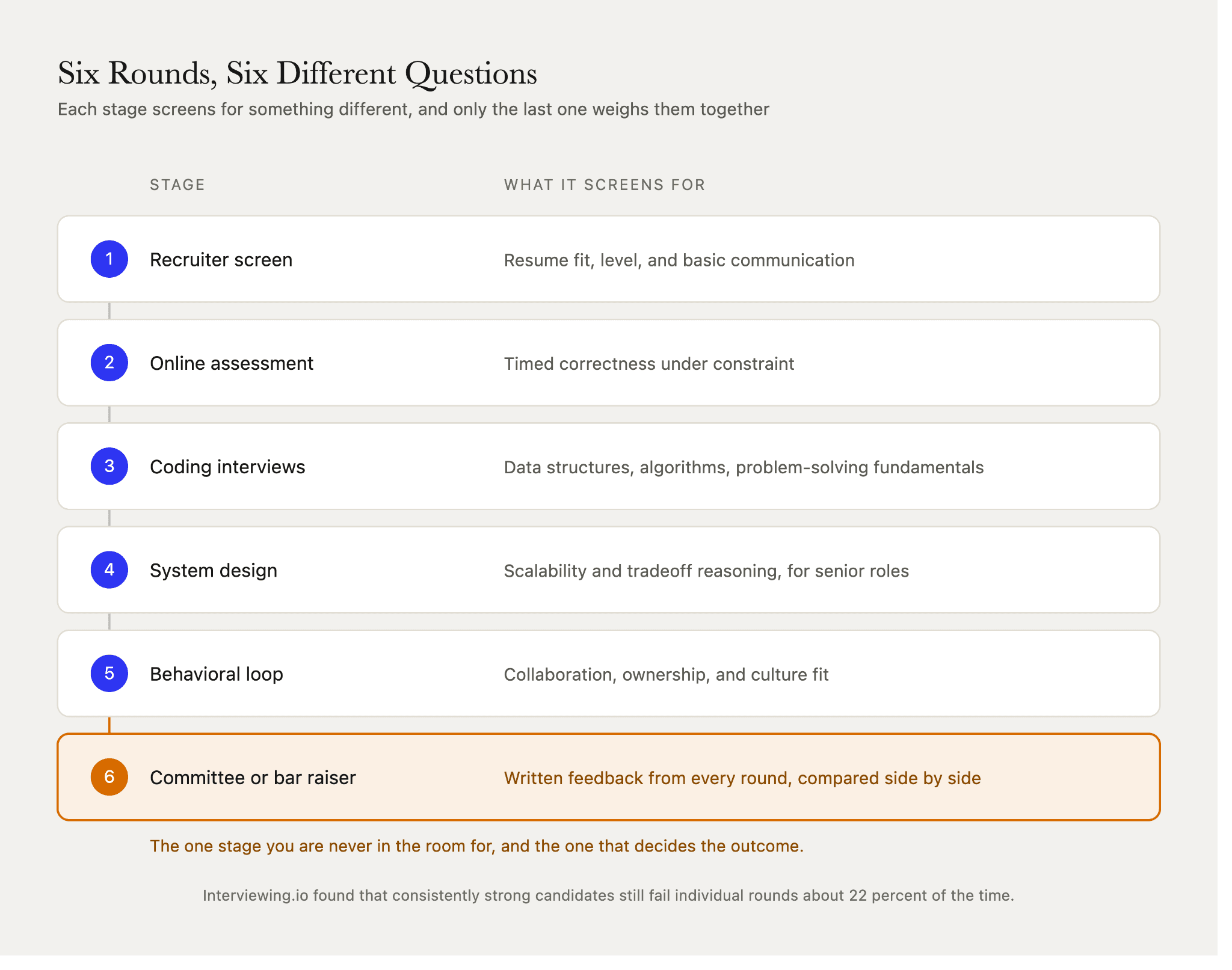
Technical interview outcomes are also less reliable than they look from the outside. Interviewing.io found that candidates who score well on average still fail individual interviews as often as 22 percent of the time, meaning the same person can pass one loop and fail another the same week. A real chunk of rejections reflects that volatility rather than a genuine skills gap. High application volume compounds this: even a well-qualified candidate can get less attention than their profile deserves, simply because a team is trying to fill a narrow skill gap rather than hire the strongest generalist in the pool.
Why You Got Rejected After a Technical Interview You Thought Went Well
Engineers frequently exit a technical interview thinking they did well, only to receive a rejection email days later. This gap between self-assessment and outcome is one of the most frustrating parts of the interview process, and it is rarely random.
The most common misreads include:
Over-weighting correctness of the final solution while underestimating how you arrived at it.
Spending long stretches in silence, which interviewers interpret as a lack of structure or an inability to collaborate.
Ignoring time management: failing to start with a brute-force approach before optimizing, or not testing edge cases.
Assuming that matching the job post tech stack is sufficient, when the interviewer is evaluating transferable reasoning.
Consider a candidate who solves a graph problem with optimal complexity in a coding interview. The answer is correct, the code compiles, and the time complexity is ideal. But the candidate spent 35 minutes in silence before explaining anything. The interviewer logged: "needed significant prompting to communicate plan, did not verbalize tradeoffs, unclear if candidate can collaborate in a team setting." That note, not the final solution, drives the rubric score.
Rejection after technical interviews may indicate issues with coding or algorithms, but just as often it indicates issues with how the candidate communicated or managed the session. A "passable" performance in the candidate's head can translate to "borderline" in the rubric, and borderline usually resolves to rejection when the company has other safe options.
Reasons Software Engineers Fail Interviews Even When the Code Is Right
Strong coding ability is necessary but not sufficient. Senior interviewers for software engineer roles track several parallel dimensions during every conversation. Coding interviews often test underlying concepts rather than just memorizing syntax, which means reciting a linked list implementation from memory matters less than demonstrating genuine comprehension of why you chose it.
Specific signals interviewers watch for include:
How the candidate clarifies requirements and handles incomplete or conflicting information.
How the person reacts to constraints such as memory limits, latency targets, or deployment concerns.
Behavioral indicators like ownership of past incidents, ability to explain tradeoffs in past production outages, and how the candidate spoke about cross-functional partners.
Whether the candidate sets context explicitly. Saying "I will start with a brute-force approach, then optimize if time allows" reduces perceived risk far more than silently refactoring halfway through the session.
Software engineers often face rejection due to weak problem-solving fundamentals, not because they lack knowledge of algorithms, but because they fail to demonstrate structured thinking under pressure. A small shift in phrasing converts implicit thinking into an explicit signal. For example, instead of saying "I handled error cases," a stronger framing is: "During production, we observed failure X. I led the response, instrumented trace logs, coordinated with the SRE team, and set up alerting to prevent recurrence." Instead of "I would optimize later," say "I plan to validate with brute-force first, check if performance is acceptable, then optimize."
What Interviewers Record Versus What Candidates Focus On
The table below illustrates where candidate self-assessment and interviewer evaluation diverge in technical interviews, a gap Fonzi's guide to candidate review breaks down from the evaluator's side.
Candidate Focus | What Interviewer Actually Logs | Impact on Decision |
Final solution correct and optimal | Needed multiple hints; slow to debug when an edge case surfaced | Raises concern about dependence on interviewer guidance |
Algorithm complexity is ideal | Did not consider memory constraints or extreme input sizes | Risk of redesign or rework in production |
Clean code style | Subtle bugs present; test cases missed; unclear variable naming | Doubts about attention to detail |
Fast coding pace | Rushed, skipped clarifying questions, stuck on minor ambiguity | Risk of miscommunication in ambiguous real-world tasks |
Solved the problem independently | Did not talk through reasoning; interviewer could not assess thought process | Unclear collaboration ability; treated as a guess rather than a plan |
Fixed a bug at the end of the session | Bug surfaced only after prompting; no self-testing before declaring done | Suggests correctness depends on review rather than the candidate's own process |
Where Software Engineer Rejection Decisions Are Really Made
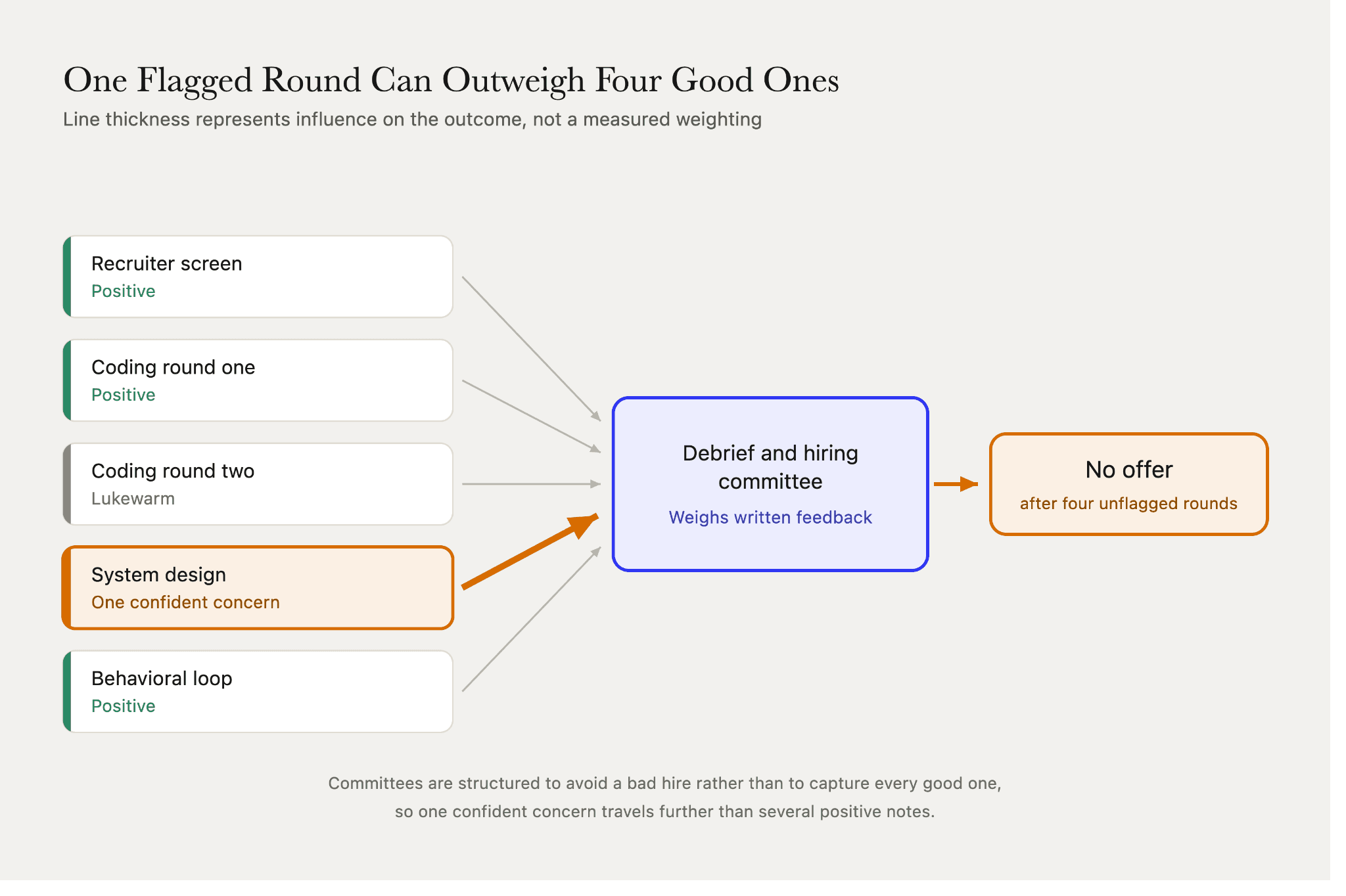
Different companies structure decision-making differently. Amazon runs a Bar Raiser program in which a trained interviewer outside the hiring team holds veto power and evaluates whether a candidate meets the company's standard independently of the team's immediate need; Google and others use hiring committees that review written feedback without an equivalent single-veto role. Early-stage startups may rely on a founder or hiring manager making a centralized call. In all of these structures, how feedback gets aggregated matters more than candidates realize. Many decisions are effectively made during debriefs held the same day as onsite loops, where the strongest opinions in the room dominate. Hiring committees are built to minimize bad hires rather than to capture every good one, a design Laszlo Bock describes in Work Rules!. In practice that means a single confident detractor in a critical round, like system design for a senior engineer, can outweigh several lukewarm positive notes. The raw signal they are averaging is noisy: a meta-analysis of 111 interrater reliability coefficients found agreement between interviewers on unstructured interviews averaging just .37.
Companies in a hiring slowdown, or working through a period of sustained layoffs, will also silently raise the bar: the same performance that got someone hired a few years ago may now get a reject, and interviewers rarely disclose that shift in feedback.
Companies have also diverged on whether AI coding assistance is permitted during interviews. A 2026 Nothiring and CandyCV analysis of tech hiring in Spain found that insufficient technical depth was cited in 25 percent of employer rejection decisions, seniority below the level sought in 14 percent, and AI use in 8 percent. Candidates are increasingly rejected for misjudging which regime they are in: using tools where they are banned, or refusing to use them where fluency with AI is the actual signal being tested. Fonzi's rundown of AI interview helpers is a reasonable starting point for understanding which tools tend to be allowed. If you don't clarify the rules before you write code, you are taking an unnecessary risk.
A bar raiser or principal-level interviewer is supposed to evaluate whether a candidate meets the company's hiring standard independently of the team's immediate need, and in practice, their veto power means a single concern from this person, especially about ambiguity, vague ownership, or over-claimed impact, can negate otherwise strong technical signals.
When the Role Disappears: Headcount, Timing, and Reshaped Jobs
Many rejections are driven by market conditions rather than candidate quality, and it is rarely personal even when it isn't disclosed that way. Common scenarios include:
Headcount being frozen after the candidate's onsite, with the role quietly shelved.
The role being reshaped to a different level or focus area (for example, more infrastructure, less product).
An internal transfer filling the job before the external loop concludes.
Salary expectations exceeding the designated team budget for the role.
Hiring managers often cannot disclose details about a cancelled role or a priority shift, so candidates get generic "we pursued other candidates" language regardless of the real reason. Understanding that these factors exist helps you avoid misattributing every rejection to technical weakness.
Communication And Collaboration: The Non-Obvious Failure Modes
Senior software engineer roles increasingly weigh communication skills and cross-team collaboration, since companies expect candidates to work effectively with product managers, QA, operations, and other less technical stakeholders. A technically correct design will not carry a candidate who cannot explain it to a product manager or absorb a challenge to it mid-session.
Concrete failure modes include:
Dismissing product or QA partners in past stories, framing them as obstacles rather than collaborators.
Blaming vague "business decisions" without showing how you navigated those constraints.
Speaking in dense jargon without adapting to the interviewer's background or cues.
An interviewer in a system design round who sees a candidate dominate the conversation and resist feedback will flag them as "high ego, low collaboration," even if the design itself is sound, and that kind of cultural misalignment is a common, if rarely stated, reason for rejection.
Small shifts in phrasing, and in how you respond to pushback, can move you from "technically strong but difficult" to "strong and workable." Narrating tradeoffs, acknowledging constraints set by others, and adapting your communication style on the fly are all signals that reduce perceived risk for the hiring team.
Signal Risk: How Interviewers Penalize Ambiguity And Overreach
Hiring managers and senior interviewers optimize for minimizing downside risk, since one bad hire can consume months of team capacity, which means ambiguity in your story or your career narrative is never neutral. It is actively penalized.
Risk-raising behaviors include:
Overstating skills or ownership of major past projects, which can lead to rejection when depth probing reveals limited decision authority.
Dodging questions about failures or being vague about performance issues in previous roles.
Resume discrepancies that surface during the interview, such as inflated titles or inconsistent timelines.
A candidate who claims to have "led" a database migration but cannot explain who decided the target architecture, what the rollback plan was, or which team members were involved will trigger distrust the moment an interviewer probes beneath the surface. Clear scope boundaries lower that perceived risk instead: saying "I owned the data access layer and coordinated with the SRE team on rollout" is more credible than "I led the entire migration." Ambiguous senior candidates are often rejected even when they are technically strong, because interviewers would rather hire a slightly less advanced engineer with very clear scope and reliability.
How to Diagnose a Pattern Across Multiple Rejections
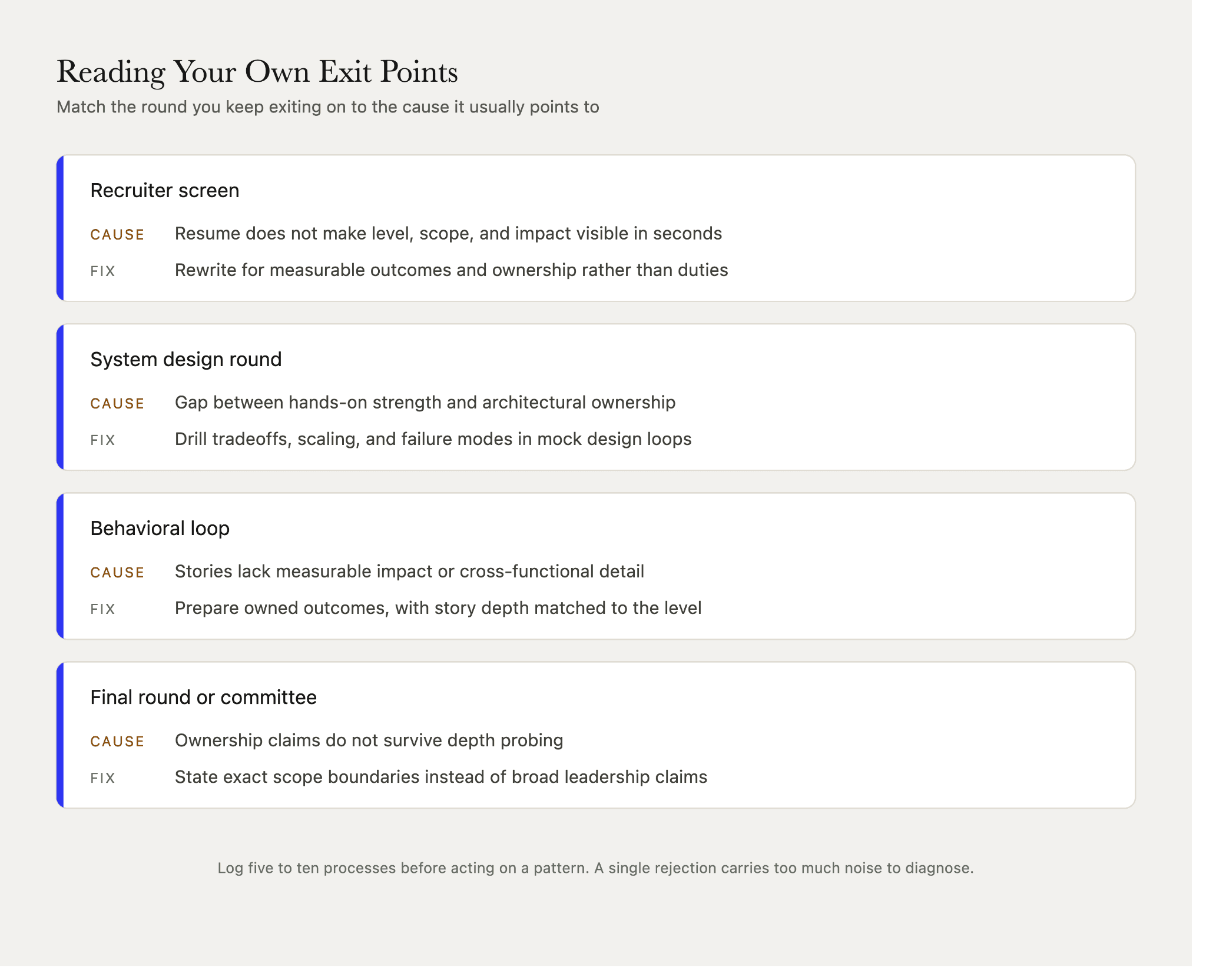
Instead of treating each interview outcome as isolated, look for patterns across your last 5 to 10 processes: even minimal feedback, accumulated across multiple cycles, reveals signal that a single rejection cannot. Places to look:
Which round do you exit on most frequently? Recruiter screen, coding interview, system design, or behavioral?
What minimal feedback do you receive? Even brief phrases like "seeking more leadership experience" are valuable when logged consistently.
Keep a simple log: date, company, role level, rounds completed, suspected failure mode.
Repeated early-screening rejections may point to a resume or profile issue, since recruiters screening high volumes give each resume seconds of attention, and a resume that does not make level, scope, and impact visible in that window rarely gets a second look.
Repeated final-round rejections typically point to bar-raising concerns instead, like ownership signals or scope clarity. If you notice you are consistently clearing coding rounds but failing system design, that is a clear, actionable diagnosis, and it is worth treating that pattern as real signal rather than a string of bad luck.
Concrete Adjustments You Can Make For Future Technical Interviews
While some hiring noise is unavoidable, strong engineers can change how they present their skills and stories to improve outcomes. The adjustments below target the most common controllable failure modes.
In coding interviews: explicitly narrate your plan before you code. Ask clarifying questions early. Label tradeoffs ("this is O(n) time but O(n) space; we could trade for O(1) space with a different approach"). Test and debug your own code before saying you are done.
In system design sessions: break down ownership boundaries, discuss scaling, reliability, and failure modes. Accept suggestions from the interviewer and incorporate feedback visibly.
In behavioral rounds: prepare stories with measurable impact. Demonstrate cross-functional work. Own mistakes and what you learned. Adapt story depth to match the seniority of the role.
On your resume and LinkedIn: emphasize measurable outcomes, ownership, and relevant tech stacks for the specific role. Candidates may be rejected for failing to demonstrate impact, so make sure your projects and value are obvious.
Arrange mock interviews with experienced interviewers or trusted senior peers to test your failure-mode hypotheses in a lower-stakes setting. A mock system design drill will tell you more about your weak spots than another guess at what went wrong.
How Fonzi Can Help Strong Engineers Get Seen
If you recognize yourself in this article as a strong engineer who keeps hitting vague, final-stage rejections, it may be worth changing which process you are going through rather than just how you perform in it. Fonzi is a curated AI engineering hiring marketplace that connects companies with pre-vetted AI and software engineers. Match Day puts strong engineers in front of AI startups and high-growth companies.
If you meet the bar, apply at Fonzi and let a batch of companies evaluate you directly, rather than absorbing one opaque rejection at a time.
Summary
Technical interview outcomes come from a mix of skill, communication, process mechanics, and market constraints, and much of that mix stays invisible to the candidate. They are rarely a reflection of your worth as an engineer. The most productive response is to systematically analyze your own patterns, adjust the behaviors you actually control, and accept that some portion of any rejection is just noise.
Review your last few interview loops and map each one to the failure modes described here, then define one or two specific changes to make before your next cycle. That is a better use of your energy than replaying the same rejection on a loop.
FAQ
How many technical interview rejections in a row should make me change my approach?
Is it useful to ask for detailed feedback after a rejection?
Should I change my resume after every rejection?
Why do I pass coding interviews but fail system design or behavioral rounds?
How do I know if the problem is market conditions versus my performance?