Staff Engineer vs Senior Engineer: What Actually Changes
By
Samara Garcia
•

Ask a room of engineers what separates staff from senior, and most will start talking about who writes better code. That's not where the real difference lives. Career ladders place staff above senior, and both levels demand serious technical depth, but title and pay track something else entirely: how far your decisions travel, how many teams depend on your judgment, and how accountable you are for outcomes you didn't build yourself.
The staff engineer vs senior engineer distinction shows up in four places: what your week looks like, what you are accountable for, how your pay is structured, and who comes to you when something breaks outside your team.
Key Takeaways
Staff engineers own outcomes across multiple teams, while senior engineers own execution quality within one product surface or domain.
Staff engineer pay widens the gap with senior mostly through equity, since a base salary difference of roughly 30 percent becomes a total compensation gap closer to 80 percent once stock is counted.
Staff engineers lead through influence rather than management authority, which means the role suits engineers who want organizational impact without taking on direct reports.
Staff Engineer vs Senior Engineer: The Real Shift in Scope
Both levels demand strong engineering. What separates them is what they own and how far their decisions travel. A senior engineer focuses on execution within a single team, shipping high-quality code and features inside a defined domain, and their scope of impact is typically limited to that team. Staff engineers operate at a higher level, influencing multiple teams by defining technical strategy, architecture, and cross-team alignment. Where a senior engineer asks how to ship this feature well, a staff engineer asks how multiple teams can repeatedly ship the right things safely and quickly.
That shift usually follows years spent excelling in a technical role, and it changes what impact means day-to-day: staff engineers influence company direction, while senior engineers focus on team delivery. It demands judgment under ambiguity, clear communication with leadership, and consistent results across quarters on top of technical depth.
Senior vs Staff Engineer: Level-by-Level Comparison
The table below compares senior, staff, and principal engineers across the dimensions that matter most when leveling these roles, and maps onto the broader engineering career ladder most companies use.
Dimension | Senior Engineer | Staff Engineer | Principal Engineer |
Typical scope | One or two teams, one product surface | Domain or cluster of teams | Company-wide or business-unit-wide |
Decision authority | Component and feature decisions | Cross-team architecture and platform choices | Strategic technology bets across domains |
Time horizon | One quarter to one release cycle | One to three years | Multi-year, aligned with long-term strategy |
Cross-functional influence | Product managers and designers within team | Product directors, security, operations, finance | VP and CTO-level leaders, shaping business direction |
Success metrics | Team-level delivery and code quality | Org throughput, engineering health, multi-team alignment | Platform reliability, innovation outcomes, cost and risk tradeoffs |
Experience usually seen | 5 to 8 years | 8 to 12 years | 12+ years |
Reports to | Engineering managers | Engineering managers or directors | Directors, VP of engineering, or CTO |
Titles for senior and staff engineers vary across companies. Big Tech organizations map these levels to well-defined, company-specific numbered bands, while smaller startups often have a senior staff engineer or principal doing what would be a staff-level job at a larger company.
How Day-to-Day Work Changes from Senior Software Engineer to Staff
This is the part most senior engineers care about: what does the week actually look like at staff? Senior engineers spend most of their time writing, reviewing, and shipping features within their team, and they mentor junior engineers along the way. Staff engineers spend comparatively less time in the editor and more time on technical strategy, design documents, and unblocking other teams. That ratio commonly flips: senior engineers spend most of the week in the editor, while staff engineers spend more of it on architecture, design reviews, and coordination across teams.
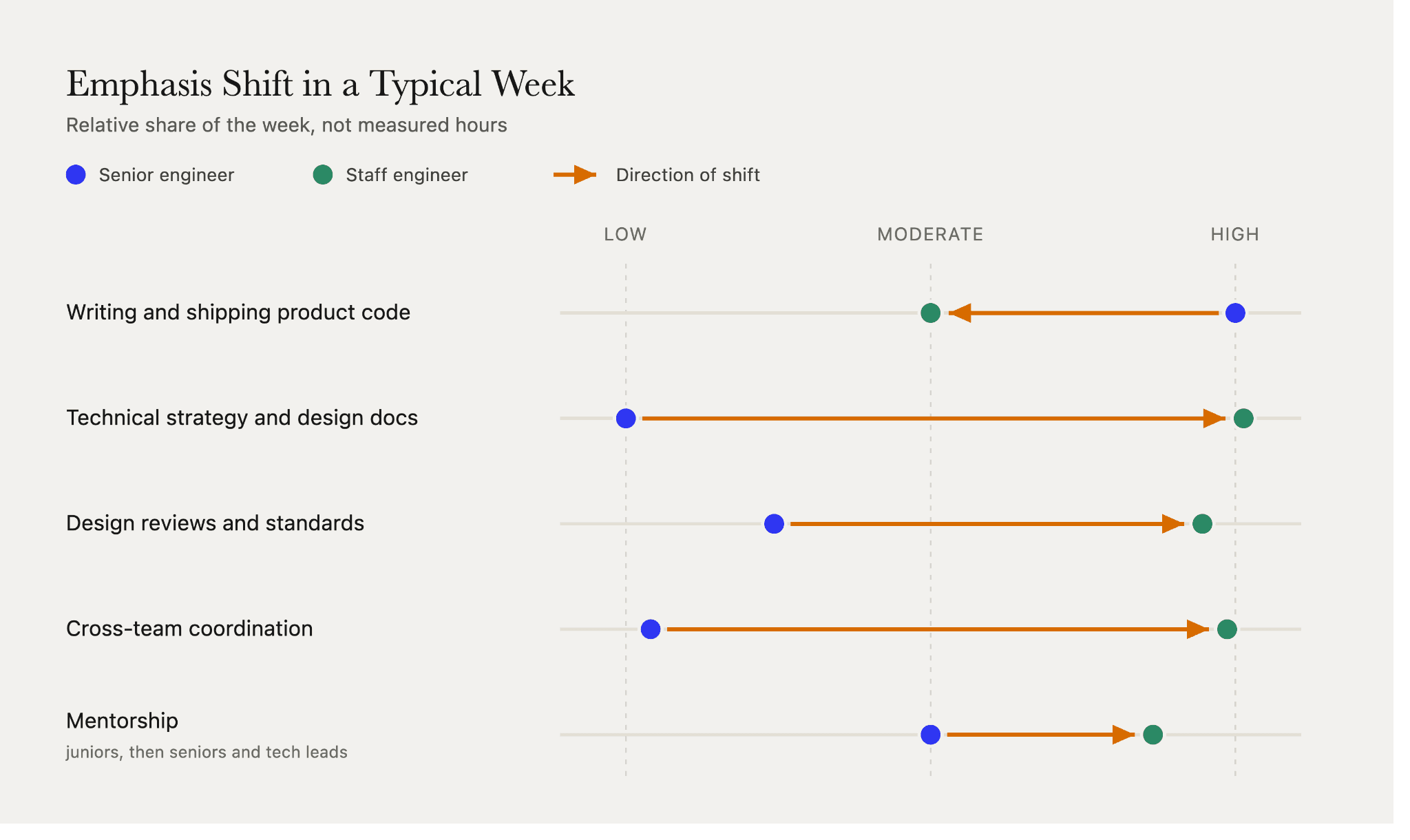
At staff level, mentorship shifts too, from developing junior engineers to developing senior engineers and establishing tech leads across multiple teams. Activities that intensify include running design reviews for major components, setting engineering standards, coordinating incident response across services, and driving deprecation or migration programs. Staff engineers still write production code, but usually for the hardest or highest-risk pieces, or to validate patterns other teams will adopt, and cross-functional meetings increase as they align with product management, security, and operations on technical direction.
Ownership, Influence, and Accountability at Staff Level
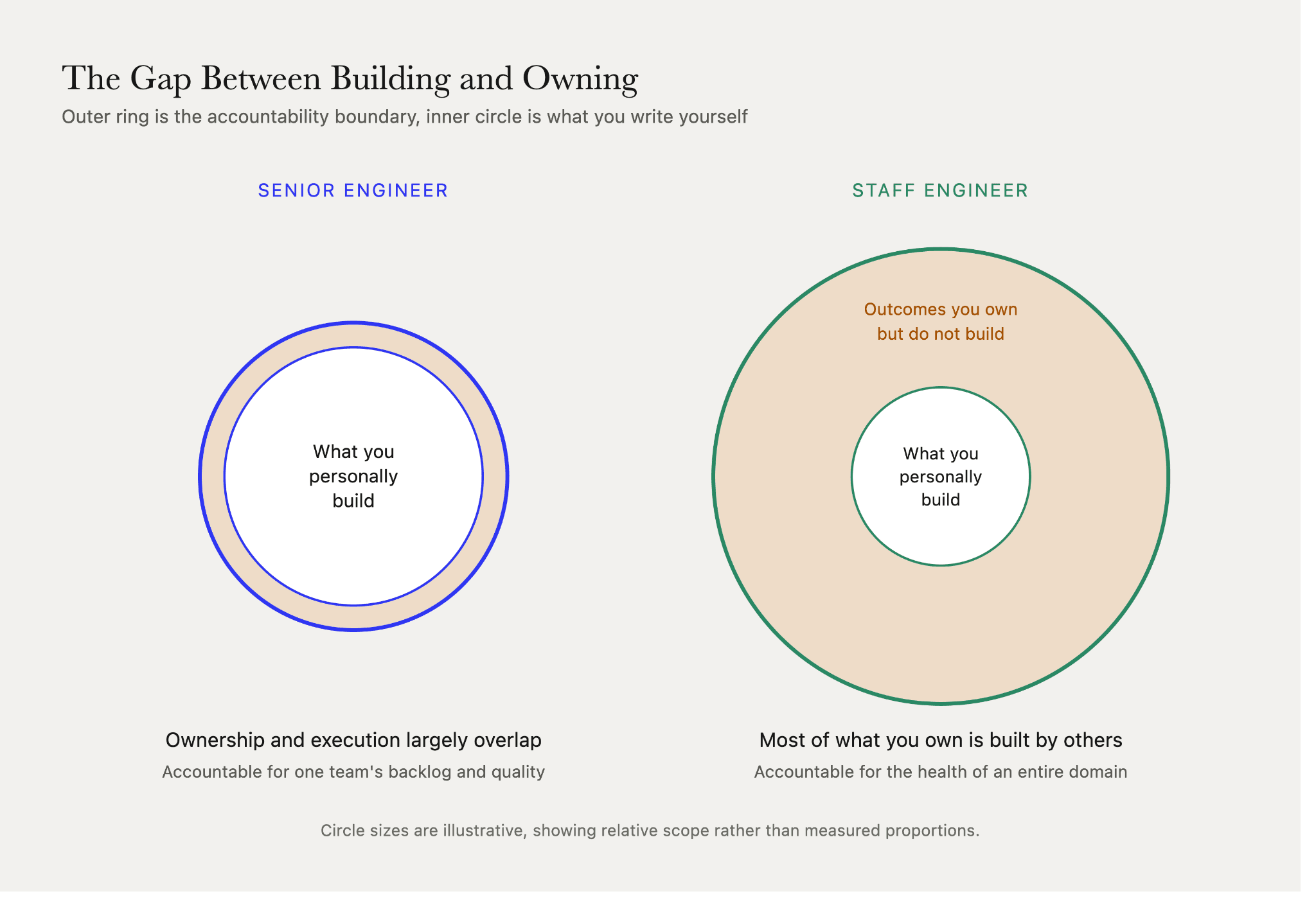
The biggest shift is how widely your decisions propagate, and how accountable you are for outcomes you don't implement yourself. Senior engineers are accountable for their team's backlog and execution quality, while staff engineers are accountable for the health and direction of entire domains, whether that's a payments platform, ML infrastructure, or developer experience. Effective staff engineers identify problems that span multiple teams and take on the ambiguous, systemic issues where neither requirements nor domain ownership are clear yet.
That ownership extends into resource allocation and roadmap influence: staff engineers partner directly with product directors, security, and operations, and sometimes finance or legal, when architecture decisions carry compliance or cost implications. The common argument now is that AI coding assistance has compressed the implementation gap between the two levels, pushing the differentiator further toward judgment, system design, and knowing which problems are worth solving. What remains uniquely valuable at the staff level is choosing which problem to solve.
Staff engineers are also often the final technical approver for large bets, like choosing foundational databases, queues, or cloud providers, and they own the long-term consequences of those choices. They build alignment between teams that disagree, manage technical risk with leadership, and communicate tradeoffs in clear, non-jargon language.
Staff Engineer Salary vs Senior: How Compensation Actually Splits
Compensation is a lagging indicator of scope. Your engineer salary band reflects what the organization expects you to own, not just what you can build. The table below shows base salary ranges for the broad US market and median total compensation at FAANG-tier employers, where equity makes up most of the package.
Metric | Senior Engineer | Staff Engineer | Principal Engineer |
Base salary (typical range) | $145,000 to $190,000 | $190,000 to $260,000 | $250,000 to $320,000+ |
Total compensation, FAANG-tier (base + bonus + annualized equity) | $350,000 to $500,000 | $450,000 to $750,000 | $700,000 to $1,000,000 |
Years of experience usually seen | 8 to 10 | 10 to 15 | 12 to 20+ |
Sources: Levels.fyi 2025 End-of-Year Pay Report; Stott and May 2026 US Technology Salary Insights
Comparing base salaries directly, staff engineers out-earn senior engineers by about $45,000 at the bottom of each band and about $70,000 at the top. That gap tends to widen further once equity is included: RSU refreshes and larger bonus targets typically push total compensation, including equity, well above the cash figures above, especially at staff level and beyond. Location matters just as much as level. Indeed puts the average staff software engineer salary in Austin at $180,804, a useful reminder that city and cost of living shift these numbers considerably.
Senior staff engineer, where it exists as a distinct level between staff and principal, typically adds a further base bump over staff, and principal compensation climbs again from there, reflecting the broader scope and risk professionals at that level carry. Levels.fyi is worth checking for current, company-specific bands before negotiating, since ranges shift often and vary widely between employers.
Signals You Are Already Operating at Staff Scope
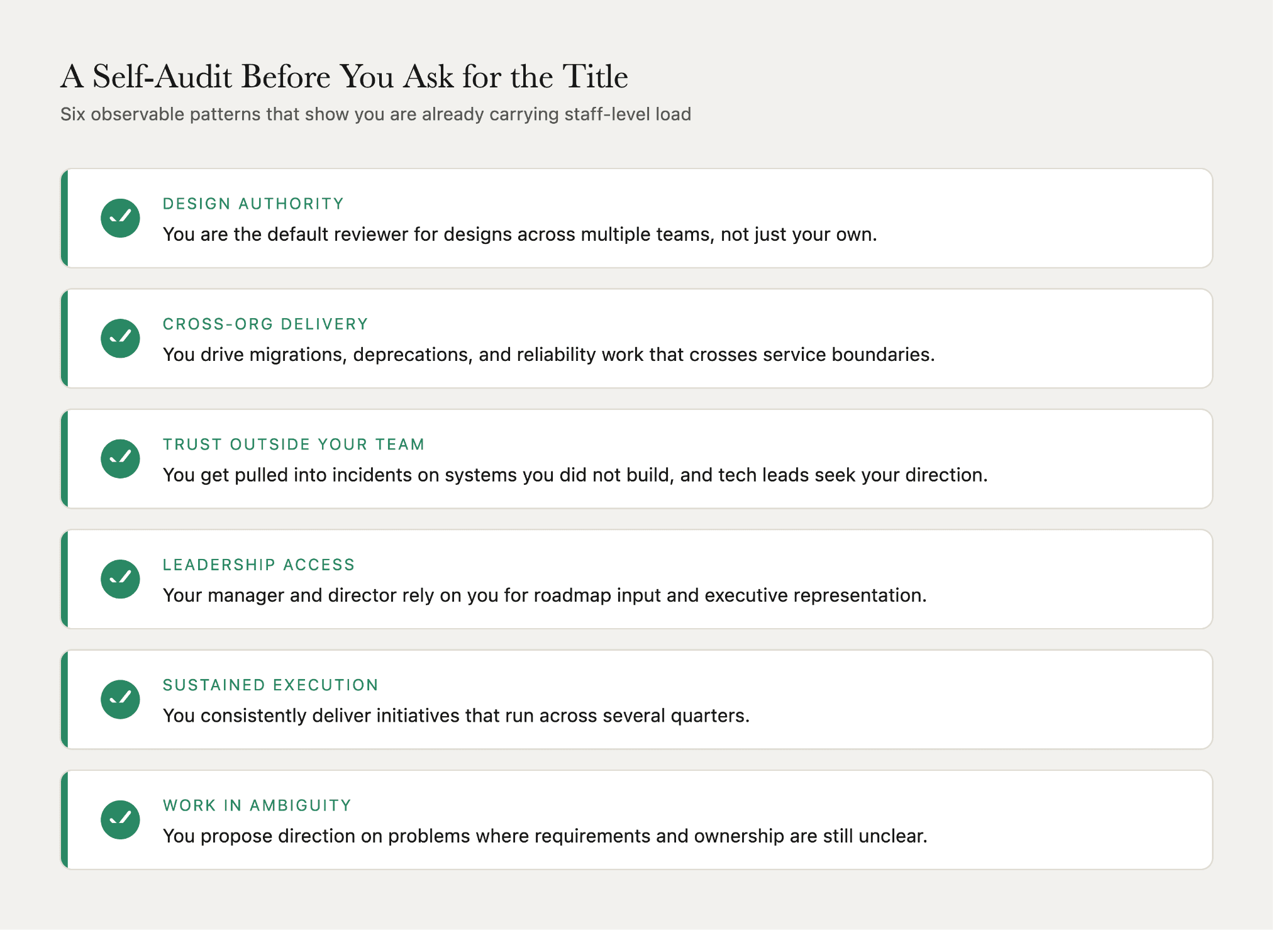
If you are a senior engineer wondering whether you are ready, the evidence is usually already in your work. Here are concrete signals to look for:
You are the default reviewer for designs across multiple teams, not just your own feature team.
You drive cross-org projects such as migrations, deprecations, or reliability improvements that cut across service boundaries.
You get pulled into incidents outside your team because others trust your judgment on systems you did not build.
You informally mentor other senior engineers, and tech leads come to you for direction.
Your manager and director already rely on you for roadmap input and trust you to represent engineering in executive discussions.
You consistently deliver initiatives that run for several quarters.
You regularly solve problems where requirements or domain ownership are unclear and you propose direction rather than wait for assignments.
Moving from senior to staff essentially means demonstrating organizational leverage, expanding your impact beyond a single team. If these signals are present but your job title and compensation still say "senior," you may have a strong case for promotion, or for a staff-level move at another company.
Staff vs Principal Engineer: Where the Next Jump Happens
Principal is a different scale, not a strictly more "elite" coder than staff. Staff and principal engineers differ mainly in blast radius: staff owns a domain, principal owns bets that cut across domains and carry multi-year consequences.
Staff engineers typically own a domain or cluster of services. Principal engineers own cross-domain strategies such as company-wide reliability, AI platform architecture, or multiyear modernization efforts. Principals are often involved in portfolio-level tradeoffs and may partner directly with VP or CTO-level leaders on company bets.
Principal compensation bands often overlap with senior engineering managers and small-team directors, which reflects their level of responsibility rather than a pure IC track premium. For many engineers, staff-level scope offers the best tradeoff between impact and sustainability. Principal often demands a higher appetite for ambiguity, organizational politics, and longer feedback cycles before you see results from your work.
Is Moving from Senior to Staff Engineer Worth It?
This is a personal decision that depends on temperament, preferred work, and financial goals. There is no universally correct answer, and most employers respect professionals who are deliberate about the choice.
Reasons to pursue staff:
Larger technical impact across the organization
More influence over technical direction and strategy
Significantly higher pay, especially through equity
Broader career options, including smoother transitions into principal engineer, distinguished engineer, or software architect roles
Reasons to stay senior:
Preference for hands-on coding and shipping features daily
Dislike of cross-team coordination and the politics that accompany it
Tighter feedback cycles and more tangible, immediate output
Better work-life balance in some organizations where staff roles carry heavier on-call or leadership expectations
At some companies, senior engineers at the top of band can earn similar or higher effective compensation than underslotted staff engineers at weaker firms, reinforcing that company context matters. Compare not just job title but actual scope, expectations, and compensation structure across opportunities.
How to Evaluate Offers and Titles Across Companies
The staff role can mean very different things across a Series B startup, a large SaaS company, and a Big Tech organization. When evaluating an offer, dig past the title.
Questions to ask:
How many teams will you support, and what systems will you own?
Who makes final technical calls on architecture and process?
What does success look like after 12 months?
What is the full engineer salary band for this level, and where in the band does your offer sit?
What are the bonus targets and equity refresher policies?
Will you have room to lead innovation in the software development process, or are standards already locked?
Who do you report to, and what is their skill set and leadership style?
Some candidates use public data from sources like Levels.fyi or Glassdoor to benchmark staff engineer salary and senior bands, then negotiate around scope, not title alone. The goal is to ensure the job postings you respond to reflect real staff-level expectations rather than a relabeled senior role.
How Fonzi Helps Engineers Find Roles That Match Their Real Scope
Title inflation cuts both ways. Companies struggle to evaluate whether a candidate who calls themselves "staff" or "senior staff" actually operates at that scope, and engineers face the same problem from the other side, trying to figure out whether a "staff" posting at one company is really a senior role in disguise. A resume alone rarely resolves this, since a title says little about actual ownership.
Fonzi is a curated AI engineering hiring marketplace that connects companies with pre-vetted AI and software engineers, evaluated on demonstrated scope and technical depth rather than title alone. Match Day brings companies and engineers together during a scheduled window, so senior and staff engineers can compare multiple opportunities and how each company actually defines the role, in one place rather than parsing job descriptions one at a time.
Summary
The real difference between senior and staff engineer is the breadth of problems you own and how far your decisions travel, not how well you can write code. Compensation bands track that scope, and plenty of engineers build fulfilling, well-paid careers at either level without ever chasing the next title.
Audit your current scope against the signals above, have an honest conversation with your manager about what's actually expected at each level, and treat title alone as a starting point rather than the final word, especially when comparing offers across companies. Whether you stay senior or push for staff, the decision should follow from how you actually want to spend your time, not just what the org chart calls it.
FAQ
How many years of experience do I usually need before staff engineer is realistic?
Can a senior software engineer earn as much as a staff engineer?
Does a staff engineer manage people like an engineering manager?
How different is a senior staff engineer from a regular staff engineer?
Should I move to a smaller company to reach staff level faster?