What Is a Pre-Screening Interview?
By
Samara Garcia
•

Pre-screening interviews have become a critical first interview in AI and ML hiring because applicant volume and specialization have exploded in the years leading up to 2026. For AI engineers, ML researchers, infra engineers, and LLM specialists, this early phone interview or video call often decides whether they ever speak with the hiring manager. Legacy screens were informal chats, but today’s pre-screening is more structured, data-driven, and tied to non-negotiable job requirements. Curated marketplaces like Fonzi and in-house recruiting teams both rely on effective pre-screening interviews to protect everyone’s time.
Key Takeaways
A pre-screening interview is the first structured filter in the hiring process, used to validate must-have criteria before deeper evaluation.
Modern AI hiring uses calibrated phone screens, video calls, async forms, and AI-assisted screening to handle larger applicant pools.
Senior candidates should prepare concise answers about their current position, salary expectations, core stack, and recent impact.
Pre-screening shapes the next stage, including coding, system design, ML theory, and “about a time” behavioral interviews.
The best candidates use the screening interview to evaluate cultural fit, company culture, technical bar, and role direction.
Pre-Screening Interviews in the Hiring Process
A pre-screening interview is a brief, structured conversation or questionnaire that validates baseline requirements early in the hiring process. These brief conversations allow hiring teams to assess basic qualifications, evaluate role fit, and filter candidates before they advance to formal multi-stage job interview, in-person interview, or face-to-face interview.
For AI roles, pre-screening usually covers location, whether you can legally work, visa sponsorship needs, start date, salary expectations, seniority, work history, and whether the candidate meets the minimum qualifications for the job position. The interviewer may also check technical skills such as PyTorch, JAX, Ray, Kubernetes, Triton, Hugging Face Transformers, or a specific tool named in the job description. For some roles, human resources may also ask about a specific certification, security clearance, or domain focus, such as LLMs, vision, ranking, recommendation, reasoning models, agentic workflows, or state-space models.
The goal is not to run a full architecture review. At this stage, interview questions focus on logistics, relevant skills, communication skills, motivation, and high-level fit. It is usually not the right format for long behavioral stories, although a concise headline example can help when a candidate mentions a specific task, measurable result, or professional strengths.
A pre-screening interview typically lasts 15 to 30 minutes, though the exact duration depends on role seniority, applicant pool size, and the specific format used. The range depends on role seniority, applicant pool size, and whether the format is a recruiter phone call, video chat, async questionnaire, or automated chat.
Why Pre-Screening Interviews Matter for AI & ML Candidates
Pre-screening is a valuable part of the hiring process because AI and engineering roles often attract large applicant pools. These conversations help hiring teams quickly assess whether a candidate meets the core requirements before scheduling deeper interviews.
Pre-screens also help candidates identify potential misalignment early, including compensation, remote work policies, time zone expectations, team structure, and role responsibilities. Many companies use structured screening questions to evaluate candidates consistently, helping both sides determine fit before investing more time in the process.
The High Stakes of the First Interview Filter
For many roles, few applicants progress past pre-screening. Candidates are commonly filtered out because salary ranges do not match, required frameworks are missing, production experience is too shallow, timezone overlap is limited, or the candidate is not genuinely interested in the role.
This is why concise signal matters. A strong answer links current position, recent impact, relevant skills, and genuine interest in the company. Effective candidates weave a narrative connecting their past and future, rather than listing disconnected tools. If your job search includes several parallel processes, that narrative also helps recruiters and hiring teams remember where you fit.
Formats of Pre-Screening Interviews in AI Hiring
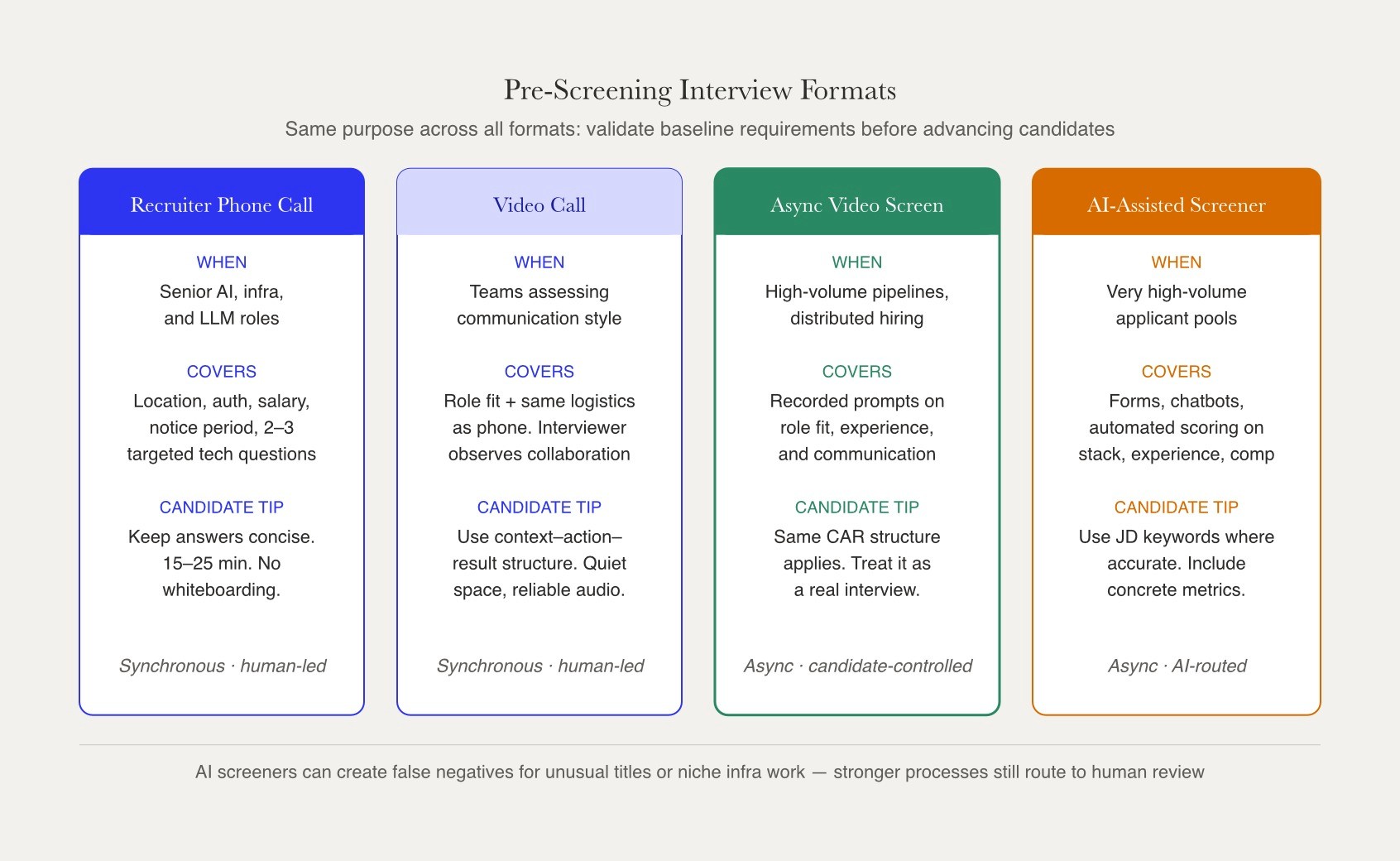
Modern AI hiring uses several pre-screening interview format options: classic recruiter phone call, short video call, async form, and AI-assisted screener. The tools differ, but the purpose is the same: assess baseline requirements and decide whether qualified candidates advance to the next round.
The Classic Recruiter Phone Call
The phone screen remains common for senior AI, infra, and LLM roles. A phone screen usually lasts 15 to 25 minutes and covers location, work authorization, salary expectations, notice period, start date, and a summary of your current position.
Expect two or three targeted technical questions, not whiteboarding. For example, a recruiter may ask which model families you are using, whether your work reached production, how large your GPU cluster is, or which deployment stack you own. Candidates should keep their answers concise during pre-screening interviews to fit time constraints.
Video Calls and Async Video Screens
Many teams use a video call or short video chat to assess communication style alongside role fit. Live calls resemble a phone call, but allow the interviewer to observe collaboration style, clarity, and comfort discussing trade-offs.
Whether the interview is live or asynchronous, keep your answers structured by covering the situation or context, the actions you took, and the results you achieved. This makes your responses easier for recruiters and hiring managers to evaluate.
Automated Questionnaires and AI-Assisted Screeners
Some companies use forms, chatbots, and AI-assisted scoring to handle high-volume screening. These systems may ask about languages, frameworks, years of experience, publications, open source work, preferred locations, compensation expectations, and whether you meet non-negotiable job requirements.
AI is often used to summarize and route candidates for human review. In stronger processes, a recruiter or hiring manager still decides who advances, because AI screening can create false negatives for unusual titles, nonstandard research paths, or niche infrastructure work.
Common Pre-Screening Interview Questions for AI & ML Roles
Pre-screening interview questions typically focus on logistics, relevant experience, technical background, career goals, and compensation expectations. Candidates should prepare concise, structured responses that clearly demonstrate their qualifications and fit for the role.
Category | Example pre-screening question | How a senior AI candidate should approach it |
Logistics | “Are you open to this location, and do you need visa sponsorship?” | Answer directly, including remote constraints, start date, and ability to legally work. |
Compensation | “What are your salary expectations?” | Share a realistic band based on 2025-2026 data, not your current salary. |
Experience | “Can you walk me through your current position?” | Cover team size, scope, work history, systems shipped, and measurable impact. |
Technical overview | “Which models, infra, or tools have you used recently?” | Mention model families, data scale, GPU infra, RAG, RLHF, Triton, Ray, Kubernetes, or the specific tool in the job description. |
Motivation | “Why are you interested in this company?” | Show that you researched the company and connect the role to your direction. |
Culture | “How do you work with product and infra teams?” | Give a concise example of work styles, collaboration, and self-awareness. |
Strong candidates prepare two or three examples that can later expand into “tell me about a time” stories. For the first interview, keep them short. For example: “I led latency work on an inference service, reduced p95 by 38%, and partnered with infra to roll it into production.” That gives enough signal for follow-up questions without turning the screen into a deep dive.
Candidates should research the company before a pre-screening interview. Researching the company shows initiative and preparedness. It also helps you ask thoughtful questions about model deployment, experimentation cadence, learning opportunities, and how the team defines success.
How Pre-Screening Fits Into the Full AI Interview Process
A prescreening interview sits before a deeper technical evaluation. A typical funnel is application or referral, pre-screening interview, technical screen, panel interviews, and final conversations on culture, level, and offer details. Some marketplaces and recruiters pre-screen on both sides, confirming role scope and compensation before introductions.
Stage | Primary goal | Typical format | Example topics for AI / ML roles |
Pre-screening | Validate must-haves and directional fit | Phone screen, video call, form, chatbot | Salary range, work authorization, stack, domain, availability |
Technical screen | Test implementation and reasoning | Coding, ML exercise, system design | RAG architecture, distributed training, model evaluation, and infra debugging |
Panel loop | Compare candidates across deeper signals | Multiple interviews | Collaboration, research depth, production judgment, and cultural fit |
Final conversations | Align on offer and work environment | Recruiter, hiring manager, leadership | Level, compensation, team roadmap, growth expectations |
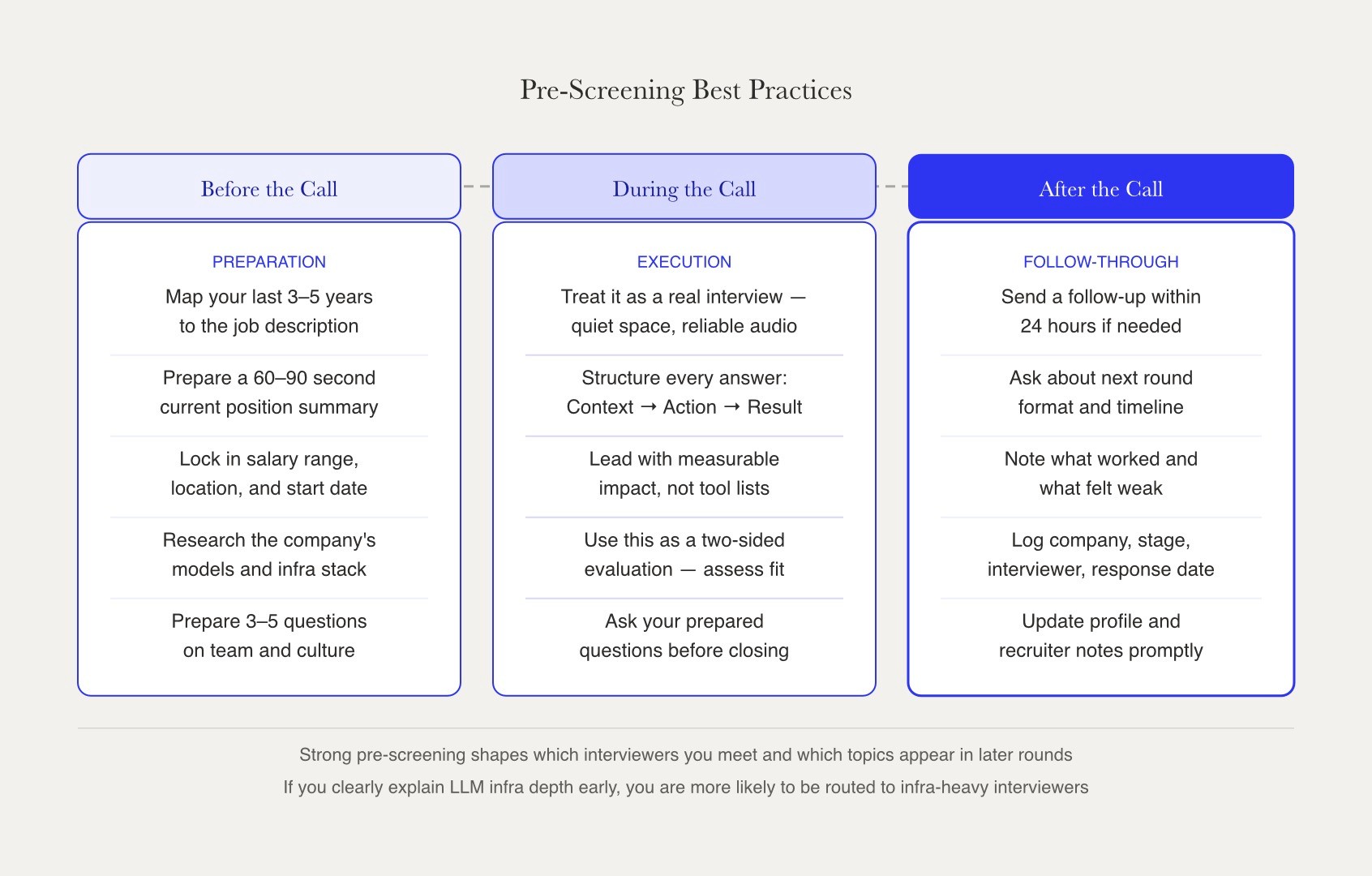
Strong pre-screening performance can shape which interviewers you meet and which topics appear later. If you clearly explain your LLM infrastructure depth, you may be routed to infra-heavy interviewers. If your research outputs are central, the next stage may focus on publications, evaluation design, or model quality.
Best Practices for Candidates: Making Pre-Screening Interviews Count
Treat pre-screening as a deliberate, two-sided evaluation. The goal is not to sell at all costs. The goal is to decide whether the role, team, and process justify more time.
Preparation Before the Pre-Screening Call
Review the job description carefully and map your last three to five years of experience to its baseline requirements. Prepare a 60 to 90-second summary of your current position, including team composition, systems owned, core skills, and key outcomes over the last 18 to 24 months.
Prepare your salary expectations, location constraints, start date, and visa sponsorship answers before the call. Also, prepare three to five thoughtful questions about the team’s models, infra, experimentation culture, and whether AI is used in the hiring process itself.
During the Phone Interview or Video Call
Treat the call as a real interview. Use a quiet environment, reliable audio, and short notes, but do not read verbatim. If asked for “three words” to describe your work style, choose terms you can support with evidence, not generic adjectives.
Use a concise structure for every answer: context, action, result. If the candidate mentions measurable impact, the recruiter can capture key details for the hiring manager. Good answers help the company compare candidates fairly and identify the best person for the role, while giving you a better understanding of the team.
After the Pre-Screening Interview
Send a short follow-up within 24 hours, especially if you need to clarify compensation, timing, or level. Ask when you should expect to receive feedback and what the next round will involve.
After each call, write down what worked and what felt weak. More tips: track every company, job, stage, interviewer, and expected response date in a simple spreadsheet. If you work through a marketplace like Fonzi, keep your profile and recruiter notes current so hiring teams see accurate information.
Fonzi Match Day and Pre Screening Interviews
Pre-screening interviews are designed to quickly determine whether a candidate meets a company's core requirements before moving into deeper technical evaluations. Fonzi supports this process through its curated hiring marketplace, where candidate profiles are reviewed and refined before being introduced to hiring teams. This helps ensure that companies evaluating engineers during Match Day already have a clearer understanding of a candidate's background, technical strengths, and career goals.
During Fonzi's weekly Match Day, companies send salary-backed interview requests to engineers they want to meet. Once a candidate accepts an interview request, the hiring process typically begins with a pre-screening conversation covering role fit, experience, compensation expectations, and technical background. For AI, ML, and infrastructure professionals, this creates a more focused path into interviews, allowing both candidates and employers to confirm alignment before investing time in more intensive coding, system design, or machine learning assessments.
Summary
Pre-screening interviews are no longer casual chats. They are structured checkpoints that decide whether deep technical conversations, official interviews, and final offer discussions will happen. Senior AI and ML candidates can use this step to assess mutual fit on logistics, scope, culture, and growth before investing more time. Update your pre-screening preparation, refine your current position narrative, and approach your next screening interview as a focused, two-sided evaluation.
FAQ
How much technical detail should I share in a pre-screening interview for an AI role?
Is it appropriate to discuss compensation ranges during the very first phone call?
How can I handle pre-screening interviews when I have multiple processes running in parallel?
Should I bring up research publications, open source work, or side projects in the pre-screening stage?
What should I do if the pre-screening is handled entirely by an automated form or chatbot?


