Backend Developer Interview Questions (General and Java-Specific)
By
Samara Garcia
•

Backend roles now sit close to AI workloads, data-heavy pipelines, and production ML systems, especially for AI engineers and infra specialists. This guide focuses on backend developer interview questions across general concepts and Java-specific topics, with an emphasis on modern distributed backend systems. It is written for senior practitioners who know the basics and want to understand what current interviews actually measure.
Key Takeaways
Companies hiring AI and ML talent expect backend developers to reason about data storage, data integrity, distributed databases, and managing data, not just write code in popular programming languages.
Interview loops are shifting toward applied prompts such as debugging slow database queries, designing a resilient application programming interface, or proving that a migration did not corrupt the same data.
AI tools are entering hiring workflows, but human judgment about tradeoffs, data anomalies, query optimization, and software architecture remains central.
Core Backend Interview Themes: From HTTP Requests To Data Storage
Backend developer interviews cluster around protocols, data storage, correctness, performance, and operations in production. Interviewers want to see how you handle client requests, user requests, web servers, web applications, and backend system behavior under load. They also look for fluency in client-server architecture, business logic, error handling, input validation, and how backend development supports software applications. While countless backend developer interview questions are available across various prep libraries, senior candidates should focus less on volume and more on depth.
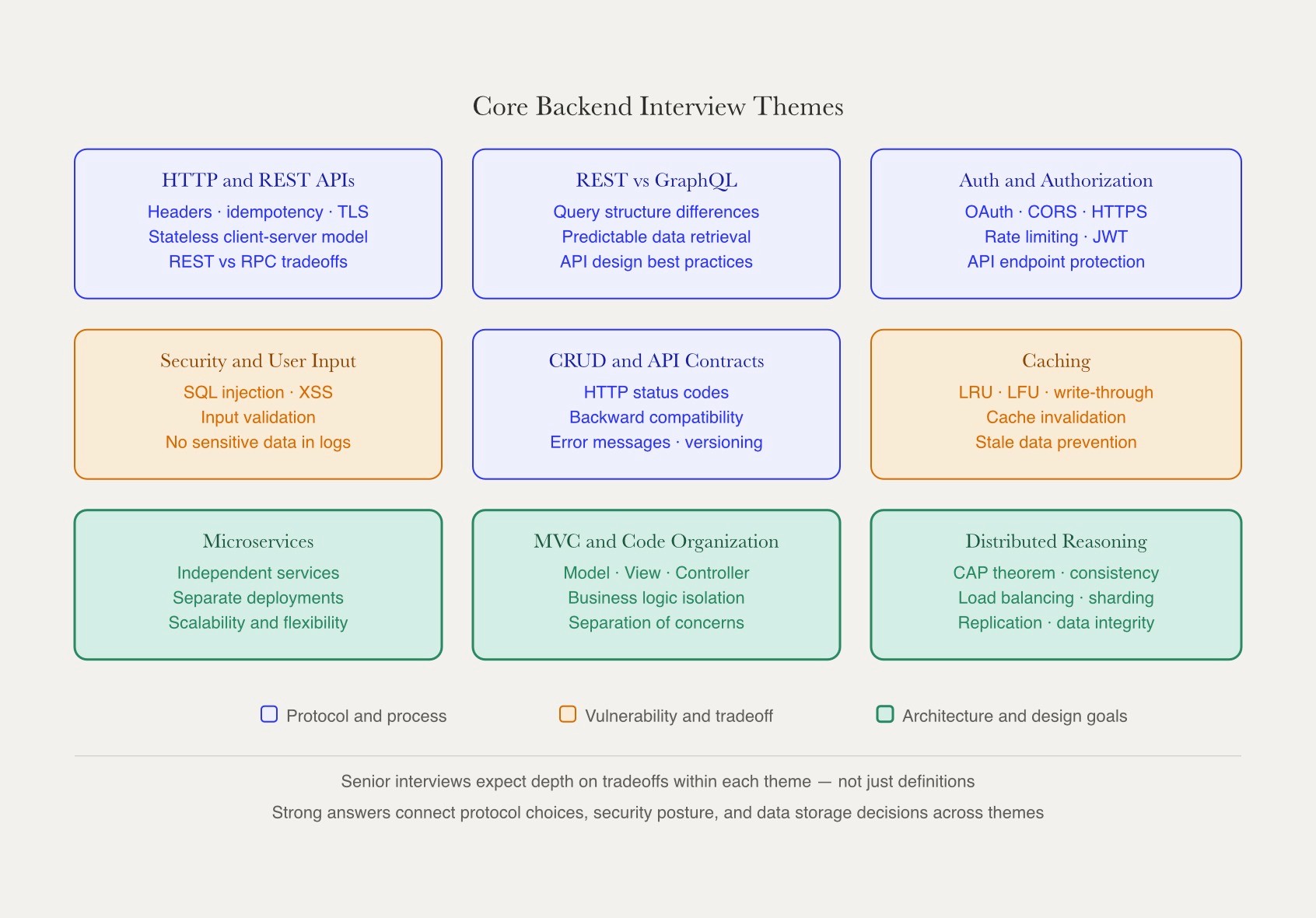
HTTP lifecycle, REST, and RPC APIs: A strong answer explains headers, idempotency, latency budgets, TLS, proxies, and security. Candidates should understand how REST uses stateless client-server communication, standard HTTP methods, cacheable responses, and resource-oriented URIs with a consistent interface. They should also be able to explain when REST is preferable to RPC and how API design affects performance, scalability, and maintainability.
REST versus GraphQL: REST and GraphQL APIs have key differences in structure and querying methodology. APIs should be designed following best practices for RESTful services, especially when creating web services or building web services that must retrieve data predictably.
Authentication and authorization: Use HTTPS to encrypt data transfer between client and server, implement OAuth for secure authentication and authorization, and configure strong CORS policies to avoid unwanted requests. Rate limiting prevents abuse of API endpoints, and understanding API rate limiting is crucial for managing request volume.
Security and user input: Common vulnerabilities include SQL Injection and XSS. Validate all inputs to prevent injection attacks, including SQL injection, and avoid exposing sensitive data in logs or responses.
CRUD and API contracts: CRUD operations stand for create, read, update, and delete. Senior answers should cover HTTP status codes, meaningful error messages, backward compatibility, and how an API can access data without leaking implementation details.
Caching: Caching reduces database load by storing frequently requested data, improves response times for high-traffic applications, helps maintain server performance under load, and can significantly enhance user experience. Caching strategies include write-through and write-behind caches. Cache strategies can include LRU and LFU for frequently accessed data, and cache invalidation is crucial to prevent stale data issues.
Architecture patterns: Microservices architecture structures applications as independent services. Each microservice focuses on a specific business function. Microservices can be developed and deployed independently using different tech stacks, which enhances scalability and flexibility across the system.
MVC and code organization: Model View Controller separates the application into three components: Model, View, Controller. By separating applications into distinct Model, View, and Controller components, the MVC architecture isolates business logic from user interfaces to promote clean separation of concerns and easier maintenance.
Distributed reasoning: Be ready to reference CAP theorem tradeoffs, data consistency, database normalization, distributed databases, multiple servers, load balancing, and consistency models without turning the answer into a textbook lecture.
Database-Focused Questions: Relational, NoSQL, And Distributed Data
Most backend interviews for AI and ML-heavy products center on data modeling, query performance, and correctness as systems grow. Interviewers care about how you design database schema, database tables, database connections, and database transactions while ensuring low-latency data retrieval. They also test whether you can ensure data integrity after failures, retries, migrations, or concurrent writes. This is where abstract knowledge becomes practical data management.
Relational Database Questions
Expect questions on ACID properties, isolation levels, primary key choices, joins, object relational mapping, data manipulation language, and structured query language. ACID properties ensure data integrity in relational databases, and SQL databases use a predefined schema for data. SQL databases are ideal for complex queries and transactions, and SQL databases ensure ACID compliance for transactions.
Database indexing is another common topic. Database indexing improves data retrieval speed significantly. Indexes are special data structures that store information for quick access. Creating an index on a column speeds up search queries on that column, and database indexing is crucial for optimizing query performance. Indexes can slow down write operations due to maintenance overhead, so senior answers should include read-write tradeoffs, query optimization, and explain plans.
Database normalization minimizes data redundancy and avoids anomalies. You should be able to discuss 1NF through 3NF, denormalization, data anomalies, and how to audit every data record after schema changes. Strong answers explain how database queries fetch, retrieve data, and process data efficiently across PostgreSQL, MySQL, Amazon Aurora Serverless v2, and analytical stores.
NoSQL Databases And Polyglot Persistence
NoSQL databases do not require a fixed schema, and NoSQL databases excel in handling unstructured data. NoSQL databases are designed for horizontal scalability, making MongoDB, Apache Cassandra, DynamoDB-style stores, and key-value systems useful when write volume or flexible document shape matters more than joins.
Event sourcing and CQRS also appear in backend developer interview questions because they separate write models from read models. A message queue can support event-driven architecture, and Event-Driven Architecture can improve scalability in software systems. For AI-heavy backends, vector databases such as pgvector, Pinecone, and Weaviate increasingly appear in interview questions because candidates must understand embedding storage, metadata filters, and approximate nearest neighbor retrieval.
Dimension | Relational databases | NoSQL databases |
Schema rigidity | Rigid schema with migrations | Flexible document, key-value, or column-family shape |
Typical latency | Low milliseconds for indexed lookups | Very low for key-value access, variable for vector search |
Scaling model | Vertical scaling, replicas, sharding | Horizontal scalability by design |
Transaction guarantees | Strong ACID across many workloads | Tunable or eventual consistency in many systems |
AI/ML pipeline fit | Reference data, features, transactions | Embeddings, metadata, cache, high-volume writes |
Distributed Databases And Replication
Distributed database questions explore CAP-informed design, replication lag, leader election, conflict resolution, and multi-region failure modes. Sharding is a method used to distribute data across multiple database instances, while horizontal and vertical scaling remain the basic scaling methods. CockroachDB, Google Cloud Spanner, Apache Cassandra, and modernized cloud-managed distributed databases force candidates to explain availability, consistency, and latency under partition.
Senior answers should discuss compensating transactions, idempotency, reconciliation jobs, and data integrity checks. The goal is not to recite definitions, but to show how a backend application preserves correctness when multiple servers are writing, reading, and repairing data.
Java-Specific Backend Interview Questions: Spring, Concurrency, And JVM Concerns
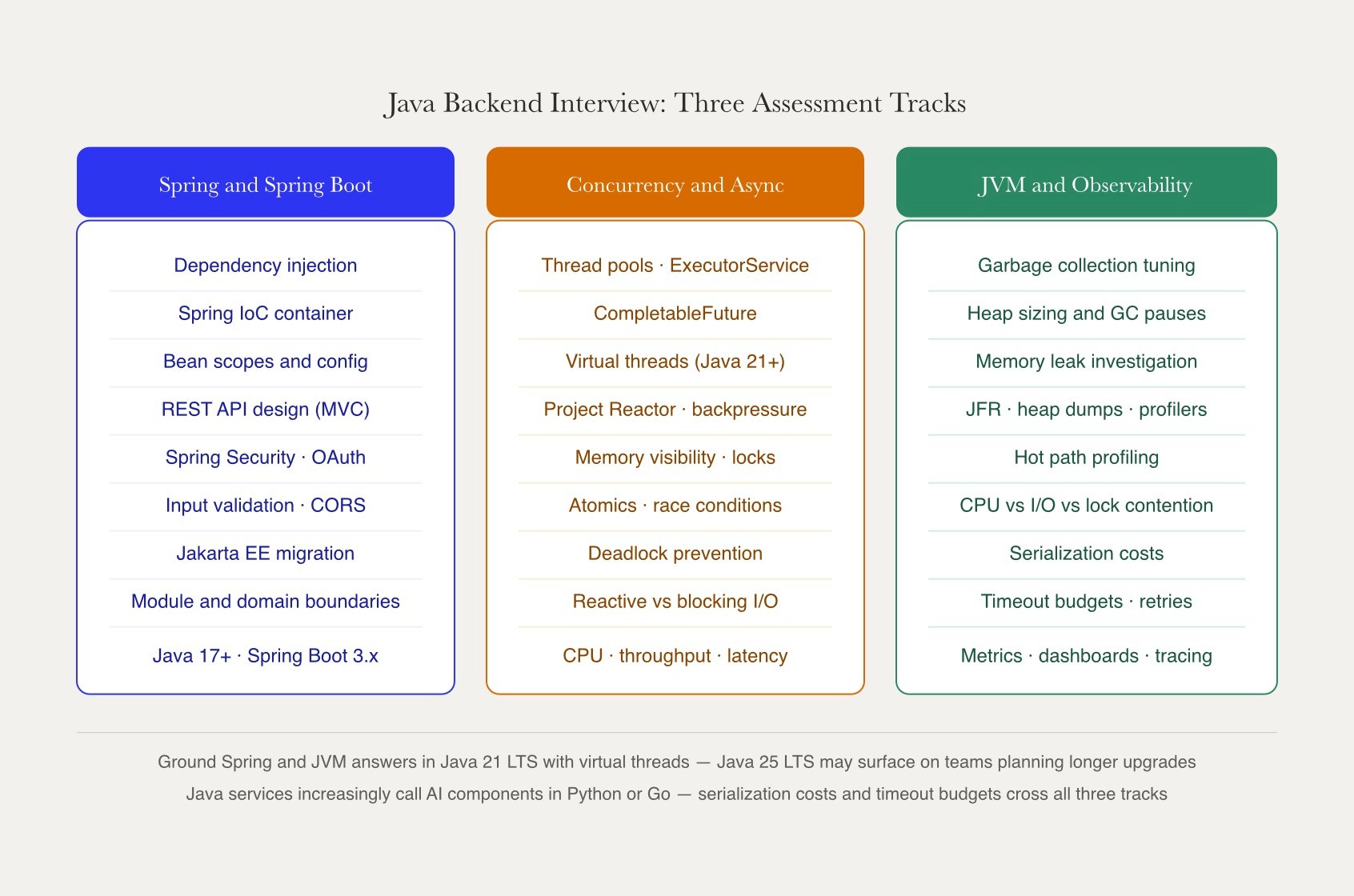
Java remains a core language for banks, ad platforms, enterprise platforms, and AI-serving infrastructure. Many loops include at least one Java-centric round, even when services also use Python, Go, or Node.js. Ground your Java answers in Java 21 LTS with virtual threads from Project Loom, and understand Spring Boot 4.x, its Jakarta EE migration, and the Java 17+ requirement. Java 25 LTS may come up where teams are planning longer platform upgrades.
Spring And Spring Boot
Spring questions often cover dependency injection, Spring IoC container behavior, bean scopes, configuration management, and REST API design with Spring MVC. You should also explain Spring Security, OAuth resource servers, CORS configuration, input validation, exception mapping, and object-oriented programming principles.
Large codebases often use multiple modules, shared libraries, and layered packages. Interviewers may ask how to preserve code quality while reusing existing functions, applying data abstraction, and preventing framework leakage across domain boundaries.
Java Concurrency And Asynchronous Programming
Understanding concurrency is essential to preventing database deadlocks and race conditions. Expect questions on thread pools, multiple threads, ExecutorService, CompletableFuture, Project Reactor, backpressure, and virtual-thread-based concurrency models in Java 21+. Strong candidates explain when virtual threads simplify blocking I/O and when reactive programming still helps with streaming or bounded resource control.
You should also know memory visibility, locks, atomics, and why Java supports interface-based multiple inheritance but not multiple inheritance of classes. Connect concurrency choices to API latency, throughput, database connections, central processing unit usage, and operating system scheduling.
JVM Performance And Observability
JVM interview questions often cover garbage collection tuning, heap sizing, memory leak investigation, profiling hot paths, and monitoring GC pauses, heap usage, and thread states. Tools such as JFR, heap dumps, async profilers, and metrics dashboards help prove whether a bottleneck is CPU-bound, I/O-bound, or caused by lock contention.
Java services increasingly call AI-serving components written in Python or Go. You should be able to explain serialization costs, timeout budgets, retries, and how failures are surfaced through robust error handling.
Evaluating System Design And Software Architecture Skills
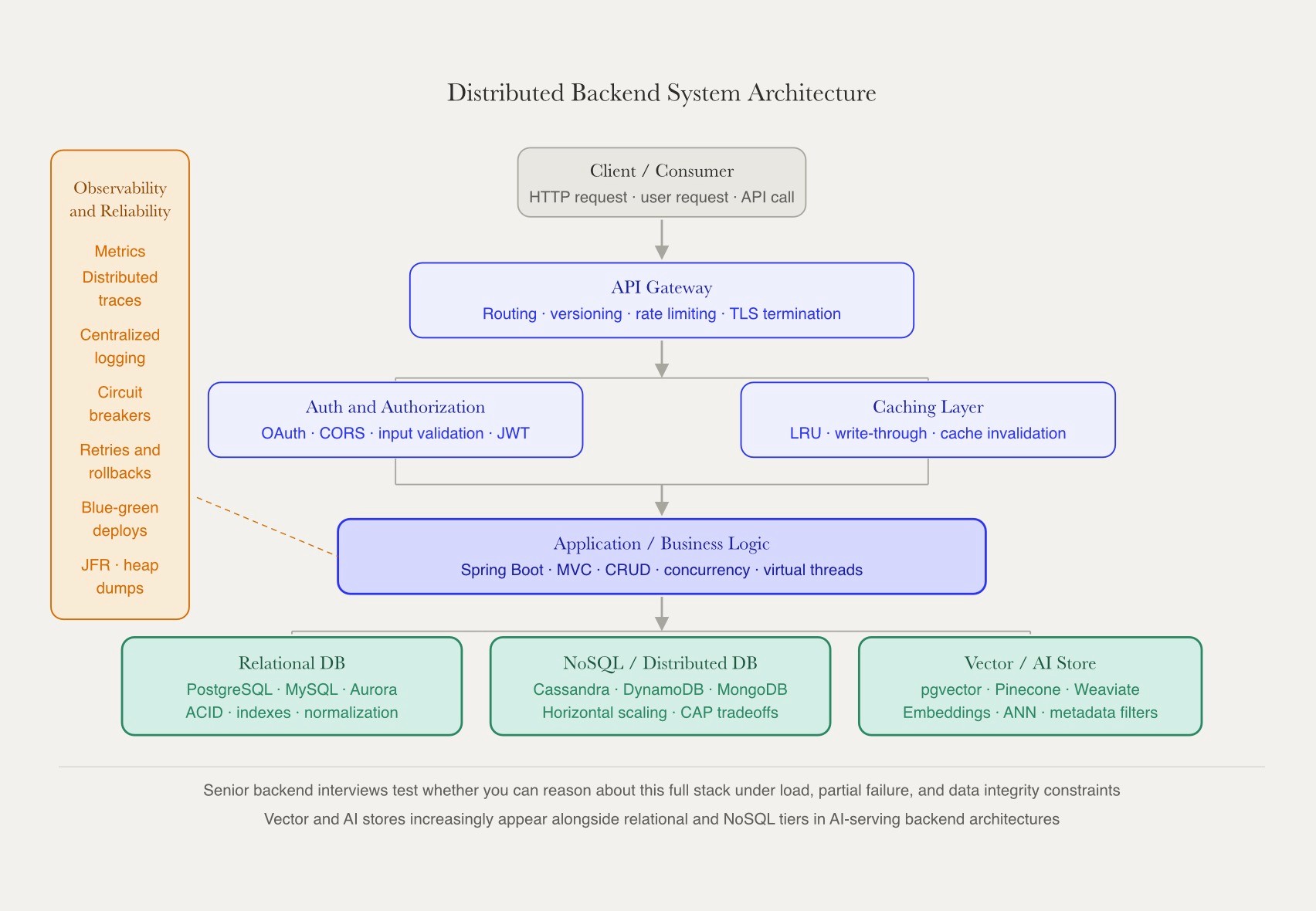
Senior backend and infra interviews almost always include system design scenarios that test architectural thinking rather than syntax recall. System design must account for handling high traffic and data volume. Good answers connect software architecture, scaling, data storage, observability, and rollback plans.
API And Service Design Scenarios
Common prompts include designing a multi-tenant REST API, adding pagination and filtering, applying rate limits, or evolving an internal API into a public platform. A senior answer should cover versioning, authorization scopes, tenant isolation, request tracing, and how web services degrade when dependencies fail.
Large-Scale Data And AI-Serving Architectures
AI-serving prompts often ask for a feature-serving layer, a retrieval system, or a streaming pipeline using Apache Kafka, Redpanda, or Apache Flink. Strong answers discuss online and offline stores, freshness, backfills, model versioning, and how fetching data changes when embeddings, features, and metadata are updated at different times.
Reliability And Observability In Distributed Backend Systems
Interviewers will ask about partial outages, graceful degradation, retries, circuit breakers, centralized logging, metrics, distributed traces, and tracing across microservices. Deployment answers should include blue-green or canary releases, rollback strategies, continuous integration, and explicit data integrity checks after complex migrations. Curated marketplaces such as Fonzi often expect candidates to demonstrate this level of system design fluency before matching them with AI-heavy companies.
Fonzi Match Day for Backend and Java Engineers
As companies scale distributed systems, AI infrastructure, and data-intensive applications, identifying backend engineers with strong architecture, database, and reliability expertise becomes more difficult through resumes alone. Fonzi is a curated hiring marketplace that connects engineers with startups and growth-stage technology companies, helping both sides focus on technical fit rather than high-volume application processes. Through Fonzi's Match Day, companies review vetted candidates and send salary-backed interview requests to engineers they want to meet.
For backend and Java engineers, Fonzi can help surface opportunities where experience with Spring Boot, microservices, distributed databases, caching, observability, and AI-serving infrastructure is highly valued. By combining candidate vetting, profile optimization, and direct employer interest, Fonzi helps engineers connect with companies looking for proven backend talent while reducing much of the noise associated with traditional job searches.
Summary
Backend developer interviews in 2026 focus on real-world system design rather than coding trivia. Candidates are expected to understand APIs, databases, caching, security, distributed systems, and data integrity while explaining tradeoffs around performance, scalability, and reliability.
For Java roles, interviewers commonly assess Spring Boot, concurrency, JVM internals, virtual threads, and observability. Strong candidates demonstrate how backend systems handle production workloads, scale efficiently, and support modern AI, ML, and data-intensive applications.
FAQ
How can an AI or ML engineer translate their project work into strong backend interview stories?
How deep should I go into relational database theory if my current stack uses mostly NoSQL databases?
How many programming languages should I actively prepare for in backend interviews?
Is it acceptable to use AI tools while working on take-home backend interview assignments?
How do curated marketplaces or match-based hiring platforms interact with a company’s own backend interview process?


