TCS NQT Prep Guide: Coding Questions, Numerical Tests, and Tips
By
Samara Garcia
•

The TCS National Qualifier Test, or TCS NQT, remains one of the largest entry-level hiring assessments, serving as a vital gateway to software engineering, data, cloud, and AI roles.
Even experienced AI and infra engineers may encounter NQT-style assessments when exploring lateral roles in large organizations, global capability centers, or service providers that standardize hiring. This guide covers the recent test pattern, numerical reasoning, and numerical ability focus areas, coding questions, and preparation strategies for technically advanced candidates.
Key Takeaways
The TCS NQT test has Foundation and Advanced sections covering numerical ability, verbal ability, reasoning, programming logic, and coding questions.
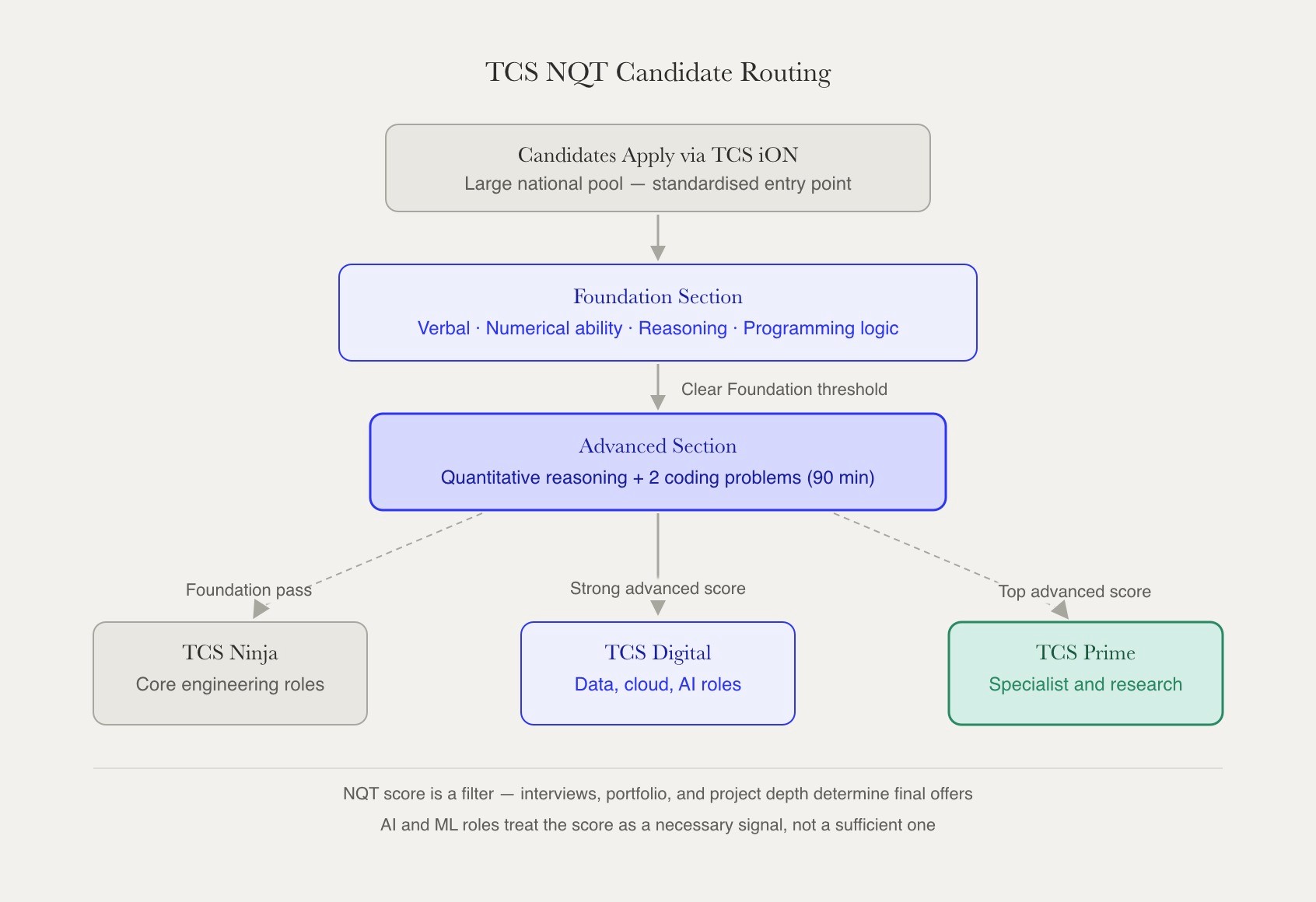
The TCS selection process uses NQT performance to route eligible candidates toward TCS Ninja, TCS Digital, and Prime-style opportunities.
Numerical reasoning, quantitative aptitude, and data interpretation remain major time sinks, even for strong engineering candidates.
Coding questions usually focus on arrays, strings, sorting algorithms, number manipulation, and clean implementation rather than obscure algorithms.
A realistic mock test schedule, reviewed with discipline, builds more confidence than solving random practice sets without timing.
Overview of TCS NQT Pattern and Role Mapping
The TCS National Qualifier Test (NQT) is an assessment used by Tata Consultancy Services to evaluate aptitude, reasoning, verbal ability, and job-related skills. Delivered through the TCS iON platform, it is commonly used for hiring and can also be accepted by other participating employers.
The exam typically includes Foundation and Advanced sections that assess verbal, numerical, reasoning, and programming-related skills. Candidates receive a scorecard that remains valid for a limited period and can be used to apply for multiple opportunities. Eligibility requirements and exam structure may vary by hiring program, so candidates should review the latest guidelines before registering.
TCS NQT Section-wise Structure and Time Allocation
The following table summarizes the common recent format based on publicly available patterns and recent candidate reports. Exact counts can vary by hiring cycle, so use this as a preparation baseline rather than a legal specification.
Section | Key skills tested | Approx. questions | Approx. time |
Foundation Verbal Ability | Reading comprehension, grammar, vocabulary, para-jumbles, and correct answer selection from close options | 24-25 | 25-30 min |
Foundation Numerical Ability and Reasoning | Quantitative aptitude, logical reasoning, data interpretation, series, next number, equation solving | 40-55 combined | 50-90 min |
Foundation Programming Logic | Arrays, strings, loops, pseudo-code, output prediction, variable tracing | Varies | Included in Foundation timing |
Advanced Quantitative and Reasoning | Probability, combinatorics, data sufficiency, analytical puzzles | 14-16 | About 25 min |
Advanced Coding | 2 hands-on coding questions, usually one medium and one harder problem | 2 | About 90 min |
Numerical ability and numerical reasoning together account for a significant portion of Part A, which is often where otherwise strong developers lose time. The advanced section is the main differentiator for TCS Digital and prime candidates, while clearing only the Foundation bar may route candidates toward TCS ninja-style roles.
Some legacy prep materials state that the Advanced section consists of three coding questions. However, most recent patterns specify two advanced coding questions in 90 minutes, so candidates should train for the two-question format. For role-prep, most recent patterns describe 2 advanced coding questions in 90 minutes, so candidates should train for the two-question format while being aware of legacy material.
How AI and ML Roles Use NQT Scores
For data engineering, analytics, AI implementation, and MLOps roles, TCS NQT scores can be the first filter across a very large candidate pool. For research-heavy ML, LLM, or infra architecture roles, the score is usually necessary but not sufficient, because technical interviews, portfolio depth, system design, and project impact carry more weight.
Some hiring teams may factor standardized numerical reasoning and coding scores into early candidate filtering workflows, though processes vary by team. Good teams still treat these scores as signals, not verdicts, and human staffing decisions can override model-driven rankings.
Numerical Ability and Numerical Reasoning: What Senior Engineers Need To Revisit
Many senior engineers underestimate the numerical reasoning part because the concepts look familiar. The difficulty is not the math alone, but speed across arithmetic, algebra, percentage, ratio, and data interpretation across varying difficulty levels.
Numerical ability refers to direct quantitative topics such as percentages, profit and loss, simple and compound interest, time and work, LCM, HCF, decimal conversions, and comparing two fractions. Numerical Ability section tests quantitative aptitude and logical reasoning, especially when a problem combines multiple steps. Numerical reasoning adds interpretation, such as reading tables, checking data sufficiency, or deriving the correct answer from a chart rather than from a direct formula.
A useful way to prepare is to treat the section like an optimization problem. Your goal is to maximize accuracy per minute, reduce context switching, and avoid letting one long calculation damage the entire score.
High-Yield Numerical Topics for TCS NQT
Focus your practice on topic clusters that appear repeatedly:
Fractions, decimals, percentage change, and approximations.
Ratio, proportion, mixtures, and partnership-style distributions.
Time, speed, distance, and work-rate models.
Simple interest, compound interest, averages, and profit-loss.
Probability and combinatorics with bounded integer constraints.
Number systems, divisibility, base conversion, digit properties, and modulo patterns.
Data interpretation using charts, tables, and a given range of values.
Number system questions connect directly to coding questions that manipulate integers. For example, a problem that asks you to find the sum of values divisible by 3 in a given range is both a numerical ability problem and a basic algorithmic loop.

Numerical Reasoning Strategies for Experienced Candidates
Read the question carefully, mark the relevant quantities, and map the problem to a known pattern before starting the calculation. If a query looks unusually computation-heavy, attempt it later, only after solving standard difficulty items.
Practice 30-45 minute timed sets that mix arithmetic, algebra, and data interpretation. AI engineers who routinely rely on NumPy, spreadsheets, or observability dashboards may still need paper-based drills to rebuild manual fluency for the exam format.
Coding Questions in TCS NQT: Patterns, Topics, and Problem-Solving Tactics
TCS NQT coding is split between programming logic in the Foundation part and hands-on coding in the advanced section, solvable in C, C++, Java, or Python. TCS NQT includes coding problems on arrays and strings, and TCS NQT coding questions cover number manipulation and sorting algorithms.
Most questions focus on basic data structures and algorithms: arrays, strings, sorting, prefix sums, loops, maps, and simple number theory. They resemble production-adjacent utilities more than ML-specific tasks. For example, you may parse one string according to an order defined by another, compare two strings, check whether strings match with wildcard characters, replace a letter or word in a string, or print counts of elements that satisfy constraints.
Many candidates practice using a curated the TCS NQT coding sheet hosted on popular preparation platforms. Use these resources to recognize underlying problem-solving patterns rather than trying to memorize specific solutions.
Typical Coding Patterns: Arrays, Strings, and Numbers
Common archetypes include:
Sort an array of integers with custom ordering or frequency-based rules.
Perform circular rotation of an array by k positions.
Remove duplicates from a sorted array while preserving the input order.
Find the sum of elements in a subarray within a specified index range.
Count positives, negatives, zeros, or values within a given range.
Compare two strings, process one string, or use wildcard characters to decide whether strings match.
Many array and string problems are solvable in O(n) or O(n log n). A prefix-sum array can answer a range query efficiently. A hash map can count elements. A basic sort can solve custom ordering if the comparator is correct.
Do not overengineer. A clean O(n log n) solution that handles input correctly will usually beat a fragile advanced algorithm. Use descriptive variable names, avoid magic numbers, and write small helper functions where they make the explanation clearer in an interview.
Boundary conditions matter. Test empty arrays, single-element arrays, all-duplicate elements, negative values, extreme k positions in circular rotation, and strings containing spaces or special characters.
Advanced Section Coding: Difficulty Curve and Expectations
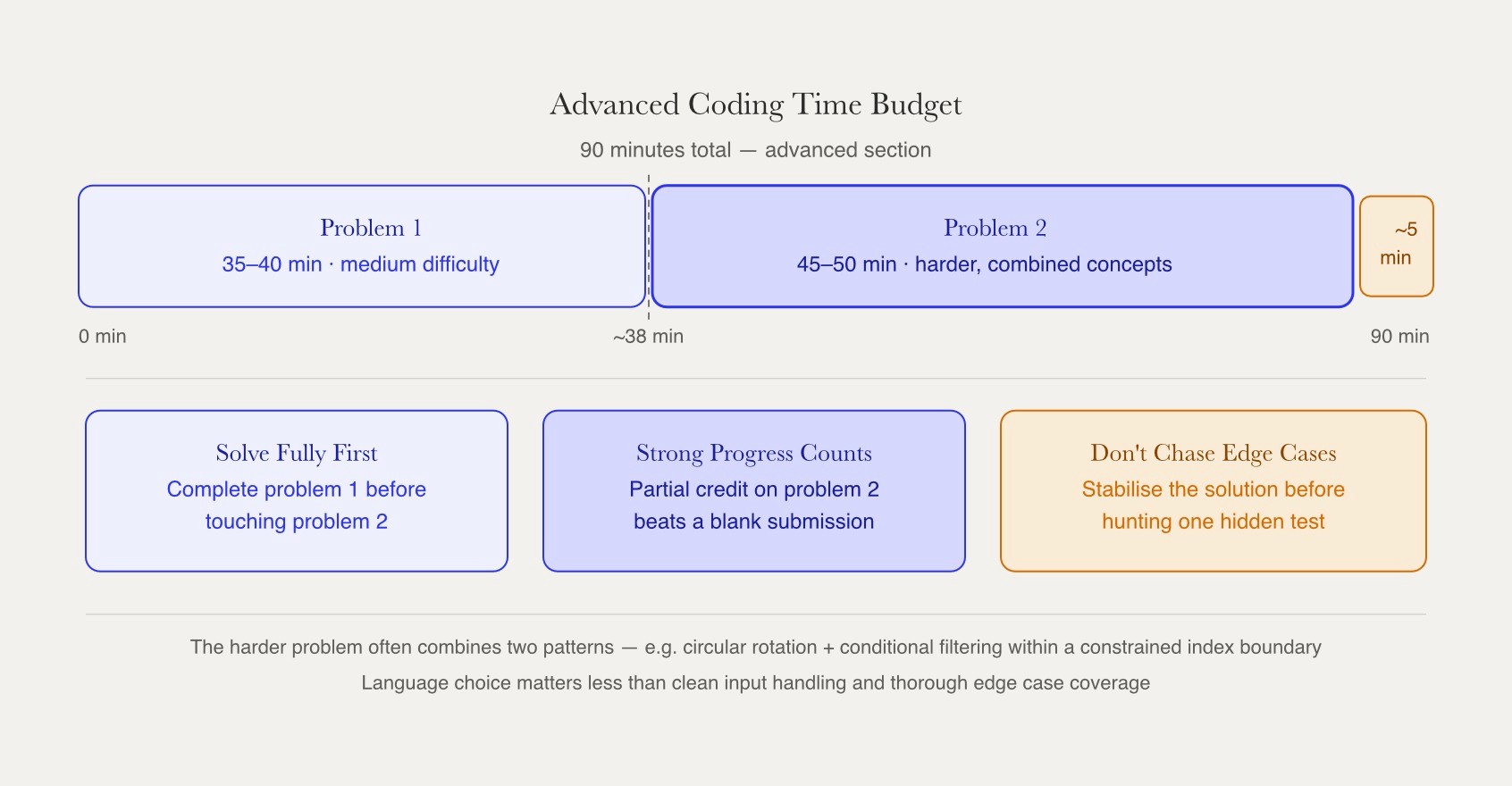
The advanced section usually contains two coding questions with increasing constraints and more involved input formats. Solving both fully, or solving the first fully and making strong progress on the second, can be enough for candidates targeting TCS Digital or TCS Prime roles when combined with strong numerical scores.
The harder problem often combines concepts. For example, it may require circular rotation plus conditional filtering within a constrained index boundary, or merging two arrays while maintaining an order defined by custom criteria.
Budget time explicitly. A practical split is 35-40 minutes for the first problem, 45-50 minutes for the second, and a few minutes to re-run tests. Do not spend the complete advanced section chasing one hidden test case unless the rest of the answer is already stable.
Language Choice and Implementation Tips
Pick the programming language you use most confidently. Python is usually sufficient for TCS NQT constraints if input and output are handled efficiently. Java and C++ give more control over memory, integer types, and performance.
Before the test, write small templates for fast input, list parsing, loop patterns, and common output formats. In Java, watch for integer overflow and scanner performance. In Python, avoid quadratic string concatenation and use lists when building output.
Mock Tests, Data-Driven Preparation, and AI-Assisted Practice
Mock test practice is the highest leverage activity in the final 2-4 weeks before the TCS NQT. Full-length sessions should replicate the 190-minute flow, including Foundation first and advanced section later, so you build endurance and pacing intuition.
Keep a simple log for each mock test: attempts per section, accuracy, average time per question, and repeated errors. Track whether your wrong answer came from a concept gap, careless arithmetic, a misread input format, or an off-by-one bug.
Busy senior engineers can plan 2-3 full mocks per week in the last month, with review sessions at least as long as the mock itself. On weekdays, alternate between numerical reasoning drills and coding-only mini mocks.
Large language models can explain circular rotation, remove duplicates, probability shortcuts, or why a particular equation setup fails. Use AI tools as tutors, not as answer generators. The goal is to write correct code from scratch under test conditions.
Curated talent marketplaces such as Fonzi can complement TCS NQT by surfacing AI-focused roles where skills, compensation expectations, and preferences are aligned earlier. They do not replace tests or interviews, but they can reduce noise in a job search.
TCS NQT, Match Day, and Career Opportunities
While TCS NQT remains an important gateway into large-scale technology organizations, many candidates also explore alternative hiring channels that emphasize skills, project experience, and career fit. Fonzi helps connect engineers with companies seeking talent in software engineering, AI, data, cloud, and platform roles, creating opportunities beyond traditional exam-based hiring pipelines.
For candidates preparing for TCS NQT, Match Day can complement that effort by providing access to employers looking for strong problem-solving ability, coding skills, and technical potential. Whether your strengths are in quantitative reasoning, programming, or AI-focused projects, Fonzi offers another path to discover roles that align with your skills and long-term career goals.
Summary
The current TCS NQT blends numerical ability, numerical reasoning, verbal ability, programming logic, and practical coding questions into a standardized filter for large-scale engineering hiring in India. Senior candidates can succeed by focusing on mock test discipline, arrays, strings, quantitative aptitude, and careful implementation.
Schedule your next full-length mock test, review your numerical and coding errors, and update your professional profiles so your score, projects, and career priorities tell the same story.
FAQ
How important is TCS NQT for experienced AI or ML engineers compared to fresh graduates?
Do I need advanced data structures for TCS NQT coding questions?
How can I balance TCS NQT preparation with a full-time AI or infrastructure role?
Will a strong TCS NQT score compensate for a limited AI portfolio?
Is TCS NQT useful if I want startups or smaller AI product companies?


