Scale AI Interview Process: Every Round and the Credos
By
Samara Garcia
•

The Scale AI interview process runs four stages: a recruiter screen, a timed coding assessment, a hiring manager call, and a final loop that includes a Credo round built on Scale's six published credos. A card game exercise appears somewhere in the coding stages, though current reports disagree on which one. Candidate reports put one to three weeks between the recruiter screen and the final loop, which leaves almost no room to prepare for one stage while you are sitting in another. Prepare the coding assessment, the technical rounds, and the Credo interview together, before the recruiter call.
Key Takeaways
Scale AI's interview process is fast and highly structured, with most engineering candidates reporting one to three weeks from recruiter screen to final loop, though new grad and senior loops often run longer.
The online assessment centers on a distinctive card game exercise that tests coding speed and adaptability to evolving requirements rather than exotic algorithms, making it fundamentally different from a typical coding screen.
The Credo round is a dedicated culture fit interview built around six published company values, Earn Customer Love, Team Flow, Quality is Our Cheat Code, Find the 20%, Write the Market, and Three Moves Ahead, with "tell me about a time" prompts mapped directly to each one.
Scale AI Interview Process Overview From Recruiter Screen To Offer
There is a consistent backbone across the Scale AI interview process regardless of team or seniority. Most engineering candidates move through four stages: recruiter screen, online assessment, hiring manager call, and a final loop of three to five virtual interviews, followed by an internal debrief you do not attend. Candidates typically put the timeline at one to three weeks from recruiter screen to final loop, so preparation for every stage should begin as soon as the recruiter call is scheduled.
The loop tests three overlapping themes: speed and correctness under time pressure, visible in every coding round; AI systems thinking, including data quality, human-in-the-loop workflows, and cost or latency trade-offs; and alignment with Scale's six published credos, assessed in a dedicated behavioral round. Many candidates underestimate how quickly rounds follow each other, so preparing across all three themes in parallel, rather than one at a time, is essential.
Scale AI Interview Stages And What Each Round Screens For
The exact sequence varies by role and application path, so use the stages below as a preparation baseline.
Stage | What It Screens For | Typical Format | Approximate Timing |
Recruiter screen | Resume fit, location, salary band, work authorization, communication skills, comfort with a high-intensity work environment | Phone or video call, 20 to 30 minutes | Week 1 |
Online assessment (OA) | Coding speed, accuracy, adaptability to evolving requirements, practical problem-solving | HackerRank or a similar timed coding platform, with a 50-minute automated assessment, separate from a 60-minute live technical screen | Week 1 |
Hiring manager call | Technical depth, roadmap alignment, early role fit and culture fit, background in AI or ML systems | Video call, 30 to 45 minutes | Week 1 to 2 |
Final loop | System design, debugging, coding round, Credo behavioral round | Three to five virtual interviews, over half a day | Week 2 to 3 |
Internal debrief | Holistic candidate evaluation across all signals | Hiring committee review | Days after final loop |
During the recruiter screen, expect questions about your background and interest in Scale rather than coding, and use the call to ask about the exact loop structure for your role. The hiring manager round combines light technical depth with roadmap alignment, often including questions about a time you handled ambiguous AI infrastructure decisions or a high-stakes launch. Final interviews include system design, debugging, and behavioral assessments, each contributing a distinct signal to the debrief.
Scale AI OA: Online Assessment And Card Game Exercise Format
Scale AI's online assessment is more like a mini work sample than a pure algorithmic test, and the card game exercise is the signature element that distinguishes this process from most other companies' screens. Reports on the Scale AI OA vary by candidate and role. Aced's 2026 new-grad guide describes a 50-minute HackerRank assessment centered on scheduling and interval logic, while other recent interview guides place Scale AI's card-game coding exercise in a HackerRank or live technical screen.
The Scale AI Card Game Interview
In the card game exercise, you receive a spec describing classes like Card, Deck, and Player, then implement a basic card game engine. Mid-round, additional rules and edge cases arrive, which forces you to design clean classes and data structures that handle new constraints quickly. Candidate reports consistently describe the same emphases: speed, correct handling of rule changes, clean object modeling, and readable code. Scale does not publish a rubric for this round. Write the simplest correct version of the current spec first, since an abstract class hierarchy built up front has to be unwound the moment the rules change.
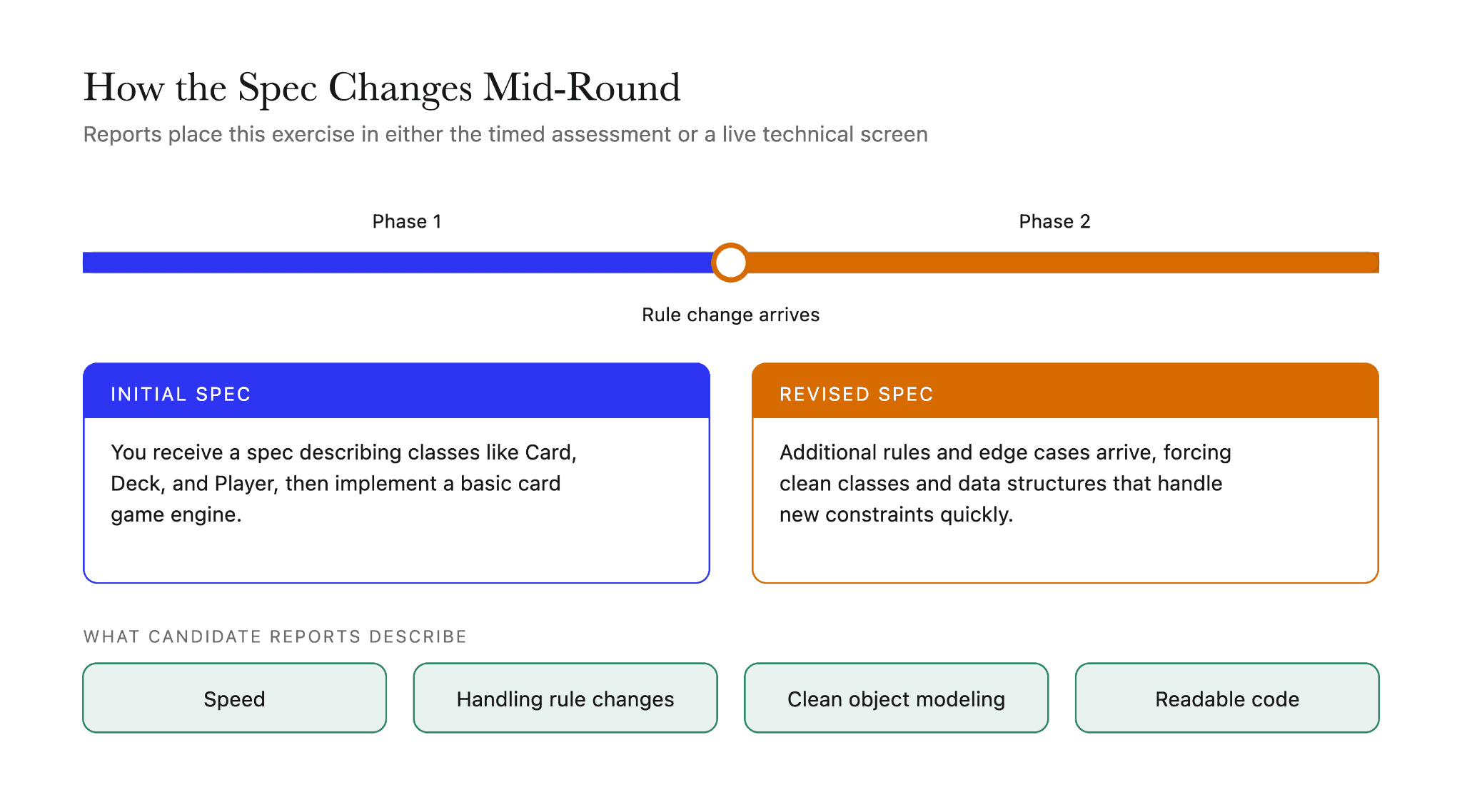
To prepare, practice building small card games and schedulers under 45- to 60-minute time limits, rehearse translating ambiguous English specs into code, and focus on one primary language to maximize typing and debugging speed.
Technical Rounds: Coding, Debugging, And System Design
The core technical rounds test how you handle production-like constraints, data pipelines, and AI infrastructure rather than textbook algorithms. Scale AI's coding rounds focus on speed and accuracy under pressure, with patterns including intervals, greedy approaches, queues, heaps, and string manipulation. Solve full problems end to end rather than half-implementing clever algorithms.
Debugging Round
In one reported new-grad debugging round, the candidate received roughly 150–200 lines of modular code with several bugs, while other Scale AI roles have been reported to use larger, multi-file codebases. You have roughly one hour to identify entry points, trace execution, and fix issues without rewriting everything. Work outward from the failing behavior rather than reading the codebase front to back, and narrate what you are ruling out as you go.
System Design
System design questions focus on AI-related architectures, ranging from data annotation pipelines and LLM evaluation platforms to RLHF workflow orchestrators and multi-tenant storage for large media, with attention to data quality, provenance, failure modes, and error handling at scale. Strong answers show awareness of public sector and enterprise constraints, explicit SLAs, metrics for label quality, and how human review interacts with models rather than treating the model as a black box.
In June 2025, Meta made a non-voting minority investment in Scale AI; Reuters reported the stake at 49%, while Scale said the transaction valued the company at more than $29 billion. Scale has since emphasized enterprise and public-sector applications and increased work on reinforcement-learning environments. Recent candidate guides describe Scale AI system design rounds as focusing on production AI infrastructure, including retrieval, evaluation, reliability, cost, and data-flow trade-offs.
Scale AI Credos, Culture Fit, And The Behavioral Round
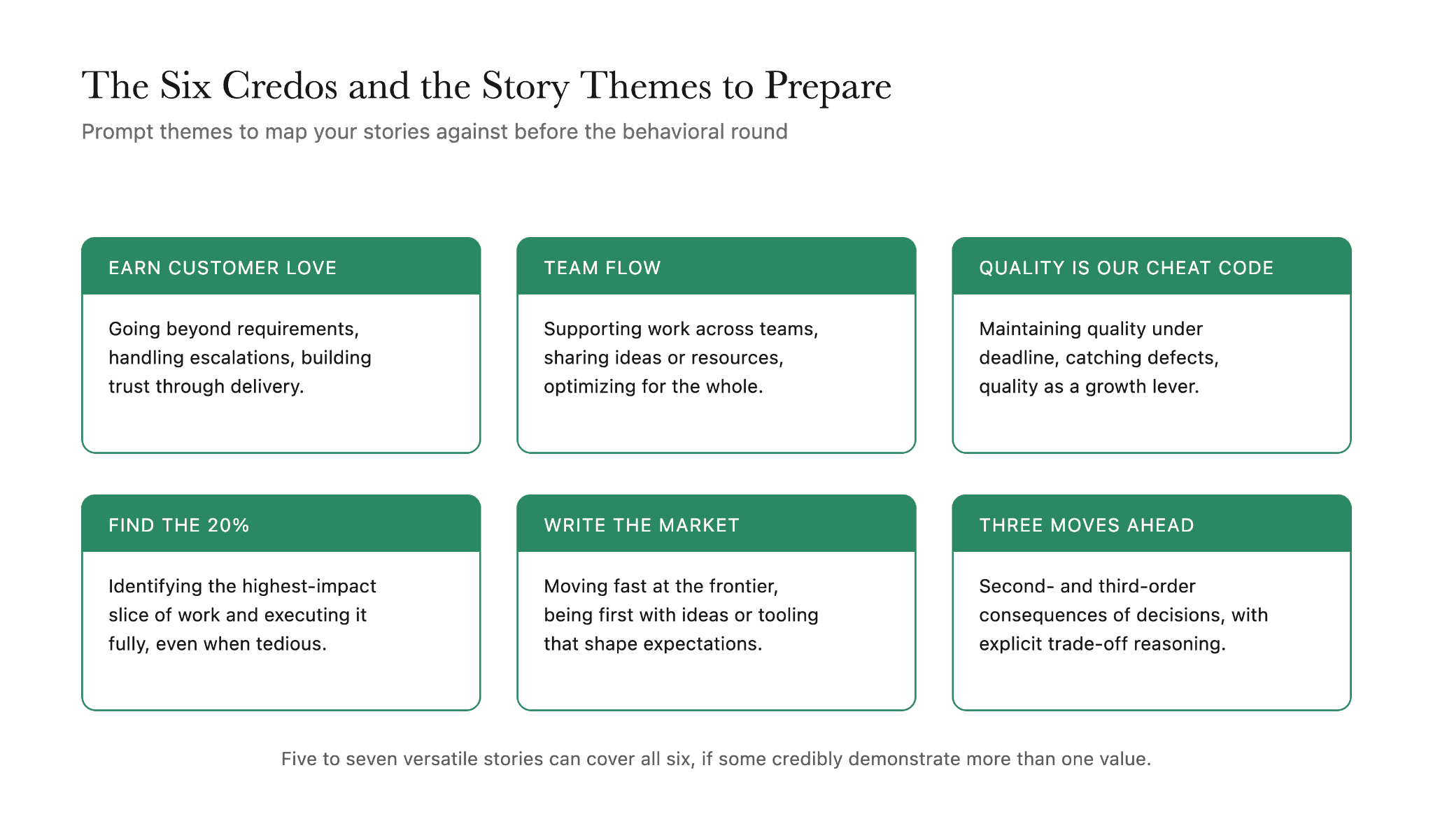
Scale AI publishes six credos on its careers page, and recent candidate guides describe a dedicated Credo behavioral interview built around those company values. Use the credo names currently published by Scale AI when preparing, because company values and their wording can change over time.
The six Scale AI credos and examples of behavioral prompts you can prepare for are:
Earn Customer Love: prompts about going beyond requirements for customers, handling escalations, and building trust through delivery
Team Flow: prompts about supporting work across teams, sharing ideas or resources, and optimizing for the whole rather than only your own team.
Quality is Our Cheat Code: prompts about maintaining quality under deadline, catching defects, and treating quality as a growth lever
Find the 20%: prompts about identifying the highest-impact slice of work and executing it fully, even when tedious
Write the Market: prompts about moving fast at the frontier, being first with ideas or tooling that shape customer expectations
Three Moves Ahead: prompts about second- and third-order consequences of important decisions and explicit trade-off reasoning
Expect "tell me about a time" prompts and answers structured in STAR format, with quantitative outcomes and explicit trade-offs. The round rewards concrete stories told under time pressure with imperfect information, so a polished success narrative lands worse than a messy decision you can defend.
A strong credo-based answer includes one high-stakes situation, specific constraints, a clear decision, the second- and third-order consequences of that decision as Three Moves Ahead requires, and how you earned customer love or preserved data quality along the way. Build a story map that covers all six credos; five to seven versatile examples can be enough if some stories credibly demonstrate more than one value. Example mappings: fixing a broken AI pipeline under a deadline (Quality is Our Cheat Code), cutting scope to the highest-impact 20% of the work (Find the 20%), and building shared infrastructure other teams adopted (Team Flow). Engineering managers can expect deeper probing on team leadership, including how they coach others against specific credos like Earn Customer Love and Team Flow, and examples of addressing misalignment while still shipping critical AI systems on time.
Differences By Role: SWE, New Grad, And Engineering Manager Loops
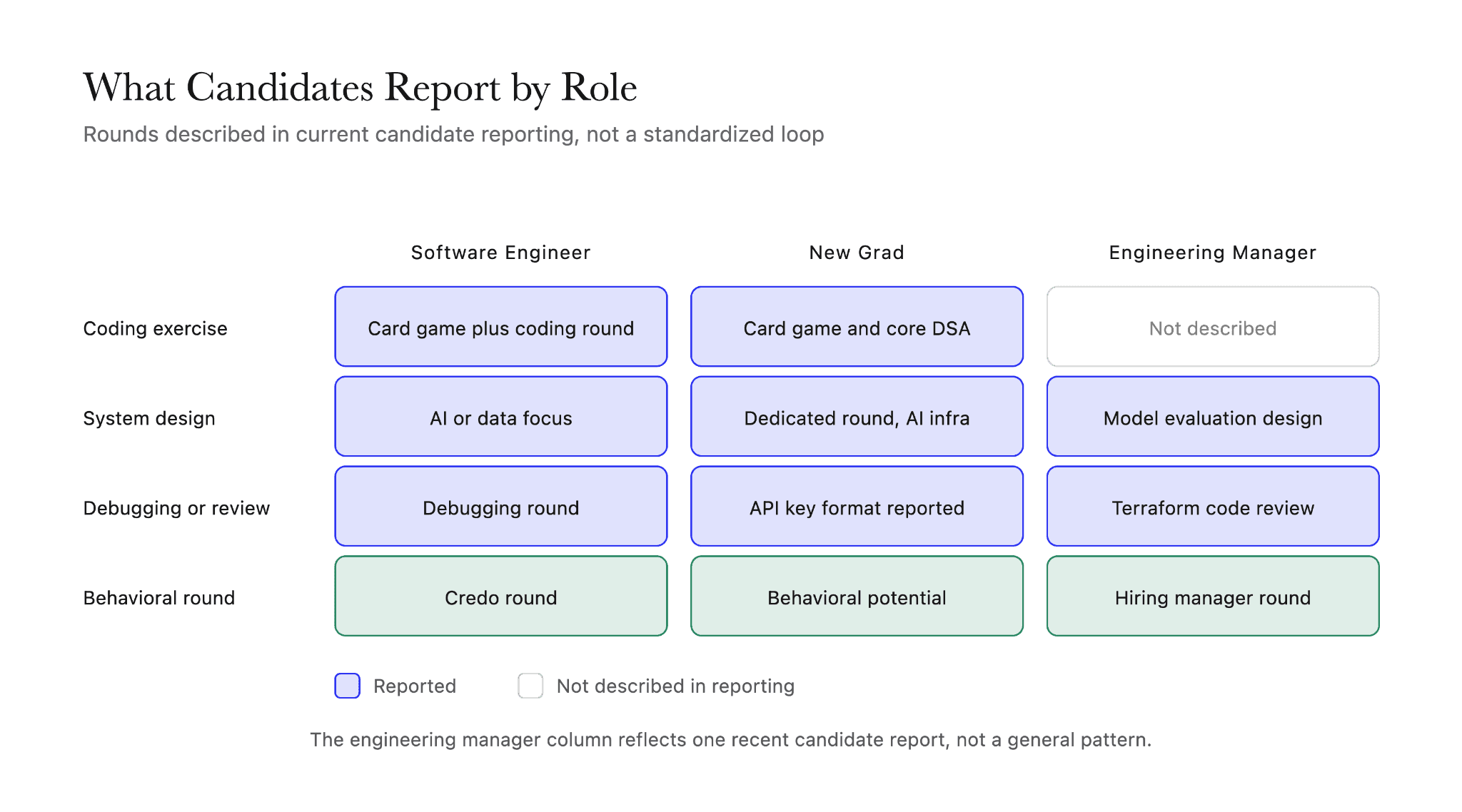
Scale AI's interview process shares core components across roles, but the balance of rounds and depth varies notably by seniority and title. The process varies by role and team, so confirm your exact sequence with the hiring manager or recruiter.
Scale AI Software Engineer Interview Process
The standard loop includes the OA with a card game, a coding round, system design with an AI or data focus, debugging, and a Credo behavioral round. Weight falls heavily on production readiness and the ability to handle edge cases in real systems.
Scale AI New Grad Interview Process
Rounds focus more on core data structures and algorithms, implementation of the card game and practical problems, and behavioral potential. New-grad candidates may still face a dedicated system design round covering applied AI infrastructure, including RAG, storage, token-cost trade-offs, and cloud-service choices. Timelines often stretch to three to six weeks. In one verified 2026 new-grad candidate report, the debugging round included an API key connected to a Scale AI model endpoint, though the exact debugging format can vary by candidate.
Scale AI Engineering Manager Interview Process
One recent Staff Engineering Manager candidate report describes Terraform code review, model-evaluation system design, and a hiring-manager behavioral round; exact EM interview stages and Credo coverage can vary by role and team. Prepare to discuss leadership judgment and people management. The same report lists questions on disagreeing with a manager, the strongest engineer you have hired, and disagreements with that engineer.
ML research and LLM specialists may see deeper case studies in reinforcement learning, model evaluation, and data quality, including discussions of RLHF pipelines, model observability, and human-in-the-loop evaluation. A public-sector-facing infrastructure engineering manager may receive a different mix of interviews from a backend software engineer.
Scale AI Interview Process Prep, Stage By Stage
Map each prep activity directly to a specific round of the process.
Recruiter and hiring manager calls: prepare a crisp "why Scale and this part of the stack" answer, a short explanation of recent AI systems you have built, and two to three questions about customer workflows and data quality. Prepare a measurable work sample or portfolio reference you can discuss.
OA and coding rounds: dedicate one to two weeks of timed practice on card games, schedulers, debugging, and medium-data structures and algorithms problems. Practicing full implementations under a fixed clock, then absorbing a rule change partway through, mirrors the actual format more closely than open-ended algorithm drilling.
System design: build a small library of patterns around data labeling platforms, RLHF feedback loops, evaluation dashboards, and provenance tracking. Include clear metrics and failure mode analysis. Research how day-to-day work at Scale intersects with enterprise and public sector delivery.
Credo behavioral round: write and refine five to seven concrete stories, each mapped to a named credo and linked to a measurable outcome such as latency reduction, annotation throughput, or customer retention.
Is Scale AI The Right Fit? Pace, Ownership, And On-Call
Beyond passing discrete rounds, assess whether Scale's expectations on speed, ownership, and AI-centric work align with how you prefer to operate. Candidates who thrive at Scale tend to be comfortable with sparse process, direct feedback, moving fast, and heavy responsibility for outcomes, including customer deployments and measurable performance metrics.
Ask interviewers about on-call expectations, experimentation on reinforcement learning or new LLM infrastructure, and how teams balance urgency with reliability. The interview experience itself, including its pace and the detail interviewers invest in explaining the role, is a practical signal about the day-to-day environment and should inform your decision as much as compensation data.
How Fonzi Can Help Engineers Find Roles Like Scale AI's
Loops like Scale AI's are hard to evaluate from the outside. You cannot tell whether a company's culture and pace will suit you until you are several rounds in, by which point you have spent weeks finding out. Fonzi is a curated AI engineering hiring marketplace that connects companies with pre-vetted AI and software engineers through structured technical assessments designed to surface how a candidate actually works, rather than relying on a resume alone.
Fonzi also runs Match Day, where companies meet batches of pre-vetted AI and software engineers, which gives engineers preparing for loops like Scale AI's a faster way to get in front of several fast-moving AI companies at once, instead of restarting the recruiter-screen-to-offer process from scratch with each one.
How To Prepare For The Scale AI Interview Process
The Scale AI interview process rewards preparation aimed at its specific format: the evolving-spec card game exercise, AI-infrastructure-focused system design, and a Credo round built on Scale's six published credos. The loop runs one to three weeks for many software engineering candidates and three to six weeks for new grads, so there is little room to prepare one stage while you are sitting in the next. Practice the card game format under a real clock, build a small library of AI systems design patterns, and map a story to each credo before the recruiter call. Confirm your exact sequence with the recruiter, since the Scale AI OA, the debugging round, and the engineering manager loop all vary by role and team.
FAQ
How many interview rounds are typical at Scale AI for software engineers?
How is the Scale AI card game interview different from standard LeetCode problems?
Can I skip system design prep if I am applying as a new grad?
How much weight does the Credo round carry in the final decision?
How should I talk about failures or negative outcomes in Credo interviews?