Startup Experience: What Hiring Teams Actually Value
By
Samara Garcia
•

Startup experience is the record of what an engineer built, shipped, and owned inside an early-stage company under resource constraints, and in AI and ML hiring that record now carries more weight than the company's name or funding stage. The problem is that startups rarely leave clean evidence of it. Titles drift, scope changes every quarter, and nobody was tracking metrics while you were fighting to keep inference costs down. For AI engineers, ML researchers, and LLM specialists, the work is getting that onto a resume in a form a hiring team can evaluate in under a minute.
Key Takeaways
Hiring teams read startup experience for scope of ownership and evidence of shipped work. A title like "co-founder" carries almost no weight on its own.
Make ambiguous startup work easy to evaluate by translating what you built, shipped, and learned into clear, measurable resume signals.
Even an early or failed venture can strengthen your candidacy when you frame it around real users, technical decisions, outcomes, and lessons you can apply to your next role.
How Hiring Managers Read Startup Experience On A Resume
Hiring managers do not treat all startup experience equally. They quickly look past titles and funding headlines to understand what you actually built, owned, and shipped. Company size, funding stage, dates, customers, and revenue provide context, but the strongest signal is measurable responsibility and impact.
For example, a hiring manager evaluating someone who spent 2023 to 2026 at a seed-stage LLM tooling startup will care less about the company's investors and more about whether the candidate deployed retrieval systems, managed inference costs, or built production observability. Scope matters too: “First ML hire,” “owned the inference stack,” or “led two engineers” communicates far more than “worked on AI models.” Startup experience is especially valuable when it shows ownership, adaptability, and the ability to make decisions with limited resources.
For AI and ML roles, hiring managers look for production evidence: shipped models, evaluation and monitoring, failure handling, and collaboration with product and engineering teams. Without those signals, a startup role can look more like a research project than experience operating a real product.
Signals That Make Startup Experience Credible To Technical Teams
The difference between "I had a startup" and "I created real value under startup constraints" comes down to specifics. Startups face resource constraints that demand creativity and resourcefulness, and strong candidates make that visible. Below is a breakdown of what separates weak from strong signals across key dimensions.
Dimension | Weak Signal | Strong Signal |
Customers / Users | "Built internal ML features," "developed PoCs" | "Fine-tuned an open-weight Llama model for 15 paying enterprise customers in 2025," "served 10,000 daily active users" |
Ownership | "Part of ML team," "helped with experiments" | "First ML hire," "owned model serving, monitoring, and retraining cycle," "defined architecture decisions" |
Technical Depth | "Used standard LLM API," "tried prompt engineering" | "Designed data pipelines, managed embedding store, optimized inference cost, implemented custom model fine-tuning" |
Impact | "Improved accuracy" (no scope) | "Reduced inference latency by 40% at scale of 10K users," "cut model cost by $2,000/month," "increased retention by 12%" |
Team / Process Context | "Part of cross-functional team" | "Sole ML hire," "hired two engineers," "built on-call rotation and deployment pipeline from scratch" |
Ownership and accountability are strong startup signals. Show not only what worked, but how you adapted when an approach failed. For your own startup or side business, credibility comes from evidence such as paying customers, a team you built, or a product still used in production. Hiring managers often value real usage and learning velocity more than funding alone.
Include specific metrics wherever possible, such as latency reductions, inference cost savings, retention rates, profit margins, or revenue growth. Use the STAR method to structure these examples: explain the Situation, Task, Action, and Result, then quantify the outcome. This turns startup ambiguity into clear evidence that senior hiring managers can evaluate.
How To Turn Unstructured Startup Work Into Resume Bullets
Startup environments often lack formal titles, performance reviews, or neatly scoped projects. Employees face rapidly shifting priorities, and headcount gaps get filled by whoever is closest, so your role may have changed every few months. This makes it harder to describe outcomes on a resume, but a structured process helps.
Identify three to five concrete outcomes from each startup stint. For each, map a problem, your action, and a measurable result. Convert that into bullet points like:
Cut p99 model serving latency from 850ms to 310ms through custom batching and quantization on a service handling 10,000 daily users.
Cross-functional collaboration is common in startup teams, so frame it clearly. Rather than "helped with operations," write:
Co-designed human-in-the-loop data labeling workflows with customer success in 2025.
Structure these bullet points to show how your technical execution directly resolved operational bottlenecks.
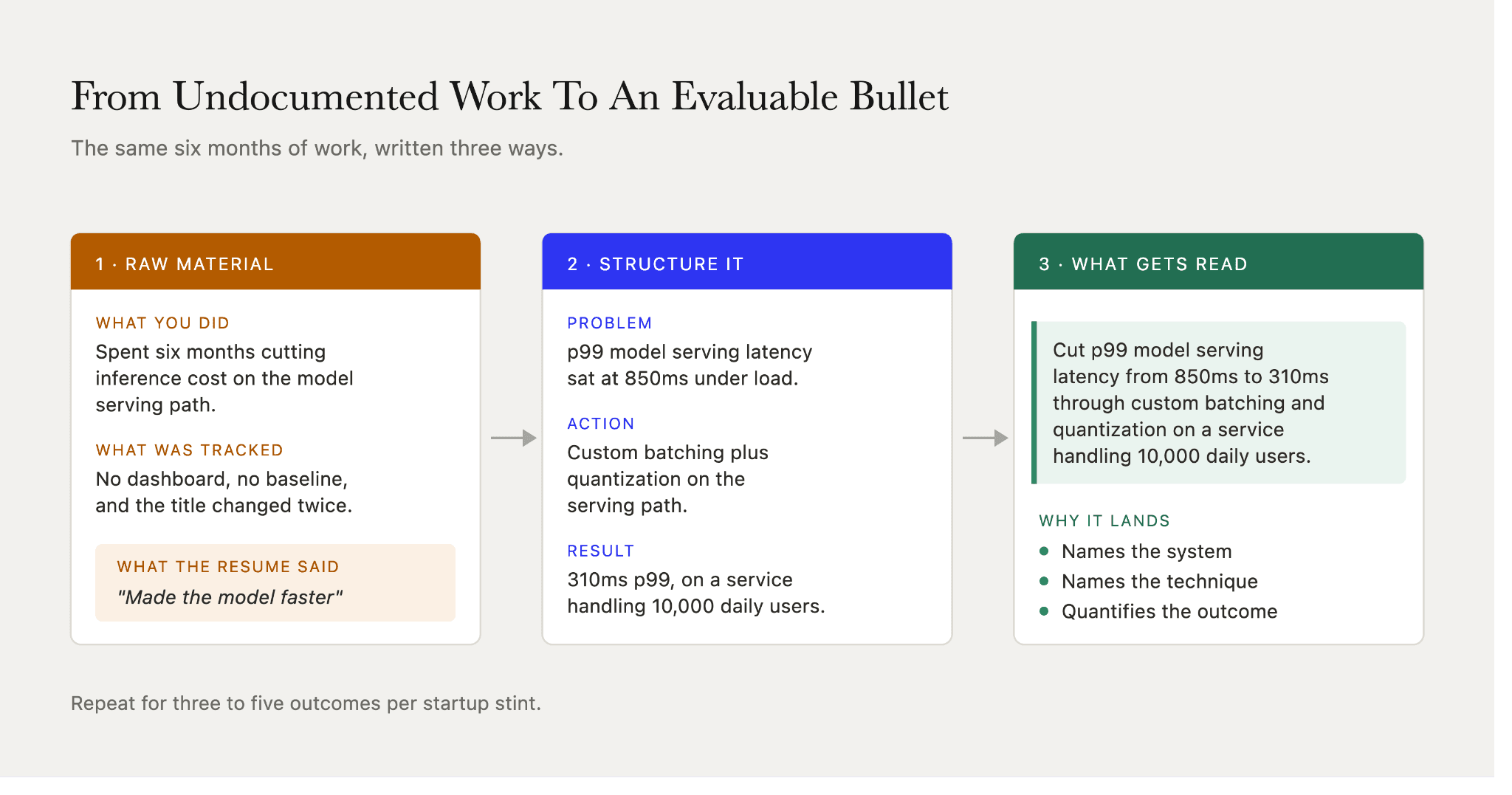
Surface infra and reliability work that might otherwise feel invisible. GPU scheduling, model serving latency, and observability pipelines rarely appear on a resume, but they are the work a technical interviewer will ask about in the most detail. Name the systems, tools, and challenges even if the scale was small. Connect technical engineering achievements directly to commercial outcomes whenever possible, such as linking pipeline optimization to reduced infrastructure spending.
Positioning Different Types Of Startup Experience: Employee, Founder, Contractor
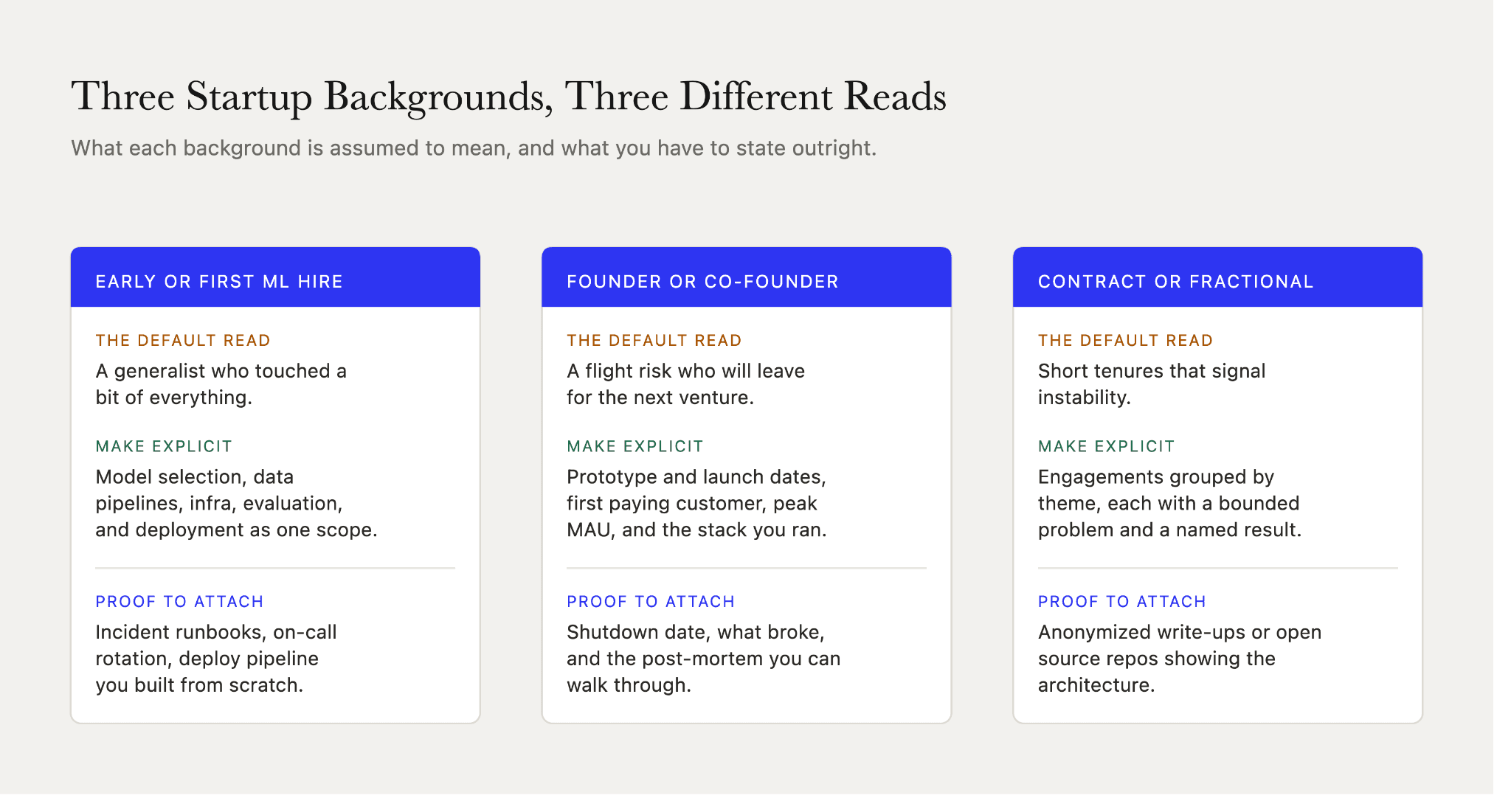
The term "startup experience" spans joining as employee number eight, founding your own business, or consulting for multiple early-stage teams. Each pattern is read differently by hiring teams, and positioning matters.
Joining An Early-Stage Startup As A First Or Early ML Hire
Hiring teams expect broad ownership from early hires: model selection, data pipelines, infra, evaluation, and deployment. Make that breadth explicit. Describe how you engaged with customers directly, traded off research depth versus shipping timelines, and set technical standards when no process existed. Whether you came to ML through a formal degree or taught yourself on the job, what matters is showing you can create structure where none exists.
For infra or platform engineers, showing how you built incident runbooks, on-call rotations, or deployment practices from scratch provides compelling evidence of technical leadership.
Founding or Co-Founding Your Own Business
Founding a company has been a common detour for AI engineers over the past few years, and hiring managers see it often enough that it no longer reads as unusual. Entrepreneurs who frame this around learning and impact, rather than just the mission or vision, tend to succeed in interviews. Focus on concrete milestones: prototype launch dates, first paying customer, peak monthly active users, and your stack, especially if LLMs or ML infra were core.
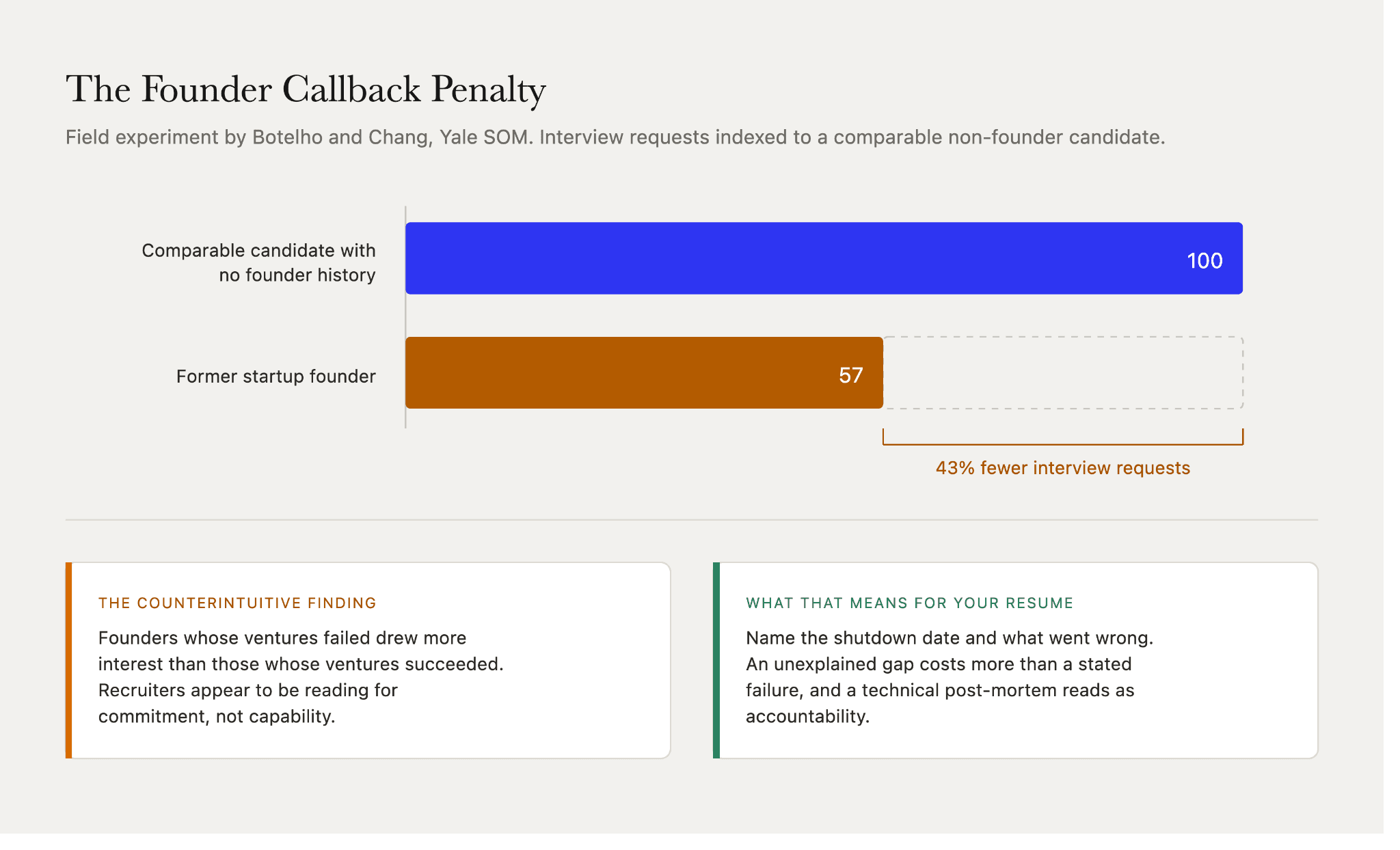
Address failure directly. Include shutdown dates, what went wrong, and what systems or habits you would carry forward. A field experiment by Botelho and Chang at Yale SOM found that former startup founders were 43% less likely to receive an interview than comparable candidates. The same study found that founders whose ventures failed drew more interest than those whose ventures succeeded, which suggests recruiters are reading for commitment rather than capability. Naming the shutdown and what you took from it costs you less than leaving the gap unexplained.
Presenting a venture shutdown through the lens of a technical post-mortem demonstrates accountability and operational maturity. Clearly articulating the technical trade-offs made under resource constraints demonstrates strong engineering judgment during technical interviews.
Consulting, Contracting, and Fractional Work with Startups
Short engagements can be perceived as either breadth of impact or instability. The answer depends on how clearly you define the scope and outcome of each project. Group related engagements by theme: "2024 to 2026, fractional ML architect for three seed-stage healthcare AI startups" with shared metrics such as reduced inference costs or a 15% improvement in retrieval precision. Link to anonymized technical write-ups or open-source repos that demonstrate the depth of architecture and implementation. Contracting across multiple startups shows you can join an unfamiliar team and deliver inside a short window, which is the specific concern hiring managers have about short tenures.
How AI Is Changing Technical Hiring And Where Startup Experience Fits
By 2026, many hiring teams use AI tools for sourcing, resume screening, and interview scheduling, yet still rely on engineers and hiring managers for final evaluation. Ashby's State of Startup Hiring report, covering more than 1,200 venture-backed startups and 32,000 hires, found that 60% of the startups on its platform used AI somewhere in their recruiting workflow in Q3 2025, up from close to zero in early 2023.
AI-based matching systems increasingly use structured data such as skills, tech stack, and stage preference to connect candidates with relevant startups. Fonzi is a curated hiring marketplace that matches AI and software engineers to startups on exactly this kind of structured signal. Candidates with startup backgrounds benefit from these systems when they express experience in structured, machine-readable ways: clear role labels, dates, stacks, and measurable outcomes. Standardizing technical terms alongside structured impact metrics ensures automated recruiting pipelines parse your profile accurately.
Over-automated screening can misread non-traditional titles or startup experience, so candidates should make their impact and responsibilities explicit. Regulations around AI hiring tools are also evolving, making human oversight increasingly important. In interviews, be ready to discuss LLM evaluation, data governance, and tradeoffs between RAG, fine-tuning, long-context, and agentic systems.
Startup Experience Versus Established Companies: Choosing And Explaining Your Path
Senior AI and infra engineers should frame moves between startups and large companies as deliberate career choices. Startups often signal adaptability, speed, broad ownership, and comfort with ambiguity, while larger companies signal experience with scale, compliance, and mature systems. Startup culture can also develop stronger resourcefulness because engineers often work across product, infrastructure, and customer problems instead of staying within a narrow role.
When explaining a move, connect it to what you learned and the impact you had. Moving from big tech to a seed-stage company can demonstrate a desire for greater ownership and faster iteration, while returning to a larger company can reflect an interest in scale, specialized infrastructure, or stability. Focus on what you built, the decisions you made, and how the experience strengthened your technical and cross-functional skills.
For entrepreneurs or engineers reentering traditional employment, connect the dots between what you built, what you learned, and what you can bring to the next team. The goal is to show that your startup experience was not simply a different work environment, but a period that expanded your ability to solve complex problems and deliver results.
Where Startup Engineers Find Roles That Match Their Experience
Startup experience can be a strong hiring signal, but the right opportunity still depends on how clearly your skills, ownership, and impact match what a company needs. Fonzi helps connect AI and software engineers with companies looking for technical talent through Match Day, where candidates can find roles that give their startup experience real responsibility rather than a narrower scope.
For engineers coming from early-stage startups, Match Day offers exposure to several companies at once rather than a single application pipeline. Candidates can present their technical experience, shipped work, and measurable outcomes in a structured profile. That structure lets hiring teams evaluate the skills behind non-traditional titles and early-stage startup experience.
Summary
Startup experience is the record of what an engineer built, owned, and shipped under resource constraints, and hiring teams weigh that record more heavily than titles or funding headlines. Credible startup experience on a resume rests on measurable impact, technical depth, real users, and clear ownership, and the STAR method turns loosely defined startup work into bullet points a hiring manager can evaluate quickly.
How you position startup experience depends on the role you held. An early hire needs to make the breadth of what they owned explicit, and contract or fractional work groups by theme with a scoped outcome attached to each engagement. Founders face a harder problem, since a field experiment by Botelho and Chang found that former founders were 43% less likely to receive an interview, which makes a shutdown better named and explained than omitted. Structured detail matters throughout, because AI-assisted screening reads clear role labels, dates, stacks, and numbers. Early-stage startup experience signals adaptability and end-to-end ownership, while established-company experience signals scale and mature process, and candidates who have moved between the two should be able to say what each move was for.
FAQ
How should I list a failed startup on my resume for senior AI roles?
What is startup experience, and why do hiring teams value it?
How can I prove impact from my startup work when metrics were not tracked well?
Is it better to show depth in one startup or breadth across several short startup roles?
How do AI-driven hiring tools treat non-traditional titles like "Founding ML Engineer" or "Head of LLMs?"


