Will Software Engineers Be Replaced by AI?
By
Samara Garcia
•

No, AI will not replace software engineers outright, but it is transforming the role: automating routine implementation while shifting human focus toward architecture, system design, and product judgment. That shift has been underway since generative coding tools arrived at the end of 2022, and agentic tools like Claude Code have made it concrete rather than theoretical. What changes is not whether engineers are needed, but which engineers are.
Key Takeaways
AI will not replace software engineers outright this decade, but it is already reshaping which skills are scarce and which are commoditized, even as the U.S. Bureau of Labor Statistics projects steady structural growth for the profession through 2034.
Generative AI and coding agents are absorbing routine implementation work, pushing engineers toward system design, task decomposition, and product judgment rather than eliminating the role.
The real risk isn't a single moment of mass layoffs; it's a slow divergence between engineers who use AI as leverage and those who don't, a divide that's already showing up in hiring.
Will AI Replace Software Engineers or Just Their Tasks?
Current models and AI agents automate tasks, not entire senior roles, especially in complex systems and production environments. AI is becoming proficient at writing documentation, translating code between languages, and generating boilerplate, with frontier models increasingly capable of resolving straightforward, tightly scoped feature requests autonomously. But it also produces subtle bugs and security vulnerabilities, especially outside well-trodden patterns, and most of what makes building software hard is still work only a person can do.
The table below breaks down what AI handles today versus what the engineer still owns.
Engineering Task | What AI Handles Today | What the Human Still Owns |
Boilerplate and scaffolding | Generates standard templates, project setup, CRUD endpoints, configuration files, and front-end code scaffolds | Choosing architecture, framework trade-offs, modularization, extensibility decisions |
Test generation | Produces unit tests, integration test skeletons, mock setups for existing code | Test strategy, coverage decisions, edge cases, property-based testing, flaky test triage |
Routine refactors | Renaming, format changes, extract-method refactors, mass find-and-replace across a codebase | Ensuring behavioral correctness, understanding domain logic, avoiding hidden regressions |
API and schema design | Auto-suggesting endpoints based on usage patterns, inferring data shapes, basic serialization | Versioning strategy, backwards compatibility, formal contracts, stakeholder alignment |
Incident response and debugging | Automating alert triage, suggesting likely root causes, replaying logs | Diagnosing ambiguous issues, gathering context from outside logs, deciding between downtime and rollback |
Security and threat modeling | Flagging known vulnerabilities, dependency scanning, input sanitization suggestions | Adversarial thinking, zero-day response, compliance, identity and access control design |
Architectural trade-off decisions | Proposing candidate architectures based on constraints or past patterns | Choosing among trade-offs (latency vs cost vs maintainability), anticipating scale, legacy integration |
Stakeholder and requirements negotiation | Drafting requirement documents, summarizing ambiguous requirements into proposals | Eliciting user needs, managing conflicting priorities, scope negotiation, aligning technical vision with business value |
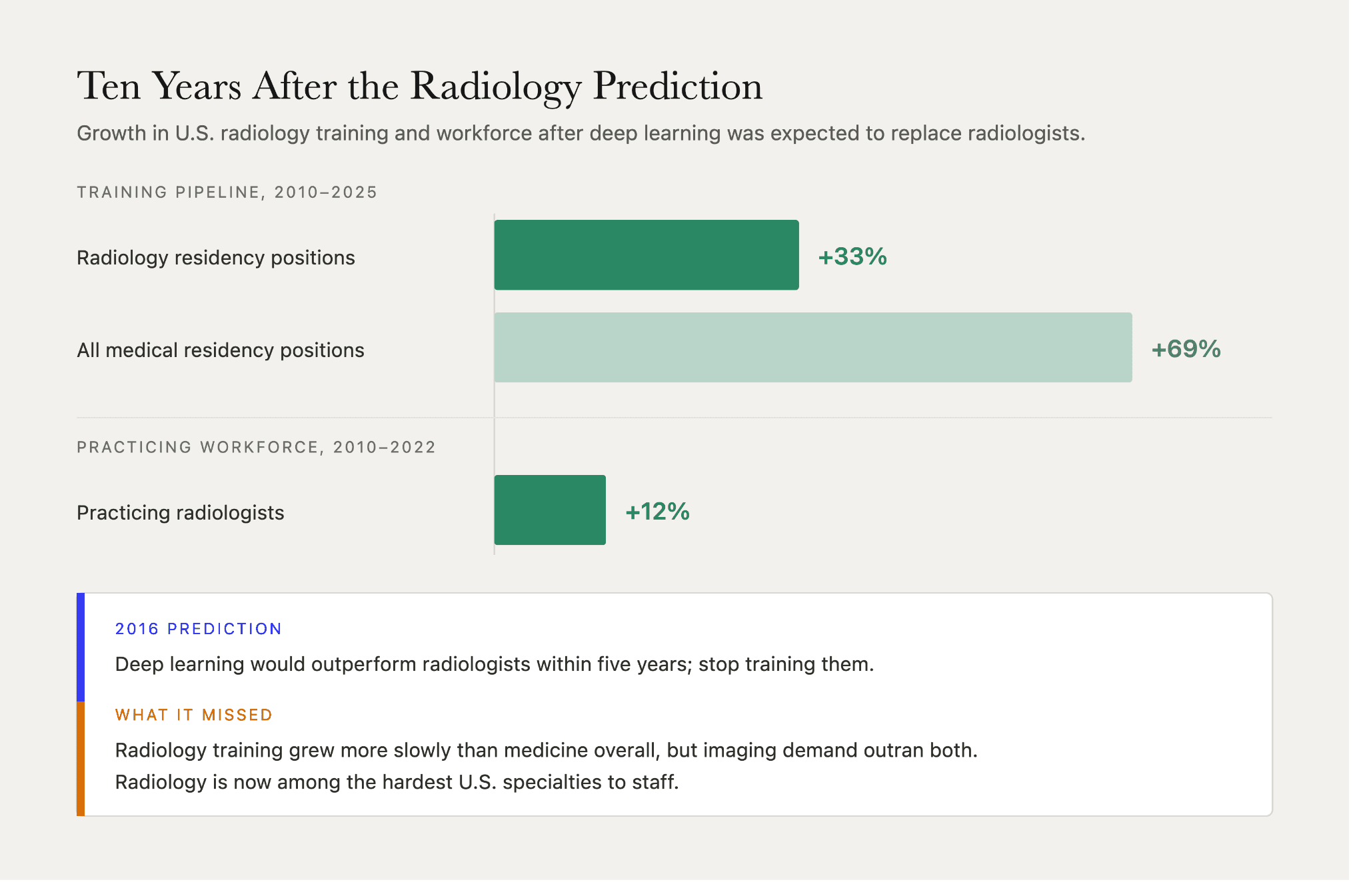
In 2016, Geoffrey Hinton said medical schools should stop training radiologists because deep learning would outperform them within five years. What actually happened is close to the opposite. Radiology residency positions grew 33 percent between 2010 and 2025 while total medical residency positions grew 69 percent, and the number of practicing radiologists rose only 12 percent from 2010 to 2022. Demand for imaging kept climbing regardless, and radiology is now among the hardest specialties in American medicine to staff. Automation raised throughput without reducing the need for the humans reading the scans. Software engineering looks to be following a similar path: the center of gravity for high-leverage engineers is shifting from manual work to directing coding agents and reviewing AI-generated diffs, not to being removed from the loop.
What Software Engineering Actually Involves Beyond AI Coding
Software engineering has never been equivalent to typing lines of code, and AI coding tools mostly address the narrow code-generation slice of the job. Problem framing, requirements clarification, tradeoff analysis under real constraints, threat modeling, and navigating organizational politics remain stubbornly human. Senior ML and infra engineers accumulate a non-local mental model of failure modes, partial observability, and messy legacy systems that current AI has no equivalent for, and as more software gets generated rather than hand-written, human skill in debugging and communication becomes more valuable, not less. Ambiguity, conflicting stakeholders, and shifting business priorities make engineering a socio-technical discipline where trust matters as much as code.
How Modern AI Agents Are Changing Day-to-Day Development
Tools like Claude Code and GitHub Copilot have evolved from autocomplete into multi-step agents that can read repositories, run tests, and propose pull requests. JetBrains' 2025 developer ecosystem survey, covering 24,534 developers across 194 countries, found 85 percent of developers now regularly use AI tools, and 62 percent have adopted at least one dedicated AI coding assistant or agent. METR finds that the length of software tasks frontier agents can complete autonomously at 50 percent reliability has doubled roughly every seven months since 2019, with the 2024 to 2025 period running closer to every four
These agents function as virtual juniors that handle straightforward implementation, configuration updates, and documentation under supervision. Senior engineers increasingly spend their time decomposing work into tasks for agents, then reviewing, integrating, and tuning the output, which makes task decomposition itself a key skill. The risk of AI slop is real: unreviewed AI-generated code can land inconsistent, insecure, or poorly factored work in a repository, quietly introducing technical debt. Production hardening now means auditing machine-generated code for security issues as a matter of course, with rigorous review and SRE-style safeguards to match.
Speed, Throughput, And the Real Metrics That Matter
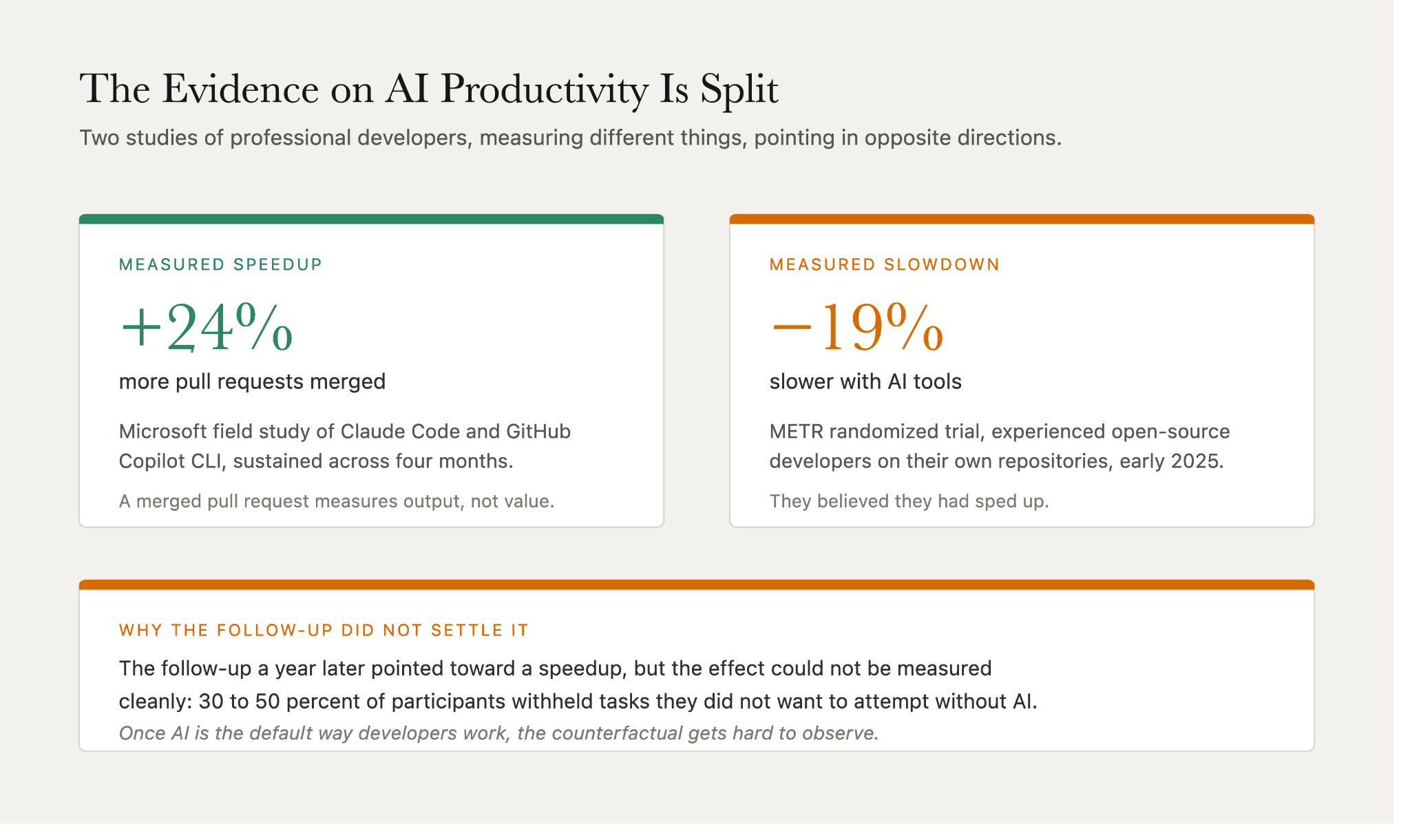
Raw code-generation speed is a misleading metric; teams care about time to reliable value, not lines of code produced. Generative AI can accelerate task completion in routine contexts, but it remains neutral or counterproductive without clear human direction, as its effectiveness is constrained by ambiguous requirements and weak system design. A 2026 Microsoft field study of Claude Code and GitHub Copilot CLI found adopters merged about 24 percent more pull requests than they otherwise would have, sustained across four months, though the authors note that a merged pull request measures output rather than value.
The picture is genuinely unsettled. METR's randomized trial found experienced open-source developers were about 19 percent slower with AI tools in early 2025, and slower even though they believed they had sped up. Their follow-up a year later pointed the other way, toward a speedup, but the effect could not be measured cleanly: between 30 and 50 percent of participants admitted withholding tasks they did not want to attempt without AI, and METR is redesigning the experiment as a result. The measurement problem is itself the finding. Once AI is the default way developers work, the counterfactual gets hard to observe.
Hiring managers are picking up on this: they increasingly ask candidates to show how they measure impact beyond raw coding throughput, looking at latency reductions, error budgets, or revenue effect.
From Handcrafted Code To Curated Systems: The Baking Analogy
Consider the transition from artisanal, one-off loaves to industrial production using machines and standardized recipes. In software development, handcrafted code will persist in critical paths such as HFT systems, kernel-level work, or core ML infra, while much of the surrounding glue, including mobile apps and simple backend developer services, will come from AI and templates. Engineers will spend less time writing code and more time as system architects, defining the recipes, frameworks, patterns, and templates that coding agents follow.

The definition of a good programmer is shifting from writing every line of code by hand to directing AI tools, evaluating generated outputs, and maintaining system quality at scale. In hiring, portfolios that show reusable patterns, internal platforms, and frameworks will differentiate candidates more than a single, handcrafted service. Cheaper production may expand demand rather than shrink employment, the pattern economists call induced demand. If it holds for software, the total volume of software rises even as the cost per unit falls. That is the optimistic case, not a settled one. This is not vibe coding with no oversight. It is engineering at a higher level of abstraction.
What the Shift Means for Engineers in the Hiring Market
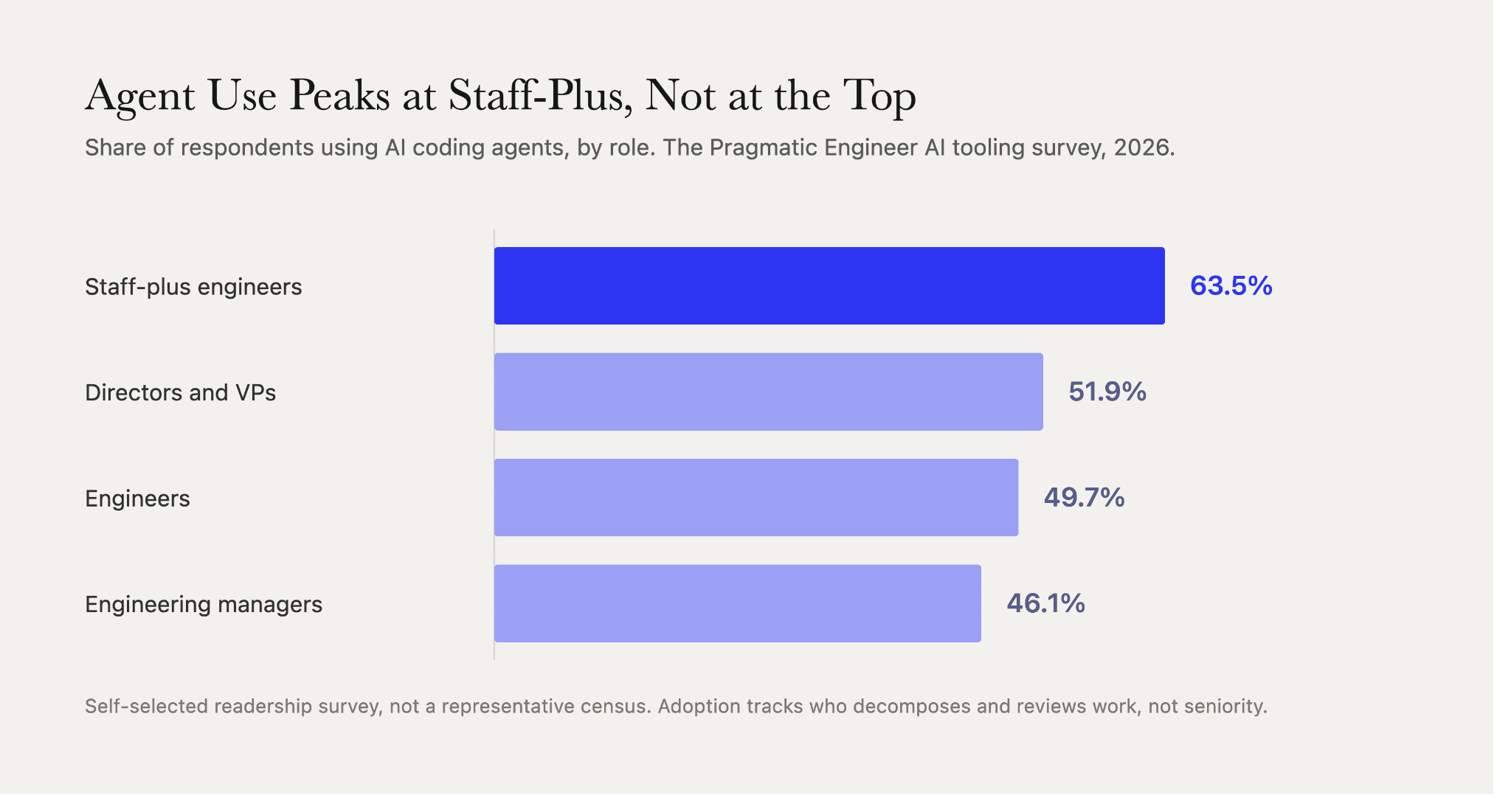
Companies are recalibrating headcount, sometimes trimming pure implementation roles while holding or increasing demand for staff-level engineers who can own subsystems, and some are experimenting with smaller teams pairing a few seniors with powerful coding agents instead of large pyramids of juniors. In The Pragmatic Engineer's 2026 AI tooling survey, staff-plus engineers reported the heaviest agent use at 63.5 percent, against 51.9 percent for directors and VPs, 49.7 percent for engineers, and 46.1 percent for engineering managers. The peak sits with senior individual contributors rather than rising with seniority generally, which fits the pattern of engineers who can decompose work and review output getting the most from agents. The sample is self-selected readership, not a representative census. This doesn't mean junior roles disappear, but entry routes may increasingly run through specialized programs, apprenticeships, or AI-fluency benchmarks rather than the traditional feature-factory path.
How Companies Use AI in Recruiting And Technical Screening
Recruiting teams now use artificial intelligence for resume parsing, skill extraction, and candidate ranking, particularly for AI and ML roles with dense technical jargon. AI code analyzers that review GitHub profiles, open-source contributions, and coding-challenge submissions are beginning to appear in technical screening, though the practice is not yet widespread.
Well-structured profiles with clear descriptions of impact and explicit mention of AI skills and tools used can help candidates surface during automated screening. However, overusing AI-generated content in profiles and cover letters can backfire if it reads like generic AI slop. Engineers should keep candidate profiles concrete and metrics-driven, avoiding generic AI-generated prose that reads like marketing copy.
What Automated Screening Still Gets Wrong
Hiring is a high-noise, high-stakes decision that depends on team context, culture, and long-term potential, which are difficult for current models to evaluate. AI-based screening can reduce recruiter time spent on repetitive resume reviews, freeing humans to focus on nuanced conversations about trade-offs, ethics, and communication style.
Companies that over-rotate into automated filters risk missing non-traditional candidates or underestimating infra depth that is not keyword-heavy. Strong interpersonal skills, clarity of explanation, and the ability to teach others how you use AI in day-to-day work will remain decisive in final hiring decisions.
The Real Risk: Shipping Code You Cannot Verify
AI will not replace software engineers, but it will expose those who rely on rote pattern matching instead of deep understanding and structured thinking. Verification and validation will be increasingly important as coding becomes more automated. AI coding tools make it easier than ever to ship superficially correct code that hides deeper design flaws, so engineers who invest in fundamentals and verification will stand out.
Behaviors that signal engineering thinking include writing testable specs, insisting on feedback loops, and designing observability before shipping features. Coach your team on safe and effective AI use. That marks you as a leader rather than an interchangeable implementer. Whether AI replaces you is the question everyone asks first. The more useful one, and the one that actually determines the answer, is whether you are thinking like an engineer or just typing.
Implications For ML Researchers And Infra Engineers
ML researchers and infra specialists occupy a unique position: their roles are central to building and maintaining the AI systems that are transforming software development. Infrastructure engineers are increasingly responsible for model hosting, vector search, feature stores, and observability. That work resists both simple automation and headcount reductions.
ML researchers who move closer to product and platform responsibilities, such as evaluation design and policy tuning, will be better insulated from volatility than those focused on one-off models. Frame your experience in terms of enabling other engineers to use AI safely and at scale. This resonates strongly with current hiring needs at AI companies and signals that you understand the new era of AI-augmented development from the infrastructure up.
Concrete Steps To Future-Proof Your Software Engineering Career
Master at least one coding agent deeply. Use Claude Code or a comparable tool in your daily workflow until directing agents feels natural.
Build a visible AI-enabled project. Ship something that integrates generative AI with real feedback loops, not a weekend demo.
Own one system end-to-end in your current role. Architects are harder to automate than feature implementers.
Learn core LLM concepts: tokenization, context windows, evaluation, and training data biases. Understanding how the latest models work makes you a better user of them.
Contribute to shared tooling in your organization. Internal platforms and developer experience improvements demonstrate leadership.
Engage with hiring managers to understand how they use AI in screening, then tailor your portfolio to show the signals they review.
Reflect periodically on where AI is reducing your unique value and move up the stack into architecture, product, or organizational leadership. The same way you'd respond to any other commoditization, meet AI by differentiating on judgment.
Proving You Direct AI Rather Than Operate It
In a market this focused on judgment over typing speed, resumes and keyword-matched applications rarely capture whether a candidate can actually own architecture decisions or direct AI-generated work responsibly. Fonzi is a curated AI engineering hiring marketplace that connects companies with pre-vetted AI and software engineers. Candidates surface real ownership and AI fluency directly, rather than hoping a resume keyword survives a filter. Its recurring Match Day are one example of how that structure plays out in practice.
That structure fits well with exactly the skills this shift rewards: system design judgment, the ability to direct and review AI-generated work, and evidence of shipped, reliable systems. Those signals rarely come through cleanly on a traditional application. It's one practical way to get in front of the right roles, alongside the usual recruiting channels, not a replacement for them.
Summary
Software engineers aren't being replaced by AI, but the job is dividing: engineers who use AI as leverage while owning architecture, correctness, and judgment are pulling ahead of those who treat it as a shortcut around understanding. That divide, not a single wave of layoffs, is the real story of this decade.
The evidence is still unsettled, which is itself informative. Adoption is near universal at 85 percent of developers, agent use peaks with staff-plus engineers rather than rising with seniority, and the productivity research points in both directions depending on who is measured and how. Audit your skills against where AI is genuinely strong today, build a portfolio that shows judgment rather than raw output, and be ready to explain how you direct and review AI-generated work, because that is what interviews are now built to test.
FAQ
Should I list specific AI tools like Claude Code or Copilot on my resume?
Is it acceptable to use AI during take-home coding assignments?
How often should I refresh my AI skills given the pace of new models?
Are there roles where AI is already close to full automation of engineering work?
How can I signal that I am not producing AI slop in my code and documentation?