The Software Engineering Job Market: Roles and Trends
By
Samara Garcia
•

The software engineering job market in 2026 is structurally strong over the long run and unusually tight right now, and those two facts are easy to mistake for a contradiction. The BLS projects 15 percent growth for software developers through 2034, while US job postings sit below their February 2020 level and early-career hiring has gone backwards. Both readings are accurate, because they measure different time horizons. What has changed underneath both is what employers expect from a single hire, and AI accounts for most of it.
Key Takeaways
The U.S. Bureau of Labor Statistics projects 15 percent growth for software developers, QA analysts, and testers from 2024 to 2034, adding roughly 287,900 jobs; that measures long-term structural demand, not current-quarter hiring conditions.
Hiring is polarized toward senior, AI-fluent engineers while entry-level and generalist roles face the most competition, with demand expanding into finance, biopharma, and industrial automation.
AI is reshaping how engineers work and what roles exist rather than eliminating software engineering jobs, and career advancement now depends on system design ability, leadership, and evidence of shipped production systems.
Software Engineer Job Outlook: Structural Growth Against a Tight Hiring Market
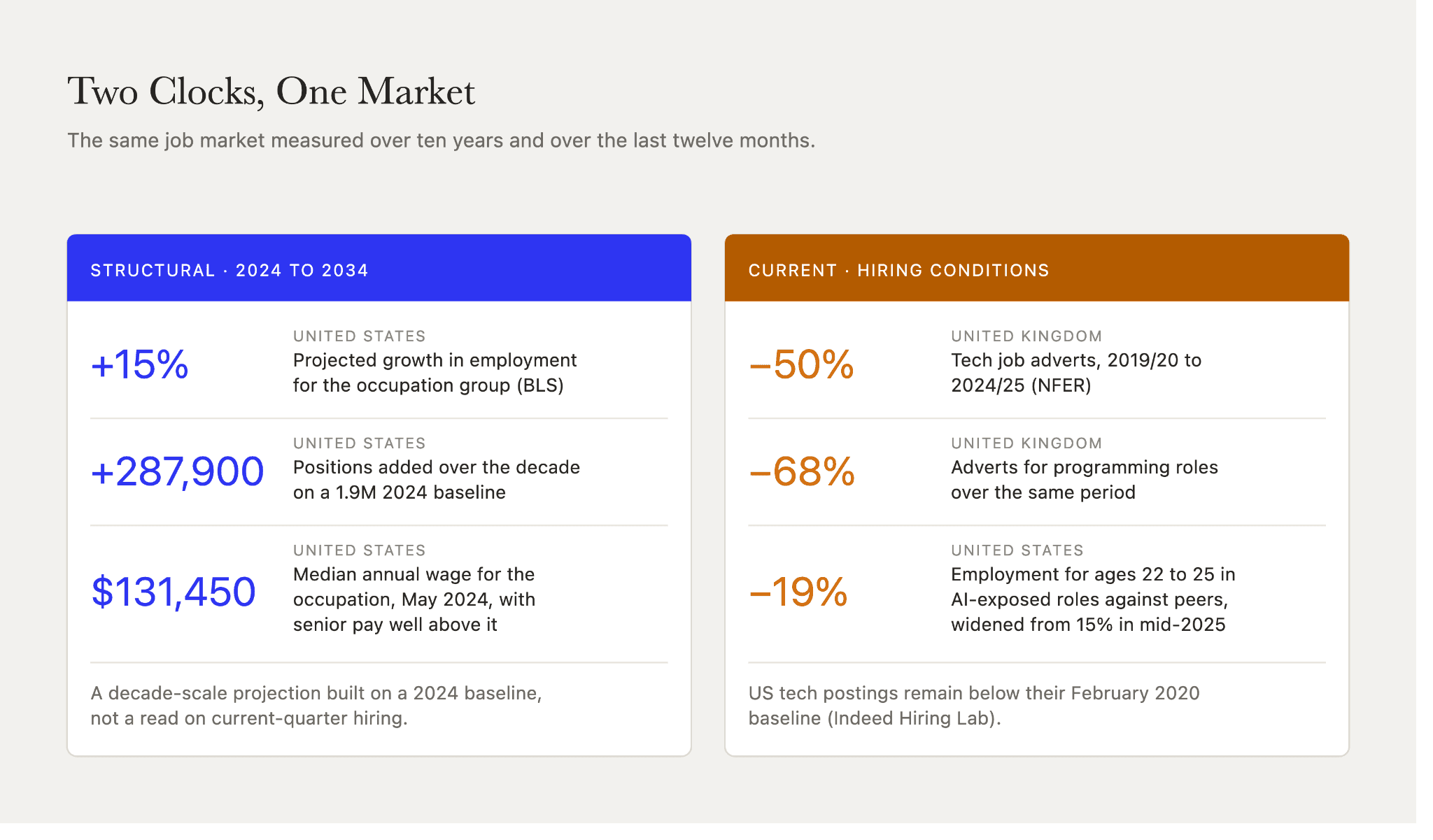
BLS employment projections are decade-scale models built on a 2024 baseline of roughly 1.9 million software developers, QA analysts, and testers combined, with 15 percent growth and 287,900 added positions projected through 2034.They describe structural demand over ten years, not current hiring conditions, which reconciles that projection with a short-term market that is tight for early-career roles and heavily polarized toward senior talent. The median annual wage for the occupation was $131,450 in May 2024, and senior engineers routinely earn well above that..
Short-term hiring data tells a tighter story. Indeed's Hiring Lab has tracked a sustained freeze in US tech postings, which remain well below their February 2020 baseline. In the UK, tech job adverts have fallen roughly 50 percent from 2019/20 and 2024/25 against a 31 percent decline across the wider economy, according to research by the National Foundation for Educational Research, with adverts for programming roles down 68 percent over the same period. Stanford's Digital Economy Lab finds that employment for workers aged 22 to 25 in the most AI-exposed occupations, software development among them, now sits roughly 19 percent below where it would be had it kept pace with less-exposed peers, a gap that has widened from 15 percent in mid-2025. Entry-level generalist roles face intense competition while specialized engineering positions enjoy far more robust demand.
Companies are prioritizing profitability and efficiency in hiring. Large companies have frozen non-critical roles while continuing to invest in AI infrastructure and platform teams, while smaller, high-growth startups are hiring AI and agent-focused engineers more aggressively, pushing up demand for senior specialists even as overall tech hiring stays soft.
How AI and Machine Learning Are Reshaping Software Roles
AI proficiency has become a mainstream requirement for software engineering roles, not a differentiator. AI coding assistants have changed how engineers work by automating boilerplate services, test scaffolding, and documentation, but they deliver value only when developers keep strong review and debugging habits. Employers increasingly expect more leverage per engineer, which is why roles defined mainly by writing code to spec are thinning out while titles like ML platform engineer, LLM application engineer and retrieval infrastructure engineer keep appearing in postings.
Engineers who treat AI tools as leverage on top of solid computer science fundamentals, including testing, observability, and performance tuning, remain competitive. Those who rely on AI agents without understanding the underlying systems fall behind when debugging novel failures in production.
Software Engineering Hiring Trends: The Rise of Hybrid Technical Roles
Software engineering postings from 2024 to 2026 increasingly describe embedded technical roles inside business units. Titles like "quant developer in trading," "lab automation engineer," and "ML engineer for marketing experimentation" combine software development with deep domain knowledge.
Co-development and low-code platforms let non-engineers ship simple workflows, which shifts experienced engineers toward platform, governance, and integration work: building the systems that let others build, rather than shipping every feature themselves. Companies are restructuring teams around these hybrid profiles, and each one requires a distinct stack.
Role Type | Typical Stack | Primary Stakeholders | Sample Job Title and Industry |
Backend Engineer | Java, Spring Boot, PostgreSQL, Kafka | Product, Platform | Senior Backend Engineer, E-commerce |
HTML, CSS, JavaScript, React | Design, Product | Staff Front-End Engineer, SaaS | |
LLM Application Engineer | Python, LangChain, Vector DBs, TypeScript | Product, Data Science | LLM Engineer, Healthcare AI Startup |
Lab Automation Software Engineer | Python, Hardware APIs, Robotics Frameworks | R&D, Lab Operations | Senior Lab Automation Engineer, European Biopharma |
AI Platform and Evaluation Engineer | Python, Kubernetes, MLflow, Prometheus | Infrastructure, ML Teams | AI Infra Engineer, New York Fintech |
Skills That Differentiate Senior Engineers in the 2026 Job Market
Strong fundamentals in algorithms, system design, and debugging remain essential in software engineering. Deep technical capabilities in distributed systems, production-grade machine learning, observability, and security-aware architecture across cloud platforms form the baseline for senior and staff-level candidates. Specialization in areas such as cloud infrastructure and cybersecurity is becoming increasingly valuable, and roles in DevOps, site reliability engineering, and security-focused development stay resilient as cybersecurity threats grow.
Leadership matters as much as code: mentoring junior engineers, influencing roadmap decisions, and aligning architecture with business constraints determine who reaches staff and principal levels. AI fluency, including prompt design, model selection, evaluation design, and understanding failure modes, is now table stakes rather than a niche specialty, and specialized AI and cybersecurity roles can command a real premium over general software engineering pay.
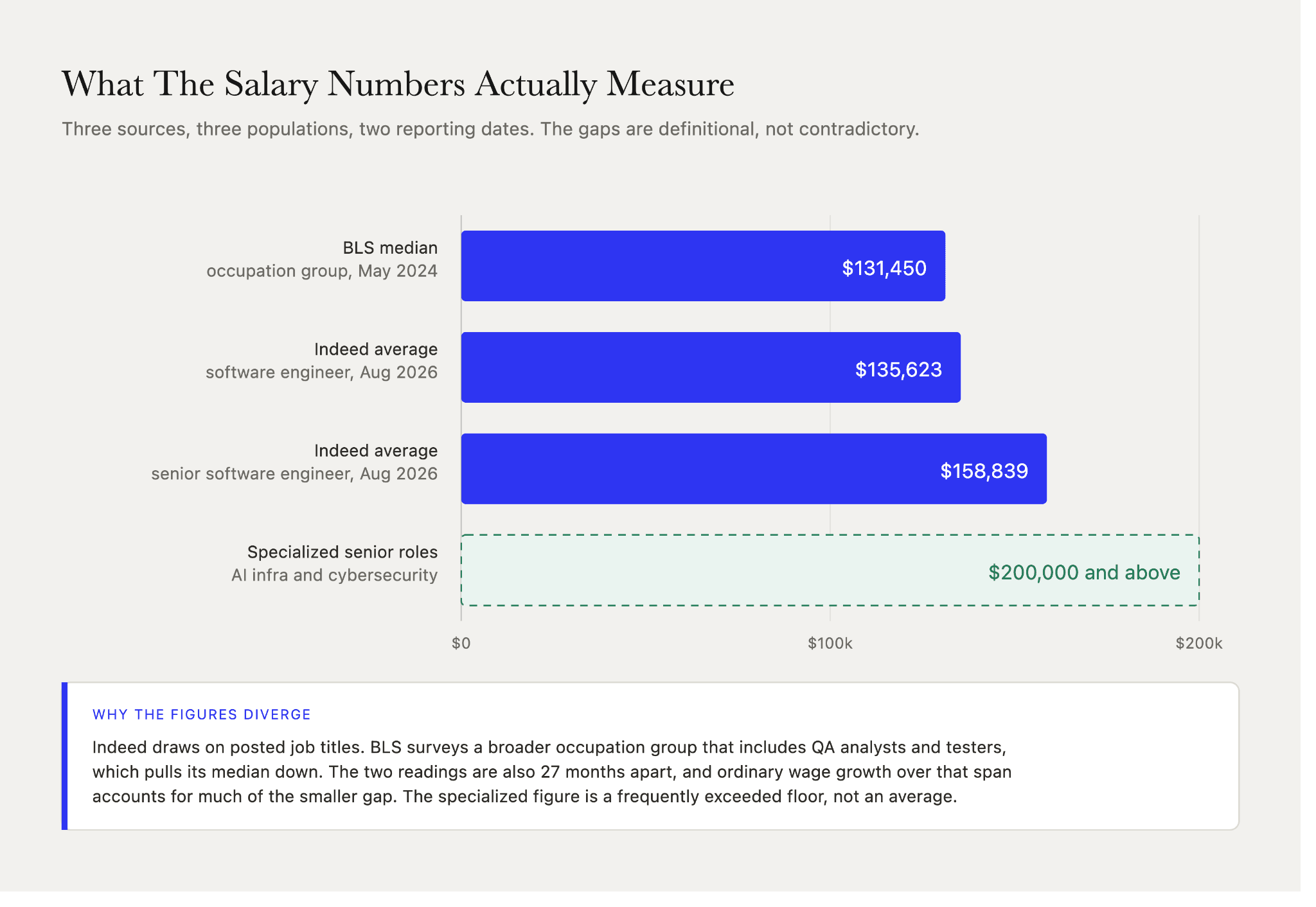
Cybersecurity, AI safety, and cloud-native infrastructure are fast-growing areas for compensation and job security. Specialized senior roles in AI infrastructure and cybersecurity frequently command total compensation packages exceeding $200,000 annually. Indeed's salary data puts the average software engineer at $135,623 per year and the average senior software engineer at $158,839 as of August 2026. Both sit above the BLS median because the two measure different populations: Indeed draws on posted job titles, while BLS surveys a broader occupation group that includes QA analysts and testers.
Present yourself as a T-shaped professional: one or two very deep areas complemented by broad working knowledge of product, infra, and data. That profile is what keeps a software engineering career durable as the market shifts.
Career Paths and Advancement for AI-Focused Engineers
Common transitions include ML engineer to ML platform engineer, backend engineer to AI infra engineer, and QA automation specialist to reliability or safety engineer for ML systems. Each builds on existing strengths while adding emerging technologies to the engineer's toolkit.
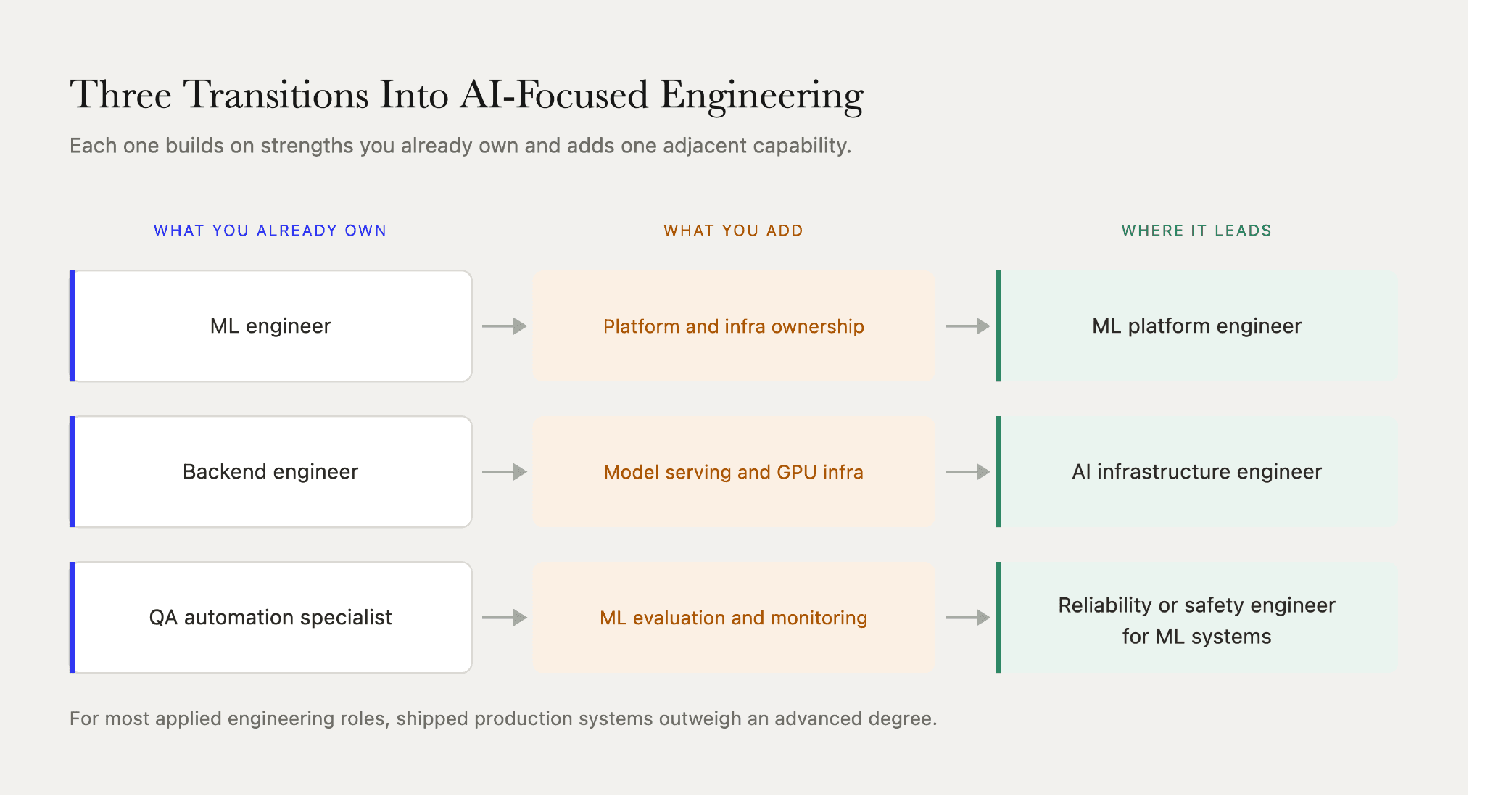
An advanced degree in computer science, machine learning, or a related field can accelerate research scientist, applied scientist, or quant roles requiring heavy statistical modeling. For most applied engineering positions, though, shipped production systems and hands-on continuous learning outweigh a bachelor's or even a master's degree, even as the entry point for new grads has grown more competitive.
Leadership roles at staff and principal levels depend on cross-functional communication and the ability to explain tradeoffs to non-technical leaders.
How to Compete for Engineering Roles in a Tight Market
Build a visible portfolio of production-grade work. Open-source contributions, detailed design docs, or public talks on LLM systems carry more weight than small demo repositories, and candidates who can show real numbers on latency improvements, cost reductions, or ML features shipped to real users stand out among hundreds of applicants.
Tailor resumes to highlight outcomes, not just languages and tools. Target hiring managers, staff engineers, and founders in relevant verticals, including AI-native startups, through conferences, Slack communities, and curated platforms like Fonzi. Fonzi matches AI and software engineers with companies hiring for technical roles. Prepare for interviews with a mix of system design, ML case studies, and behavioral questions that test ownership of complex systems in production.
Fonzi Connects Engineers With Companies Hiring for AI Roles
In a more selective hiring market, getting matched to the right opportunity depends on making your skills, ownership, and shipped work easy to evaluate. Fonzi is a curated hiring marketplace that connects AI and software engineers with companies hiring technical talent. It runs Match Day where engineers are evaluated on their experience instead of resubmitting the same resume across separate application processes.
That can be particularly useful for engineers in hybrid or AI-adjacent roles, where a non-traditional title may not fully capture the work they have done. A structured profile surfaces technical skills, responsibilities, and outcomes, which lets hiring teams assess the experience behind a non-traditional title.
Summary
The software engineering job market runs on two clocks. Structural demand is strong: the BLS projects 15 percent growth for software developers, QA analysts, and testers through 2034. Current conditions are not: US postings remain below their February 2020 level, UK tech adverts have halved since 2019/20, and employment for engineers aged 22 to 25 in AI-exposed occupations has fallen well behind their less-exposed peers. Neither reading is wrong, which is how the same market gets called booming and collapsing in the same week.
The software engineering hiring landscape has tightened around a higher bar. Employers treat AI fluency as a baseline rather than a specialty, and they reward engineers who can point to production systems they owned and measured. Build your portfolio around outcomes, stay current on the tools reshaping your specialty, and reach hiring managers through specialist communities and direct outreach instead of application queues.
FAQ
How often should senior engineers update their skills in AI and related tooling?
Is an advanced degree still valuable for ML and software engineers in 2026?
How can engineers with a quality assurance or testing background move into AI-focused roles?
Which industries outside big tech are currently expanding software and ML hiring?
How can senior engineers decide between roles at large companies and early-stage startups?


