Software Engineering Skills for the AI Era
By
Samara Garcia
•

Software engineering skills for the AI era are the ones that survive when generating code stops being the hard part. With an AI coding assistant, a working feature is often minutes of work, which moves the difficulty upstream to deciding what should exist and downstream to judging whether it is safe to ship. Interviewers and managers have adjusted accordingly, and the questions they ask now are less about whether you can write the code than whether you can be trusted to decide what gets written. That shift is already reshaping who gets hired, who gets promoted, and who gets left behind.
Key Takeaways
AI tools now handle a large share of routine coding, which moves the value to engineering skills beyond coding: system design, critical thinking, and domain knowledge rather than raw typing speed.
Hiring loops for AI engineers increasingly test how candidates collaborate with AI models and agents, validate AI output, and reason about trade-offs, not only how fast they solve isolated coding problems.
Continuous learning and demonstrated production experience matter more than formal pedigree as companies shift toward skills-first, portfolio-based hiring.
The New Baseline: AI-Native Software Engineering Workflows
AI-native teams treat AI tools, coding copilots, and AI agents as standard across planning, coding, testing, and documentation, not as occasional experimentation. In practice, engineers use agentic coding tools such as GitHub Copilot, Claude Code, and Cursor to scaffold services, write tests, refactor legacy code, and generate design docs. The measured productivity effects are real but contested, and the useful thing to notice is that every credible study lands in the same place: throughput moves, and system architecture and correctness stay with the human engineer. That shift is moving engineers from writing code line by line toward orchestrating and validating AI output.
Hiring managers now look for evidence that candidates have built real systems where AI handled part of the work: AI-assisted migrations of legacy codebases, LLM-powered features shipped to production, or evaluation pipelines that measure hallucination rates and latency. JetBrains' 2025 Developer Ecosystem survey, covering 24,534 developers across 194 countries, found 85 percent regularly use AI tools for coding and 62 percent rely on at least one AI coding assistant, agent, or code editor. Fluency with AI tools is the baseline expectation now, not a line item about having tried a copilot once.
The Four Technical Areas Interviewers Probe Hardest
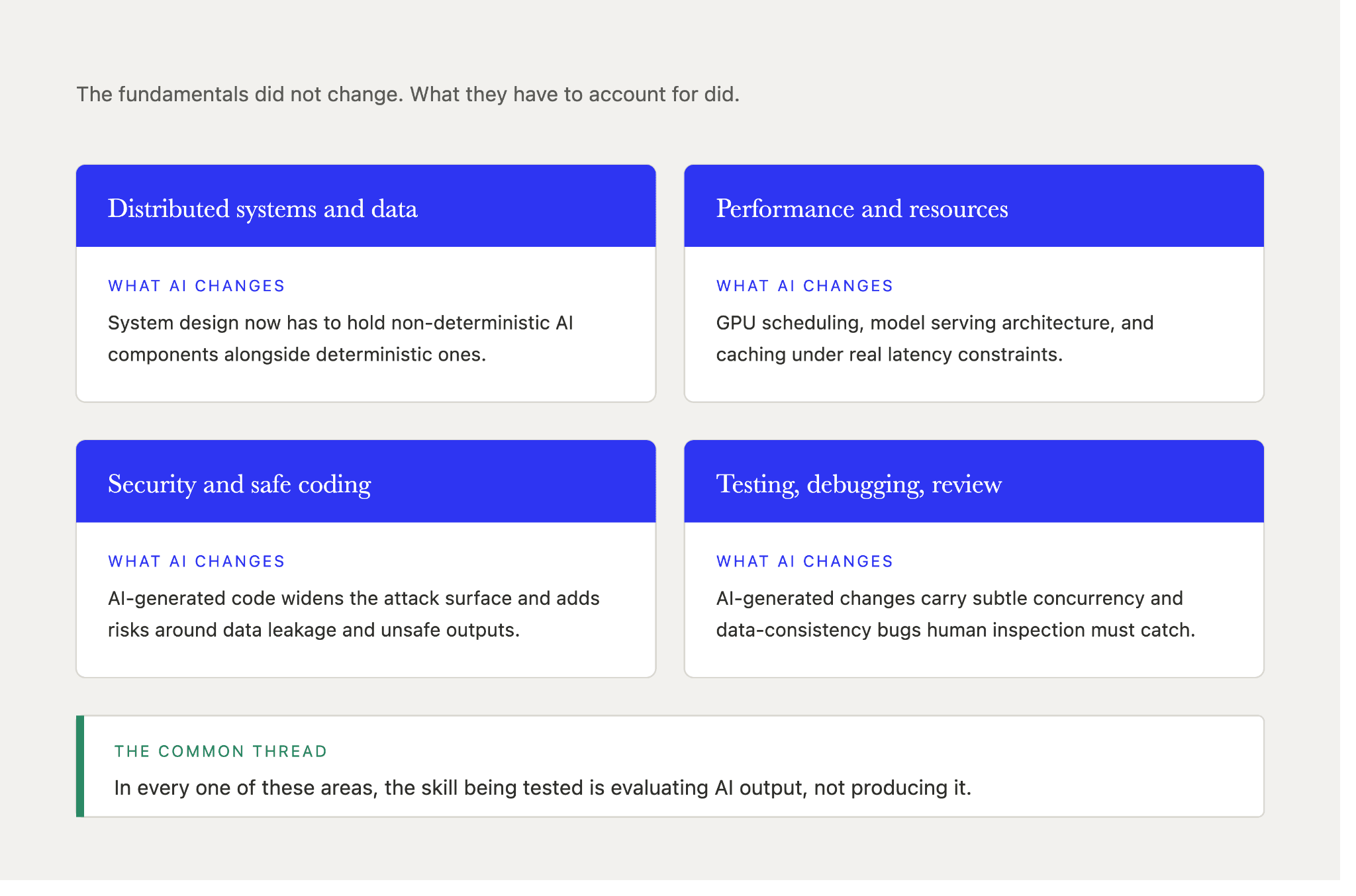
AI doesn't remove the need for fundamentals; it raises the value of engineers who deeply understand systems and can evaluate AI-generated code for correctness, security, and performance. Interviewers evaluating senior candidates focus heavily on the core skills engineers need with AI:
Distributed systems, networking, and databases. System design now has to handle non-deterministic AI components alongside deterministic ones.
Performance tuning and resource management. GPU scheduling, model serving architecture, and caching under latency constraints.
Security and safe coding practices. AI-generated code expands the attack surface and introduces new risks around data leakage and unsafe outputs.
Testing, debugging, and code review. AI-generated changes often carry subtle concurrency or data-consistency issues that only careful human inspection catches.
Portfolio pieces should reflect that shift: system diagrams, failure analysis, and resilience design carry more weight with hiring teams than demo videos or accuracy numbers alone.
Where AI Helps and Where Human Engineers Still Decide
Skill Area | What AI Handles Well | What Human Engineers Must Do |
Coding and Refactoring | Generate boilerplate, scaffolding, repetitive patterns, simple utility functions. Suggest naming improvements and structural refactors. | Ensure correctness in edge cases. Verify security, performance, and maintainability. Review AI suggestions with the same rigor as peer code. |
System Design | Propose architectures, microservice skeletons, and trade-off diagrams from specifications. | Assess domain constraints. Choose between architectural trade-offs (latency vs. cost vs. safety). Architect error handling, resilience, and compliance. |
AI Model Integration | Assist in prompt design, generate wrapper code, plug into RAG pipelines, run basic automated evaluation. | Define guardrails, select data sources, monitor production behavior, handle model updates, enforce privacy and safety, determine SLAs. |
Communication and Stakeholder Management | Draft documentation, generate summaries, translate technical content into write-ups. | Clarify ambiguous requirements, negotiate trade-offs with a product manager, explain AI risks and failure modes to non-technical stakeholders. |
Ethical and Regulatory Risk Assessment | Flag standard risks, suggest best practices, identify known fairness and privacy issues. | Interpret domain-specific regulations, anticipate novel risks, decide acceptable risk levels, embed ethics into architecture at design time. |
The pattern holds across every row: AI handles synthesis and generation, while humans own judgment, context, and accountability.
Where Domain Knowledge Beats Pattern Matching
Critical thinking in AI engineering means interrogating problem statements, questioning metrics, challenging model outputs, and making trade-offs explicit. AI handles pattern-based generation well but struggles when requirements are ambiguous, contradictory, or shaped by organization-specific edge cases, which is exactly where domain knowledge earns its value. An engineer who understands healthcare privacy law, financial auditability requirements, or logistics safety constraints is far better positioned to judge what counts as a safe solution and to catch what the model missed.
That's the real shift in hiring: from "who can implement this spec fastest" to "who can co-design the spec, spot missing constraints, and make sure the AI-generated solution actually fits the domain." In interviews, this shows up as deeper trade-off questions, like whether a given AI agent workflow is acceptable in a regulated production environment, or what the cost of a rare failure mode is versus average performance. That kind of judgment is the defining skill now, and no amount of fast prompting substitutes for it.
Working with AI Models and AI Agents as First-Class Colleagues
Modern AI engineer roles expect candidates to orchestrate multiple models and at least one AI agent, not just call a single completion endpoint. That means knowing when to reach for retrieval-augmented generation, fine-tuning, long-context prompting, or agentic memory, and understanding the compute, latency, and reliability trade-offs each option carries. Practical skills include designing prompt schemas, configuring the tools an agent can call at runtime, defining production guardrails, and managing the unstructured data and vector stores AI applications depend on.
Verification is just as central. Offline benchmarks, human-in-the-loop review, and continuous production monitoring now show up explicitly in job descriptions, and LLMOps practices exist specifically to catch drift, behavior anomalies, and silent failures before they reach users. Interviews increasingly include tasks like debugging a misbehaving agent, reducing hallucination rates, or improving task success through better prompting and tool design, and strong candidates can explain those failure modes to non-technical stakeholders as clearly as they can fix them.
Human Skills AI Cannot Automate: Communication, Leadership, and Ethical Judgment
As AI absorbs more mechanical work, hiring managers weight soft skills and interpersonal ability more heavily, not less. Communication is central: clarifying ambiguous requirements, aligning expectations across product and design, and translating AI model behavior into language a product manager or legal counsel can act on. Leadership matters even for individual contributors, since owning outcomes, coordinating cross-functional work, and mentoring teammates on safe AI use are what make an engineer who can bridge ML, security, and the business hard to replace.
Ethical reasoning and risk assessment are now built into many hiring processes, as engineers increasingly work under evolving regulatory expectations around AI use in hiring, finance, and healthcare that vary by jurisdiction and continue to shift. Companies need engineers who can spot fairness, privacy, and safety issues at design time, not at audit time, and interviews increasingly test for that through system design discussions and scenarios where the trade-off between speed and safety is made explicit.
How AI Is Changing Hiring and Interview Practices
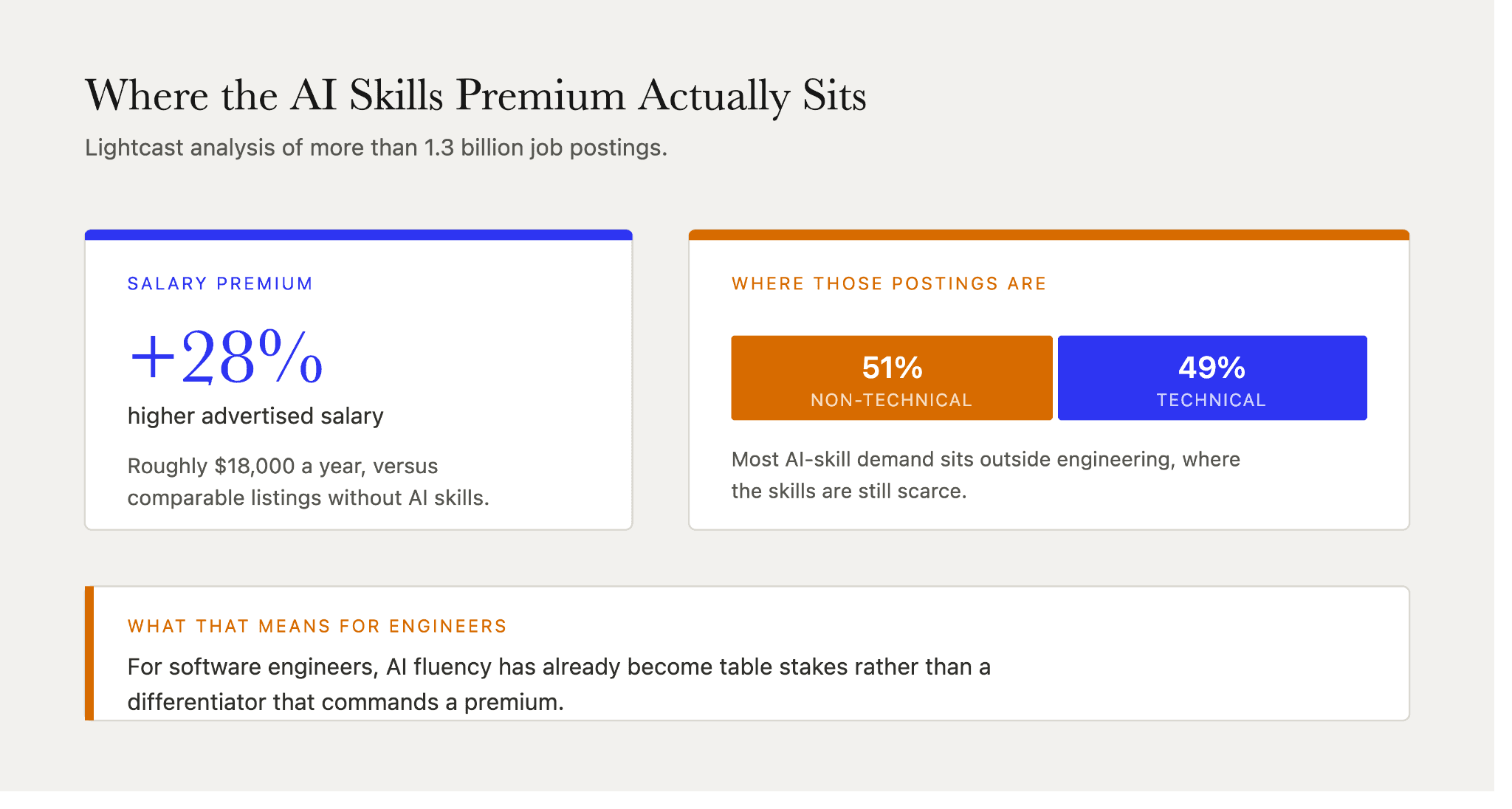
Companies now use AI in recruiting workflows, including resume screening, structured scorecards, and coding task generation, while still keeping final hiring decisions with humans. AI skills carry a real premium in the broader labor market: Lightcast's analysis of over 1.3 billion job postings found that listings requiring AI skills advertise salaries 28 percent higher, roughly $18,000 a year, than comparable listings without them. Most of that premium sits outside engineering: 51 percent of AI-skill postings are in non-technical occupations, where the skills are still scarce. For software engineers, AI fluency has already become table stakes rather than a differentiator that commands a premium.
The squeeze is not evenly distributed. Stanford's Digital Economy Lab finds employment for workers aged 22 to 25 in the most AI-exposed occupations sits roughly 19 percent below where it would be had it kept pace with less-exposed peers. Experienced engineers show no comparable gap, which is part of why hiring loops are shifting toward evidence of production judgment that early-career candidates have had less chance to accumulate.
Because contemporary technical interviews increasingly emphasize collaborative problem-solving, candidates should clearly articulate how and why they utilize AI tools during evaluation tasks. Emerging formats include pair programming with an AI coding assistant, designing an evaluation pipeline for a new model deployment, or debugging an AI-powered feature under time pressure. Structured rubrics are also replacing informal impressions, which reduces noise but requires candidates to articulate their reasoning clearly. That shift toward skills over credentials extends beyond interview format. Alongside that, technical hiring managers are increasingly evaluating portfolio artifacts and demonstrated production work alongside formal credentials when assessing senior candidates.
What to Put in Your Portfolio
Senior candidates should treat their portfolio and public presence as evidence they can thrive in AI-native environments, not lean on job titles alone. Worth showcasing: AI agents that automate real internal workflows or domain-specific copilots, evaluation frameworks for LLMs or data pipelines, infrastructure that scales AI models reliably under real production traffic, and contributions to open-source LLM or infra projects, which many AI-first companies treat as a genuine signal of real-world collaboration.
Documenting decision-making carries real weight here. Design docs, postmortems, and architecture notes that show trade-off analysis and domain judgment are more compelling than code alone, and being explicit about what you rejected and why is often the evidence hiring managers look for before the first interview even happens.
Continuous Learning: Staying Current without Chasing Every Shiny Tool
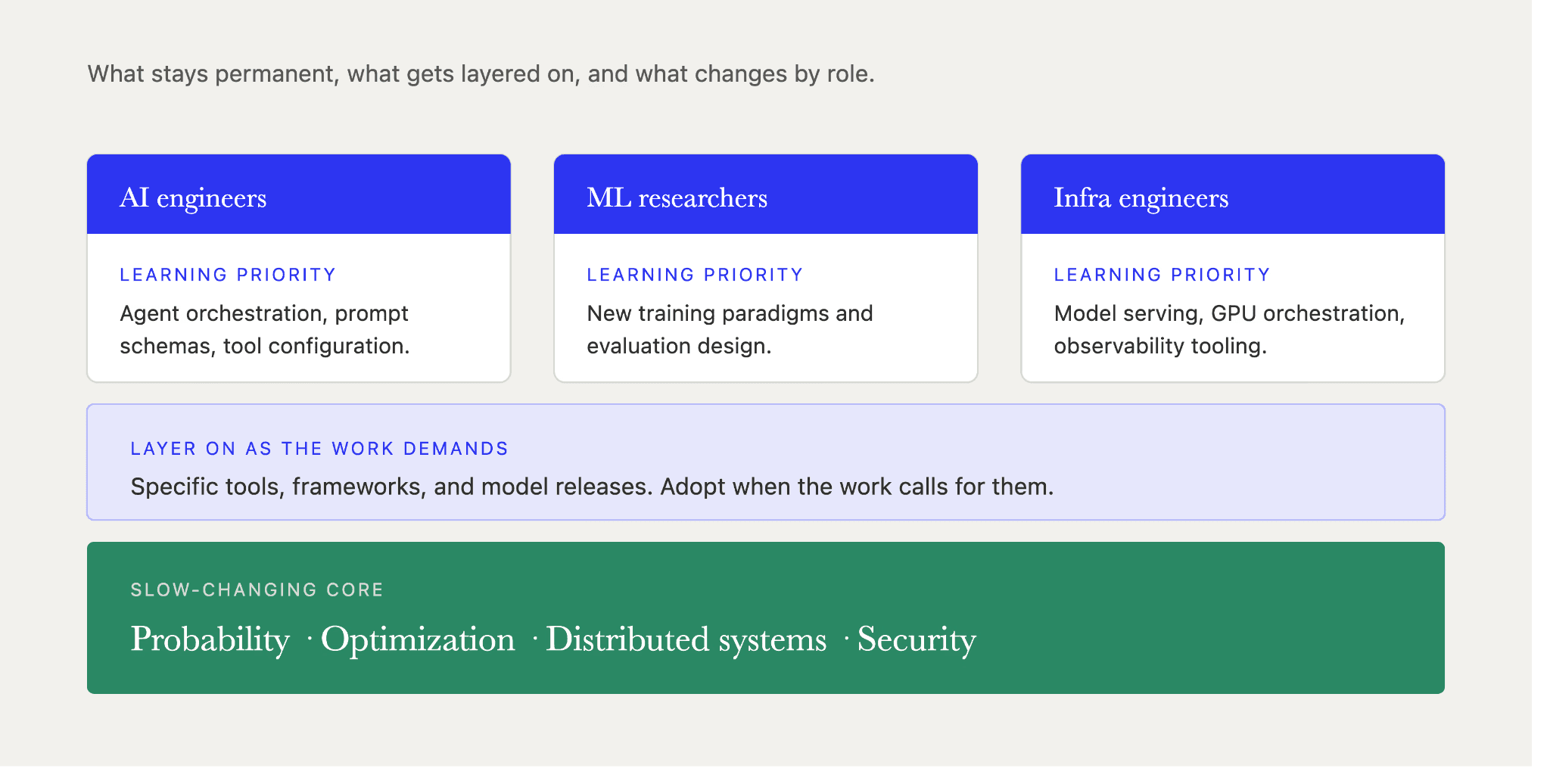
Continuous learning is essential given how fast AI tools and models change, but senior practitioners need a sustainable approach rather than reacting to every new release. Future software engineering skills rest on a core that changes slowly: probability, optimization, distributed systems, and security. Layer specific tools and frameworks on top as your work actually demands them. A mix of courses, conference talks, primary research, and hands-on experimentation keeps that knowledge current without turning into constant context switching.
Deliberate practice helps: a regular block of time spent refining prompts, evaluating AI output against known benchmarks, and measuring the productivity impact directly. Learning priorities differ by role, with AI engineers leaning toward agent orchestration, ML researchers toward new training paradigms, and infra engineers toward model serving, GPU orchestration, and observability tooling. For senior practitioners, refining this evaluative judgment requires leading production code reviews, conducting incident postmortems, and directly auditing AI-generated contributions in live environments.
Getting Evaluated on Judgment Instead of Keywords
The hardest part of this shift for candidates isn't building the skills; it's getting them to register with a hiring team that's screening hundreds of resumes for keywords instead of judgment. Fonzi is a curated hiring marketplace for AI and software engineers, built around structured technical assessment rather than a resume scan. Its recurring Match Day gives candidates a chance to show the judgment and ownership a keyword filter would never surface.
That fits naturally with what this shift already rewards: evidence of judgment, trade-off reasoning, and shipped systems rather than credentials alone. It's a practical channel for getting evaluated on that evidence alongside the usual recruiting paths, not a replacement for them.
Summary
Software engineering in 2026 is less about out-coding AI and more about orchestrating AI systems, exercising judgment, and integrating AI safely into real products. With 85 percent of developers now using AI tools regularly, fluency with them has stopped being a differentiator, and what separates candidates is critical thinking, domain knowledge, and the ability to explain a trade-off to someone who will not read the code.
Audit yourself against the four areas interviewers actually probe: distributed systems, performance and resource management, security, and testing and review. Update your portfolio to show AI-native decision-making rather than raw output, and put that evidence in front of teams that evaluate judgment rather than keywords.
FAQ
How should I talk about my use of AI tools in interviews without undermining my own contribution?
Which AI-related skills matter most for infra engineers who do not train models directly?
Do formal AI or ML certifications still matter for senior candidates in 2026?
How can I demonstrate critical thinking and judgment on my resume or portfolio?
How do I show system design depth when most of my recent work has been AI-assisted?