The Most In-Demand Software Engineering Roles
By
Samara Garcia
•

The most in-demand software engineering roles in 2026 are the ones where technical depth meets production responsibility, and they cluster in a narrower band than they did five years ago. The BLS projects 15 percent growth for software developers, QA analysts, and testers through 2034, but that growth is concentrating around AI, cloud, and infrastructure, where companies need engineers who can tie technical decisions to scalability, reliability, and product outcomes. For senior engineers, AI engineers, and DevOps engineers, the hiring bar has moved past coding ability toward system-level thinking and measurable impact.
Key Takeaways
The highest-demand roles in 2026 are AI and machine learning engineers, full stack developers, backend and platform engineers, DevOps and site reliability engineers, software architects, QA and SDET engineers, and security engineers.
Demand is driven by machine learning adoption, cloud-native architecture, and the need to ship reliable systems faster, not by generic tech growth alone.
Engineers who pair strong fundamentals with system design, data structures, and infrastructure skills see the strongest career growth, and depth in one area now differentiates more reliably than breadth across several.
Which Software Engineers Are in Demand Right Now?
The combined occupation group of software developers, quality assurance analysts, and testers is projected to grow 15 percent from 2024 to 2034, much faster than the average for all occupations, with about 129,200 openings projected each year over the decade.
Demand clusters around AI and machine learning, cloud platforms, developer tooling, and vertical SaaS in industries like healthcare, fintech, and manufacturing. The market is shifting toward specialized infrastructure and security work, and postings in those areas have held up better than generalist listings. That makes the entry-level market more competitive, since depth in a specific area now matters more for differentiation than breadth alone.
Seven Roles Compared: Stack, Screening Criteria, and Progression
The table below summarizes the seven role archetypes covered in this article: their core stacks, what hiring managers screen for, typical career progression, and median US total compensation.
Role | Core Stack | What Hiring Managers Screen For | Typical Next Step | Median US Total Comp |
AI / ML Engineer | Python, PyTorch, inference serving, vector DBs, streaming | Production ML systems, MLOps, model evaluation | Staff ML Engineer, ML Architect | $278,800 |
Full Stack Developer | TypeScript/React, Go/Java/Python backends, SQL/NoSQL, cloud services | End-to-end feature ownership, API design, front-end craft | Staff Engineer, Tech Lead | $171,000 |
Backend / Platform Engineer | Kubernetes, microservices, message queues, observability stacks | System design, migration strategy, latency reduction | Staff Platform Engineer, Infra Architect | $194,480 |
DevOps / SRE | Terraform, CI/CD, AWS/Azure/GCP, containers, observability tooling | Automation, incident management, SLO/SLI discipline | Staff SRE, Reliability Architect | $155,000 (DevOps) / $205,000 (SRE) |
Software Architect / Principal Engineer | Cross-stack; system design, architectural patterns, mentoring | Trade-off reasoning, cross-team alignment, written communication | VP Engineering, Distinguished Engineer | Set by level, not title |
QA / SDET Engineer | Test frameworks, CI/CD integration, scripting, distributed systems | Automated test design, shift-left strategy, regression analysis | QA Lead, Backend/DevOps transition | $140,345 |
Security Engineer | SAST/DAST tools, IAM, cloud security, cryptography | Threat modeling, secure SDLC, vulnerability management | Security Architect, CISO | $264,612 |
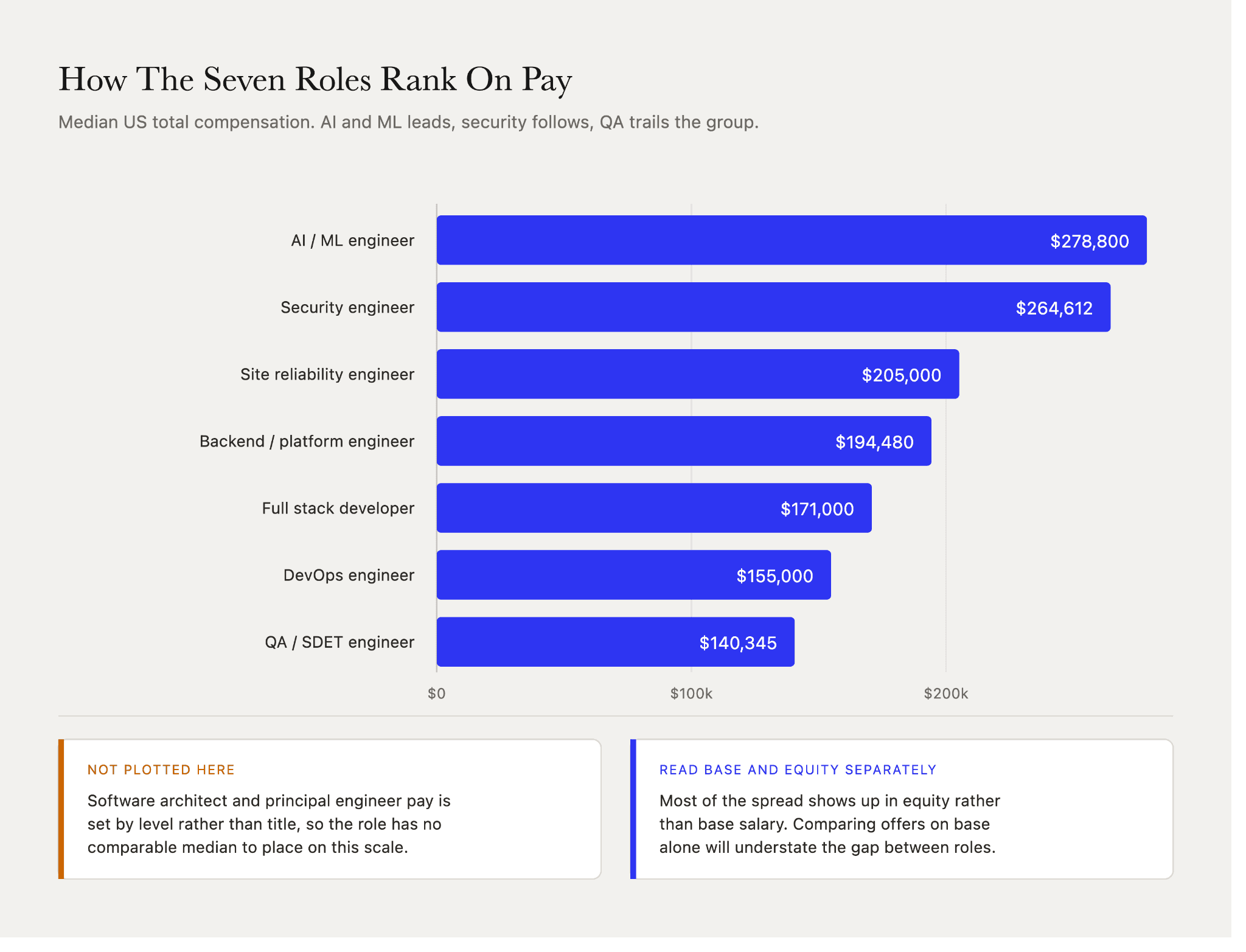
Senior hiring is strongest for roles that sit at the intersection of software development, data science, and infrastructure: ML platform engineers, staff-level full stack developers, and principal software architects see the strongest outlook. Remote and hybrid work has widened the talent pool, though major global technology hubs continue to attract a high concentration of specialized engineering roles.
AI Engineers and Machine Learning Engineers: From Models to Production Systems
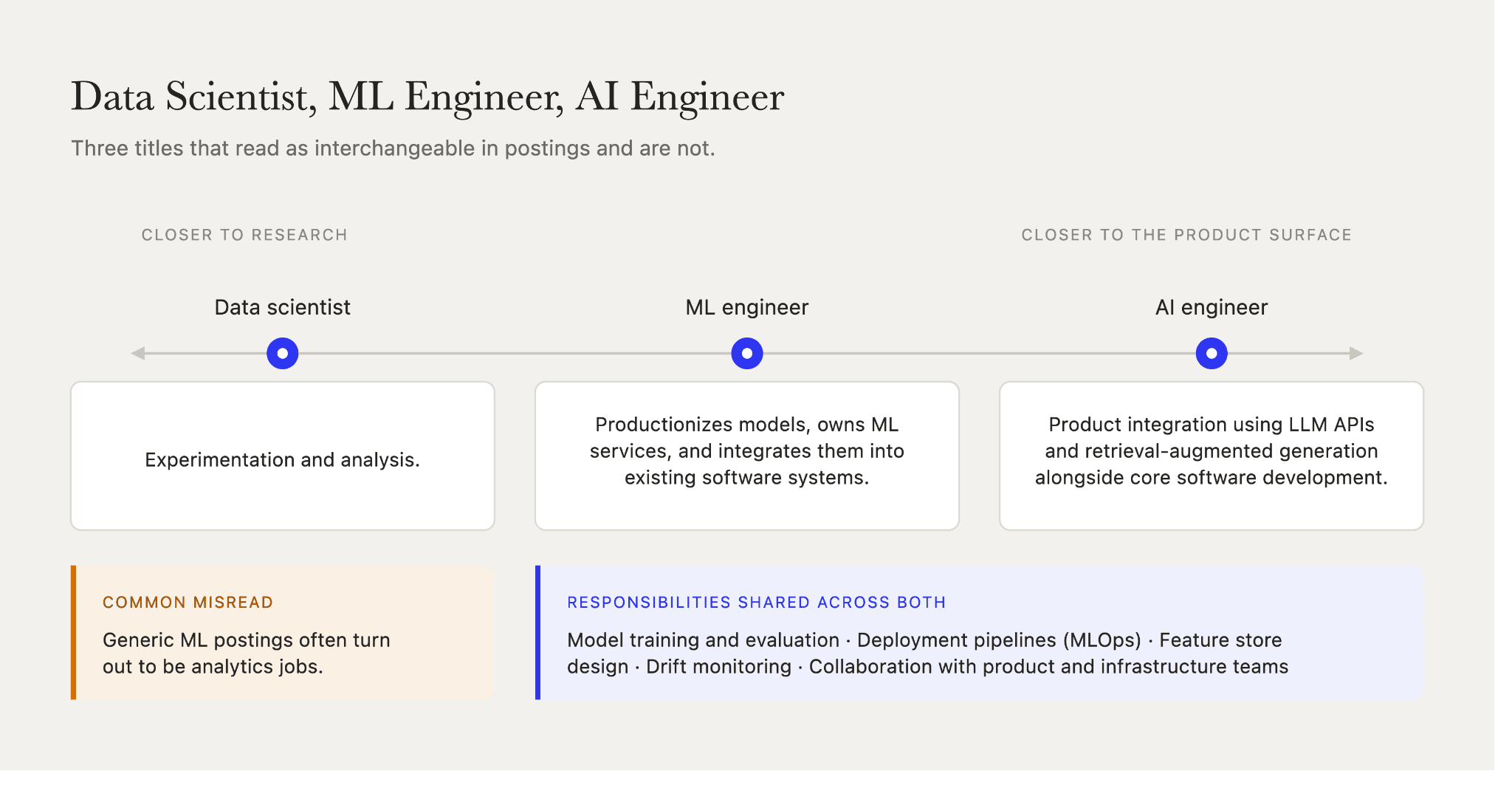
The distinction between data scientists, machine learning engineers, and AI engineers matters for hiring. A data scientist typically focuses on experimentation and analysis. Machine learning engineers productionize models, own ML services, and integrate them into existing software systems. AI engineers often straddle product integration, working with LLM APIs and retrieval-augmented generation alongside core software development, and AI-assisted development has become baseline practice even for engineers outside dedicated ML roles.
Key responsibilities include model training and evaluation, building deployment pipelines (MLOps), feature store design, monitoring for drift, and collaborating with product and infrastructure teams. Core skills include Python as the primary language, distributed training frameworks, PyTorch as the default (with TensorFlow still present in established production stacks), inference and serving tooling such as vLLM, vector databases, and modern LLM orchestration and evaluation tooling. No single orchestration framework is canonical in this space, since preferences shift fast.
Demand is particularly high in recommendation systems, fraud detection, search and ranking, and generative AI applications. AI and ML roles carry the widest compensation premium of any role in this guide, and most of that premium sits in equity rather than base salary. Comparing offers on base alone will understate the gap. AI engineers still have to sift through generic "ML" postings that turn out to be analytics jobs, which makes reading the responsibilities more reliable than filtering on the title.
Full Stack Developers: Product Velocity Across the Stack
In practice, full stack developers work as generalists who own features end-to-end, from database schema to UI. This is especially common at startups and on small product teams, where a single engineer carries a feature from spec to production.
Typical responsibilities include designing APIs, implementing front-end views, integrating third-party services, and handling basic observability and debugging in production. What differentiates senior full stack developers is depth across modern JavaScript frameworks (React, Vue), typed backends in Go, Java, or TypeScript, relational and NoSQL databases, and cloud platform experience. Employers value that flexibility, especially in early-stage AI startups building user-facing products on top of machine learning systems, and career growth from these roles often leads to staff engineer, tech lead, or early software architect positions that shape system and product direction.
Backend and Platform Engineers: Scaling Infrastructure and Core Services
Backend, platform, and infrastructure engineering overlap significantly, and together they underpin most software engineering work at scale. Backend engineers focus on core services, APIs, and data storage; platform engineers build internal tools other engineers rely on; infrastructure engineers manage cloud services, networks, and low-level systems design. Cloud engineering has become vital for supporting both conventional and AI workloads.
Core responsibilities include designing APIs and microservices, working on databases and storage, building internal platforms, and ensuring reliability, performance, and security on critical paths. Microservices, message queues, Kubernetes, service meshes, and observability stacks are now table stakes for senior backend and platform roles. Demand remains high for engineers who can turn messy monoliths into maintainable systems, design migration strategies, and collaborate effectively with DevOps and SRE teams; candidates should highlight past work on latency reduction, capacity planning, and incident response.
DevOps Engineers and Site Reliability Engineers: Automation and Reliability at Scale
Site reliability engineering, DevOps, and platform operations roles share a focus on automation, CI/CD, and reliability. DevOps leans toward continuous delivery and infrastructure provisioning, while SREs own system behavior in production and enforce SLOs, SLIs, and error budgets. Job listings use the two titles loosely and often interchangeably, but the compensation does not follow suit: Levels.fyi puts median total compensation at $205,000 for site reliability engineers against $155,000 for DevOps engineers.
Typical responsibilities include building deployment pipelines, managing infrastructure as code, setting SLOs and SLIs, and leading incident management and post-incident reviews. High-value skills include containers, Kubernetes, Terraform, major cloud providers (AWS, Azure, GCP), observability tooling, and strong scripting or systems programming in Python or Go. Demand stays high in 2026 because of the shift to multi-cloud, the rise of platform engineering teams, and the need to keep AI workloads cost-effective and reliable. Older "DevOps" title labels are increasingly being absorbed into platform and SRE roles, and the compensation has followed the same path. Senior practitioners often transition into staff platform engineer or reliability architect roles that shape organization-wide engineering practices.
Technical Leadership Without the Management Track
Software architects and principal engineers focus on system design, technical strategy, and mentoring rather than day-to-day feature delivery, and these roles are where sustained technical impact compounds into organization-wide influence. Common responsibilities include defining architectural patterns, reviewing critical designs, setting coding standards, and partnering with product and engineering leadership on long-term roadmaps. Demand is highest in complex environments such as multi-tenant SaaS, AI platforms, and regulated industries (healthcare, finance, government), where architectural mistakes carry real cost and risk.
Most engineers grow into these roles by demonstrating consistent impact, cross-team collaboration, and the ability to reason about tradeoffs between performance, cost, and complexity. Engineers preparing for this path should deepen system design skills, practice clear written communication, and build a track record of successful technical decisions.
QA and SDET Engineers: Automated Testing at Release Scale
Quality assurance analysts, test engineers, and software developers in test (SDET) own the reliability layer on modern engineering teams, especially in high-risk domains where a bad release carries real consequences. These roles have evolved well beyond manual test execution: responsibilities now include designing automated test suites, building test frameworks, and working closely with developers on shift-left testing strategies. Demand is strongest for QA professionals who can write code, work with CI pipelines, and understand distributed system behavior.
AI-assisted testing and code generation tools are augmenting, not replacing, human QA roles, handling repetitive checks so analysts can focus on edge cases and usability. Strong QA and SDET backgrounds can lead into backend, DevOps, or security engineering for candidates who invest in broader software engineering skills.
Security Engineers: Protecting Software in an AI-Driven World
Security engineers are in growing demand as cloud-native architectures, compliance requirements, and AI-related attack surfaces expand. BLS projects 29 percent growth for information security analysts from 2024 to 2034, among the fastest of any occupation it tracks, and security engineering carries the second-highest median compensation of the seven roles here. Key responsibilities include threat modeling, secure code review, vulnerability management, and partnering with developers to embed security into the SDLC. Important skills include knowledge of common vulnerabilities, cryptography basics, identity and access management, and security testing tools.
AI-specific security topics, such as prompt injection, data exfiltration from LLMs, and model supply chain risk, are becoming part of the modern security engineer's toolkit, and the OWASP Top 10 for LLM Applications 2026 is the reference most security teams work from Senior developers can pivot into security by leading remediation efforts, contributing to secure-by-default patterns, and picking up certifications like CISSP or CCSP where useful.
Emerging Hybrid Roles: MLOps, Data-Centric Engineering, and AI Product Engineering
New hybrid roles are appearing at the intersection of data engineering, machine learning, and core software development, especially at AI-first companies building on top of foundation models. MLOps roles combine DevOps practices with model lifecycle management, including feature pipelines, model registries, and real-time monitoring of model performance. AI product engineering pairs full stack development with deep familiarity with LLM APIs, retrieval-augmented generation, and prompt or system design.
Job descriptions increasingly use overlapping titles like "AI engineer," "LLM engineer," "AI full stack developer," and "ML platform engineer," and the title alone rarely describes the actual work. Reading the responsibilities, not the label, is the reliable way to tell these roles apart.
Positioning Yourself for Career Growth in High-Demand Roles
Moving into an in-demand role takes deliberate skill development and targeted visibility, not buzzwords added to a profile. For AI engineers and full stack developers, building a credible portfolio matters most: ship open-source tools, write technical posts, or publish reproducible ML projects that show integration into production systems rather than just a list of frameworks.
For senior-level interviews, focus preparation on systems design discussions, past incidents and tradeoffs, and role-specific case studies rather than algorithm practice alone. The median annual wage for software developers was $133,080 in May 2024, with the combined group of developers, QA analysts, and testers at $131,450. Senior engineers earn well above both, and specialized roles command the widest premium over generalist ones.
Matching Engineers to the Roles Companies Are Hiring For
With demand concentrated in specific engineering profiles, getting matched to the right role starts with being evaluated on what you have actually built, not just how closely your resume matches a keyword filter. Fonzi is a curated hiring marketplace that connects AI and software engineers with companies hiring for these roles. It runs Match Day where candidates are evaluated once and considered for relevant openings, instead of submitting the same application through separate applicant tracking systems.
That structure is especially useful as engineering titles become less standardized. An "AI engineer" or "ML platform engineer" role can mean very different things from one company to another. A curated matching process surfaces the actual skills, responsibilities, and experience behind the title. That gives hiring teams a view of relevant expertise a keyword-based application would miss.
Summary
The most in-demand software engineering roles in 2026 sit where AI, infrastructure, and reliability intersect: AI/ML engineers, full stack developers, backend and platform engineers, site reliability engineers, software architects, QA and SDET engineers, and security engineers. Structural demand is real and growing, but it rewards depth, system thinking, and shipped, reliable work far more than generalist breadth.
Compensation follows the same shape. AI and ML roles carry the highest median total compensation of the seven, security engineering sits second, and QA trails the group, with most of the spread showing up in equity rather than base salary. Pick one target role, audit your skills against what hiring managers actually screen for, and commit to one or two concrete next steps: a specific project, a focused course, or an application strategy aimed at companies where your experience fits.
FAQ
Which in-demand role is most realistic to transition into from a traditional backend engineer position?
How important is formal machine learning research experience for AI engineer roles?
Can remote candidates still access top-tier software engineering jobs in 2026?
How are coding interviews changing for senior software engineering roles?
Should I specialize deeply or stay broad to remain competitive in the next decade?


