How to Compare Job Offers When One Includes Equity
By
Samara Garcia
•

Software engineers comparing two job offers frequently face a specific tension: a public company offering a higher salary and predictable compensation versus a startup offering a lower base paired with equity that is difficult to price. Knowing how to compare job offers when one includes equity means converting every component of each package into a single annualized, risk-adjusted number, then deciding how much certainty that number is worth to you. The startup equity versus salary question is the hard part, since pricing an option grant takes explicit assumptions about valuation, dilution, and exit odds rather than a feel for the company. The example running through this article pairs a $240,000 public-company offer against a $185,000 Series B offer with 40,000 options at a $3 strike.
Key Takeaways
Comparing job offers with equity turns on total compensation, risk level, and your own timeline, with base salary as one input among them.
Startup equity versus salary comparisons require explicit assumptions about valuation, dilution, and exit probability, worked through with real numbers instead of estimated by feel.
Non-cash factors like company culture, growth potential, and manager quality can outweigh a modest pay gap between two otherwise comparable offers.
How to Evaluate a Job Offer as a Software Engineer: Break It into Comparable Components
To compare job offers, express every component in annualized, apples-to-apples terms before you start weighing career advancement or company culture. Base salary is the number everything else gets measured against, so evaluate the full compensation package, not just that figure, and request the offer in writing so you have exact terms for benefits and role expectations.
Pull these core components from each offer:
Base salary
Target bonus (percentage and payout history)
Equity grant details: type of instrument, number of units, strike price or grant price, vesting schedule
Signing bonus and relocation assistance
Benefits package: health insurance, retirement match, paid time off
Benefits carry more weight than they first appear. KFF's 2025 Employer Health Benefits Survey puts the average annual premium for employer-sponsored single coverage at $9,325, or about $777 a month, so what an employer pays toward that premium is real money. Average total employer 401(k) contributions, including nonmatching contributions, run about 4.8 percent of salary, per Fidelity, while the typical plan's match formula caps closer to 4 percent. Moreover, Levels.fyi's company PTO listings show large tech employers clustering between 15 and 25 vacation days before holidays, with a sizable share offering unlimited or flexible time off instead. A meaningful signing bonus should be amortized over the period you actually expect to stay rather than treated as free money.
Here is the running example used throughout this article:
Component | Offer A (Public Company) | Offer B (Series B Startup) |
Base salary | $240,000 | $185,000 |
Target bonus | 10% ($24,000) | None stated |
Equity | RSUs worth $80,000/year | 40,000 ISOs, $3 strike, current 409A $6 |
Signing bonus | $25,000 | $10,000 |
401(k) match | 4% of salary ($9,600) | 3% of salary ($5,550) |
Health insurance | Employer pays 90% | Employer pays 80% |
How to Value Startup Equity vs Salary in Practice
Engineers evaluating offers run into several different equity instruments. Stock options give you the right to purchase shares at a fixed strike price, and their value depends entirely on the gap between that strike and the eventual sale price. RSUs at public companies vest into shares you can sell on the open market, which makes them relatively straightforward to value, while double-trigger RSUs at private companies require both time-based vesting and a liquidity event before you receive anything, adding real uncertainty. Fonzi's guide to equity compensation covers how these instruments compare to cash in more depth.
Turning an Options Grant into a Dollar Estimate
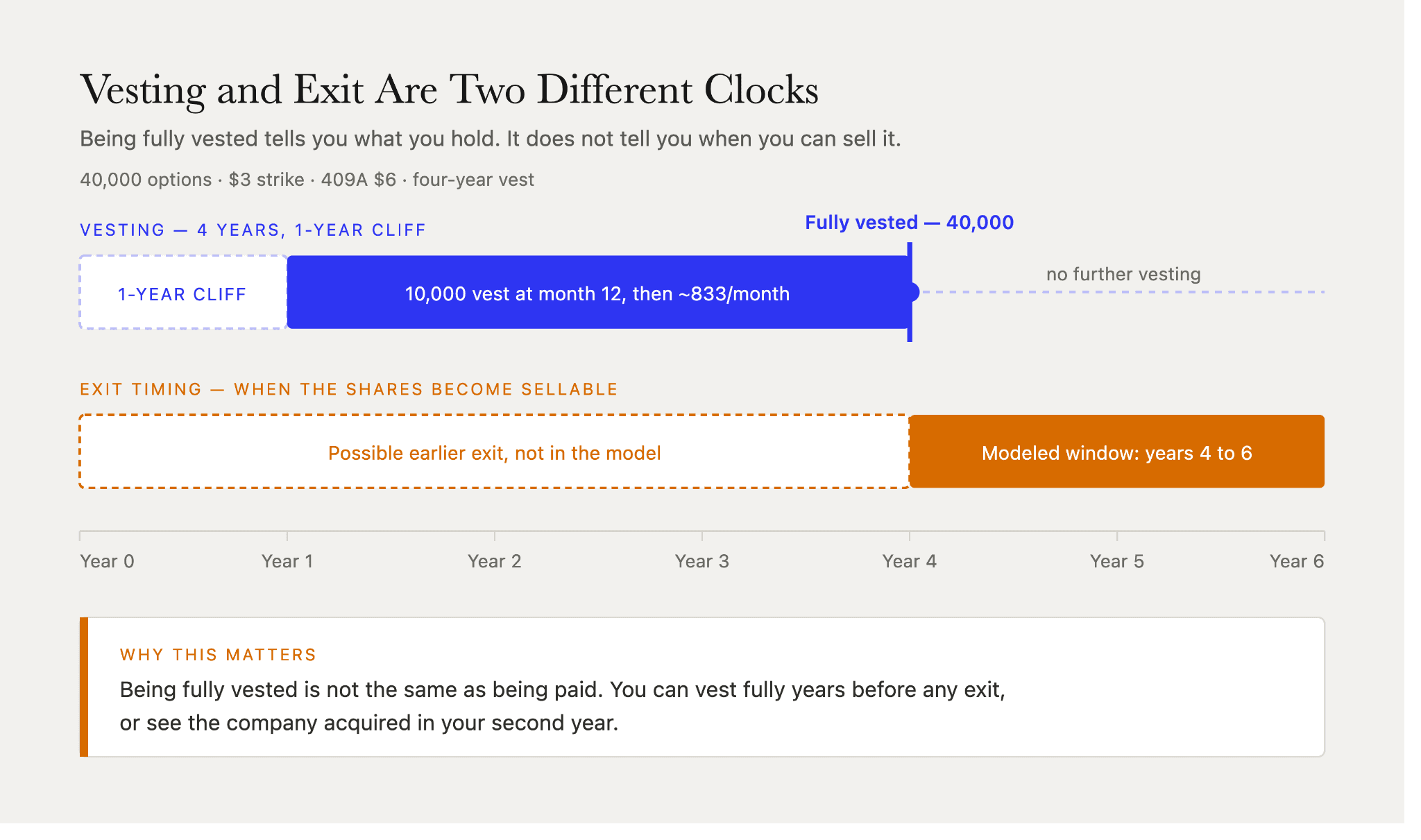
To convert Offer B's 40,000 options into a present-dollar estimate, you need several inputs: the strike price ($3), the current 409A valuation ($6 per share of common stock), the fully diluted share count, and an exit probability you select for a four-to-six-year window. That probability is your own assumption based on research into the company, not a universal benchmark. The four-year vesting schedule and the four-to-six-year exit window are separate variables: you may be fully vested well before any exit occurs, or the company could get acquired during your second year.
Three Exit Scenarios for a 40,000-Option Grant
Using Offer B's figures, 40,000 options at a $3 strike and a current 409A of $6, the standard vesting schedule is four years with a one-year cliff, so 10,000 options vest at month twelve and roughly 833 vest per month after that. The table below applies a 30 percent haircut to expected proceeds as a conservative allowance for future rounds and later-round preferences. Your 40,000 options stay 40,000 no matter how many rounds the company raises: dilution shows up in the exit price per share, not in your share count. Carta's round benchmarking data puts median Series B dilution near 15 percent per round.
Scenario | Exit Price per Share | Spread per Option ($exit - $3) | Risk-Adjusted Option Equivalent (70% of 40,000 grant) | Gross Pre-Tax Value | Annualized over 4 Years |
Downside | $6 (flat) | $3 | 28,000 | $84,000 | $21,000/year |
Base case | $18 (3x current) | $15 | 28,000 | $420,000 | $105,000/year |
Upside | $60 (10x current) | $57 | 28,000 | $1,596,000 | $399,000/year |
If you assign your own probability weights, say 40 percent downside, 40 percent base case, and 20 percent upside, the probability-weighted annualized equity value comes out to $130,200 per year: (0.40 × $21,000) + (0.40 × $105,000) + (0.20 × $399,000). This approach mirrors the First Chicago Method used in venture valuation, which blends multiple outcome scenarios into one weighted estimate. It leaves out any discount for illiquidity and time, so a startup grant and public-company RSUs of the same nominal value are not equivalent.
What Can Make Startup Equity Worth Zero
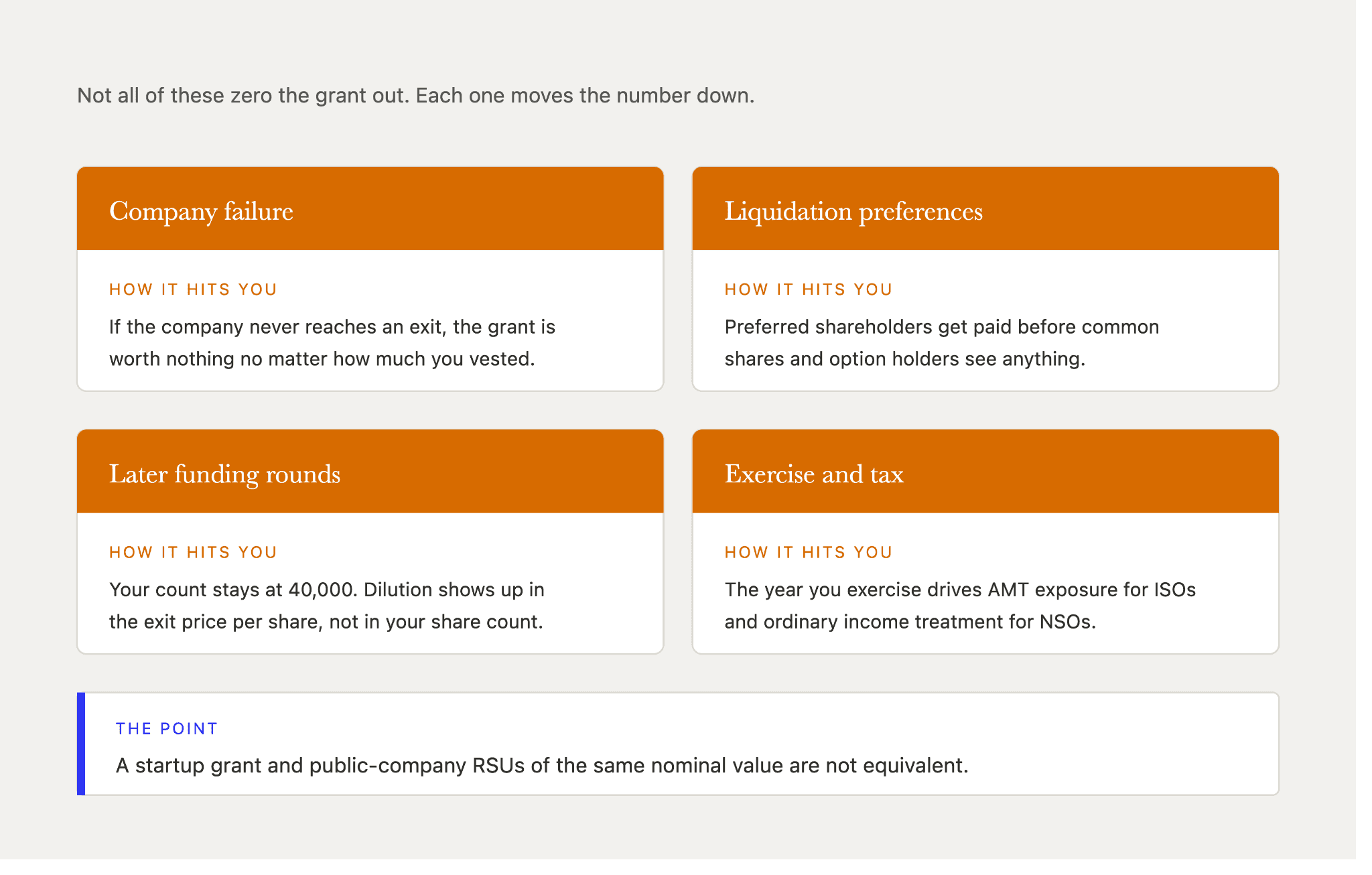
The equity could be worth $0 if the company fails, or if liquidation preferences let preferred shareholders get paid before common shareholders and option holders see anything. Future fundraising rounds dilute your stake further, and for tax purposes, the year you choose to exercise affects AMT exposure for ISOs and ordinary income treatment for NSOs. Startups often skip the annual performance bonus that established companies pay on top of base salary, so confirm whether one exists rather than assuming parity.
Worked Example: Comparing Two Job Offers Side by Side
Continuing with Offer A and Offer B, here is how to compute total compensation for the first year and four-year totals. Comparing base salaries tells you which number is bigger. Adding equity, bonus, and employer contributions tells you which offer is worth more.
Component | Offer A: Year 1 | Offer A: 4-Year Total | Offer B: Year 1 | Offer B: 4-Year Total |
Base salary | $240,000 | $960,000 | $185,000 | $740,000 |
Bonus (target) | $24,000 | $96,000 | $0 | $0 |
Signing bonus | $25,000 | $25,000 | $10,000 | $10,000 |
Equity (expected value) | $80,000 | $320,000 | $130,200 | $520,800 |
401(k) match | $9,600 | $38,400 | $5,550 | $22,200 |
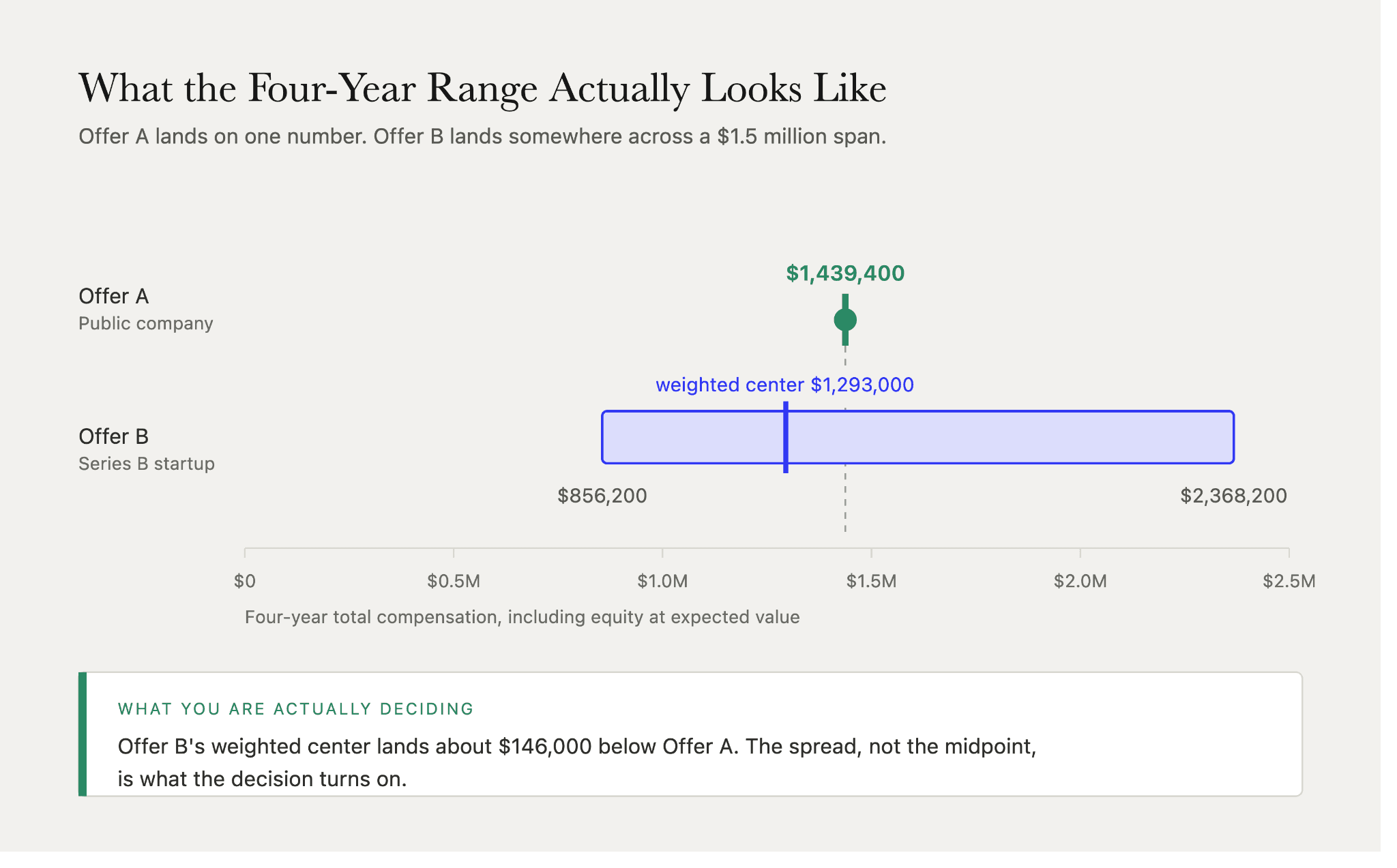
Total | $378,600 | $1,439,400 | $330,750 | $1,293,000 |
Offer A dominates on expected value and has a much narrower range of outcomes. Offer B's four-year total could range from roughly $856,000 in the downside case to more than $2,300,000 in the upside case, and the probability-weighted center lands roughly 10 percent below Offer A over four years. A simple spreadsheet, or a job offer comparison calculator, can help you run this same math on your own numbers.
Non-Compensation Factors That Should Influence Your Decision
Once the compensation numbers look roughly comparable, or even when they don't, factors like company culture, team quality, and growth potential often determine which job actually serves you better over the next few years. A positive culture drives satisfaction and retention, while a toxic one can undercut even a higher salary. You can get a read on culture through employee reviews on platforms like Glassdoor and through direct conversations during interviews.
Also assess the technical caliber of your future peers, whether the environment will push you to grow, and the hiring manager's track record of mentorship and promoting people. Ask about product-market fit and how the company measures success over the next 12 to 24 months, and find out whether the role has a realistic path from senior engineer to staff or principal within two to three years, since that shapes your future earning power as much as this offer does.
On lifestyle, consider on-call frequency, remote or hybrid policy, expected weekly hours, and commute. Employer group long-term disability plans commonly replace 50 to 60 percent of pre-disability income, according to Guardian, which is worth checking in each benefits package since it rarely gets attention until you need it. These day-to-day and long-term factors can matter more than a few thousand dollars in salary.
How to Use a Competing Offer in Negotiation Without Burning Bridges
Engineers often end up with multiple offers within the same week or two, which means having a clear strategy for using them in negotiation without damaging either relationship. When you share details, stick to high-level numbers, first-year total cash, equity percentage, or the specific gap you need closed, and avoid naming the other company if either employer restricts that.
A straightforward script: "I am genuinely excited about this position. I have another offer with a higher guaranteed base, and I would like to discuss whether we can close that gap through base salary, a signing bonus, or an additional equity grant." This keeps the tone collaborative rather than adversarial. Realistic outcomes include no change, a modest salary bump, a larger signing bonus, more paid time off, or a calibrated equity increase. Full offer rescission is rare, but it can happen if the process feels aggressive or dishonest. For more specific phrasing, Fonzi's salary negotiation email templates walk through how to put this kind of ask in writing.
Timing, Deadlines, and Asking for More Information
Offer deadlines rarely line up neatly, and you may need to request an extension, especially when complex equity terms require real review. Gather all the relevant information before deciding, and weigh company stability, financial health, and employee turnover alongside the numbers.
A polite extension request:
“Thank you for the offer. I want to give this the thorough evaluation it deserves. Would it be possible to extend the deadline by five business days so I can review the equity terms with a financial advisor?”
If you receive an unusually short deadline, understanding how exploding offers work can help you evaluate the timeline and decide how to respond.
Send these follow-up questions in writing:
What is the vesting cliff and schedule?
Is early exercise available, and what is the post-termination exercise window?
What is the fully diluted share count and the current 409A valuation?
Does the company plan to pursue a liquidity event within a stated time frame?
How are refresh grants determined for high performers, and how often are they awarded?
Can I review the plan documents or a summarized term sheet for the option plan?
Understanding these details can materially change what the equity is actually worth to you.
Risk Tolerance, Personal Runway, and Choosing the Right Balance
Your financial runway, family situation, and appetite for risk should shape how much weight you give equity upside versus guaranteed salary. Separate your essential needs from your desirable wants, and evaluate each offer against your own career goals rather than someone else's playbook.
An engineer with 18 months of savings and no dependents can rationally accept a lower base for a real shot at equity upside. Someone supporting a family on a single income needs more certainty. Define the minimum guaranteed cash you need for the next 24 months, then treat anything above that as upside rather than money you're relying on for core expenses.
As a practical framework, rate each offer on a 1-to-5 scale across four dimensions: safety, upside, learning, and lifestyle. If safety scores a 5 at the public company and a 2 at the startup, and your life right now genuinely demands safety, that pattern tells you something no spreadsheet will. An engineer earning $185,000 base who needs $200,000 a year to cover expenses is taking on real personal risk, no matter how large the option grant looks on paper.
How to Compare Job Offers: A Simple Decision Framework
A structured framework that combines quantitative equity valuation with qualitative factors keeps the decision from coming down to gut feeling alone, though trusting your gut still matters once the analytical work is done. Watch for red flags like evasive answers about the cap table or unusually high employee turnover.
Create a two-offer decision grid that carries forward the values already computed:
Factor (Weight) | Offer A (Public Company) | Offer B (Series B Startup) |
Year 1 total compensation | $378,600 | $330,750 |
4-year expected value (from table) | $1,439,400 | $1,074,600 |
Culture fit (20%) | 4/5 | 4/5 |
Manager quality (10%) | 3/5 | 5/5 |
Growth potential (30%) | 3/5 | 5/5 |
Lifestyle (10%) | 4/5 | 3/5 |
A weighted decision matrix like this helps you score offers against your own priorities. Give compensation its own weight so the grid totals 100 percent, then adjust to fit your situation: compensation 30 percent, growth 30 percent, culture 20 percent, manager quality 10 percent, and lifestyle 10 percent. Score each factor from 1 to 5, multiply by its weight, and add the results for a single number per offer. Set an explicit decision date, write down your reasoning, and accept that there's no risk-free option, only different trade-offs between present certainty and future upside.
How Fonzi Helps Engineers Get Multiple Offers to Compare
Much of the difficulty in this article comes from timing as much as math: a real apples-to-apples comparison only happens when two offers land in roughly the same window. Traditional recruiting processes drag out over weeks or months at inconsistent paces, so by the time one offer arrives, the next interview process might be barely underway, which forces a decision on incomplete information rather than a genuine comparison.
Fonzi is a curated AI engineering hiring marketplace that connects companies with pre-vetted AI and software engineers. Match Day brings multiple companies together, so engineers are more likely to end up with several offers close enough in time to compare side by side rather than weighing a live offer against a hypothetical one. That doesn't guarantee any particular mix of salary and equity, but it removes some of the scheduling friction that otherwise makes comparison harder than the compensation math alone.
Summary
Comparing job offers with equity comes down to translating each component into a realistic, risk-adjusted number, then layering in the factors a spreadsheet cannot capture, like growth potential and company culture. On the numbers in this comparison, the public-company offer finishes roughly $146,000 ahead over four years and with a far narrower range of outcomes. Startup equity can still outperform a higher salary at a larger company, but only under a favorable exit and over a multi-year horizon, so treat the upside case as a possibility rather than a plan.
Build your own offer comparison table with real numbers for base, bonus, equity, and employer contributions, ask the vesting and cap table questions before you sign anything, and weight the non-cash factors explicitly rather than settling them by feel. If you are negotiating with a competing offer in hand, name the gap you need closed instead of the other company. There is no universally right answer between guaranteed cash and equity upside, only the one that fits your risk tolerance and your timeline right now.
FAQ
How do I compare two job offers when one is remote with lower pay and the other is in-office with higher pay?
Should I prioritize a smaller equity grant at a later-stage company over a larger percentage at an early-stage startup?
What should I do if a startup will not disclose basic cap table or valuation details?
How often should engineers expect equity refresh grants, and how should I factor them into long-term comparisons?
What should I do when one offer expires before the other company has finished interviewing?