How to Build a Software Project Plan for Modern Development Cycles
By
Liz Fujiwara
•
Picture a typical software development project from 2020. A product manager drafts a 60-page requirements document. Engineering spends three months hiring through traditional recruiters. The development team kicks off a waterfall-style build, discovers a fundamental architecture flaw in month four, and scrambles to course-correct. Sound familiar?
Now contrast that with the 2026 reality. Your senior engineer uses Claude to scaffold a microservice in an afternoon. Your ML engineer fine-tunes a model while the frontend team ships an experimental feature flag. Your entire project runs on two-week sprints with continuous deployment, and your biggest bottleneck is not code, it is finding the right AI talent before your competitors do.
This article is written for startup founders, CTOs, tech leads, and hiring managers who need a pragmatic, modern approach to software development planning. By the end, you will have a framework for building a detailed plan that actually works in modern development cycles.
Key Takeaways
Modern software project planning in 2026 requires adapting to AI-driven development cycles, distributed teams, and compressed timelines, as gut-feel estimates no longer provide reliable guidance.
A comprehensive project plan must cover goals, scope, architecture, staffing, delivery cadence, and risk, with explicit ownership and dates assigned to each element, while AI-assisted development tools like GitHub Copilot change estimation accuracy, risk profiles, and required skill sets.
Fonzi AI serves as a curated talent marketplace that helps founders and CTOs staff AI-heavy projects faster, with most hires closing within three weeks through structured Match Day events, supporting predictable delivery, fewer slipped sprints, and a better experience for the engineers building your product.
Core Phases of a Modern Software Project Plan
Even in agile and continuous delivery environments, you still need structured planning phases. The difference in 2026 is that these phases are lighter, iterative, and data-driven rather than heavy, sequential, and assumption-based.
Here are the five critical phases of planning in software project management that form the backbone of any successful software development project:
Discovery & Outcomes – Defining business objectives, stakeholders, and success metrics
Scope & Constraints – Establishing boundaries, requirements, and explicit exclusions
Architecture & Technical Decisions – Selecting technology stack, AI integration points, and infrastructure
Delivery & Governance – Creating the roadmap, sprint structure, and change management protocols
Talent & Capacity Planning – Mapping required roles to milestones and securing the right team members
These phases map onto classic project management frameworks like PMBOK and PRINCE2, but they are adapted for AI-assisted, sprint-based development. Each phase should produce concrete artifacts, such as an OKR sheet, product brief, architecture decision records, capacity plan, and hiring plan, with clear owners and target dates.
Here is where many project managers miss the mark: Fonzi AI becomes especially critical in the Talent & Capacity Planning phase, which is where ambitious roadmaps collapse because teams cannot hire fast enough or consistently enough to meet their project milestones.
Defining Outcomes, Stakeholders, and Success Metrics
Instead of leading with “build a recommendation engine,” lead with “increase self-serve conversions by 20 percent by Q4 2026.” This shift forces your entire project team to stay anchored to value creation rather than output for its own sake.
Identify and document your key stakeholders early. For most AI startups, this includes:
CEO or founder (strategic direction)
CTO or VP Engineering (technical feasibility)
Product lead (user experience and roadmap)
Engineering manager (team capacity and delivery)
Data/ML lead (model performance and infrastructure)
External partners (integrations, compliance, vendors)
Next, define three to five success metrics tied directly to the project’s objectives. Record baselines and targets so you can actually measure progress as the project moves forward. Examples include:
Latency: API response time under 200ms (p95)
Reliability: 99.9% uptime for production services
Business impact: 15% increase in user retention within 90 days of launch
Quality: Less than 2 critical bugs per sprint reaching production
Finally, document a simple RACI framework (Responsible, Accountable, Consulted, Informed) so everyone knows who signs off on scope changes, architecture decisions, and go/no-go calls. This prevents the “I thought you were handling that” conversations that derail project control.
Scoping the Project: Requirements, Boundaries, and Risks

Modern scoping is about defining boundaries and assumptions rather than freezing a 100-page specification document. Your project scope should be precise enough to guide the development process but flexible enough to accommodate iterative development.
Functional Scope
Document the core user journeys and features with specific, dated targets:
Support OAuth2 SSO with Google and Microsoft by May 15, 2026
Implement real-time collaborative editing for up to 50 concurrent users
Integrate payment processing via Stripe with subscription management
Deploy LLM-powered search with retrieval-augmented generation
Build admin dashboard with role-based access controls
Enable webhook notifications for key system events
Non-Functional Requirements
Do not skip these, as they often determine project success more than features:
Performance SLAs: 95th percentile response time under 300ms
Uptime targets: 99.9% availability with defined maintenance windows
Data residency: All EU user data stored in eu-west-1
Compliance: SOC 2 Type II certification by Q4 2026
Accessibility: WCAG 2.1 AA compliance
Explicit Out-of-Scope Items
This is where you prevent scope creep before it starts:
No Android app in v1 (web and iOS only)
No on-premise deployment option before 2027
No multi-language support until v2
No custom enterprise SSO beyond Google/Microsoft in initial release
Risk Subsection
Every software development project plan should include a preliminary risk assessment:
Risk | Likelihood | Impact | Mitigation Strategy |
Regulatory changes to AI governance | Medium | High | Build configurable guardrails; monitor EU AI Act developments |
Third-party API dependency delays | Medium | Medium | Identify backup providers; build abstraction layers |
Data quality issues in training sets | High | High | Establish data validation pipeline early; allocate QA resources |
Key hire departure mid-project | Low | High | Document knowledge; use Fonzi AI for rapid backfill |
LLM cost overruns | Medium | Medium | Implement token budgets; cache frequent queries |
Architectural & Technical Planning for Modern Stacks
This section bridges product intent and implementation. Your architecture choices determine not just how you will build, but how fast you can iterate and how easily you can staff the project.
Typical 2026 Technology Stack
Modern software development teams typically work with:
Frontend: TypeScript with React or Next.js, deployed via Vercel or Cloudflare
Backend: Python (FastAPI) or Go for performance-critical services
Infrastructure: Cloud-native on AWS, GCP, or Azure with Terraform for IaC
Data layer: PostgreSQL or managed databases, vector databases (Pinecone, Weaviate) for AI features
AI/ML: OpenAI, Anthropic, or custom fine-tuned models with LangChain or similar orchestration
AI Integration Decisions
Document your approach to AI explicitly:
LLM APIs vs. custom models: Start with managed APIs and plan fine-tuning for Q3 if quality targets are not met
Retrieval-augmented generation: Implement RAG for knowledge-grounded responses
Guardrails: Deploy content filtering, output validation, and rate limiting from day one
Fallback strategies: Define degraded experiences for when AI services are unavailable
Documentation Artifacts
Your architecture planning should produce:
Architecture Decision Records (ADRs): Document why you chose PostgreSQL over MongoDB, or why you’re using serverless for specific functions
Sequence diagrams: Show critical user flows and system interactions
Data flow diagrams: Map how information moves through your system, especially PII
Tech radar: List approved libraries, services, and tools to prevent sprawl
Build vs. Buy Decisions
These choices directly impact your project timeline and human resources needs:
Component | Build | Buy | Decision |
Authentication | Custom RBAC | Auth0/Clerk | Buy: faster, more secure |
ML pipelines | Custom | AWS SageMaker | Hybrid: managed for training, custom for serving |
Observability | Custom dashboards | Datadog | Buy: not core to product |
Vector search | Custom embedding | Pinecone | Buy in v1, evaluate custom for v2 |
Planning for AI-Assisted Development and Estimation
AI coding tools like GitHub Copilot, Cursor, and Claude have fundamentally changed how software development teams work. They compress coding time significantly, but they do not eliminate the need for proper planning, code quality control, or quality assurance.
Here’s how to adjust your project planning for AI-assisted development:
Update estimation practices: Story points and t-shirt sizing still work, but calibrate them against historical velocity data that includes AI tool usage, as teams using Copilot often see 20 to 30 percent faster completion on boilerplate tasks, while complex logic and integration work remains human-limited.
Account for new risk types: AI-generated code introduces security vulnerabilities, licensing concerns, and subtle bugs from model hallucinations, so build review time into estimates explicitly.
Pair AI assistance with rigorous review: Every AI-generated code block should go through the same code review process as human-written code, and automated security scanning tools such as Snyk, Dependabot, or Semgrep should be added to your CI/CD pipeline.
Track AI-specific metrics: Measure how much code is AI-assisted, acceptance rates on suggestions, and bug rates in AI-generated versus human-written code to gain insights for future estimation.
Plan for skill evolution: Your development team needs new competencies, including prompt engineering, AI output validation, and understanding model limitations, so factor training time into your project schedule.
Build quality gates: Automated testing, linting, and type checking become even more critical when code generation is accelerated, and faster coding should not outpace your testing infrastructure.
Delivery Model, Roadmap, and Governance
This section turns your vision into a sequenced roadmap, typically expressed in sprints and quarterly milestones. Your delivery framework should match your team’s maturity and project requirements.
Choosing Your Delivery Framework
Scrum: Best for teams needing clear structure and regular ceremonies. Use when you have stable team composition and well-defined product backlogs.
Kanban: Better for teams handling variable work types (ops + features) or continuous delivery with less predictable scope.
Hybrid: Many modern teams use Scrum sprints for feature development while running Kanban for bug fixes and operational work.
Sprint and Release Structure
For a typical AI startup project:
Sprint length: 2 weeks (allows rapid iteration without excessive ceremony overhead)
Release cadence: Continuous deployment to staging; weekly production releases
Key ceremonies with dates:
Sprint planning: Every other Monday, 10am (2 hours)
Daily standup: Weekdays, 9:15am (15 minutes async or sync)
Sprint review: Every other Friday, 2pm (1 hour with stakeholders)
Retrospective: Every other Friday, 3:30pm (45 minutes, team only)
Governance Elements
Change management: All scope changes require written impact assessment (timeline, cost, risk) and sign-off from product owner and engineering lead
Decision forums: Weekly architecture review (30 min) for technical decisions affecting multiple services
Risk/issue logs: Maintained in project management software, reviewed every Monday
Escalation path: Team lead → Engineering manager → CTO for blocking issues
Documentation Rhythms
Weekly status reports to stakeholders
Monthly roadmap reviews with executive team
Quarterly project milestones and retrospectives
Continuous backlog grooming (at least weekly)
Talent, Capacity Planning, and the Role of Fonzi AI
Even the best software development project plan can fail without the right engineering, AI/ML, and data talent in place when milestones arrive, and many ambitious projects collapse not from technical challenges but from hiring delays.
Translating Roadmap to Capacity Plan
Work backward from your project milestones to identify required roles and start dates:
Role | Required By | Reason |
Senior Backend Engineer | Week 3 | Core API development begins |
ML Engineer | Week 5 | Model integration and fine-tuning |
Frontend Engineer | Week 4 | UI development parallel to API |
Data Engineer | Week 6 | Pipeline and vector DB setup |
DevOps/Platform | Week 2 | Infrastructure scaffolding |
The AI Talent Challenge
AI-heavy projects now require specialized roles that didn’t exist five years ago:
Prompt engineers who can optimize LLM interactions
LLMOps specialists who manage model deployment and monitoring
MLOps engineers who build training pipelines and model serving infrastructure
AI safety engineers who implement guardrails and compliance
Traditional hiring processes for these roles often take 3–6 months. When your project’s purpose depends on shipping an AI feature by Q3, that timeline destroys your entire project.
How Fonzi AI Solves the Hiring Bottleneck
Fonzi AI operates as a curated talent marketplace specifically designed for AI and software engineering talent:
Pre-vetted candidates: Every engineer goes through bias-audited evaluation before matching, so you are not sifting through unqualified resumes
Match Day events: Structured hiring events compress the entire process from interview to offer into approximately 48 hours
Average hiring time under three weeks: Compared to three to six months for traditional processes
Salary transparency upfront: Companies commit to salary ranges before matching, eliminating negotiation delays
Concierge support: Dedicated recruiters handle logistics so your team stays focused on building
The difference between ad hoc hiring, such as inbound resumes or generalist recruiters without an AI focus, and Fonzi’s structured process is the difference between predictable project delivery and hoping you get lucky.
For project managers and CTOs, Fonzi AI becomes a planning input, not just a hiring tool. Knowing you can staff an ML engineer role in three weeks allows you to plan your entire project around that reality rather than padding months of uncertainty into your schedule.
Example 12-Week Software Project Planning Table
Here’s a realistic 12-week plan for an AI-powered B2B SaaS product, showing how all the planning elements come together. Adapt this template based on your specific project requirements, technology stack, and team members.
Week | Key Activities | Owners | Dependencies | Talent Needs |
1 | Discovery workshops; finalize outcomes and success metrics | Product Lead, CTO | Stakeholder availability | — |
2 | Architecture decisions; infrastructure scaffolding; initiate Fonzi Match Day for ML Engineer | Engineering Lead, DevOps | ADR sign-off | DevOps (in place) |
2-3 | Fonzi Match Day event – interview and extend offer to ML Engineer | CTO, Engineering Lead | Fonzi AI platform | ML Engineer (hired by end of Week 3) |
3 | Complete API design; begin core backend services; finalize tech stack | Backend Engineers | Architecture complete | Senior Backend (in place) |
4 | Frontend scaffolding; design system setup; user stories defined | Frontend Engineer, Product | API contracts | Frontend Engineer (in place) |
5 | ML Engineer onboards; model integration planning begins; data pipeline design | ML Engineer, Data Engineer | Data access agreements | ML Engineer starts; Data Engineer (in place) |
6 | Core feature buildout; LLM integration POC; database schema finalized | Full Team | Vector DB selected | — |
7 | Feature development continues; RAG implementation; initial QA cycles | Full Team | Training data ready | — |
8 | Feature freeze for MVP scope; integration testing begins | Engineering Lead, QA | All core features complete | QA resource (contract or full-time) |
9 | Hardening sprint: performance optimization, security audit prep | Full Team | Security tooling configured | — |
10 | User acceptance testing with beta customers; bug fixes; documentation practices finalized | Product, Engineering, Customer Success | Beta user agreements | — |
11 | Production deployment; monitoring setup; incident response testing | DevOps, Engineering Lead | Infrastructure ready | — |
12 | Launch; post-launch review; retrospective; roadmap revision for Q2 | Full Team | Launch criteria met | — |
For founders and CTOs, this template scales. Whether you are building your first AI product or your tenth, the structure remains consistent. Adjust the timeline, add rows for additional hires, and modify activities based on your market research and product requirements.
Aligning Planning with Agile and Continuous Delivery
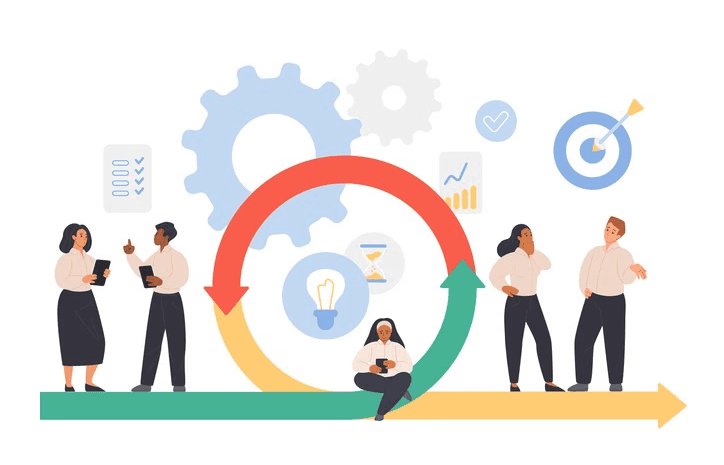
Planning does not contradict agility. Instead, it provides the guardrails within which teams can adapt, learn, and deliver high-quality software without chaos.
The key distinction is between fixed long-term Gantt-style planning, which assumes you can predict everything, and modern adaptive planning, which sets quarterly north stars while leaving sprint-level details flexible.
Lightweight Documentation Approach
Concise project brief: 2-3 pages covering outcomes, scope, key constraints, and success metrics
Living roadmap: Updated monthly, showing quarterly objectives and current sprint focus
Evolving backlog: Groomed weekly, with detailed user stories only for the next 2-3 sprints
Handling Changing Requirements
Rather than “just saying yes” to every request, establish explicit policies:
Intake process: All change requests documented with business rationale
Impact assessment: Engineering provides timeline, cost, and risk implications
Trade-off discussion: What gets deprioritized if this gets added?
Decision and communication: Product owner decides; stakeholders informed within 24 hours
Example: Mid-Quarter Reprioritization
Your team is in Week 6 of a 12-week project. User feedback from beta testing reveals that your AI feature’s response time is frustrating end users. They expect sub-second responses, but you are delivering 3 to 4 seconds.
Instead of blowing up the entire plan:
Hold an emergency triage (1 hour) with engineering and product leads
Identify quick wins (caching, async loading) that can ship in current sprint
Defer one planned feature (admin analytics dashboard) by 2 weeks
Update stakeholders on revised timeline and rationale
Add “latency optimization” as explicit success criterion for launch
This is iterative development in practice, responding to user feedback without abandoning your project’s goals or expected outcomes.
Budgeting, Tooling, and Risk Management
Budget and risk are inseparable, and a realistic software development plan requires clear cost expectations for people, tools, and infrastructure, along with explicit mitigation strategies for potential issues.
Major Cost Categories
Category | Typical Range (Early-Stage AI Startup) | Notes |
Engineering salaries | $150K-$300K/year per senior engineer | AI/ML specialists command premium rates |
Cloud infrastructure | $5K-$50K/month | Scales with users and model inference costs |
LLM API costs | $2K-$20K/month | Varies dramatically by usage patterns |
Software licenses and tools | $500-$5K/month | Project management, dev tools, security |
QA and security tooling | $1K-$10K/month | Automated testing, scanning, monitoring |
Contractor/consulting | Variable | Architecture review, security audits |
Project Management Tooling
Choose tools that support distributed, remote-first teams:
Project management: Linear, Jira, or Notion; pick one and commit
Documentation: Notion, Confluence, or GitBook for living documents
Communication: Slack for async, Zoom/Google Meet for sync
Code: GitHub or GitLab with branch protection and CI/CD
Observability: Datadog, Grafana, or cloud-native monitoring
Risk Management Plan
Your risk management plan should include your top 5 project risks with likelihood, impact, owners, and contingency plans:
Risk | Likelihood | Impact | Owner | Mitigation |
LLM model reliability degrades | Medium | High | ML Lead | Multi-provider fallback; quality monitoring |
Key engineer leaves mid-project | Low | High | Engineering Manager | Knowledge documentation; Fonzi AI for rapid backfill |
Data privacy incident | Low | Critical | CTO | SOC 2 controls; incident response plan |
Cloud provider outage | Low | Medium | DevOps | Multi-region deployment; chaos engineering |
Budget overrun on inference costs | Medium | Medium | CTO | Token budgets; usage alerts; caching strategy |
Using platforms like Fonzi AI for talent acquisition is a risk mitigation tactic, as it allows you to build a predictable hiring process into your plan from day one rather than discovering you cannot hire a critical ML engineer until three months after you need them.
Conclusion
Modern software project planning connects outcomes, scope, architecture, delivery, talent, and risk into a single framework that keeps teams aligned while moving fast. Teams that treat planning as a living, collaborative process see faster time-to-market, fewer fire drills, and higher morale.
For AI startups, the main bottleneck is talent. Even with the best roadmap, a project stalls without the right engineers. Fonzi AI solves this with a curated marketplace and Match Day events that deliver pre-vetted talent in weeks, with salary transparency, bias-audited evaluations, and concierge support.
Planning combined with the right talent marketplace ensures successful delivery and keeps teams competitive through 2026 and beyond.
FAQ
What are the 5 critical phases of planning in software project management?
How has AI-assisted development changed the way we estimate project timelines?
What should be included in a comprehensive software project plan in 2026?
How do you balance Agile flexibility with the need for a fixed project roadmap?
What is the difference between a project plan and a technical specification document?


