Anthropic’s Claude is widely used for work, study, and coding, which makes one question especially important: what happens to the data you share? With updates to its Consumer Terms and Privacy Policy in late 2025, Anthropic clarified how chats and files may be used for model improvement. In this article, we’ll break down what “training on your data” actually means, how it differs across Claude plans, and the steps you can take to stay in control of your information.
Key Takeaways
Claude may train on your data, but this depends on your account type (consumer vs business) and your privacy settings.
Since Anthropic’s September 2025 policy changes, most consumer accounts can be used for model training unless users actively adjust their settings.
Claude Enterprise and most commercial API deployments are contractually excluded from model training and handled under stricter privacy terms.
Anthropic typically keeps training-eligible data for up to five years, while opted-out or sensitive data has shorter retention and extra safeguards.
Users should treat Claude like any cloud service, avoid unnecessary sensitive data, and regularly review privacy settings and contracts.
Does Claude Use Your Conversations To Train Its AI Models?
The short answer is yes, Claude can train on some user data, but only under certain plans and consent settings. Not every conversation is automatically used for training, and individual users have meaningful control over whether their inputs contribute to future models.
When Anthropic refers to “training on your data,” it means that anonymized snippets from chats and coding sessions may be fed back into training pipelines to improve performance, accuracy, and safety. This process helps large language models like Claude become more helpful over time. As of today, consumer accounts such as Claude Free, Pro, Max, and many Team workspaces are typically eligible for model improvement unless users switch off the relevant privacy toggle.

Anthropic applies automated filters and sometimes human review to strip or obfuscate obvious personal identifiers and sensitive fields before data collected enters training datasets. This includes removing passwords, financial details, and certain medical identifiers. However, no filtering system is perfect, which is why user behavior matters.
Deleting individual chats or full conversations prevents those items from being used for future model training, although some logs may be retained for security and abuse monitoring. If you handle client, patient, or proprietary business data, do not rely solely on defaults. Verify whether your specific Claude plan permits data training before sharing sensitive information.
How Claude’s Data Policies Differ By Account Type
Claude’s privacy and training behavior depend on your plan. Consumer tiers (Free, Pro, Max, and many Team accounts) may use your data for model improvement by default, unless you opt out in settings.
Business and API offerings, such as Claude Enterprise, Claude for Work, and deployments via platforms like Amazon Bedrock or Vertex AI, typically follow commercial terms that treat user data as confidential and prohibit its use for training. This creates a clear distinction between consumer and enterprise protections.
Typical Claude Data Training Behavior By Plan
Plan Type | Default Training on User Content | Approximate Retention Period | Best Suited For |
Consumer Free/Pro/Max | Yes, by default, the user may opt out | Up to five years for the opt-in model improvement | Casual personal use, experimentation |
Consumer Team | Yes, by default, the user may opt out | Up to five years if enabled | Small teams, freelancers |
Enterprise / Claude for Work | No, contractually excluded | Short operational logs only | Regulated industries, large organizations |
API via Anthropic directly | No by default, per commercial terms | Configurable per agreement | Developers, production applications |
API via cloud platforms (Amazon Bedrock) | No, configured by enterprise/platform policy | Configured per enterprise data policy | Enterprises with existing cloud infrastructure |
This comparison highlights practical implications for freelancers, employees, and organizations. If you are an employee using a personal Free or Pro account for company matters, you may inadvertently expose client code, contracts, or forecasts to long-term storage and potential model influence. Organizations should audit for this “shadow AI” use and migrate critical workflows to properly governed enterprise environments.
Understanding Anthropic’s Privacy Policy And Data Retention
Anthropic’s Privacy Policy and related terms set out how long data is stored, what it can be used for, and when it may be accessed by humans. After the update in September 2025, opted-in consumer users often have their chats and coding sessions retained for up to five years for model training and evaluation, instead of the much shorter 30-day window Anthropic used for some earlier settings.
If a user disables the “Help improve Claude” toggle in their privacy settings, future conversations are generally excluded from training datasets. However, brief operational logs may still exist for fraud detection, security, and service reliability. This data retention applies to most users regardless of their training preferences.
Incognito chats or “no history” modes in Claude are not used to improve models, even when model improvement is enabled globally. However, explicit thumbs-up or thumbs-down feedback on those chats can be stored separately, de-linked from user ID, and studied for research and safety purposes.
Anthropic states that it does not sell user data and applies filtering and obfuscation to reduce the presence of highly sensitive information in training corpora. Despite these safeguards, organizations in regulated sectors should treat any five-year retention and training eligibility as a serious compliance consideration, particularly in relation to document destruction policies and sector rules like HIPAA or GDPR.
Is Claude Safe For Work, Sensitive Data, And Regulated Industries?
Claude can be used safely for professional work, but only if the right plan is in place and users follow basic data hygiene practices. The distinction between consumer accounts and enterprise deployments determines most of your risk exposure.
Law firms, healthcare organizations, financial institutions, and technology companies should strongly prefer enterprise-grade or API-based Claude deployments that operate under Commercial Terms and prohibit training on submitted content. These plans also offer configurable retention periods and often store data on a secure back end with stricter access controls.
Risks emerge when employees use personal Claude Free or Pro accounts for company matters. This creates five-year retention windows, training eligibility, and potential violations of corporate confidentiality rules or industry regulations. Most users do not realize that their casual AI chatbot use might conflict with their employer’s data practices or client agreements.
Businesses should conduct periodic audits to identify shadow IT use of Claude, adjust privacy toggles, and migrate critical workflows to properly governed enterprise environments. Curated talent marketplaces and AI-focused startups, such as Fonzi’s network of engineers and founders, often help companies design and implement secure AI workflows that respect both Anthropic’s terms and internal governance rules.
For truly sensitive material, companies might still choose to strip identifying details, use synthetic data where possible, or keep certain highly confidential workflows entirely outside third-party AI tools.
Practical Safety Tips For Using Claude At Work
Never paste full credential sets, API keys, or live secrets into chat windows. Even with filters, this creates unnecessary data exposure risk.
Use redaction techniques when discussing real projects in consumer accounts. Replace names with labels like “Client A” or mask unique IDs to reduce identifiability.
Coordinate with your security or legal teams before adopting Claude for core workflows. Request written confirmation that Commercial Terms apply before sharing confidential client data.
Rely on incognito or no-history modes for exploratory prompts, combined with disabled training toggles, while reserving highly sensitive work for enterprise environments with stronger contractual protections.
Document internal AI usage policies that spell out which Claude plans are approved, what data types are permitted, and how employees should handle exports and file sharing. This helps maintain full control over your organization’s AI interactions.
How To Control Whether Claude Trains On Your Data
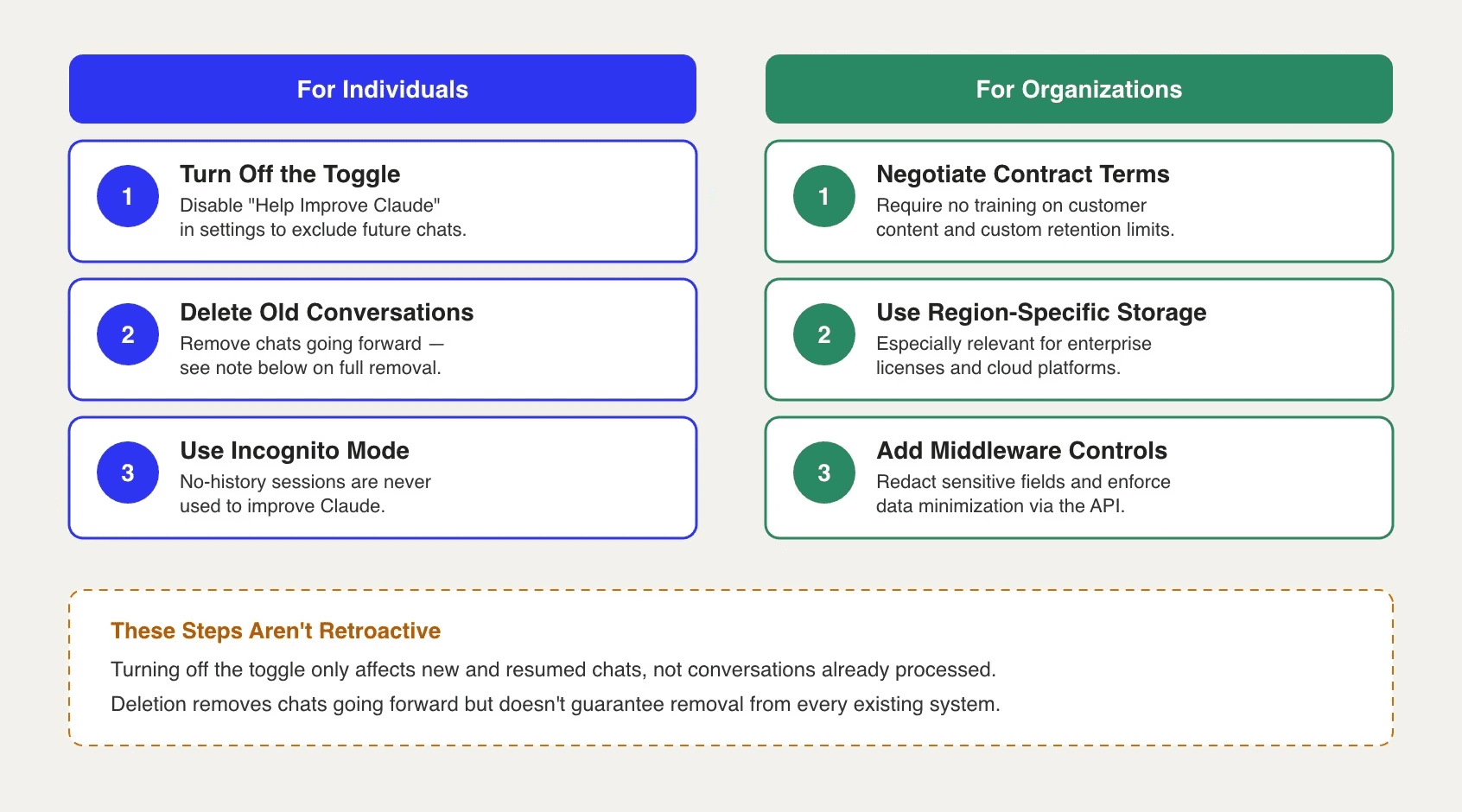
Individuals have direct control through in-product settings and account choices, while organizations have additional leverage through contracts and platform integrations.
To disable model improvement, visit your account settings in Claude, locate the “Help improve Claude” or “You can help improve Claude” toggle, and switch it off. This prevents future conversations from entering training datasets. Note that this affects new chats and resumed sessions, not data that may already have been processed.
Turning this toggle off does not retroactively remove content that may already have been processed for future model training. Users concerned about past data should also review deletion tools. You can delete individual chats or entire conversation histories through the interface.
Incognito or “no history” modes create sessions that are not used to improve Claude. However, feedback actions, bug reports, or abuse reports can still be stored and reviewed separately as part of safety and quality efforts.
Businesses can negotiate stricter data terms, including no training on customer content, custom retention limits, and region-specific storage. This is especially relevant when accessing Claude through enterprise licenses or cloud platforms like Amazon Bedrock. Technical teams can integrate Claude via the Anthropic API in ways that protect upstream systems, for example, through middleware that automatically redacts sensitive fields, logs prompts centrally, and enforces internal data minimization rules.
Summary
Claude can use some user data to improve its models, but this depends on your account type and settings. Most consumer plans (Free, Pro, and Team) are opted in to training by default unless you disable it, and eligible data may be retained for up to five years. While Anthropic applies filtering to remove sensitive information, users still need to be cautious, as deleting chats or using incognito mode can limit how data is used, but does not guarantee full removal from all systems.
In contrast, enterprise and API-based deployments typically exclude customer data from training under stricter contractual terms, making them safer for business or regulated use. To stay in control, users should review privacy settings, avoid sharing sensitive information, and choose the appropriate plan for their needs. Overall, Claude can be used safely, but only with informed decisions about data handling, account type, and internal policies.
FAQ
Does Claude use your conversations to train its AI models?
What does Anthropic’s privacy policy say about how user data is handled?
Is Claude AI safe to use for work and sensitive business information?
How does Claude’s data privacy compare to ChatGPT and other AI tools?
How do I use Claude in a way that keeps my data as private as possible?