The Truth About the Difficulty of Software Engineering in the AI Era
By
Liz Fujiwara
•

In 2016, learning to code meant wrestling with loops, REST APIs, and deploying to Heroku. In 2026, it means navigating Kubernetes clusters, integrating LLMs into production pipelines, and pairing with GitHub Copilot while evaluating every suggestion.
Software engineering remains challenging due to high responsibility, constant learning, and real consequences when systems fail, but it is more accessible than ever with structured online resources, AI tutors, and free access to production-grade tools.
This article focuses on software engineering in the AI era, including cloud-native systems, ML-driven products, and AI-augmented workflows, with challenges that differ from a decade ago. We will cover what makes software engineering hard today, how AI reshapes the difficulty curve, why the job market feels intense, and strategies to navigate it successfully.
Key Takeaways
Modern software engineering is challenging due to ecosystem churn, architectural complexity, and collaboration demands, not just math or writing code in isolation.
AI assistants like GitHub Copilot and Claude make coding easier but raise expectations for system design, security judgment, and cross-functional collaboration.
Fonzi AI addresses the hardest part for engineers, breaking into a competitive job market, by compressing months of job hunting into a 48-hour high-signal Match Day with responsible AI handling fraud detection, bias-audited evaluation, and logistics.
What Makes Software Engineering “Hard” Today?

In 2026, “hard” means orchestrating microservices across distributed systems, integrating LLMs with retrieval pipelines, managing observability across dozens of cloud services, and doing all of this while collaborating asynchronously with teams spread across time zones. The tech stack has exploded in scope and complexity.
The dimensions of difficulty in a modern software engineer career include:
Cognitive load: Abstract thinking across multiple layers of abstraction, from database schemas to API contracts to frontend state to infrastructure provisioning.
Ecosystem churn: Frameworks, libraries, and best practices shift constantly, and what was standard in 2023 may be deprecated by 2026.
System complexity: Production systems involve dozens of interconnected services, each with its own failure modes, security surfaces, and operational requirements.
Soft skills demands: Writing design documents, communicating with non-technical stakeholders, estimating timelines, and collaborating with fellow developers are now core expectations.
Hiring competition: The job market for entry-level roles has tightened significantly, while specialized AI and infrastructure roles command premium salaries but require demonstrated experience.
Consider debugging a distributed system where a bug surfaces only under load, somewhere between an AWS Lambda function, an S3 bucket, and a DynamoDB table. Or deploying a Retrieval-Augmented Generation pipeline that performs well in development but hallucinates in production due to subtle data drift. These are not theoretical challenges; they are part of a typical Tuesday afternoon for machine learning engineers and infrastructure teams at growing startups.
Difficulty is uneven across specializations. Frontend development grapples with state management and accessibility across browsers. Backend engineers optimize for latency and throughput. Infrastructure engineers handle distributed consensus and disaster recovery. AI engineers monitor model drift and evaluation pipelines.
Later sections will separate learning difficulty, day-to-day job difficulty, and job market difficulty to give you clearer mental models for what you are actually up against.
Is Software Engineering Hard to Learn vs Hard to Do as a Job?
There is a meaningful gap between learning software engineering in a tutorial environment and practicing it professionally. Academic learning such as LeetCode problems, bootcamp projects, and online courses provide structure and immediate feedback. Professional practice brings deadlines, tradeoffs, ambiguity, and the reality that your code must survive contact with users, teammates, and production infrastructure.
Many beginners find the first 3–6 months hardest because of fundamental mindset shifts. Learning programming means learning to think in abstractions, debug systematically, and read existing codebases rather than just writing new code. Most people underestimate how much professional software development involves understanding code someone else wrote years ago.
As engineers progress, the difficulty shifts. Early-career challenges sound like “How do I implement this feature?” Mid-career challenges sound like “Should we build this at all? How does it fit architecturally, operationally, and ethically into the product? What technical debt are we incurring?” The cognitive demands scale with responsibility.
A toy CRUD app with a simple database is qualitatively different from a real-world system with authentication, authorization, observability, CI/CD pipelines, and SLAs. AI coding assistants reduce friction when learning syntax and APIs; however, they cannot replace understanding algorithms, complexity tradeoffs, and design patterns.
Learning Software Engineering: The Early Curve
Confusion is normal. If you are struggling with pointers, async/await, or Git merge conflicts in your first months, you are in good company.
The hardest early concepts for most programmers typically include:
Control flow and conditional logic
Data structures such as arrays, hashmaps, trees, and graphs
Recursion and its mental model
Object-oriented versus functional paradigms
Version control workflows with Git
Test-driven development basics
Advice: focus on 1–2 programming languages rather than chasing every new framework. Python works well for aspiring AI engineers and data scientists. TypeScript or Go serve backend engineers. JavaScript remains essential for frontend development.
Consistent practice matters more than any single resource. Ten to twenty hours per week over 6–12 months of self-study, whether through a college degree, boot camps, or self-learning, builds the foundation. What separates successful engineers is not talent alone; it is consistent effort applied over time.
Build small, end-to-end projects early. Deploy a Flask or Next.js app on Render or Vercel. Connect it to a database. The gap between “I understand this concept” and “I can ship something real” closes only through hands-on experience on real projects.
Doing Software Engineering: The Professional Reality
The job is as much about reading and modifying existing systems as writing brand-new code. New features often require understanding legacy code written by other developers who left the company years ago. Fixing bugs in unfamiliar codebases is a core skill, not an edge case.
Common “hard” realities in professional software engineering include:
Dealing with legacy code and technical debt (consuming 40–60% of effort in mature organizations)
Navigating unclear or changing business requirements
Coordinating across teams with conflicting priorities
Handling production incidents at 2 a.m.
Managing complex problems like cloud costs, security audits, and compliance requirements
Modern challenges amplify these realities. Microservices complexity means a single request might traverse ten services before returning a response. Observability, including logs, traces, and metrics, is essential but often poorly implemented. Cloud services require ongoing cost optimization. Security and privacy requirements in 2026 are stricter than ever, especially for systems handling user data or training machine learning models.
Soft skills are now core parts of the job. Writing design documents, giving and receiving code review feedback, estimating work accurately, and communicating with a product manager about tradeoffs are daily expectations. Getting stakeholders on the same page about technical constraints requires diplomacy.
AI now appears in daily workflows through linting suggestions, test generation, and refactor recommendations. Engineers must supervise AI output rather than blindly trust it, as the tools accelerate work but introduce new failure modes if used carelessly.
How AI Is Changing the Difficulty Curve for Engineers

Since 2023, tools like GitHub Copilot, Codeium, ChatGPT, and Claude have become standard in many engineering teams. They accelerate both junior and senior engineers in different ways and are reshaping what the tech industry expects from software developers.
AI reduces difficulty in low-level tasks such as generating boilerplate, making API calls, and refactoring repetitive patterns. Tasks that once required Stack Overflow searches and documentation dives now complete in seconds with a well-phrased prompt, which is transformative for learning software development.
However, AI increases expectations around higher-level coding skills. If boilerplate is cheap, companies expect more architectural thinking, product judgment, security awareness, and ethical consideration.
AI literacy itself has become a core technical skill. Prompt design, understanding LLM failure modes, evaluating hallucinations, and integrating models into products are now part of the job description for many roles. AI-era specializations have emerged, including LLM engineer, ML platform engineer, data engineer for AI workloads, and MLOps/SRE roles managing model deployment pipelines.
What AI Makes Easier vs What It Makes Harder
The following table compares how development tasks have shifted with AI adoption. Each row contrasts pre-AI difficulty, post-AI difficulty, and the implication for engineers navigating this landscape.
Task | Pre-AI Difficulty | Post-AI Difficulty | Implication for Engineers |
Writing boilerplate code | Time-consuming, error-prone | Near-instant generation | Focus shifts to reviewing and validating AI output |
Learning new frameworks | Hours of documentation reading | Rapid Q&A with AI tutors | Faster onboarding, but risk of shallow understanding |
Implementing OAuth 2.0 | Complex, multi-day effort | Quick scaffolding, but validation still required | Security judgment becomes the bottleneck, not implementation |
System design decisions | Required deep experience | AI can suggest patterns, but can’t evaluate context | Architecture and tradeoff analysis remain human skills |
Debugging complex issues | Methodical, often slow | AI can accelerate hypothesis generation | Still requires understanding of problem solving fundamentals |
Writing tests | Often skipped due to time pressure | AI generates test scaffolds quickly | Test quality and coverage strategy still need human judgment |
Hiring signal (for candidates) | Resume, interviews, references | AI-generated portfolios raise noise | Demonstrable, unique project work becomes more valuable |
Ethical decision-making | Rarely explicit in job scope | Now expected as AI systems scale | Engineers need frameworks for evaluating harm and bias |
AI doesn’t remove difficulty; it shifts it toward judgment, architecture, and people skills. Engineers who embrace this shift, treating AI as a force multiplier rather than a replacement for understanding, will thrive.
Is It Harder to Break Into Software Engineering Than Before?
Entry-level hiring in 2026 is competitive. Tech layoffs, remote-first global competition, and companies raising hiring bars have squeezed the junior market. Entry-level postings dropped roughly 30 percent after the 2024 AI boom as companies prioritized senior and specialized hires.
While free resources for learning programming are abundant, including online courses, open source projects, and YouTube tutorials, the signal-to-noise ratio in hiring has worsened. Application-to-interview ratios for junior roles sometimes hit 300:1. Automated screens reject candidates before humans see their resumes, and feedback loops are opaque or nonexistent.
Most companies now apply FAANG-style interview processes even for mid-market roles, creating a mismatch between preparation expectations and actual job requirements.
The situation differs by seniority. Mid-level and senior engineers with real production experience remain in high demand, especially in AI, infra, and security. Difficulty concentrates at the new graduate or first-job level, where the experience paradox creates frustration.
Why Traditional Job Hunting Feels So Hard
The typical experience for job seekers involves mass applications, ghosting, repetitive online assessments, unpaid take-home projects, and inconsistent feedback. You invest hours in a single line of hope, only to receive silence.
Structural issues compound the problem:
Overloaded recruiters triaging hundreds of applications per role
Uncalibrated resume filters rejecting qualified candidates
Non-technical screeners making technical judgments
Tools prioritizing volume over quality matching
AI is increasingly used by ATS systems to rank resumes or assess video interviews, often opaquely and with potential biases. Candidates do not know why they were rejected or how to improve, which amplifies frustration for serious candidates with strong technical skills who cannot get their materials in front of decision-makers.
The traditional path treats job search as a numbers game: apply to 200 positions, hear back from 10, interview at 3, and maybe get one offer. This wastes time for both candidates and companies.
How Fonzi AI Uses AI to Make Hiring Easier, Not Harder
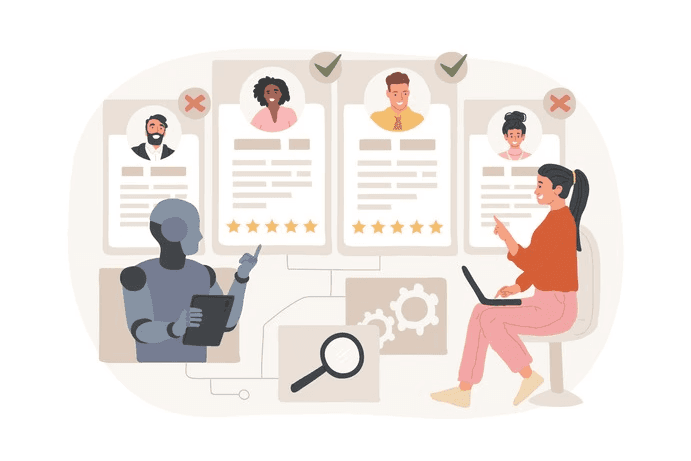
Fonzi AI is a curated talent marketplace focused on AI/ML, backend, full-stack, data, and infra engineers. Unlike generic job boards where applications vanish into black holes, Fonzi structures the hiring process around clarity and commitment.
The core idea is that instead of endless applications, candidates join a structured “Match Day” hiring event. Pre-vetted engineers and committed companies meet in a compressed 48-hour timeframe, with interviews scheduled by Fonzi’s concierge team. This creates high-signal interactions with companies that have already committed to salary bands and are actively ready to hire.
Fonzi uses AI for specific, constrained tasks: fraud detection to prevent fake profiles, deduplicating and organizing candidate information, and bias-audited scoring assistance to ensure fair evaluation. AI supports the process rather than replacing human judgment known as human-centered AI. Hiring decisions and interview experiences remain driven by human hiring managers and recruiters.
Companies on Fonzi commit to salary transparency upfront and operate under clear communication standards. This reduces ghosting and lowball offers, two of the most demoralizing aspects of modern job search.
For engineers, Fonzi’s service is free. Employers pay an 18 percent success fee only when they hire. The incentives align: Fonzi succeeds when good matches happen, not when applications pile up.
Inside Fonzi Match Day: What Actually Happens
A typical Match Day runs as a 48-hour hiring event window. The goal is to replace months of noisy job hunting with a few days of focused, high-quality interactions with AI startups and high-growth tech companies.
The sequence works like this:
Application and vetting: Candidates apply and Fonzi evaluates skills, experience, and preferences
Profile polishing: Resume and portfolio receive feedback and optimization for the types of roles being filled
Pre-event matching: Candidate preferences for tech stack, seniority, and compensation are aligned with company needs
Live intros and interviews: Engineers can expect 2–5 serious conversations with companies during the window
Rapid offer and feedback cycles: Decisions happen fast, often within 48 hours of the event
AI works behind the scenes to align preferences and avoid mismatches, while human recruiters maintain nuance and context. The concierge team handles scheduling logistics so engineers can focus on performing in interviews rather than coordinating calendars.
Bias-Audited, Human-Centered Evaluation
Bias and fairness matter even more when ML and LLM engineers are building sensitive systems themselves. If the hiring process is biased, teams building AI will lack the diverse perspectives needed to catch blind spots in their work.
Fonzi’s evaluation flow is designed with this in mind:
Structured rubrics and standardized question sets reduce variance between evaluators
AI assistance is explicitly bias-audited, focusing evaluations on skills rather than names, photos, or irrelevant metadata
Companies are encouraged to prioritize signals of skills, such as projects built or research work, over pedigree such as school logos or previous company brands
This reduces the hidden difficulty of job search: candidates receive a fairer shot based on what they can actually do, rather than whether their resume triggered the right keywords in an opaque ATS system.
Practical Tips: Succeeding as an AI-Era Software Engineer
Whether you’re looking for your first job in AI, your next ML platform role, or a senior backend position, the market rewards preparation and positioning. Here’s concrete guidance for engineers preparing for a competitive career path.
Core levers for success:
Choose a focus: Pick a primary lane such as LLM engineer, ML platform engineer, senior backend in Go or TypeScript, or data engineer and go deep rather than broad.
Build portfolio projects: Two to three projects directly aligned with your target role demonstrate capability better than resume bullet points.
Leverage AI tools wisely: Use AI coding assistants as force multipliers for boilerplate while practicing from-scratch problem solving for interviews.
Prepare systematically: Technical interviews require data structures, system design, and role-specific knowledge.
Manage your online presence: GitHub, LinkedIn, and portfolio sites are your public evidence of genuine interest and capability.
Get real feedback: Use Fonzi’s process including resume feedback, curated intros, and Match Day to benchmark your positioning against real hiring teams.
Portfolio and Project Strategy in 2026
Portfolios now matter as much as resumes, especially for ML, LLM, and platform roles. Hiring managers want to see what you’ve actually built, not just read about where you’ve worked. A strong portfolio demonstrates that you can ship real projects, not just talk about them.
Recommended project types by specialty:
Specialization | Example Project |
LLM Engineer | Production-ready RAG app with evaluation harness and deployed API |
Backend Engineer | Scalable API with queues, caching, rate limiting, and monitoring dashboard |
Data Engineer | dbt + Airflow pipeline with clear documentation and data quality tests |
ML Engineer | End-to-end model training, evaluation, and serving pipeline with experiment tracking |
Infra Engineer | Terraform-managed infrastructure with CI/CD, monitoring, and cost optimization |
Each project should be:
Deployable: Live on AWS, GCP, fly.io, or similar; not just local
Documented: README with architecture diagram, setup instructions, and design decisions
Test-covered: At least basic tests demonstrating you understand quality
Use AI to accelerate boilerplate and solve complex issues faster, but be prepared to defend architecture choices, tradeoffs, and performance considerations in interviews, as hiring managers will ask why you chose X over Y.
Link these projects in your Fonzi profile and GitHub so companies on Match Day can review your work immediately rather than relying solely on your claims.
Interview Prep for AI, ML, and Infra Roles
Modern interviews blend CS fundamentals, systems thinking, and practical coding under time pressure. Prepare for all three dimensions rather than hoping you can wing one of them.
A balanced prep plan includes:
Data structures and algorithms: LeetCode-style practice on arrays, trees, graphs, dynamic programming. Not everyone loves this, but it’s still gated for most companies.
System design: High-level diagrams, understanding tradeoffs between consistency and availability, and articulating how you’d scale a specific feature.
Role-specific deep dives: For ML roles, understand transformers, evaluation metrics, and deployment. For infra roles, know container orchestration, networking, and observability. For LLM roles, understand vector databases, RAG architectures, and prompt engineering.
Practice AI-assisted coding in a controlled way, but also complete sessions with AI turned off, since many technical interviews still ban AI tools and you need to demonstrate baseline coding skills. Prepare 3–4 “anchor stories” using the STAR method for behavioral questions, such as navigating a challenge with legacy code, resolving a production incident, launching a complex feature, or handling a technical disagreement. Last but not least, use Fonzi’s team and partner companies to understand interview expectations, making preparation more targeted than cold-applying through generic job boards.
Conclusion
Software engineering is hard in the same way all demanding disciplines are hard. It requires abstract thinking, ongoing learning, evolving technology knowledge, and the ability to solve problems under ambiguity. The AI era has shifted this difficulty toward judgment, architecture, and collaboration rather than rote coding. Engineers who embrace this shift, treating AI as a tool rather than a crutch, will find a good career with sustained growth.
For many engineers, the hardest part isn’t the technical work itself. It’s the chaotic hiring process, including ghosting, unclear signals, and months spent on applications with no feedback. This is a solvable problem.
Fonzi AI exists to fix hiring for serious engineers in AI, ML, backend, and infra roles. Match Day compresses the job search into a high-signal event where you meet companies ready to hire at committed salary levels. Apply to Fonzi AI as a candidate, which is free, curated, and focused on AI/ML/infra talent, and experience your first Match Day to see how a modern hiring platform can match the sophistication of the tech you’re building.
FAQ
Is software engineering harder than other engineering majors like Electrical or Civil in 2026?
How much advanced math and discrete logic is required for a 2026 computer science degree?
Can AI coding assistants like GitHub Copilot make software engineering easier for beginners?
Why is the entry-level software engineering job market so difficult to break into right now?
What are the hardest concepts for new developers to master in a modern cloud-native environment?


