Best AI Career Coaches for Senior Engineers
By
Ethan Fahey
•
AI-based career tools have moved from novelty to standard practice for senior engineers, ML researchers, and infrastructure specialists weighing new roles. These candidates now engage with AI on both sides of the process: using it to sharpen resumes and prep for interviews, while also being screened and ranked by AI systems on the company side.
For recruiters and hiring managers, the same tradeoff applies. AI improves efficiency, but outcomes still depend on how well it's paired with human judgment. Fonzi is built around that balance, combining AI-assisted matching with structured human review to create a higher-signal experience on both sides of a hire.
Key Takeaways
AI career coaches help with resume optimization, interview preparation, portfolio reviews, and identifying skill gaps, making career support more accessible and scalable.
AI tools are most effective for structured tasks such as tailoring resumes, generating interview questions, and analyzing job market trends, but they still require human oversight.
Human coaches, recruiters, and mentors remain essential for evaluating team quality, negotiating offers, and making major career decisions that depend on context and judgment.
Senior engineers typically achieve the best results by combining AI tools for efficiency with human guidance for strategy, career planning, and long-term decision-making.
What is an AI career coach?
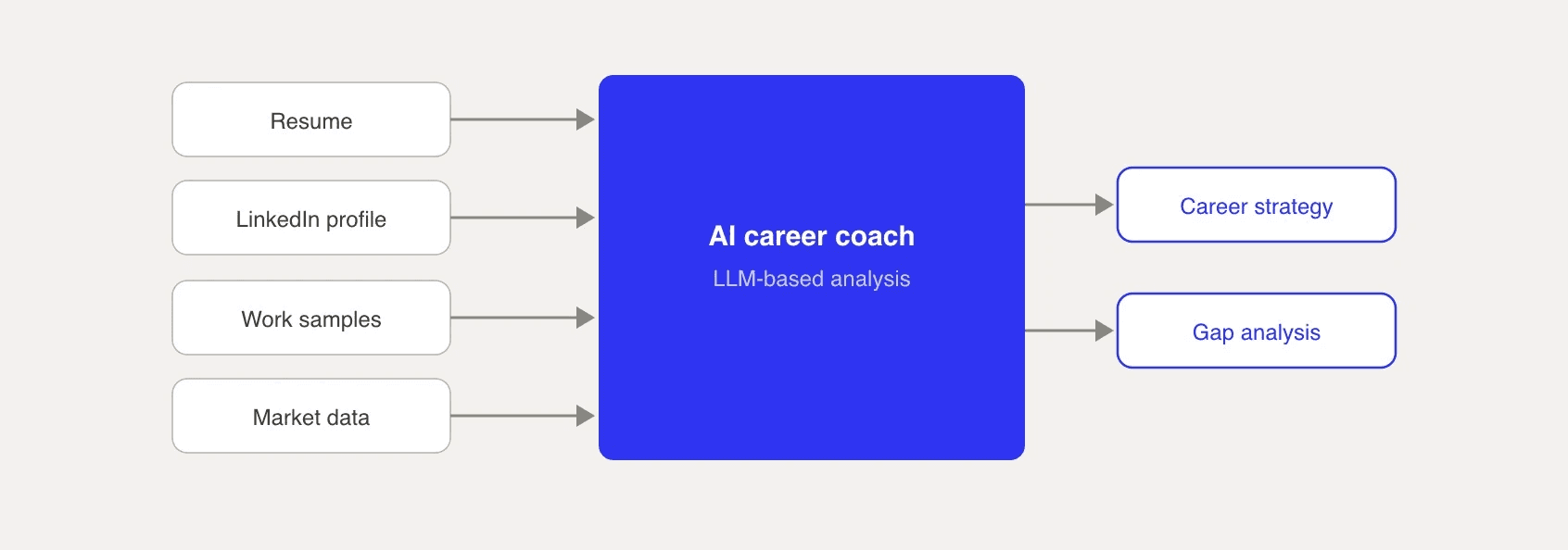
An AI career coach is typically an LLM-based system that analyzes profiles, work samples, and market data to provide structured career guidance. These tools process resumes, LinkedIn profiles, and job descriptions to deliver recommendations without the wait times or cost of working with a traditional coach.
Employers, especially AI-focused startups and large platforms, now use AI in sourcing, resume parsing, and initial screening. For many candidates, that means interacting with multiple automated systems at once. For senior AI talent specifically, these systems rarely make final decisions, but they strongly influence who is surfaced to hiring managers and which interview questions are generated.
Curated marketplaces like Fonzi use AI to structure matching and reduce noise while keeping final evaluation in human hands on both sides.
What modern AI career coaches can do
The core capabilities most platforms offer:
Resume optimization and rewriting using role-specific keywords
Portfolio and GitHub profile critique aligned with target roles
LinkedIn profile optimization for recruiter visibility
Mock interview question generation across coding, systems design, and research formats
Interview simulation with feedback on transcripts
Cover letters tailored to specific job postings
More advanced tools run skill gap analyses against job descriptions, suggest learning resources, and propose timelines for upskilling in frameworks such as PyTorch, JAX, or distributed training stacks. Some tools recommend target companies or salary bands using scraped market data, though the quality varies.
Where generic AI tools fall short for senior candidates
Generic AI coaches are trained on broad career advice and often give guidance that's too junior or too vague for staff, principal, or research-level transitions. A mid-career professional targeting a principal role at a foundation model lab needs very different advice than a new graduate.
These tools have no access to live internal hiring signals: actual headcount plans, org dynamics, and the reputation networks that experienced recruiters and coaches lean on heavily. There are real privacy risks in sharing sensitive materials like performance reviews with AI systems. Additionally, for specialized roles involving areas such as RLHF, LLM safety, or large-scale inference infrastructure, advice from an AI career coach can lag behind what the market actively requires right now.
Where AI coaches genuinely help
AI coaches are good at the repetitive, structured work senior candidates tend to put off: tailoring materials to job postings and running through interview scenarios repeatedly. The value goes up when you give the AI specific context and constraints rather than asking for generic career advice.
The average human career counselor charged $272/hour in 2023. A 2021 Harris Poll found only 12% of working adults were using one, even though nearly two-thirds said professional guidance would be helpful. AI tools close that gap.
Resume and portfolio feedback
An AI coach can generate multiple resume variants from a single work history, each angled differently for applied research, infrastructure, MLOps, or product engineering. You can paste your LinkedIn profile or GitHub README and ask for critique against a specific target role. A prompt like "critique this for a staff ML engineer working on recommendation systems" gets you something far more actionable than a generic request. From there, iterate, compare versions, and apply your own judgment on tone and accuracy before sending anything out.
Interview preparation
AI interview partners can produce realistic question sets across coding, system design, data pipelines, and research deep dives using actual job descriptions as context. Senior candidates can make conditions harder: constrain the time, tell the AI to play a skeptical staff engineer, or ask it to focus on follow-up questions about tradeoffs and edge cases.
Feeding transcripts back into the AI gets you feedback on organization, clarity, and whether you're over-indexing on implementation details instead of strategic framing. The goal isn't to memorize AI-generated answers. It's to improve how you explain your work and structure your thinking.
Market mapping and skill gaps
By scanning public job descriptions, AI tools can surface patterns in what roles like "ML platform lead" or "LLM infra engineer" actually require right now. You can ask an AI coach to map your current stack against market requirements and propose a learning sequence, which is especially useful if you're considering a shift, say from bespoke infrastructure to Kubernetes and Ray.
Treat salary estimates and leveling advice as rough baselines. For accurate compensation expectations in a specific geography and domain, you still need peers, mentors, or active recruiters.
Where human coaches and recruiters are still irreplaceable
The more senior and ambiguous the decision, the more you need people who understand context, incentives, and informal power structures. For senior ICs and AI leaders, the hard problems aren't resume formatting. They're choosing between competing offers, evaluating leadership quality, and figuring out whether a role actually maps to where you want your career to go.
Reading signals and team quality
Experienced coaches and recruiters pick up on things current AI systems can't: what frequent rescheduling actually signals, why the interviewers in your loop were mismatched, and what a two-week pause in communication usually means at a company of that size. Evaluating the quality of a research group or infrastructure team requires human conversations, backchannel references, and awareness of recent reorgs.
Offer negotiation
Salary negotiation isn't only about numbers. It's about timing, narrative, and how you manage the relationship with the hiring team through the process. Human advisors are better at calibrating when to push and when to hold. They can also help you think through equity, refresh schedules, and the risk profile of early-stage AI startups in a way that's specific to your situation.
Career inflection points
Moving from research to product, from hands-on engineering to management, or from big tech to a seed-stage lab involves identity questions that generic AI advice doesn't handle well. A human coach can challenge your assumptions, surface paths you hadn't considered, and factor in things that are hard to specify in a prompt: visa constraints, burnout, and personal priorities. AI should support that reflection, not replace it.
A practical workflow
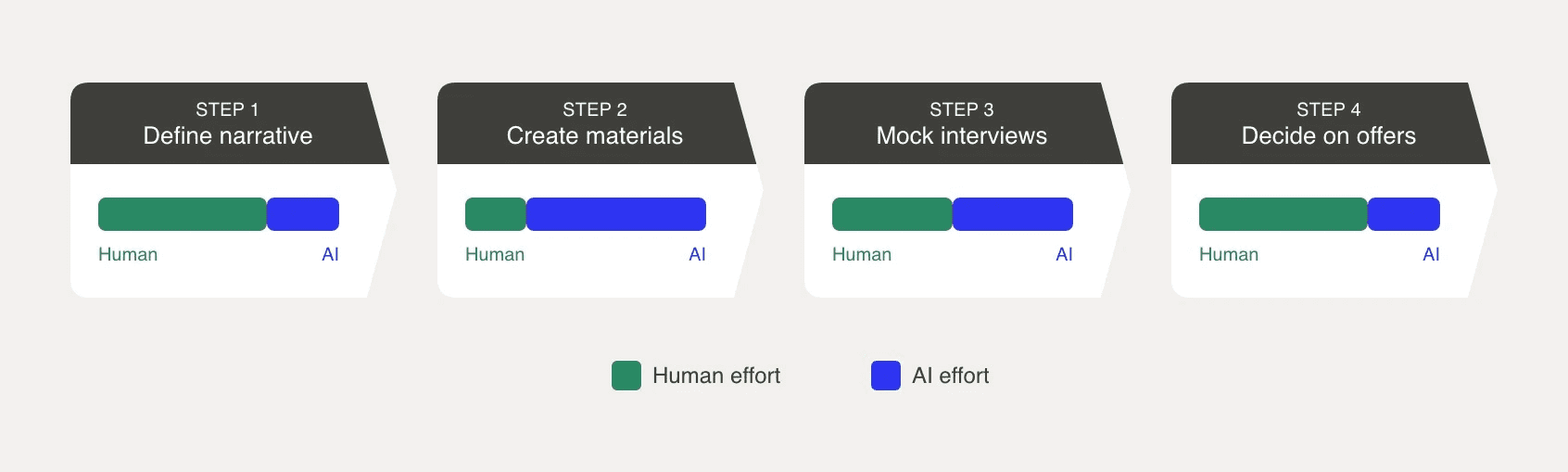
Step 1: Nail your constraints and narrative before touching any tool
Write down explicit goals: role type, geography, compensation floor, on-site expectations, research vs. product balance. Use AI to draft different career narratives connecting your past work to target roles, then validate the final version with a peer or mentor who's active in the same technical space.
Step 2: Use AI to generate materials and outreach at scale
Once the narrative is set, use AI to produce tailored resumes, role-specific summaries, and short outreach messages. Keep one source-of-truth document for your experience and let AI generate per-role variants rather than maintaining multiple documents manually. Platforms like Fonzi can reduce the volume of outbound work by surfacing relevant opportunities and standardizing profile fields.
Step 3: Mix AI and human practice for interviews
Schedule regular AI-driven mock interviews, one dimension at a time: coding, infrastructure design, model architecture, research presentations. Log questions and weak spots. Then include periodic live sessions with peers or a human coach to calibrate realism and get feedback on how you actually come across under pressure. Use AI to summarize what you learned from each human session and turn it into targeted drills.
Step 4: Use humans for offer decisions, AI for the math
Offer evaluation should start with human conversations about team quality, roadmap credibility, and your own priorities. Once you have numbers, feed sanitized parameters into an AI to model scenarios around equity value and risk across multiple offers. Write a short rationale for each major decision, review it with a human advisor, then sign.
When to use which
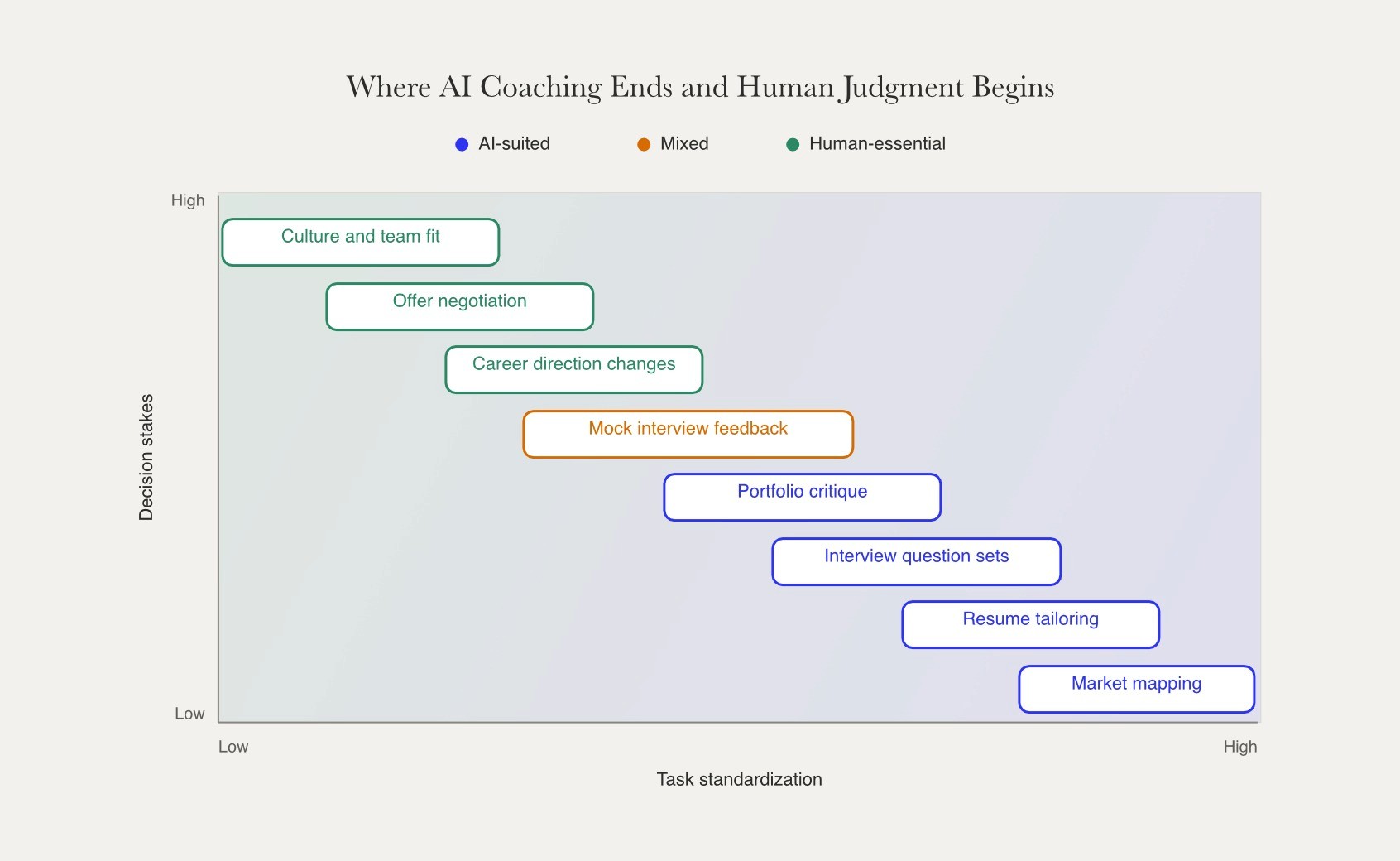
Task | AI | Humans |
Resume tailoring | High-volume variants, keyword optimization | Final tone and accuracy |
Portfolio critique | Initial feedback, formatting | Authenticity, strategic positioning |
Market mapping | Aggregating postings, spotting skill patterns | Reading company culture and team quality |
Interview question generation | Comprehensive question sets | Realistic pressure and ambiguity |
Mock interview feedback | Transcript analysis, pattern identification | Nuanced behavioral feedback |
Culture and team assessment | Limited | Essential |
Offer negotiation | Scenario modeling, data synthesis | Strategy, timing, relationship management |
Career direction changes | Exploring options, initial research | Identity-level decisions, personal constraints |
Can AI career coaches replace the real thing for AI engineers?
For senior AI engineers and researchers, AI coaches are powerful accelerators, but they're not substitutes for the right relationships or judgment in decisions that actually matter. The more standardized the task (keyword optimization, standard behavioral answers), the more AI can handle it end-to-end. The more strategic the task, the more human input matters.
Candidates who combine AI tools with strong human networks generally outperform those who rely on either alone. Curated matching environments, like structured marketplaces or research-focused communities, often function as a human layer on top of AI infrastructure, keeping nuance in the process while using automation for scale.
AI career coaching works best when you stay in control of your decisions, treat the AI as an analyst or editor, and reserve final judgment for yourself. The most effective mix delivers speed and judgment, and the two aren't in conflict if you're clear about which tool you're reaching for.
AI career coaches have become a standard part of the toolkit for senior AI professionals, especially for interview prep and refining resumes or portfolios. They make capabilities that once required expensive one-on-one coaching far more accessible. That said, they're best viewed as accelerators, not replacements, for the human judgment needed to make the decisions that actually shape your career.
The most effective approach pairs AI tools with input from mentors, peers, and experienced recruiters. Before your next job search or interview cycle, set up a simple workflow that blends both: AI for speed and structure, trusted people for context and nuance. Platforms like Fonzi complement this model by pairing AI-assisted matching with direct access to hiring teams, helping candidates turn preparation into real opportunities.
Fonzi and AI-Powered Career Growth
AI career coaches help candidates prepare for opportunities, but finding the right opportunities is a separate challenge. Fonzi combines AI-assisted matching with a curated network of engineering, AI, and ML employers, helping candidates discover roles that align with their experience, skills, and career goals.
Through Match Day, engineers can connect directly with companies actively hiring technical talent, creating a more efficient path from career preparation to real interviews. By pairing AI-driven recommendations with human review and recruiter engagement, Fonzi helps senior engineers spend less time navigating job boards and more time exploring relevant opportunities.
Summary
AI career coaches help senior engineers improve resumes, portfolios, LinkedIn profiles, interview preparation, and job search strategy by automating structured tasks and providing personalized feedback. They are particularly effective for resume tailoring, mock interviews, skill-gap analysis, and market research, making career support more accessible and scalable than traditional coaching alone.
However, AI tools work best as complements to human guidance, not replacements. Experienced mentors, recruiters, and coaches remain essential for evaluating team quality, negotiating offers, navigating career transitions, and making high-stakes decisions that require context and judgment. Senior engineers typically achieve the strongest outcomes by combining AI for efficiency and preparation with human expertise for strategy, networking, and long-term career planning.
FAQ
What is an AI career coach, and how does it differ from a human career coach?
What are the best AI-powered career coaching tools available?
What prompts should I use with an AI career coach to get the most useful advice?
Can an AI career coach actually help me land a job or negotiate a salary?
When should I use an AI career coach vs paying for a human one?


