How to Prepare for an Embedded Systems Engineer Interview
By
Liz Fujiwara
•

Embedded system interviews now sit at the intersection of firmware development, embedded Linux, and AI-enabled tooling. For senior practitioners transitioning from AI, ML, or infrastructure roles, preparation requires shifting from high-level abstractions to low-level constraints like flash limits, interrupt latency, and power consumption. This article focuses on preparing for embedded systems engineer interviews by aligning with how companies like Qualcomm, Texas Instruments, and Bosch design, test, and ship production embedded software using modern workflows such as Yocto builds, CI/CD pipelines, and over-the-air updates.
Key Takeaways
Most embedded interviews still focus on Embedded C, bit manipulation, data structures, and computer architecture, while also testing systems thinking across firmware, embedded Linux, and connected systems.
Effective preparation is structured around communication protocols, memory management, RTOS scheduling, and debugging, rather than generic coding interview practice.
Companies increasingly rely on standardized rubrics and AI-assisted screening, so clear evidence from real projects matters, and strong fundamentals in C, hardware-software integration, and whiteboard-style problem solving remain essential.
Core Technical Foundations for Embedded System Interviews
Nearly every embedded software interview in 2026 evaluates low-level C programming, memory management, and hardware interaction, even for candidates coming from AI or backend roles.
Embedded C and C Programming
C is the most commonly used programming language in embedded systems, with C++ gaining popularity. Embedded software development often requires knowledge of lower-level programming languages such as assembly language, especially for performance-critical applications. To prepare effectively for embedded systems interviews, focus on high-priority topics such as C programming mastery, hardware fundamentals, and communication interfaces, which are tested in over 95% of interviews.
Key areas to master include:
Pointer arithmetic for efficient buffer traversal and direct memory access
The volatile keyword, which indicates that a variable’s value may change unexpectedly due to hardware or interrupts, preventing compiler optimizations
Proper use of const for read-only lookup tables to prevent accidental overwrites
Function pointers for pluggable interrupt service routines
Common patterns like infinite loops with low-power wait instructions
Data Structures for Firmware
Interviewers rarely focus on exotic structures for firmware roles. The data structures that matter for embedded development include:
Circular buffers for UART receive queues handling high baud rates without dynamic allocation
Ring buffers with head and tail pointers for DMA transfers
Singly-linked lists for task queues in bare-metal schedulers
Lookup tables for PID control gains and calibration data
Static arrays sized to fit within 32KB SRAM constraints
Common interview questions for embedded systems often include topics such as packed and aligned data structures, endianness, toolchains, and bitwise operations.
Bit Manipulation and Register Access
Masking, shifting, and packed flags form the foundation of embedded systems programming. You should be able to extract specific bits from a register, implement flag checks, and handle endianness swaps. A typical question might ask you to extract bits 12–15 from a 32-bit unsigned int register using a right shift and mask operation.
Dynamic Memory Allocation Strategy
Dynamic memory allocation is debated in embedded contexts. Malloc and free are sometimes used in embedded Linux with sufficient RAM but are typically avoided in ISRs due to latency and fragmentation risks. Static allocation with custom allocators is often preferred for predictable performance. Safety-critical standards like ISO 26262 may restrict heap usage in high-integrity systems.
Computer Architecture Expectations
Core hardware concepts are a high priority in embedded systems interviews. You should understand:
Cache behavior differences between Harvard and von Neumann architectures
Pipeline depths on Cortex-M versus application processors
MMU basics for Linux virtual memory mapping peripherals
Interrupt controllers like NVIC on Arm with multiple vector priorities
Memory-mapped I/O at fixed addresses for peripheral registers
Microcontrollers (MCUs) integrate CPU, memory, and peripherals on a single chip, while microprocessors (MPUs) contain only the CPU and require external components
Hardware knowledge is essential for embedded systems development because it directly impacts system design and performance.
Comparing Embedded System vs Generic Software Interview Focus
The following table highlights the mindset shift required when preparing for embedded interviews versus general software or AI interviews.
Topic Area | General Software / AI Focus | Embedded System Interview Focus | What To Prepare |
Programming Language | Python, Java, high-level APIs, OOP patterns | Embedded C, volatile and const qualifiers, no exceptions | Whiteboard ISR with pointer casts, explain undefined behavior |
Data Structures | Hashmaps, BSTs, graph algorithms | Circular buffers, bitfields, static arrays | Implement ring buffer overflow handling for SPI DMA |
Performance | Big-O analysis, profiling with perf tools | Cycle-accurate timing, ISR latency under 5 microseconds | Optimize loops for Cortex-M4 FPU, measure with hardware timers |
System Design | Microservices, Kafka scaling, cloud architecture | Bare-metal to Linux stack, power budget constraints | Design sensor node with RTOS tasks, I2C polling vs DMA |
Debugging | Logs, GDB on x86, unit tests | JTAG, OpenOCD, logic analyzers, oscilloscopes | Walk through UART glitch from oscilloscope capture |
Operating Systems | Linux user-space, containers, orchestration | RTOS like FreeRTOS, embedded Linux with Yocto | Explain semaphores vs mutexes, write kernel module |
Testing | pytest, CI/CD Jenkins pipelines | Static analysis with Cppcheck, hardware-in-loop testing | Unity framework tests for flash wear-leveling, 95% coverage |
Systems-Level Skills: RTOS, Embedded Linux, and Communication Protocols
Senior embedded engineer interviews in 2026 often go beyond bare-metal coding to assess full-system thinking, including scheduling, networking, and runtime behavior in connected systems. Knowledge of communication interfaces and protocols is central, since they define how hardware components interact in complex embedded designs.
Real-Time Systems, RTOS, and Scheduling
Familiarity with real-time operating systems like FreeRTOS and VxWorks is important for embedded systems programming, with common focus areas including:
Fixed-priority preemptive scheduling using Rate Monotonic Scheduling
Interrupt handling with tail-chaining to reduce latency
Priority inversion and mitigation using priority inheritance
In RTOS design, a task runs in its own context and is managed by the scheduler. A mutex provides mutual exclusion, while a semaphore supports synchronization. A watchdog timer resets the system if software fails to respond. Task states (ready, running, blocked, terminated) and power-aware sleep modes are also commonly tested.
Embedded Linux and Operating System Concepts
For roles involving embedded Linux, prepare to discuss:
Process versus thread models with fork, exec, and clone system calls
Virtual memory management and mmap for peripheral access
Device drivers as kernel modules exposing file system interfaces
Epoll for non-blocking I/O on gateway nodes handling many connections
Shell-level debugging with dmesg, strace, and perf on Yocto-based builds
Communication Interfaces and Protocols
Interviewers test both conceptual understanding and practical debugging of protocols. I2C uses two wires and supports multiple master and slave devices, while SPI uses four wires, is faster, and operates in full-duplex mode. Be prepared to discuss:
UART configuration including baud rates, parity, and error handling
SPI master mode timing, chip select behavior, and clock polarity
CAN bus arbitration, ISO-TP segmentation, and error frames
BLE connection intervals and GATT service design
Real time constraints on protocol timing and deadline management
Sketching timing diagrams and explaining atomic operations during protocol transactions are common in tech interviews.
Interview Mechanics: Coding Interview, Debugging, and Hardware-Aware Problem Solving
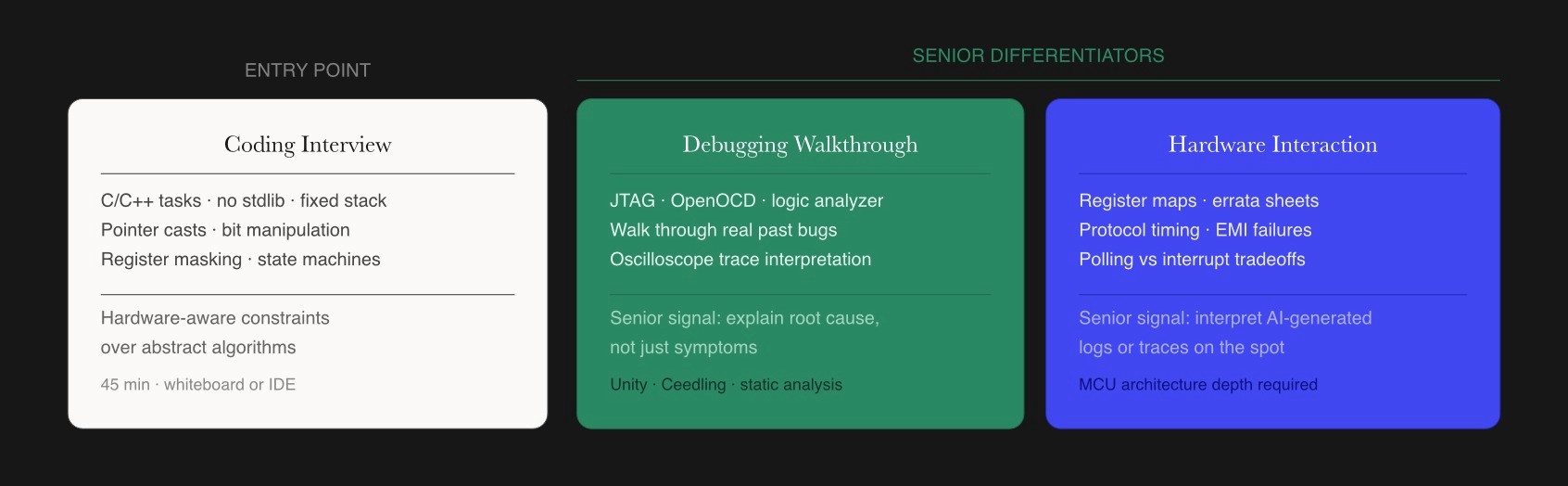
Embedded software interviews mix traditional coding interview formats with hardware-centric reasoning, such as tracing signal paths, diagnosing deadlocks tied to interrupt-driven code, or interpreting real hardware registers.
Embedded Coding Interview Patterns
Coding questions in embedded systems interviews often focus on packed and aligned data structures, endianness, toolchains, and bitwise operations, with tasks typically written in C or C++. Expect constraints like no standard library usage and fixed stack sizes. While generic coding platforms can help refresh basic C syntax, targeted embedded system interview prep should prioritize hardware-aware problems, register masking, and real-time firmware constraints over abstract algorithmic puzzles. Problem solving skills matter, but within embedded constraints.
Common patterns include:
Parsing protocol frames into structures without memcpy
Rate-limiting queue operations to specific frequencies
Implementing state machines for device control
Handling null pointer checks in resource-constrained contexts
Debugging and Testing Embedded Software
Effective debugging in embedded systems can involve tools such as JTAG, UART console, logic analyzers, and oscilloscopes to address issues like deadlocks or peripheral communication failures. Interviewers ask candidates to walk through real bugs from past projects, focusing on:
GDB usage with arm-none-eabi-gdb and OpenOCD for SWD flashing
Unit testing frameworks like Unity and Ceedling
Test driven development practices for firmware validation
Code quality metrics and static analysis compliance
Hardware Interaction and Protocol Debugging
Understanding hardware registers, errata sheets, and signal integrity basics is expected. Interviewers frequently ask candidates to explain technology fundamentals, which can include defining terms related to RTOS and memory types. Be ready to discuss:
Register maps from reference manuals
Microcontroller architecture specifics for your target platform
Intermittent protocol failures from EMI or timing violations
Trade offs between polling and interrupt-driven approaches
Many teams now supplement whiteboard questions with AI-generated logs or traces, expecting candidates to interpret them quickly rather than hand-simulate code line by line.
Strategic Preparation Plan for Senior Embedded Engineer Candidates
Building a Project Portfolio That Reflects Modern Embedded Development
Polish two to three recent projects involving real hardware that demonstrate your capabilities in the embedded world. Good starting point examples include:
An STM32 Nucleo IoT sensor using FreeRTOS and MQTT, with measurable power reduction through tickless idle mode
A Raspberry Pi or Arm-based edge ML deployment running TensorFlow Lite Micro for object detection
An ESP32 OTA updater demonstrating heap management and reliability metrics
Quantify outcomes with specific data points like reduced ISR jitter from 80 microseconds to 12 microseconds or achieved 99.9% uptime over six months.
Practicing Effectively: Rehearsing Problems and Narratives
Effective interview prep combines timed coding sessions with narrative preparation:
Maintain a comprehensive log of high-yield embedded system interview questions from resources like GeeksforGeeks
Time yourself at 45 minutes per problem to simulate real interview round conditions
Prepare tight narratives around debugging, memory optimization, and cross functional collaboration
Practice explaining your learning curve when adopting new specific tools or platforms
Curated marketplaces like Fonzi can reduce time spent on low-signal screening by matching embedded engineers to teams that already value their profile, while no platform replaces deep technical preparation.
Communicating Experience: Behavioral Patterns, System Design, and Human-Centered Hiring
At senior levels, success often depends on how well candidates explain decisions, trade-offs, and failure handling in complex embedded systems, not only on solving isolated coding prompts. The role of an embedded engineer typically involves designing, developing, and maintaining computer systems integrated into hardware products, requiring expertise in both software development and embedded systems.
Behavioral and Process Questions for Embedded Engineers
Behavioral interview questions are common, focusing on a candidate’s past experiences and how they approach problem-solving and collaboration in team settings. Use the STAR method to structure responses around concrete events:
Resolving intermittent I2C faults in an automotive cluster through DMA implementation
Addressing dynamic memory leaks in a medical device through slab allocators
Shipping a safe OTA update by implementing rollback mechanisms
Interviewers may also ask open-ended questions about core technologies to assess depth of understanding and adaptability to new tools and platforms.
Embedded System Design Discussions
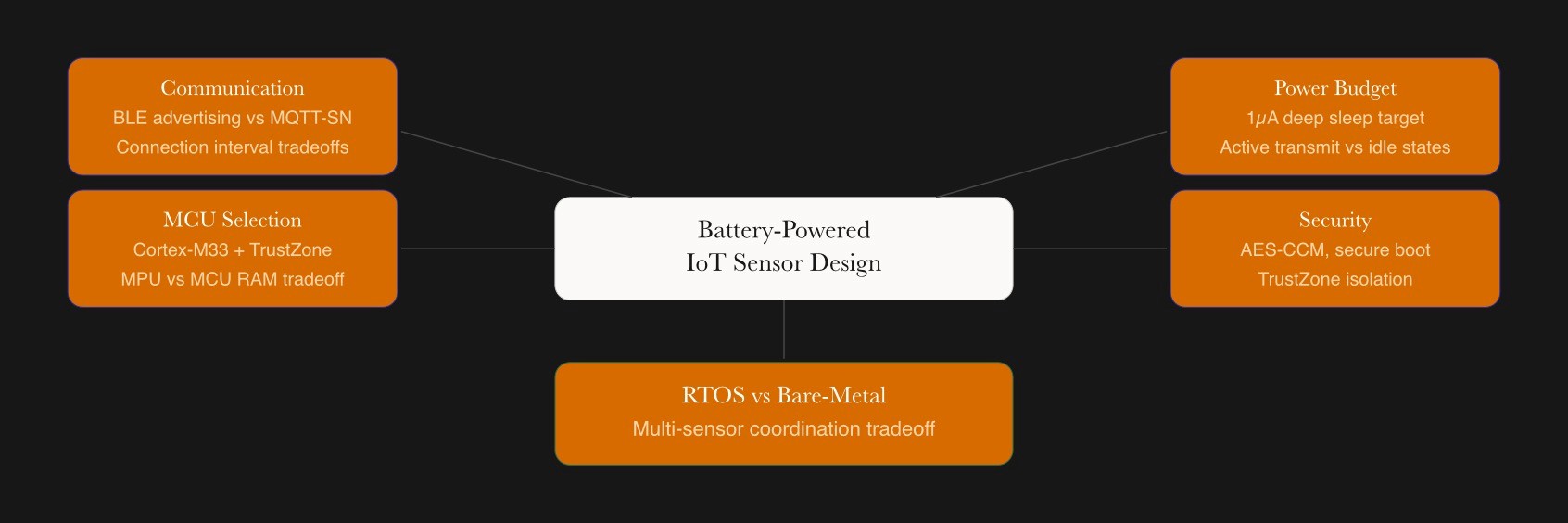
System design prompts like designing a battery-powered IoT sensor require breaking down the problem into components:
MCU selection considering Cortex-M33 with TrustZone for security
Communication protocol choices between BLE advertising intervals and MQTT-SN
Power budgeting for deep sleep modes at 1 microamp versus active transmit
RTOS versus bare-metal trade offs for multi-sensor coordination
Security considerations including AES-CCM and secure boot
AI in Hiring and the Role of Human Judgment
Companies increasingly use AI to pre-screen resumes and coding results. Clear keywords like embedded Linux, C on Cortex-M, and CAN bus diagnostics can help profiles surface in automated matching systems. However, final hiring decisions still rely on human evaluation of real-time systems thinking, problem-solving ability, and behavioral responses.
Candidates should also ask thoughtful questions about test infrastructure, release processes, and cross-team collaboration to signal seniority and understanding of embedded development workflows.
Conclusion
Systematic preparation across C programming, data structures, computer architecture, RTOS, embedded Linux, and communication protocols is the most reliable path to success in embedded systems interviews. By aligning preparation with how modern embedded teams design and ship systems, candidates turn deep technical experience into clear interview performance.
Structure a concrete four-week plan starting today and consider using curated channels such as Fonzi or trusted referrals to focus your efforts on tech companies that value strong embedded engineering rigor.
FAQ
What topics should I study to prepare for an embedded systems engineer interview?
What are the most common embedded systems interview questions?
How are embedded systems interviews different from standard software engineering interviews?
Do embedded systems interviews include coding challenges or hardware-focused problems?
What projects or experience should I highlight in an embedded systems interview?


