What Is an Embedded Systems Engineer?
By
Liz Fujiwara
•

The rise of AI at the edge has significantly elevated the role of embedded systems engineers. Embedded systems now power real-time AI workloads under tight constraints like low latency and limited power consumption. Many AI and ML practitioners now encounter embedded constraints when deploying models to edge devices and want to better understand what embedded systems engineers actually do. This article explains the role, skills, and career paths for embedded systems engineers, especially for readers coming from software, infrastructure, or ML backgrounds.
Key Takeaways
Embedded systems engineers work at the intersection of hardware, real-time systems, and low-level software, building systems for industries like automotive, robotics, aerospace, medical devices, and consumer electronics.
Their core technical stack includes C and C++, RTOS fundamentals, bare metal development, embedded Linux, interfaces like SPI and I2C, and hardware-level debugging with tools such as oscilloscopes and logic analyzers.
Unlike embedded software engineers who focus mainly on firmware, embedded systems engineers often own system architecture, hardware integration, component selection, and collaboration across electrical, firmware, and software teams.
What Does an Embedded Systems Engineer Do?
An embedded systems engineer designs, develops, and manages computing systems tightly integrated with physical hardware. These systems typically run on microcontrollers or Systems-on-Chip with strict real-time and resource constraints, often operating under 100mW idle power and 128KB RAM limits. Embedded systems engineers are responsible for ensuring that hardware and software components work together effectively.
Day-to-day work involves writing C for ARM Cortex-M microcontrollers, configuring real-time operating systems, bringing up new PCB revisions through bootloaders, and debugging issues using JTAG debuggers, oscilloscopes, and logic analyzers. System architecture design includes creating embedded systems architectures that integrate hardware and software while translating product requirements into system-level constraints and interfaces.
Embedded systems come in various types, including standalone, networked, mobile, and real-time systems:
Standalone embedded systems operate independently and do not require a host computer. Examples include digital cameras and washing machines.
Networked embedded systems communicate with web servers through wired or wireless networks. Examples include ATMs and home security systems.
Mobile embedded systems are portable devices such as smartphones and tablets that can function independently.
Real-time embedded systems prioritize immediate results and are critical in applications where time-sensitive execution is essential, such as self-driving vehicles and medical devices.
Real-world examples from 2026 include automotive ECUs in EVs managing battery BMS with CAN bus at 1ms cycles, industrial robots like Universal Robots UR5e using RTLinux for 500Hz control loops, medical monitoring devices such as Abbott FreeStyle Libre CGM with Cortex-M33 for sub-5s glucose reads, smart meters processing Zigbee data with 10-year battery life requirements, and wearables like Fitbit Charge 6 running always-on heart rate monitoring.
Embedded systems engineers collaborate with electrical engineers on schematic reviews, firmware engineers on HAL abstractions, and application software teams on APIs. They also ensure systems meet strict safety standards for critical devices, including medical and automotive electronics, with certifications such as IEC 61508, ISO 26262, and IEC 62304. Responsibilities span the full lifecycle from early hardware and software design to testing, certification, and field debugging of deployed devices.
Embedded Systems Engineer vs Embedded Software Engineer vs Other Embedded Roles
Terminology in embedded engineering is notoriously inconsistent. Job titles like embedded engineer, embedded systems engineer, and embedded software engineer are used interchangeably across companies, creating confusion for candidates evaluating roles. In practice, the distinctions matter significantly for understanding scope and career trajectory.
Role | Primary Focus | Typical Responsibilities | OS/Environment | Hardware Depth |
Embedded Systems Engineer | System architecture and integration | Component selection, board bring-up, full lifecycle ownership | Bare-metal, RTOS, embedded Linux | High: schematics, datasheets, power and thermal analysis |
Embedded Software Engineer | Application and firmware coding | Device drivers, algorithm implementation, optimization | RTOS (FreeRTOS), Linux userspace | Medium: peripherals, some debugging |
Firmware Engineer | Low-level boot and HAL | Bootloaders, HAL, interrupts, DMA | Bare-metal, lightweight RTOS | High: MCU internals, clock configuration |
In smaller startups, including many AI and robotics teams like Covariant or Figure AI, these distinctions blur significantly. A single embedded engineer might own everything from Jetson Orin bring-up to ROS2 nodes, handling board-level hardware integration alongside higher-level application software.
The key distinction is that a systems engineer owns architecture tradeoffs, such as choosing between MPU versus MCU based on RAM requirements, hardware integration including NPU clock gating for AI workloads, and power, thermal, and reliability concerns like FMECA analysis for failure modes. An embedded software engineer focuses primarily on writing portable code atop stable HALs, with less direct involvement in hardware selection or system-level constraints.
Core Technical Skills for Embedded Systems Engineers
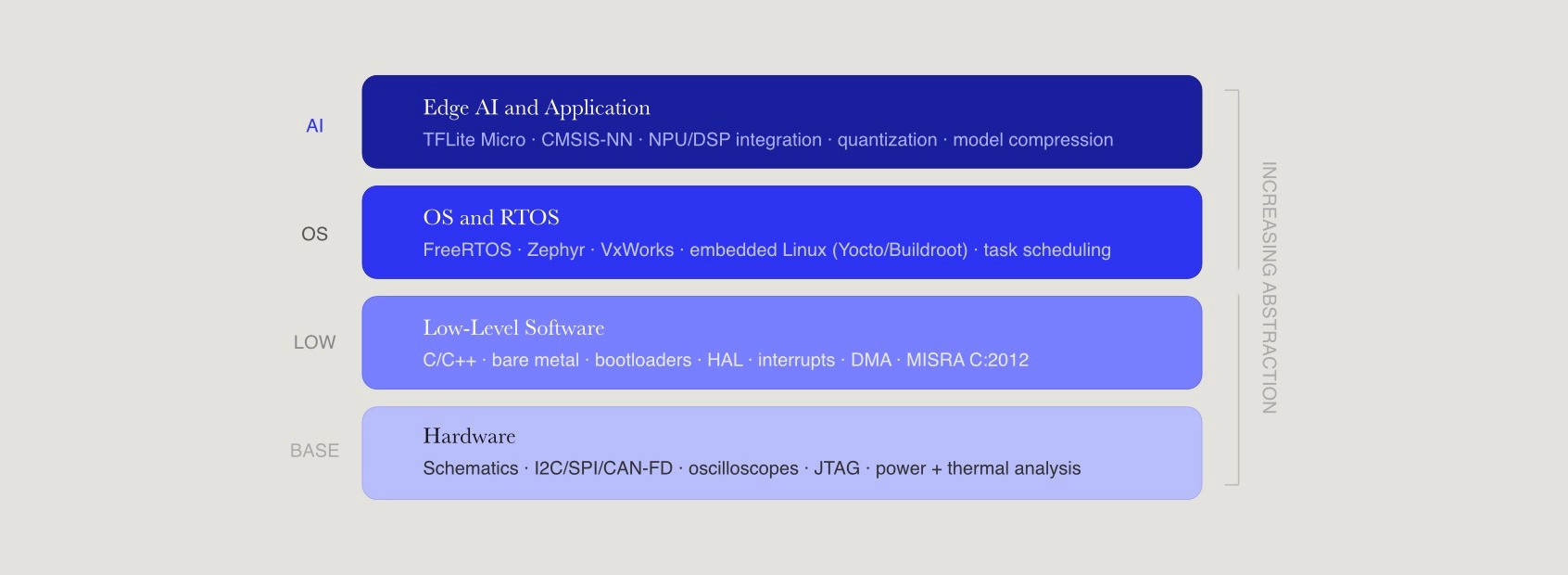
Embedded systems engineering combines elements of computer architecture, operating systems, networking stack knowledge, and control theory. The exact stack depends on whether the target is MCU-based, Linux-based, or a hybrid platform combining both.
Programming and software skills:
Strong command of C and C++ is essential, with 90% of embedded job postings requiring these programming languages. Familiarity with MISRA C:2012 or similar safety-related guidelines is important for automotive and medical work.
Python and Rust serve as useful tools for scripting, testing, and selected embedded platforms. Rust adoption in Zephyr reached 20% by 2025.
Experience with version control systems, such as Git, is essential for software management in embedded systems engineering.
Operating systems knowledge:
Bare metal development for startup code, vector tables, and minimal runtime environments.
Experience with real-time operating systems (RTOS) such as FreeRTOS and VxWorks is valued in embedded systems engineering. FreeRTOS appears in 40% of MCU projects, with Zephyr at 15%.
Embedded Linux distributions such as Yocto or Buildroot are widely used for deploying custom operating environments on higher-end SoCs.
Hardware-related skills:
Reading schematics in tools like KiCad or Eagle and understanding microcontroller datasheets.
Working with buses including I2C (400kHz), SPI (quad at 80MHz), CAN-FD (5Mbps), and UART with DMA.
Handling low-level topics like interrupts, DMA transfers, and power management including sleep states.
Tooling and debugging:
Cross-compilers (GCC/Clang arm-none-eabi), debuggers like GDB with OpenOCD, and remote debug configurations.
Debugging tools used in embedded systems include oscilloscopes, logic analyzers, and JTAG debuggers. Testing and validation use emulators, debuggers, and hardware tools to ensure system performance and reliability.
Continuous integration platforms that run hardware-in-the-loop tests using QEMU or FVP models.
System-level performance:
Analyzing interrupt latency (targeting under 5us), minimizing flash and RAM usage (under 50% utilization), and profiling CPU utilization under real workloads.
Edge AI skills for ML practitioners:
Quantization (post-training to 4-bit), model compression (pruning 70% of weights), integration with specialized NPUs or DSPs like ARM Ethos-U on Cortex-M55 delivering 4 TOPS/W, and dealing with strict power budgets on battery-operated devices.
Essential skills for embedded systems engineers include programming in C and C++, experience with RTOS environments, and strong debugging capabilities across both hardware and software domains.
Education, Background, and Pathways into Embedded Systems Engineering
The standard qualification for embedded systems engineers is a bachelor’s degree in computer engineering, computer science, embedded systems, or a related discipline such as electrical engineering. Many professionals in embedded systems hold a bachelor’s degree, while others pursue advanced education at the master’s level.
A modern embedded curriculum typically blends courses in microcontrollers, digital design, operating systems, real-time systems, and networks, along with lab-based project work using platforms like STM32Cube and Verilog on FPGAs.
Self-directed learning paths:
Working through open-source firmware for platforms such as Arduino, ESP32, or STM32 using the RP2040 SDK or Zephyr samples.
Building personal projects like custom sensor nodes (BME280 over I2C), RTOS-based robots with micro-ROS, or drone flight controllers.
Contributing device drivers or board support packages to RTOS projects like Zephyr or FreeRTOS.
Many embedded systems engineering roles expect candidates to demonstrate concrete project experience such as PCB bring-up, bootloader implementation, or RTOS-based applications. Portfolios with Git repositories, PCB Gerber files, and demonstration videos carry significant weight with hiring teams.
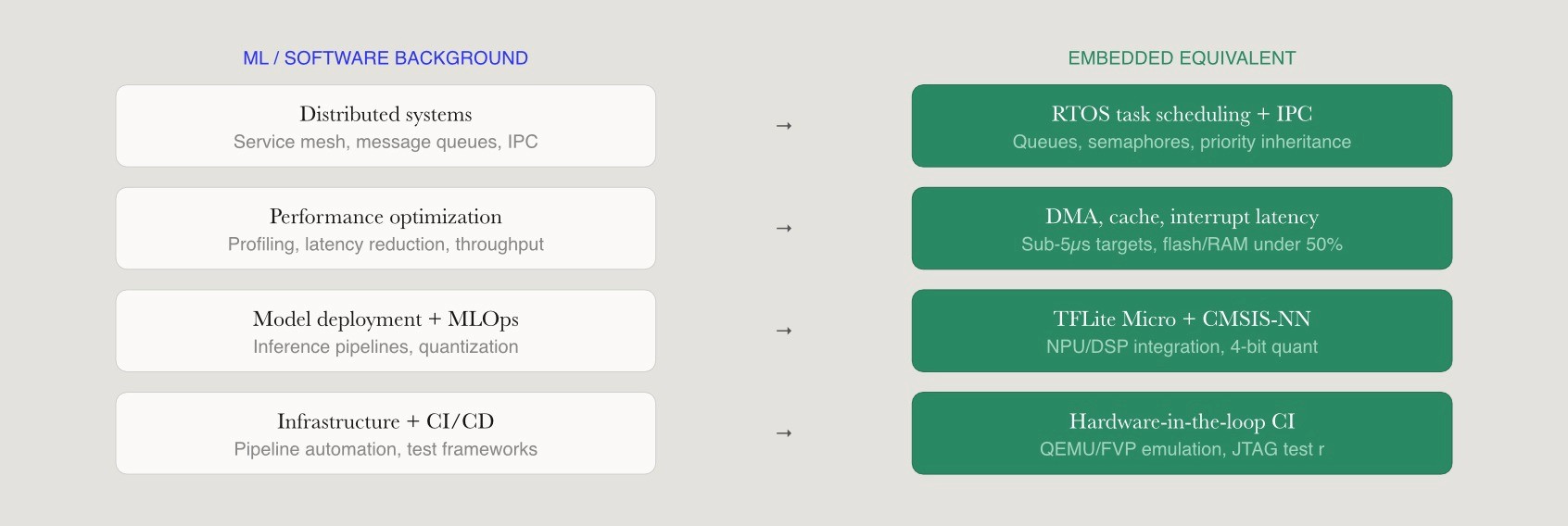
For senior software, infra, or ML engineers transitioning:
Map distributed systems knowledge to RTOS IPC and task scheduling.
Apply performance optimization skills to cache management, DMA configuration, and interrupt latency reduction.
Leverage model deployment experience with TFLite Micro and CMSIS-NN for edge AI work.
Start with accessible platforms like Jetson Nano edge AI kits to bridge ML and embedded domains.
Soft skills such as written and verbal communication, problem-solving, and teamwork are also important, since embedded engineers frequently collaborate with cross-functional teams.
Curated hiring platforms and match-based marketplaces, such as Fonzi in the AI startup ecosystem, can surface embedded-adjacent roles like robotics infrastructure or edge AI engineer positions that align with both systems and ML expertise.
Working Environments, Industries, and Demand for Embedded Systems Engineers
The embedded systems market continues to grow alongside increasing demand for connected devices, AI at the edge, industrial automation, and smart consumer hardware. Demand for embedded engineers remains strong across industries including IoT, healthcare, automotive, robotics, and consumer electronics.
Major industries:
Automotive: ADAS and EV battery management systems.
Industrial automation: PLCs and robotics systems.
Consumer electronics: smart speakers, wearables, and everyday connected devices.
Medical devices: pacemakers, insulin pumps, and CGM systems under strict regulatory standards.
Aerospace and defense: aircraft control systems and drones.
Startup versus enterprise dynamics differ significantly. Startups often expect broader ownership spanning embedded systems design through cloud integration, while larger firms typically divide responsibilities between firmware, systems, and application software teams.
Modern team structures increasingly pair embedded engineers with ML engineers, DevOps or infrastructure engineers, and product managers to deliver full edge-to-cloud solutions through cross-functional systems integration teams.
Strong hiring demand exists in regions with concentrated hardware and automotive ecosystems, including the U.S. West Coast, Texas, Germany, Japan, and India.
Compensation for embedded systems engineers varies by industry, specialization, and region, with automotive and AI-focused roles often commanding higher salaries and equity packages.
Platforms using structured matching and AI-assisted screening, including modern talent marketplaces like Fonzi, are increasingly used by hardware-focused startups to identify embedded systems engineers with specialized domain and toolchain expertise.
How to Build and Demonstrate Embedded Systems Expertise
For embedded roles, concrete projects and reproducible artifacts carry significant weight because they demonstrate the ability to ship reliable systems under constraints. Hiring managers look for evidence that candidates can solve complex technical problems involving both software and hardware.
Portfolio recommendations:
Build at least two or three end-to-end embedded projects, such as a sensor-based IoT node (ESP32 with FreeRTOS and MQTT achieving 10uW sleep), a small real-time control application (STM32 PID motor control with 2ms loop), or a robotics platform (Raspberry Pi with ROS2 navigation).
Include hardware schematics (KiCad), firmware code (GitHub with CI), and comprehensive documentation.
Add measurements and benchmarks like latency histograms, power consumption (150mA peak), uptime under stress tests (99.9%), or memory footprint analysis using size-info tools.
Contribute board support packages, device drivers, or RTOS features to projects like Zephyr or FreeRTOS. These contributions are straightforward for hiring managers to evaluate and demonstrate practical embedded programming skills.
Interview preparation for embedded systems engineer jobs:
Review C and C++ fundamentals including volatile keywords, atomics, and memory models.
Prepare to discuss real-time scheduling (rate monotonic analysis, priority inheritance).
Be ready to debug code on a whiteboard and explain past hardware integration issues like EMI fixes or race condition resolution.
Practice explaining system-level tradeoffs in previous projects.
For AI and ML professionals, combining an embedded-focused portfolio with existing experience in models, inference pipelines, and MLOps can open opportunities in edge AI. Companies actively recruit for these hybrid roles through curated platforms such as Fonzi, where combinations of systems and ML expertise are especially valuable.
Conclusion
Embedded systems engineers are central to turning advanced algorithms and connectivity into reliable physical products, especially in safety-critical and mission-critical domains like automotive, aerospace, and medical devices. For senior AI, ML, and infrastructure practitioners, understanding embedded systems engineering opens opportunities in edge computing, robotics, and intelligent devices that are expected to expand through the 2030s.
Choose a concrete next step: start a hands-on embedded project with STM32 or ESP32, contribute to an open-source RTOS like Zephyr, or explore curated marketplaces and specialized job boards focused on embedded and AI hardware roles.
FAQ
What do embedded systems engineers do day to day?
How is an embedded systems engineer different from an embedded software engineer?
What is the average salary for an embedded systems engineer?
What skills and education do I need to become an embedded systems engineer?
Where are the best places to find embedded systems engineer jobs?


