What Is a 9/80 Work Schedule?

By

Ethan Fahey

Dec 8, 2025

Illustration of a person pointing to a calendar with sticky notes labeled "5 DAY WEEK" and "4 DAY WEEK"—representing the comparison between traditional schedules and alternative formats like the 9/80 work schedule.

The modern workforce expects flexibility, and forward-thinking employers are meeting that demand with scheduling options that help them stay competitive, especially in tech, where attracting and retaining strong talent is tougher than ever. One approach gaining real traction is the 9/80 work schedule, a compressed setup that gives employees more time off without reducing total working hours. It’s an appealing balance of productivity and work-life benefits, making it a valuable tool for companies aiming to strengthen retention and stand out to candidates.

For recruiters and AI engineers shaping hiring strategies, understanding schedules like 9/80 is becoming part of building a compelling employer brand. And while AI can streamline everything from schedule management to workforce planning, platforms like Fonzi AI add another layer of value by connecting companies with top AI engineering talent, professionals who expect modern, flexible work environments. Leveraging both flexible scheduling and smarter talent-matching tools positions organizations to compete more effectively in today’s fast-moving talent market.

Key Takeaways

  • The 9/80 work schedule is a compressed work arrangement that gives employees every other Friday off without reducing total hours worked

  • This flexible schedule has become a powerful tool for attracting and retaining top talent in competitive industries, particularly tech

  • Employers benefit from improved recruitment outcomes and employee satisfaction while maintaining full productivity

  • The 9/80 arrangement creates a win-win scenario—employees gain better work-life balance, and employers gain a competitive edge in hiring

Understanding the 9/80 Work Schedule

A 9 80 schedule allows employees to work 80 hours over nine days instead of the traditional ten days across a two-week period. This compressed schedule consists of eight nine-hour days plus one eight-hour day that is strategically split between two workweeks to maintain compliance with labor regulations.

The structure enables employees to earn one extra day off every two weeks, providing 26 additional three-day weekends throughout the year. This represents a significant improvement in work-life balance compared to traditional nine-to-five schedules, while maintaining the same total hours worked over the pay period.

The 9/80 work schedule differs meaningfully from other compressed work schedules like the 4/10 arrangement, where employees work four ten-hour days. While both provide extended time off, the nine-hour workday format reduces potential fatigue compared to the more intensive ten-hour daily commitment required by alternative schedule options.

Here’s how the basic structure works:

Week

Monday

Tuesday

Wednesday

Thursday

Friday

Week 1

9 hours

9 hours

9 hours

9 hours

8 hours (split 4+4)

Week 2

9 hours

9 hours

9 hours

9 hours

Day Off

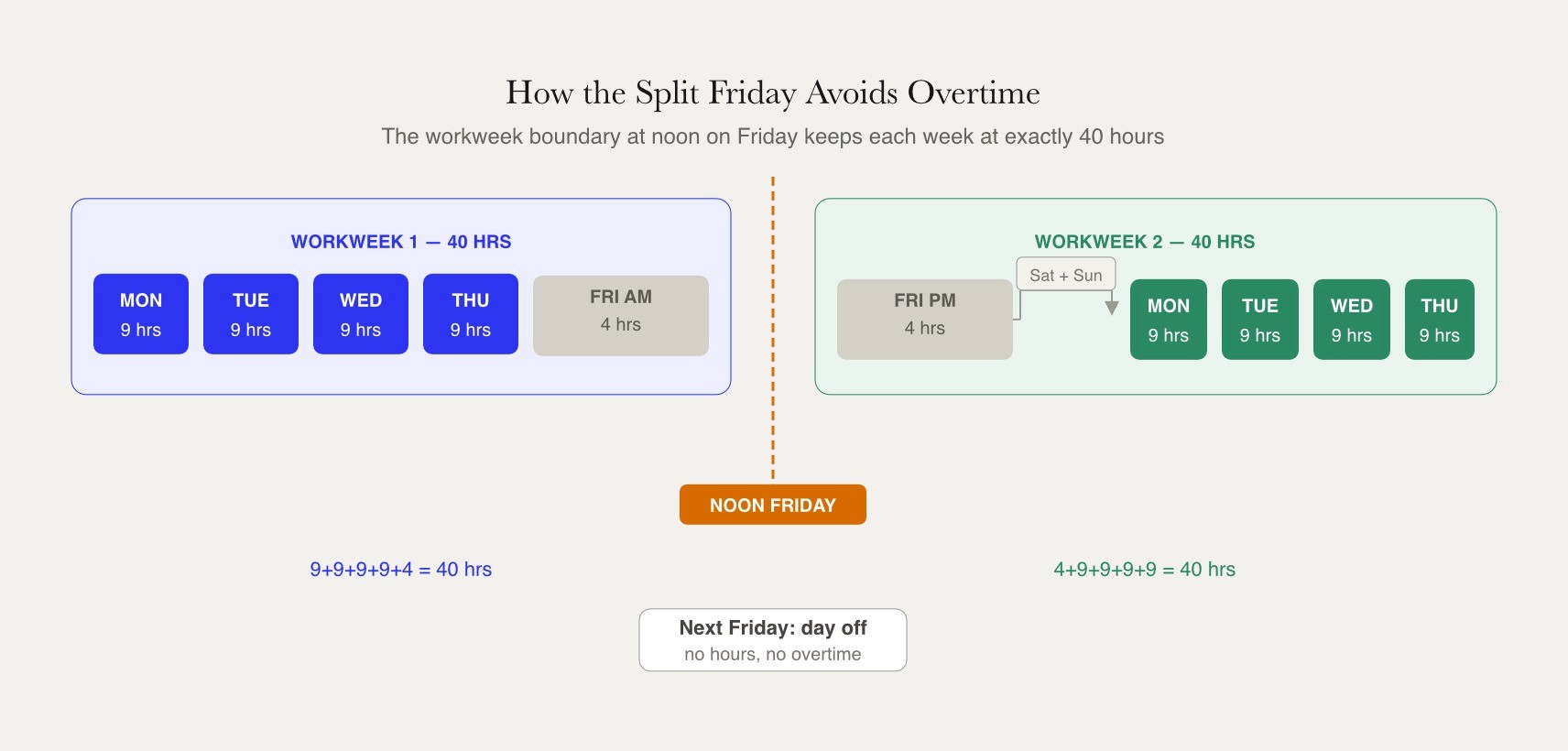
The key to understanding this compressed work schedule lies in recognizing that the Friday of the first week serves a dual purpose. The first four hours count toward the first workweek, while the remaining four hours are allocated to the second week. This strategic division ensures each workweek contains exactly 40 hours, preventing overtime complications while providing the desired flexibility.

How the 9/80 Schedule Works in Practice

Let’s examine a concrete example of how the 9/80 schedule operates in a real workplace environment. Consider an employee whose regular work hours are 8:00 AM to 5:00 PM with a one-hour lunch break.

Week 1 Schedule:

  • Monday through Thursday: 8:00 AM to 6:00 PM (nine hours with one hour lunch)

  • Friday: 8:00 AM to 12:00 PM (four hours, no lunch break)

Week 2 Schedule:

  • Monday through Thursday: 8:00 AM to 6:00 PM (nine hours with one hour lunch)

  • Friday: Day off

The Friday split prevents overtime complications by maintaining the 40-hour workweek structure required by the Fair Labor Standards Act. When properly implemented, the first week totals 44 hours of paid time, while the second week provides 36 hours, averaging 40 hours per week over the two-week cycle.

This arrangement requires careful coordination with payroll systems to ensure the split eight-hour day is correctly allocated. Many organizations define their workweek to begin at noon on Friday, allowing the morning hours to complete the previous workweek while the afternoon hours (which don’t exist on alternating Fridays) start the new cycle.

The flexibility of the 9/80 work schedule extends beyond the standard Friday arrangement. Organizations can allow employees to choose their alternating day off, such as Wednesdays, as long as the fundamental structure of four nine-hour days plus one eight-hour day across the two-week period remains intact.

A professional woman is focused on her tablet, reviewing her calendar and work schedule, likely planning her hours for the upcoming two-week pay period, which may include a 9 80 work schedule for improved work-life balance. The scene suggests a modern approach to managing work hours, emphasizing flexibility and productivity.

The Urgent Need for Flexible Work in Tech Hiring

The technology industry faces unprecedented talent acquisition challenges that demand innovative solutions. Current market data reveals that 67% of employers now offer schedule flexibility as a standard benefit, recognizing its critical role in attracting and retaining skilled professionals.

The cybersecurity sector alone has 3.5 million unfilled positions globally, while software development, data science, and AI specialization roles continue to see demand far outpace supply. Traditional nine-to-five work schedules no longer meet the expectations of millennial and Gen Z candidates who prioritize work-life balance alongside competitive compensation.

Post-2020 workplace evolution has fundamentally shifted employee expectations regarding flexibility. Remote work normalization has created a talent pool that actively seeks employers offering compressed work schedule options, flexible hours, and better work-life balance arrangements. Organizations that fail to adapt their work schedules risk losing top candidates to competitors who embrace these flexible work arrangements.

The cost of tech talent turnover averages between $15,000 and $25,000 per departing employee when considering recruitment, training, and productivity loss. For specialized roles requiring longer onboarding periods, these costs can exceed $50,000 per position. Implementing alternative work schedules like the 9/80 model serves as both a retention strategy and a recruitment differentiator in this competitive landscape.

Consider the following hiring challenges facing tech companies today:

  • Talent scarcity: Limited qualified candidates for specialized technical roles

  • Geographic competition: Remote work enables candidates to consider opportunities globally

  • Generational preferences: Younger professionals prioritize flexibility over traditional perks

  • Burnout prevention: High-stress technical roles require enhanced work-life balance

  • Retention pressure: Competitors actively recruit from established tech teams

Addressing these challenges requires strategic thinking about how work schedules can support both operational excellence and employee satisfaction. The 9/80 schedule provides one proven solution that helps organizations compete effectively for top talent while maintaining productivity standards.

Benefits of 9/80 Schedules for Employee Retention

A diverse team of professionals is collaborating in a bright, modern office space, showcasing a flexible work schedule that promotes better work-life balance. The environment reflects a commitment to employee well-being and increased productivity, as they engage in discussions about innovative business operations.

The implementation of a 9/80 work schedule delivers measurable improvements in employee retention through enhanced work-life balance and increased job satisfaction. Employees gain 26 additional three-day weekends annually, providing substantial opportunities for personal commitments, family time, and stress recovery that traditional schedules cannot match.

Research demonstrates that employees with flexible schedule options experience 25% less severe mental distress compared to those working traditional schedules. This reduction in workplace stress directly correlates with improved employee morale, reduced absenteeism, and stronger long-term retention rates across organizations implementing compressed work schedules.

The financial benefits extend beyond employee well-being. Workers following a 9/80 schedule save an estimated $2,000+ per year in commuting costs and time, as they travel to the office 26 fewer days annually. This represents approximately 20% fewer commuting days, reducing both transportation expenses and the environmental impact associated with daily travel.

Key retention benefits include:

Enhanced Personal Time Management: The longer hours worked during the four nine-hour days are offset by the guaranteed three-day weekend every two weeks. Employees can schedule medical appointments, handle personal business, and spend quality time with family during their alternating day off without requesting paid time from their accumulated leave balances.

Improved Recovery and Focus: The extended weekend allows for better rest and recovery, leading to increased productivity during work hours. Employees return to work more focused and energized, completing tasks more efficiently during their nine-hour workday compared to traditional eight-hour workday arrangements.

Competitive Advantage in Recruitment: Organizations offering flexible work schedules attract higher-quality candidates who view schedule flexibility as a key decision factor. The 9/80 schedule serves as a differentiator when competing against companies maintaining traditional work schedules, particularly when recruiting millennial and Gen Z professionals.

Reduced Burnout Risk: The compressed schedule provides regular recovery periods that help prevent the accumulation of workplace stress. Employees report feeling more capable of managing demanding projects when they know extended time off is consistently available every two weeks.

Business Advantages and Productivity Gains

Organizations implementing 9/80 work schedules report measurable improvements in employee productivity, operational efficiency, and overall business performance. Studies indicate that companies experience 15-20% improvement in employee satisfaction scores within six months of adopting compressed work schedules, translating to stronger performance metrics and reduced turnover costs.

The concentrated nine-hour workday format encourages employees to work at their own pace with fewer interruptions, as they recognize the importance of maximizing productivity during their longer workdays. This focused approach often results in higher task completion rates and improved project delivery timelines compared to traditional eight-hour workday structures.

Operational Cost Reductions: Implementing staggered 9/80 schedules across different departments can reduce office overhead costs significantly. With alternating teams taking different days off, organizations can operate with reduced facility usage, lower utility costs, and decreased parking requirements while maintaining full operational coverage.

Enhanced Recruitment Outcomes: Companies offering 9/80 schedules experience faster time-to-hire metrics and higher offer acceptance rates. The flexible schedule option serves as a powerful recruitment tool, particularly when competing for top-tier talent in competitive markets where multiple organizations may offer similar compensation packages.

Improved Employee Productivity Metrics: The promise of extended weekends motivates employees to complete their work efficiently within the allocated hours worked. Many organizations report that employees become more strategic about meeting management, project prioritization, and task delegation to maximize their productive output during the compressed schedule.

Reduced Absenteeism and Sick Leave Usage: Employees with better work-life balance through 9/80 schedules tend to use fewer sick days and personal time off requests. The regular three-day weekends provide adequate time for medical appointments, personal errands, and stress recovery, reducing the need for unplanned absences during regular work hours.

The business case for implementing a 9/80 schedule extends beyond employee satisfaction to encompass measurable improvements in operational efficiency, recruitment success, and long-term organizational performance that support sustainable growth in competitive markets.

Implementation Challenges and Solutions

While the 9/80 work schedule offers significant benefits, organizations must carefully navigate several implementation challenges to ensure successful adoption. Understanding these potential obstacles and preparing appropriate solutions enables smoother transitions and better employee adoption rates.


The image depicts a modern office workspace featuring multiple monitors displaying various time management and scheduling tools, illustrating a flexible work schedule that supports a 9 80 work schedule. This setup promotes improved work-life balance and employee productivity, highlighting the importance of effective time management in contemporary business operations.

Extended Daily Hours and Employee Fatigue: The transition from an eight-hour day to longer workdays can initially challenge employees accustomed to traditional schedules. Some team members may experience fatigue during the longer hours, particularly in roles requiring intense concentration or physical demands throughout the extended workday.

Solution: Implement gradual transition periods where employees work progressively longer hours over several weeks. Encourage proper break scheduling and guide energy management techniques. Consider offering flexible start times within the nine-hour workday structure to accommodate individual energy patterns and personal commitments.

Complex Scheduling Coordination: Coordinating schedules across multiple departments, teams, and external stakeholders becomes more complex when different groups follow alternating day off patterns. Meeting scheduling, project collaboration, and client communication require careful planning to ensure adequate coverage and participation.

Solution: Utilize AI-powered scheduling software that automatically accounts for team member availability and suggests optimal meeting times. Establish clear communication protocols and shared calendars that indicate when team members are following their alternating day off schedules.

Customer Service Coverage Gaps: Organizations providing customer support or client services must ensure continuous coverage despite team members having alternating day-off schedules. This challenge is particularly acute for businesses operating across multiple time zones or providing emergency support services.

Solution: Implement staggered 9/80 schedules where different team members take alternate days off on different weeks. This approach maintains full coverage while still providing the work-life balance benefits. Consider hybrid approaches where customer-facing roles maintain traditional schedules while back-office operations adopt the compressed schedule.

Payroll and Administrative Complexity: Managing payroll for employees working different hours worked patterns requires updated systems and procedures. HR teams must track vacation days, sick leave, and holiday pay differently when employees work nine-hour days versus traditional eight-hour workday structures.

Solution: Invest in comprehensive HR software that handles compressed work schedules automatically. Update employee handbooks and policies to clearly define how paid time off, holidays, and other benefits interact with the 9/80 structure. Provide training for payroll administrators and managers on the new systems and procedures.

Legal and Payroll Considerations

Implementing a 9/80 work schedule requires careful attention to legal compliance and payroll management to avoid costly violations and ensure proper compensation for all employees. The Fair Labor Standards Act provides the framework for compressed work schedules, but organizations must understand specific requirements for overtime pay, workweek definitions, and state-specific regulations.

Federal Fair Labor Standards Act Compliance: The FLSA permits employers to define their workweek as any seven consecutive 24-hour periods, enabling the strategic Friday split that makes 9/80 schedules legally compliant. By defining the workweek to begin at the midpoint of the split Friday (typically noon), organizations ensure each workweek contains exactly 40 hours, preventing unintended overtime pay obligations for non-exempt employees.

State-Specific Overtime Regulations: Several states, including California, Alaska, and Nevada, have daily overtime laws requiring overtime pay for any work performed beyond eight hours in a single day. These regulations make traditional 9/80 schedules impractical, as the nine-hour workday would automatically trigger daily overtime pay, significantly increasing labor costs.

Compliance Strategy: Organizations operating in states with daily overtime laws must either modify their approach or provide additional compensation. Some companies offer 4/10 schedules (four ten-hour days) with daily overtime pay, while others maintain traditional schedules supplemented by additional flexible work arrangements.

Proper Friday Hour Allocation: The split eight-hour day requires precise tracking to ensure compliance and accurate payroll processing. The first four hours of the split Friday count toward the previous workweek, while the second four hours (which may not exist on alternating weeks) apply to the following week.

Updated PTO and Holiday Policies: Organizations must revise their time-off policies to account for nine-hour workday versus the eight-hour workday differences. When employees take a vacation day during their nine-hour workday, they use nine hours of accumulated time off rather than eight. Similarly, when a holiday falls on a scheduled nine-hour workday, employees should receive nine hours of holiday pay to maintain equity.

Essential Policy Updates:

  • Vacation and sick leave calculations based on scheduled work hours

  • Holiday pay aligned with the scheduled workday length

  • Overtime calculations for hours worked beyond the defined workweek

  • Clear definitions of workweek start and end times

  • Documentation requirements for split Friday allocation

Organizations should consult with employment law attorneys and payroll specialists before implementing 9/80 schedules to ensure full compliance with applicable regulations and avoid potential legal complications.

How AI Streamlines 9/80 Schedule Management

Modern artificial intelligence solutions transform the complexity of managing 9/80 work schedules into streamlined, automated processes that reduce administrative burden while ensuring compliance and optimal coverage. AI-powered workforce management systems address the technical challenges that previously made compressed work schedules difficult to implement effectively.

Automated Scheduling and Coordination: AI scheduling platforms analyze team composition, project requirements, and individual preferences to generate optimal 9/80 schedule rotations automatically. These systems prevent scheduling conflicts, ensure adequate coverage across all business functions, and accommodate special requirements like customer service availability or project deadlines.

Machine learning algorithms continuously improve scheduling decisions by analyzing patterns in productivity, employee satisfaction, and operational efficiency. The system learns which combinations of alternating day off patterns work best for specific teams and automatically suggests adjustments when changes are needed.

Intelligent Time Tracking and Compliance: Advanced AI systems monitor hours worked in real-time, automatically flagging potential overtime violations before they occur. The technology tracks the complex Friday split requirements, ensures proper allocation between pay periods, and maintains compliance with both federal and state labor laws without requiring manual intervention.

These systems integrate seamlessly with existing payroll platforms, automatically calculating appropriate compensation for nine-hour days, vacation time usage, and holiday pay based on the employee’s scheduled work hours. This eliminates the manual calculations that often lead to errors in compressed schedule implementations.

Predictive Analytics for Optimization: AI-powered workforce analytics identify patterns in employee performance, satisfaction, and productivity across different 9/80 schedule configurations. The system can predict which employees are most likely to thrive under compressed schedules and suggest optimal implementation strategies for maximum benefit.

Real-time monitoring capabilities allow organizations to track key metrics like employee morale, task completion rates, and work-life balance indicators, providing data-driven insights for continuous improvement of their flexible work schedule implementation.

The image features an advanced computer interface showcasing workforce analytics and scheduling data, highlighting various work schedules including the 9 80 work schedule, which allows employees to work nine hour days for four days, resulting in three day weekends and improved work life balance. The interface displays key metrics related to hours worked, employee satisfaction, and productivity, emphasizing the importance of flexible work schedules for better employee morale.

Dynamic Schedule Adjustments When employees request changes due to personal commitments, medical appointments, or project requirements, AI systems automatically evaluate available options and suggest alternatives that maintain coverage and compliance. The technology considers factors like team workload, client commitments, and individual preference patterns to recommend optimal solutions.

Emergency situation management becomes significantly easier when AI systems can instantly reorganize schedules to accommodate sick leave, family emergencies, or unexpected business needs while maintaining the core benefits of the 9/80 structure.

Leveraging Multi-Agent AI for Hiring Success

The integration of multi-agent artificial intelligence systems like Fonzi revolutionizes how organizations approach hiring while simultaneously managing complex work schedules like the 9/80 arrangement. These sophisticated AI platforms address the urgent hiring challenges facing tech companies by automating candidate screening, optimizing interview processes, and predicting cultural fit with flexible work arrangements.

Intelligent Candidate Screening for Schedule Compatibility: Fonzi’s AI agents analyze candidate profiles, work history, and preferences to identify individuals most likely to thrive in compressed work schedule environments. The system evaluates factors like previous experience with flexible schedules, productivity patterns, and work-life balance priorities to rank candidates based on their compatibility with 9/80 arrangements.

This targeted screening approach dramatically reduces time-to-hire metrics while improving the quality of candidates who advance through the hiring process. Organizations can focus their interviewing efforts on candidates who demonstrate both technical qualifications and alignment with their flexible work schedule culture.

Automated Interview Scheduling for Compressed Workweeks: Multi-agent AI systems excel at coordinating complex interview schedules that accommodate both hiring team members following 9/80 schedules and candidates with various availability constraints. The system automatically finds optimal meeting times, suggests alternative options when conflicts arise, and manages rescheduling when team members are on their alternating day off.

The AI considers factors like timezone differences, project deadlines, and individual productivity patterns to suggest interview times that maximize engagement and evaluation quality. This sophisticated scheduling capability removes a significant administrative burden from hiring managers and HR teams.

Predictive Cultural Fit Analysis: Advanced AI algorithms analyze communication patterns, work style preferences, and career progression indicators to predict how well candidates will adapt to organizations offering flexible work schedules. The system identifies personality traits and professional characteristics that correlate with success in compressed schedule environments.

This predictive capability helps hiring decision-makers make more informed choices about candidate selection, reducing turnover risk and improving long-term employee satisfaction with the 9/80 work schedule implementation.

Streamlined Onboarding for Schedule Integration: Fonzi’s multi-agent system creates personalized onboarding experiences that help new hires understand and adapt to 9/80 schedules effectively. The AI generates customized training materials, schedules orientation sessions during optimal times, and provides ongoing support as employees adjust to longer workdays and alternating time off patterns.

The system tracks new employee adaptation metrics and suggests interventions when individuals struggle with the transition to compressed schedules, improving retention rates and accelerating productivity gains from new team members.

Step-by-Step Implementation Guide

Successfully implementing a 9/80 work schedule requires systematic planning, careful execution, and continuous monitoring to ensure both legal compliance and operational effectiveness. This comprehensive implementation guide provides organizations with a proven framework for transitioning to compressed work schedules while minimizing disruption and maximizing employee adoption.

A group of business professionals is gathered in a conference room, discussing the implementation of new technology systems to improve business operations and employee productivity. The meeting focuses on exploring flexible work schedules, such as the 9 80 schedule, to enhance work-life balance and employee satisfaction.

Phase 1: Legal Review and Policy Development (2-4 weeks)

Begin implementation by conducting a thorough legal review to ensure compliance with federal, state, and local labor laws. Consult with employment attorneys to verify that your jurisdiction permits 9/80 schedules and understand any specific requirements or restrictions that may apply.

Key Activities:

  • Review the current employee handbook and policy documents

  • Analyze existing payroll systems for compatibility with compressed schedules

  • Define new workweek start times to accommodate the Friday split structure

  • Draft updated policies covering vacation time, sick leave, and holiday pay

  • Establish overtime calculation procedures for non-exempt employees

Update your employee handbook to clearly explain how the 9 80 schedule works, including specific examples of how vacation days, sick time, and holidays interact with the nine-hour workday structure. Ensure all policy language complies with Fair Labor Standards Act requirements and addresses potential edge cases.

Phase 2: Pilot Program with Select Departments (3 months)

Launch a carefully monitored pilot program with one or two departments to test systems, identify challenges, and refine procedures before company-wide implementation. Choose departments with less complex customer coverage requirements or those with strong internal collaboration needs.

Pilot Program Elements:

  • Select 15-25 employees representing different roles and experience levels

  • Establish baseline metrics for productivity, satisfaction, and operational efficiency

  • Implement weekly feedback sessions to identify issues and optimization opportunities

  • Monitor payroll accuracy and compliance throughout the trial period

  • Document lessons learned and best practices for broader implementation

Track key performance indicators, including employee morale, task completion rates, customer satisfaction (if applicable), and any operational disruptions. Use this data to refine your approach and address concerns before expanding the program.

Phase 3: Technology Setup Including AI-Powered Scheduling Tools

Invest in comprehensive workforce management technology that can handle the complexity of 9/80 schedules automatically. Modern AI-powered systems eliminate most administrative challenges while ensuring compliance and optimal coverage.

Technology Requirements:

  • Automated time tracking that handles split Friday allocation

  • Schedule coordination tools for managing alternating days off

  • Payroll integration that calculates overtime correctly

  • Employee self-service portals for vacation and schedule requests

  • Analytics dashboards for monitoring program effectiveness

Configure systems to send automatic alerts when potential overtime violations are approaching and ensure all integrations with existing HR and payroll platforms work correctly. Test the technology thoroughly during the pilot phase before expanding usage.

Phase 4: Employee Training and Communication Rollout

Develop comprehensive training programs that help employees understand how the 9/80 work schedule affects their daily routines, compensation, and career development. Clear communication during this phase significantly improves adoption rates and reduces confusion.

Training Components:

  • Overview sessions explaining schedule mechanics and benefits

  • Detailed workshops on time tracking and payroll implications

  • Manager training on leading teams with flexible work schedules

  • Individual consultations for employees with specific concerns

  • Resource materials and FAQ documents for ongoing reference

Address common concerns about longer workdays, schedule coordination, and work-life balance impacts. Provide practical tips for managing energy during nine-hour days and strategies for maximizing the benefits of three-day weekends.

Phase 5: Full Implementation with Continuous Monitoring

Roll out the 9/80 schedule across the entire organization while maintaining close monitoring of all key metrics. This phase requires ongoing attention to ensure systems work effectively and employees adapt successfully to the new schedule structure.

Monitoring Activities:

  • Weekly review of payroll accuracy and compliance issues

  • Monthly employee satisfaction surveys to track adaptation

  • Quarterly analysis of productivity and operational metrics

  • Ongoing refinement of policies and procedures based on feedback

  • Regular assessment of technology performance and optimization needs

Establish clear escalation procedures for addressing problems quickly and maintain open communication channels for employee feedback. Plan for gradual adjustments as the organization learns what works best for its specific culture and operational requirements.

Measuring Success and ROI

A professional team is gathered around large display screens, analyzing business data and charts to enhance productivity and employee morale. They are likely discussing strategies for implementing a flexible work schedule, such as the 9 80 work schedule, to improve work-life balance and overall job satisfaction.

Implementing effective measurement systems enables organizations to quantify the value of their 9/80 work schedule investment and identify opportunities for continuous improvement. Comprehensive metrics tracking provides the data necessary to justify program expansion, optimize operations, and demonstrate return on investment to stakeholders.

Employee Satisfaction and Engagement Metrics

Track employee satisfaction scores through regular surveys that measure work-life balance improvements, job satisfaction, and overall engagement with the flexible work schedule. Monitor changes in employee morale indicators such as participation in company events, internal referral rates, and voluntary feedback quality.

Key Performance Indicators:

  • Employee satisfaction survey scores (target: 15-20% improvement)

  • Work-life balance rating improvements

  • Job satisfaction index changes

  • Internal referral and recommendation rates

  • Voluntary turnover reduction (target: 10-15% decrease)

Measure how employees utilize their additional time off and whether the three-day weekends contribute to better work-life balance as intended. Survey data should capture both quantitative ratings and qualitative feedback about specific benefits and challenges.

Recruitment and Retention Improvements

Monitor hiring metrics to evaluate how offering 9/80 schedules affects your ability to attract and retain top talent. Track time-to-hire improvements, candidate quality enhancements, and offer acceptance rate increases that result from promoting flexible work schedule options.

Recruitment Metrics:

  • Time-to-hire reductions for positions marketed with schedule flexibility

  • Offer acceptance rate improvements (target: 10-20% increase)

  • Quality of the candidate pool based on skills and experience assessments

  • Cost-per-hire calculations, including recruitment advertising and processing expenses

  • New employee retention rates at 6-month and 12-month intervals

Compare recruitment outcomes for positions advertised with 9/80 schedule availability against similar roles without this benefit to isolate the impact of schedule flexibility on hiring success.

Productivity and Operational Efficiency

Analyze productivity metrics to determine whether the concentrated nine-hour workday format enhances or impairs overall output. Monitor project completion rates, quality indicators, and efficiency measures to ensure the compressed schedule supports business objectives.

Productivity Measurements:

  • Task completion rates during nine-hour days versus eight-hour workday historical data

  • Project delivery timeliness and quality assessments

  • Employee output per hour worked calculations

  • Customer satisfaction ratings for service quality

  • Error rates and rework requirements

Track whether employees maintain consistent productivity throughout the longer workdays or experience fatigue-related performance declines during extended work periods.

Cost Savings and Financial Impact

Calculate direct and indirect cost savings resulting from 9/80 schedule implementation. Include reduced turnover costs, lower recruitment expenses, decreased absenteeism, and potential facility overhead reductions from staggered scheduling.

Financial Impact Analysis:

  • Turnover cost reductions based on improved retention rates

  • Recruitment cost savings from enhanced candidate attraction

  • Absenteeism cost reductions due to better work-life balance

  • Facility cost savings from reduced daily office occupancy

  • Overtime cost changes due to schedule structure modifications

Consider both immediate cost impacts and longer-term financial benefits, such as improved productivity leading to revenue growth or enhanced employee engagement supporting innovation and business development.

Technology ROI and Automation Benefits

Measure the return on investment from AI-powered scheduling and management tools used to support 9/80 schedule operations. Calculate time savings for HR teams, reduced administrative errors, and improved compliance maintenance.

Technology Metrics:

  • Administrative time reduction for schedule management tasks

  • Payroll error rate improvements through automated compliance monitoring

  • Employee self-service adoption rates for schedule-related requests

  • System uptime and reliability measurements

  • User satisfaction with technology tools and interfaces

Document how AI automation reduces manual workload for managers and HR staff while improving accuracy and compliance with labor law requirements.

Industry-Specific Considerations

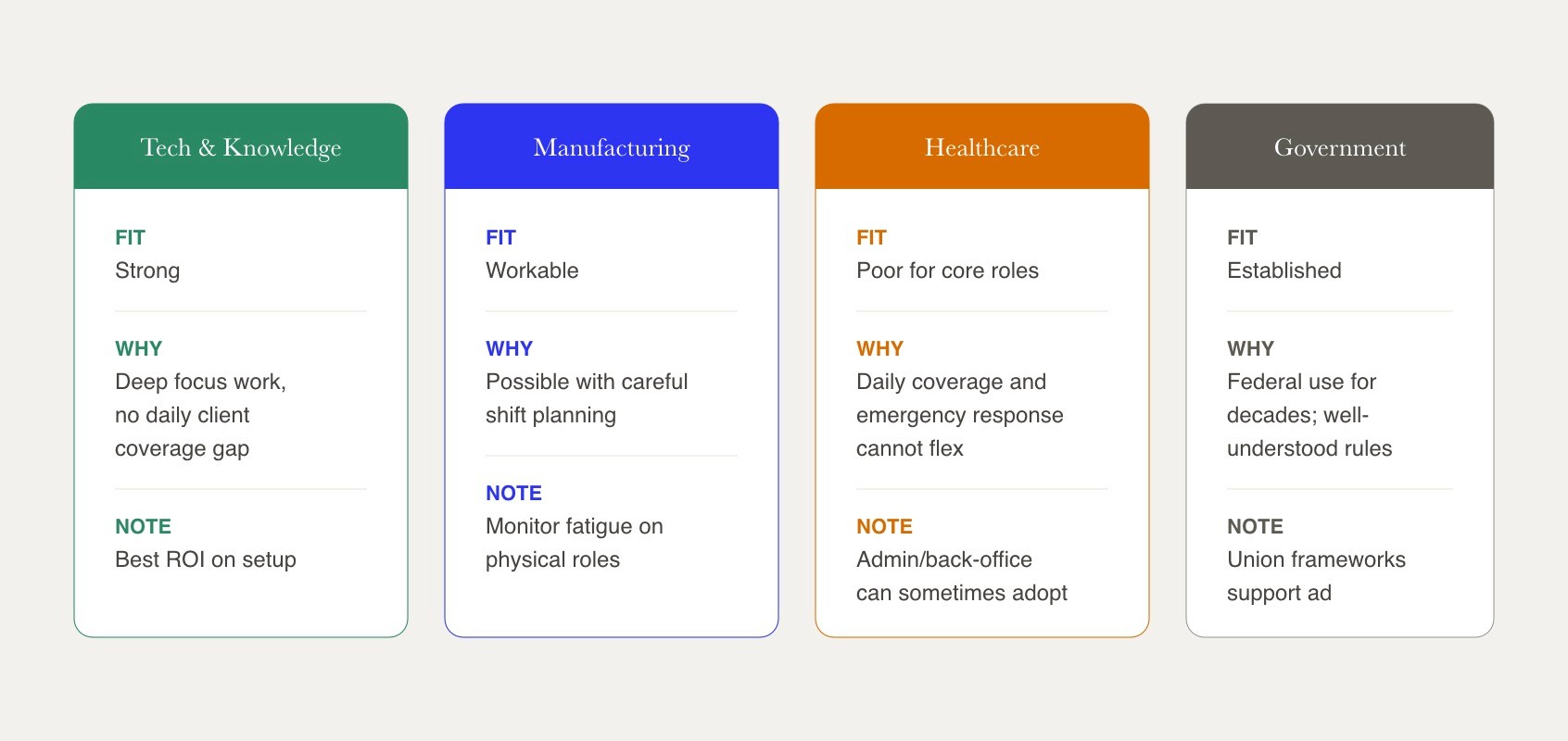
The suitability and implementation approach for 9/80 work schedules vary significantly across different industries based on operational requirements, customer service needs, and regulatory constraints. Understanding these industry-specific factors enables organizations to adapt the compressed schedule model effectively or determine whether alternative flexibility approaches better serve their business objectives.

Technology and Software Development

The technology sector represents an ideal environment for 9/80 schedule implementation due to project-based work, flexible deadlines, and minimal customer service requirements during extended hours worked. Software development, cybersecurity, and data science roles particularly benefit from longer uninterrupted work periods that support deep focus and complex problem-solving.

Implementation Advantages:

  • Project work aligns well with concentrated nine-hour days

  • Remote work compatibility enhances schedule flexibility

  • Talent acquisition benefits in competitive hiring markets

  • Innovation benefits from improved work-life balance

  • Minimal customer service disruption during alternating day off periods

Technology companies should consider staggered team approaches where different development squads take alternating days off to maintain collaboration opportunities while preserving individual flexibility benefits.

Manufacturing and Aerospace

Manufacturing environments can successfully implement 9/80 schedules with proper shift coverage planning. The structured nature of production work aligns well with compressed schedules, and the predictable workload distribution supports consistent productivity during longer workdays.

Key Considerations:

  • Shift coverage requirements for continuous production lines

  • Safety considerations during extended work hours

  • Equipment maintenance scheduling around alternating day patterns

  • Quality control consistency across different schedule patterns

  • Supply chain coordination with vendor schedules

Organizations should monitor fatigue levels carefully in manufacturing environments where safety concerns make alert, focused work essential throughout the entire nine-hour workday.

Healthcare and Emergency Services

Healthcare organizations face significant challenges implementing traditional 9/80 schedules due to patient care requirements and emergency response needs. However, administrative and support roles within healthcare systems may benefit from compressed schedules.

Alternative Approaches:

  • Administrative staff adoption while maintaining clinical coverage

  • Specialized department pilots in areas with predictable workloads

  • Modified approaches with different compressed schedule patterns

  • Integration with existing shift work patterns is common in healthcare

  • Consideration of patient care continuity requirements

Emergency services, law enforcement, and critical infrastructure roles typically cannot accommodate 9/80 schedules due to coverage requirements, but may benefit from other flexibility options.

Retail and Hospitality

Customer-facing businesses with extended operating hours find traditional 9/80 schedules challenging to implement effectively. However, creative approaches can provide some benefits while maintaining service quality.

Hybrid Implementation Strategies:

  • Back-office operations adopting compressed schedules while front-line staff maintain coverage

  • Seasonal variation approaches during slower business periods

  • Department-specific implementation based on customer interaction requirements

  • Extended hour coverage using staggered team approaches

  • Integration with existing part-time and flexible scheduling practices

Government and Public Services

Government organizations often lead in implementing innovative work schedules due to employment law flexibility and focus on employee satisfaction. Public sector environments typically have well-defined procedures and strong union relationships that support systematic schedule changes.

Implementation Benefits:

  • Established precedent for alternative work schedules in government

  • Clear regulatory framework for implementation

  • Strong employee relations and union cooperation potential

  • Public service mission alignment with work-life balance goals

  • Reduced facility costs for taxpayer-funded operations

Government organizations should ensure public service availability during traditional business hours while leveraging compressed schedules for improved efficiency and employee satisfaction.

The image depicts a diverse group of professionals from various industries collaborating in a modern workplace, highlighting teamwork and communication. This setting emphasizes the importance of flexible work schedules, such as the 9 80 work schedule, which can enhance employee morale and work-life balance.

Future of Flexible Work and AI Integration

The evolution of workplace flexibility continues to accelerate as organizations recognize the strategic value of adaptive work arrangements in attracting top talent and maintaining competitive advantages. Artificial intelligence integration with flexible work schedules represents the next frontier in workforce optimization, promising even greater efficiency and employee satisfaction benefits.

Emerging Trends in Compressed Work Schedules

Beyond traditional 9/80 arrangements, organizations are experimenting with hybrid compressed schedules that combine remote work, flexible start times, and project-based scheduling. These advanced models leverage AI to optimize individual productivity patterns while maintaining team collaboration and operational efficiency.

Future compressed schedule variations may include:

  • AI-optimized personalized work patterns based on individual productivity data

  • Dynamic schedule adjustments based on project deadlines and team requirements

  • Integration with remote work to create fully flexible work arrangements

  • Seasonal schedule variations aligned with business cycles and personal preferences

  • Cross-functional team scheduling that optimizes collaboration across departments

Advanced AI Capabilities for Schedule Management

Next-generation AI systems will provide predictive capabilities that anticipate scheduling challenges before they occur. Machine learning algorithms will analyze patterns in employee performance, project requirements, and external factors to suggest optimal schedule configurations automatically.

Future AI Features:

  • Predictive analytics for optimal schedule assignments based on personality and productivity patterns

  • Real-time adjustment capabilities that respond to changing business needs automatically

  • Integration with project management systems for dynamic resource allocation

  • Advanced compliance monitoring that adapts to changing labor regulations automatically

  • Emotional intelligence capabilities that consider employee well-being in scheduling decisions

Integration with Remote and Hybrid Work Models

The combination of compressed schedules with remote work creates powerful flexibility options that appeal to top talent across all industries. AI systems will manage the complexity of coordinating remote team members, in-office collaboration requirements, and compressed schedule preferences seamlessly.

Organizations implementing hybrid approaches report higher employee satisfaction and broader talent pool access when offering multiple flexibility options simultaneously. The technology infrastructure supporting these complex arrangements continues improving, making sophisticated schedule management accessible to organizations of all sizes.

Building AI-First HR Strategies for Competitive Advantage

Forward-thinking organizations are developing comprehensive AI-powered HR strategies that extend beyond schedule management to encompass recruitment, performance management, and employee development. These integrated approaches provide sustainable competitive advantages in talent markets.

Strategic AI Implementation Areas:

  • Candidate screening and matching for culture and schedule compatibility

  • Performance optimization based on work pattern analysis

  • Predictive retention modeling that identifies at-risk employees early

  • Personalized career development planning aligned with flexible work preferences

  • Automated compliance management for complex labor regulations

The organizations that successfully integrate AI with flexible work arrangements will dominate talent acquisition and retention in increasingly competitive markets, making early adoption of these technologies a strategic imperative for long-term success.

Predictions for 2026 and Beyond

Industry analysts predict that 85% of knowledge work organizations will offer some form of compressed or flexible scheduling by 2026, with AI-powered management systems becoming standard HR technology. The companies that master these capabilities early will establish significant advantages in talent acquisition, employee satisfaction, and operational efficiency.

The convergence of artificial intelligence, flexible work arrangements, and changing employee expectations is creating a new paradigm in workforce management that prioritizes both human needs and business objectives through sophisticated technology solutions.

Conclusion

A 9/80 work schedule can be a smart way for companies to stand out in competitive talent markets, especially when candidates increasingly expect flexibility without sacrificing career growth. By offering employees an extra day off every other week, while still maintaining full-time productivity, organizations can boost morale, reduce burnout, and improve retention without compromising output. For tech teams and knowledge-based roles, this kind of schedule is often a meaningful differentiator when traditional structures no longer meet employee expectations.

Pairing flexible scheduling with intelligent hiring strategies gives companies an even greater edge. While AI tools can help streamline workforce planning and reduce administrative overhead, connecting with the right talent remains just as essential. That’s where Fonzi AI can help. Our platform directly connects engineers with AI-focused companies, ensuring employers attract candidates who thrive in modern, flexible work environments. By combining thoughtful scheduling options with precise talent matching, organizations can build stronger teams and create a workplace that appeals to today’s top AI professionals.

FAQ

What is a 9/80 work schedule, and how does it work?

What is a 9/80 work schedule, and how does it work?

What is a 9/80 work schedule, and how does it work?

How do you calculate hours on a 9/80 schedule?

How do you calculate hours on a 9/80 schedule?

How do you calculate hours on a 9/80 schedule?

What are the pros and cons of a 9/80 work schedule?

What are the pros and cons of a 9/80 work schedule?

What are the pros and cons of a 9/80 work schedule?

Is a 9/80 schedule better than a traditional 5-day workweek?

Is a 9/80 schedule better than a traditional 5-day workweek?

Is a 9/80 schedule better than a traditional 5-day workweek?

How do companies implement a 9/80 schedule and handle payroll?

How do companies implement a 9/80 schedule and handle payroll?

How do companies implement a 9/80 schedule and handle payroll?