Best Job Board Software & Platforms for Automating Job Boards
By
Liz Fujiwara
•

Hiring top engineering talent has become increasingly challenging. AI companies are growing rapidly, yet many organizations still struggle with lengthy hiring cycles, overwhelming application volume, and strong candidates disappearing before interviews are completed.
Modern job board software has evolved far beyond posting vacancies online. Today's platforms help automate sourcing, candidate screening, workflow management, and ATS integration, while AI-powered solutions can improve matching accuracy and reduce recruiter workload. This guide explores the different types of job board software, the features that matter most for tech recruiting, and how newer AI-driven platforms are changing the hiring process.
Key Takeaways
Traditional job boards generate reach, but often struggle to deliver high-signal engineering candidates.
Modern hiring platforms combine sourcing, automation, screening, and ATS integrations to streamline recruiting.
AI-powered tools can improve candidate matching, reduce recruiter workload, and identify stronger shortlists faster.
The best platform depends on your hiring needs, technical roles, workflow integrations, and desired level of automation.
The Hiring Problems Fast-Growing Tech Companies Face
Hiring cycles are getting longer, and product teams feel the impact. Filling senior software engineering, machine learning, and AI roles can take months, especially in competitive markets. Every unfilled position delays projects, increases pressure on existing team members, and gives competitors more time to move ahead.
At the same time, lean talent acquisition teams are often managing dozens of open roles while reviewing hundreds of applications per position across multiple job boards. Most of that effort goes toward filtering noise instead of building relationships with qualified candidates.
Traditional job boards are optimized for reach, not relevance. Broad keyword searches surface large volumes of applicants, but many lack the required skills, duplicate applications appear across platforms, and hiring managers are left sorting through weak pipelines. The rise of AI-generated resumes, embellished experience, and other forms of candidate fraud has made signal quality even harder to assess.
As a result, most engineering leaders are not looking for more applicants. They want better candidates, stronger shortlists, and more efficient hiring processes. The challenge is no longer distribution. It's identifying qualified talent quickly and consistently. Platforms that combine sourcing with screening, validation, and quality control are increasingly filling that gap.
What Modern Job Board Software Actually Does
Most SaaS job board platforms today handle the following:
Posting and distribution: Multi-board posting to Indeed, LinkedIn, ZipRecruiter, and niche communities (including Reddit job subreddits); branded career pages on your own domain; aggregation of all applications into a single pipeline view.
Automation: Scheduled reposting, basic keyword matching and screening questions, auto-rejection for obviously mismatched applicants, and resume parsing into structured fields.
Analytics: Views, clicks, applies, and cost-per-apply by source; time-to-fill by role and channel; dashboard reporting on job posting ROI.
Monetization (for publishers and associations): Self-serve job posting with Stripe billing, per-post or subscription pricing, custom branded boards for niche communities.
That covers a lot of repetitive work. For tech companies hiring engineers and AI specialists, though, the gaps are real: candidate pools that don't filter for technical depth, no support for code-level assessment, no fraud detection, and AI that mostly amounts to keyword matching.
That's the opening Fonzi fills.
Types of Job Board Software
Not all job board tools serve the same purpose. The goal isn't to find one platform that does everything; it's to match the right tools to your hiring volume, role types, and technical requirements.
Category | Primary User | Best For | Core Strengths | Key Limitations | Representative Tools |
Traditional Job Boards | Job seekers, employers | Broad reach, high-volume roles | Massive candidate pools, easy posting, brand recognition | High noise, low relevance for senior/niche roles | Indeed, LinkedIn Jobs, ZipRecruiter |
Associations, publishers, niche communities | Launching a branded board fast | Quick setup, monetization tools, full brand control | Requires your own audience; no built-in sourcing | JBoard, Jeaves, Niceboard | |
AI-Enhanced Job Boards | Employers seeking automation | Improving match quality at scale | Resume parsing, basic AI matching | AI tends to be superficial; it is not built for technical depth | Monster, CareerBuilder |
Employers, TA teams | Centralizing hiring workflow | Single system for posting and tracking | Limited AI; dependent on board quality | Greenhouse, Lever, Workable, Ashby | |
AI-First Talent Marketplaces | Tech companies are hiring engineers | Senior technical roles, speed, and quality | Multi-agent AI, fraud detection, structured scoring | Narrower scope; not suited for all role types | Fonzi |
In practice: early-stage startups often start with an ATS that includes multi-board posting, then layer on Fonzi for high-priority engineering roles. Late-stage companies scaling fast tend to use traditional boards for reach, but need AI-first marketplaces to get quality on senior hires. Global teams targeting the US, EU, LATAM, or India benefit from platforms with location filtering and credential verification built in.
Features That Matter for Tech Hiring
Distribution: Multi-board posting to major platforms and niche tech communities; Google for Jobs integration via structured data; scheduling for optimal posting times.
Candidate experience: White-label career pages on your domain, mobile-optimized; advanced filters by location, skills, stack, and seniority; easy-apply flows that don't create unnecessary friction.
Workflow and integrations: Native ATS integrations with Greenhouse, Lever, Workable, and similar tools; webhook and API support; stage syncing so your job board doesn't become a disconnected second system.
Analytics: Source-level conversion tracking from view to hire; cost-per-apply and cost-per-hire by channel; interview rate by source as a quality indicator.
AI and automation: Resume parsing and tech stack tagging; deduplication across boards; risk flags for mismatched profiles; fraud detection for synthetic resumes and inconsistent histories.
Candidate-facing features: Saved searches and job alerts for passive candidates; transparent status updates; responsive communication throughout the process.
Senior engineers often notice how a hiring process is run, and the tools a company chooses can signal something about its culture before a conversation even starts.
Fonzi: A Different Approach to Engineering Hiring
Unlike traditional job boards that focus on generating more applications, Fonzi is an AI-powered talent marketplace built specifically for engineering, AI, and ML hiring. Instead of relying on keyword searches and large applicant pools, Fonzi combines curated candidate networks with AI-driven evaluation to help companies identify qualified engineers faster.
For teams hiring senior software engineers, ML engineers, and AI specialists, Fonzi acts as both a sourcing and screening layer. Candidates are evaluated for technical fit, experience, and role alignment before reaching recruiters, helping reduce manual resume review and improving shortlist quality. Through Match Day, companies can connect directly with pre-vetted engineers who are actively exploring new opportunities, creating a faster path from discovery to interview.
Companies Looking for Engineering Talent
Companies hiring engineers often face large applicant volumes and lengthy screening cycles. Through AI-powered evaluation and Match Day introductions, Fonzi helps hiring teams move faster from sourcing to interview, connecting them with engineers who match their technical requirements and hiring goals.
Where AI Helps and Where It Doesn't
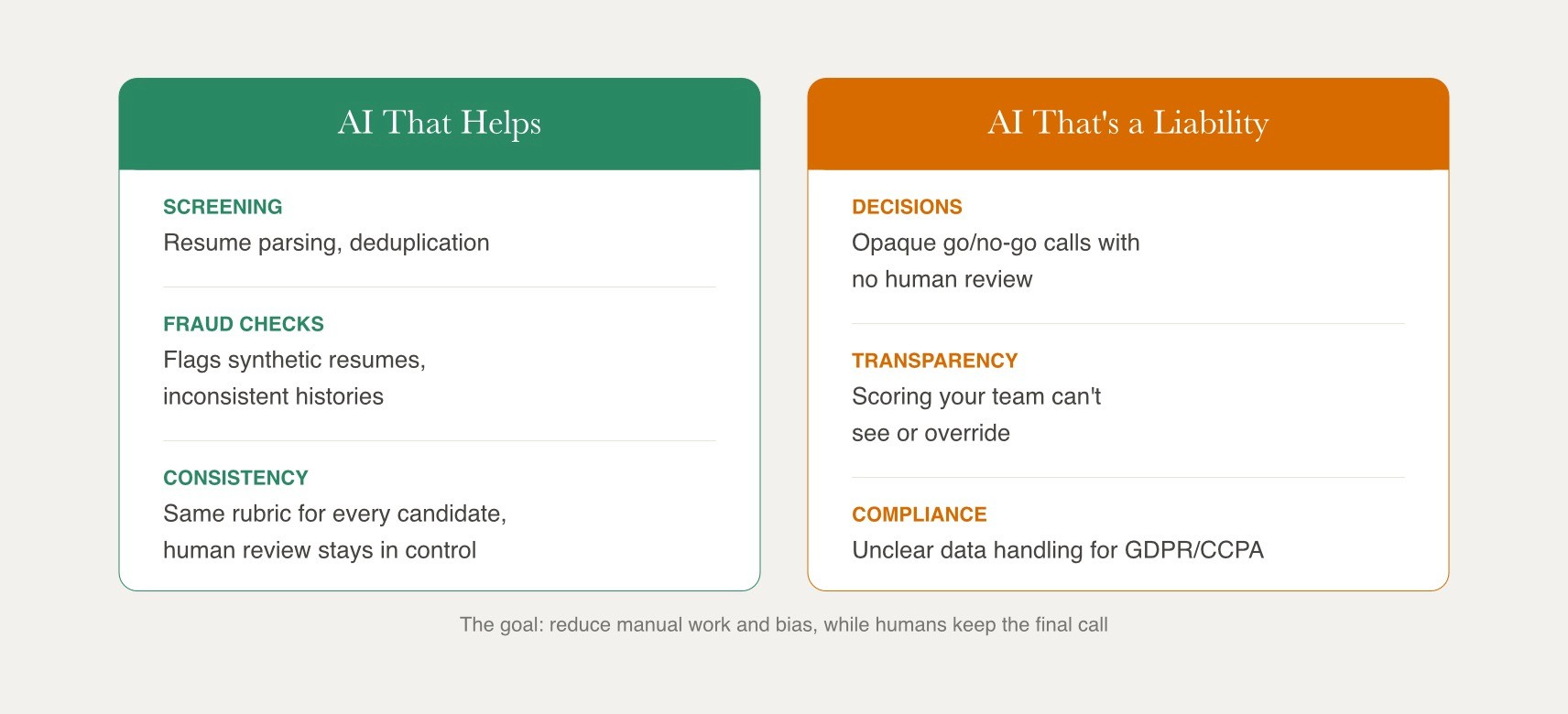
Many hiring leaders approach AI with justified skepticism. Bias, black-box decisions, compliance risk, and concerns about fairness in hiring are real. The goal is not to replace human judgment, but to use AI to reduce manual work, apply more consistent evaluation criteria, help eliminate bias in recruitment, and surface stronger candidates while keeping humans in control of final decisions.
AI that automates screening, summarization, deduplication, and fraud checks is useful. AI that makes opaque go/no-go decisions without human review is a liability.
Multi-agent systems can also surface candidates that keyword filters would miss: nontraditional career paths, meaningful open-source contributions, or signals buried in inconsistent resume formats. Consistent rubrics applied across every candidate can reduce certain types of bias compared to manual review, though no system eliminates it.
What to require from any AI-enabled hiring platform: audit logs showing how candidates were scored; explainable scoring that your team can review and override; clear data handling policies for GDPR and CCPA compliance; easy overrides that keep humans in control of final decisions.
How to Evaluate Job Board Software
If you're deciding in the next three to six months:
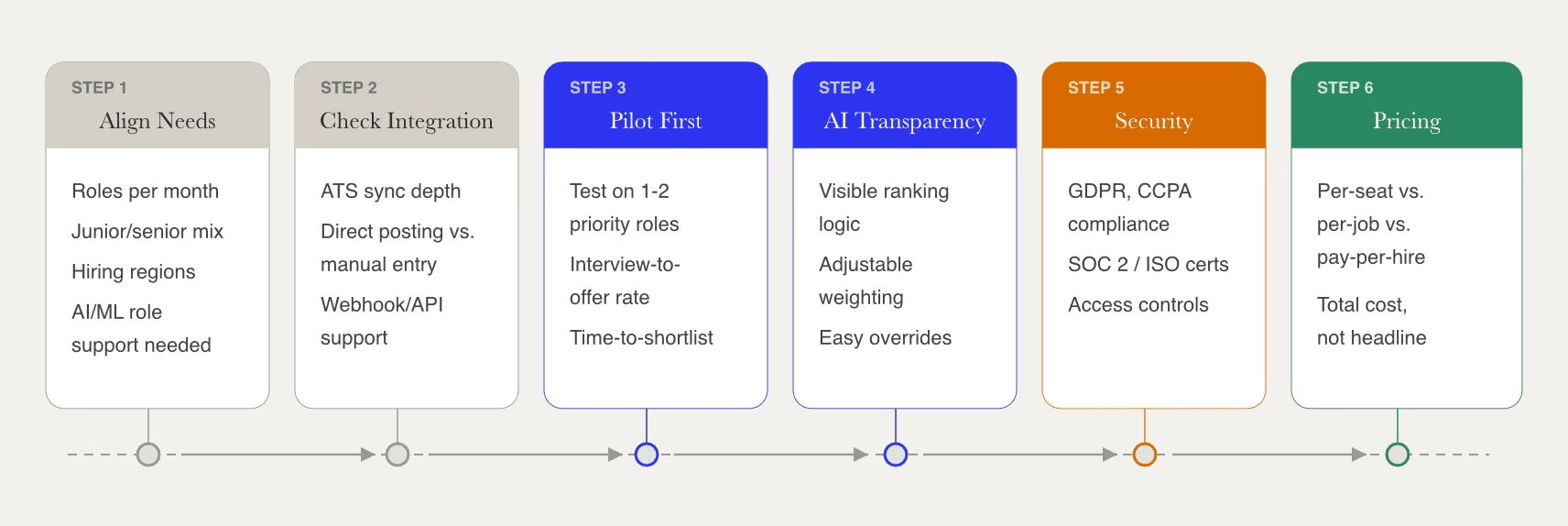
Align with your actual hiring picture: How many roles per month? What's the junior/senior split? Which regions? Do you need specialized support for AI and ML roles?
Test integration depth: Does the platform sync with your ATS at the job and candidate level? Can you post directly, or does it require manual copying? Are webhook or API options available?
Pilot before committing: Run a test on one or two priority roles. Track interview-to-offer rate by source, not just total applicants. Compare time-to-shortlist against your current process.
Assess AI transparency: Can your team see why candidates are ranked a certain way? Can you adjust the criteria for location, compensation, and skill weighting? Are overrides easy to execute?
Security and compliance: Data residency options for EU hiring; GDPR and CCPA support; SOC 2 or ISO certifications; access controls for candidate data.
Pricing: Compare total cost, not headline plan pricing. Per-seat vs. per-job vs. pay-per-hire models have very different economics at scale. Fonzi-type marketplaces often tie pricing to successful hires, which tends to be more predictable for growth-stage companies. For publisher-style boards, look for built-in billing with Stripe or equivalent.
Summary
The best job board software for engineering hiring in 2026 goes beyond job postings by combining sourcing, automation, screening, analytics, and ATS integrations. While traditional job boards provide reach, many companies struggle with high application volume and low candidate quality, making AI-powered platforms increasingly valuable for identifying qualified engineers faster.
Modern hiring teams prioritize tools that improve candidate matching, reduce recruiter workload, support technical hiring workflows, and integrate seamlessly with existing systems. For engineering, AI, and ML roles, platforms that combine sourcing with candidate evaluation, fraud detection, and structured screening often deliver stronger shortlists and faster hiring outcomes.
FAQ
What is the best software for creating a job board?
How does job board platform software work?
What features should job posting software include?
Can automated job board software aggregate listings from other sources?
How much does it cost to build a job board with software platforms?