What Is an Environmental Engineer?
By
Liz Fujiwara
•

Environmental engineering sits at the intersection of science and engineering, focusing on how we design systems that protect public health and manage the natural environment. From clean drinking water and wastewater treatment to air pollution control and climate resilience, environmental engineers build and operate the infrastructure that keeps modern society functioning safely and sustainably. This article explains what environmental engineers do, how they work day to day, the skills and education required, and where the field is headed in terms of careers and demand.
Key Takeaways
Environmental engineers apply engineering disciplines to reduce environmental impact, manage air pollution and water resources, and protect human health through design, operations, and regulation of infrastructure.
Environmental engineering roles span infrastructure, energy, manufacturing, and government agencies, with growing demand driven by climate policy, ESG regulation, and aging infrastructure investment.
The field combines civil, chemical, and mechanical engineering approaches with environmental science to address challenges in water treatment, air quality, waste management, and site remediation.
Core Definition: What an Environmental Engineer Does
Environmental engineering applies principles of science, biology, chemistry, and engineering to protect and improve the environment. Environmental engineers develop solutions to problems related to planetary health, designing systems that manage water, air, and waste while ensuring compliance with environmental regulations.
The distinction from an environmental scientist is important. While scientists investigate processes, monitor pollutant levels, and study ecosystem responses, environmental engineers apply physics, chemistry, fluid mechanics, and systems modeling to create infrastructure that meets both performance and regulatory constraints. They design systems, sign off on infrastructure, and are responsible for physical system performance.
Environmental engineering has roots in early civilizations, where people learned to modify and control environmental conditions to meet their needs. The advanced water management systems of the Indus Valley Civilization around 3300 B.C.E. demonstrate this lineage. Modern environmental engineering began with projects like the design of a sewerage system in London by Joseph Bazalgette in the mid-19th century, a response to the Great Stink aimed at preventing cholera outbreaks. The field emerged as a separate academic discipline in the mid-20th century due to public concern about water and air pollution, particularly after events like the publication of Rachel Carson’s Silent Spring in 1962.
Typical project types include municipal wastewater treatment plants, industrial air pollution control systems, solid waste and recycling facilities, and site remediation at contaminated sites. Environmental engineers work at the interface of engineering disciplines, combining civil, chemical, and mechanical approaches. For example, a wastewater treatment plant requires civil engineering for tanks and foundations, mechanical engineering for pumps and blowers, and environmental engineering for process selection, control, and regulatory compliance.
Key goals of environmental engineering include controlling pollution, managing waste, providing safe drinking water, and mitigating the impact of climate change. The field also addresses emerging global challenges, such as the impact of climate change on communities and ecosystems.
Typical Day-to-Day Responsibilities
Environmental engineers work in various settings, including offices and field locations, and most work full time, often exceeding 40 hours per week. A water and wastewater engineer might start the day reviewing SCADA data from treatment plants, examining influent flow, dissolved oxygen levels, and effluent quality. They run process models to evaluate how changes in temperature or load affect treatment performance, then adjust setpoints or chemical dosing plans.
Design work occupies a significant portion of time. This involves sizing pipes using fluid mechanics, calculating reactor volumes for aeration basins, and documenting these calculations in design reports submitted to regulators. Air quality engineers assemble emissions inventories from industrial processes, configure meteorological inputs in dispersion models, and perform sensitivity analyses on stack parameters.
Documentation and permitting form a substantial portion of the job. Engineers write technical reports, permit applications, and responses to regulatory comments. They must explain plans and methods clearly to both technical and nontechnical audiences, ensuring regulators can audit their work. Common tools include GIS software for mapping, hydraulic modeling tools like EPANET, and programming languages like Python for time series analysis and anomaly detection.
Collaboration patterns involve coordination with civil engineers on structural components, meetings with regulators about permit conditions, and engagement with community stakeholders during environmental impact assessment milestones.
Work Environments and Sectors
Environmental engineers work in diverse settings, including industry, government, and consulting, to balance economic needs with environmental protection. Major employers include consulting firms like AECOM and WSP, public utilities such as municipal water boards, and government agencies like the United States Environmental Protection Agency and Rijkswaterstaat in the Netherlands.
Industrial and municipal facilities in energy, manufacturing, and process industries employ environmental engineers for emissions control and waste management. Many engineers split time between design work in offices and field inspections, sampling, or construction oversight. The workload often exceeds 40 hours per week during design deadlines or environmental improvement program milestones.
Technical Focus Areas within Environmental Engineering
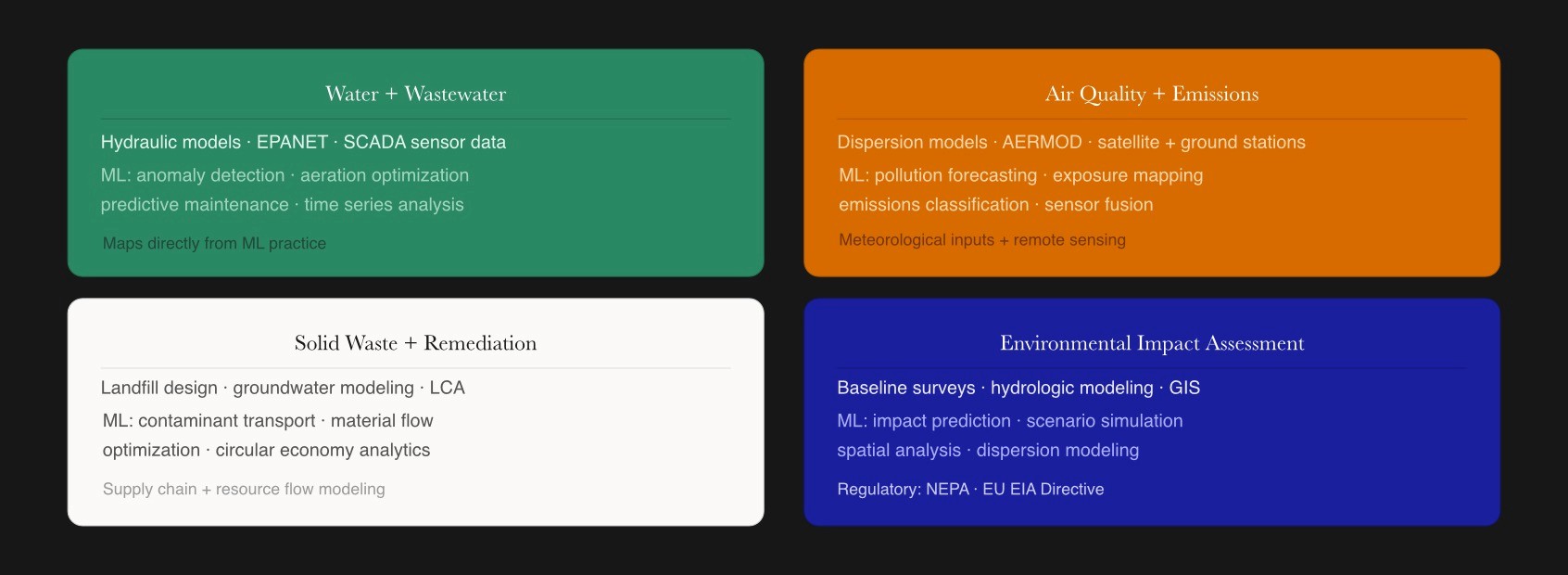
Environmental engineers may focus on specific areas such as water treatment, recycling, air pollution management, and environmental impact assessment. Each subfield has distinct models, regulations, and data needs. For practitioners familiar with time-series modeling or optimization from AI and ML work, environmental engineering offers many applications where these skills directly translate.
Environmental engineers help communities build resilience against extreme weather events through improved infrastructure and land-use planning. They design systems that minimize waste, increase energy efficiency, and use renewable resources.
Water Supply and Wastewater Treatment
Water supply and treatment involves designing systems to provide safe drinking water and treating wastewater to prevent waterborne diseases. Environmental engineers ensure access to safe drinking water and effective sanitation. Urban water supply work includes watershed assessment using hydrologic models and GIS, reservoir modeling for storage dynamics, and distribution network design for pressure and reliability.
Wastewater treatment plants follow a multi-stage structure: primary treatment (screening, grit removal, clarification), secondary biological treatment (activated sludge, sequencing batch reactors), and tertiary processes (nutrient removal, filtration, disinfection).

After events like the 2014 Flint water crisis in the United States, environmental engineers place stronger emphasis on corrosion control and real-time water quality monitoring.
Opportunities for data-heavy work include using sensor data and control algorithms to optimize energy use in aeration systems, which represent one of the largest electricity loads at treatment plants. Predictive maintenance and anomaly detection using time series analysis map directly to skills from ML practice.
Air Pollution and Atmospheric Control
Air pollution management includes analyzing and controlling industrial emissions and addressing issues like smog and ozone depletion. Environmental engineers design and evaluate controls on industrial stacks, power plants, and traffic-related emissions to reduce particulate matter and nitrogen oxides.
Regulatory dispersion models such as AERMOD and CALPUFF predict pollutant spread under the United States Clean Air Act and similar EU rules. Engineers configure meteorological inputs, terrain data, and source parameters, then compute design values for comparison against standards. PM2.5 management in major cities and flue gas desulfurization at coal plants during the 2000s and 2010s represent concrete applications.
High-resolution emissions data, remote sensing, and ML-based forecasting are increasingly used alongside traditional deterministic models. Integration of satellite data with ground stations generates exposure maps, while forecasting models combine meteorology and historical patterns to predict pollution episodes.
Solid Waste, Site Remediation, and Resources
Waste management encompasses solid waste handling, hazardous waste treatment, and cleanup of contaminated sites. Environmental engineers design landfills with composite liners, leachate collection systems, and gas capture for methane recovery. They also design municipal recycling systems and material recovery facilities.
Contaminated site remediation includes groundwater pump-and-treat, in situ chemical oxidation, and soil vapor extraction. United States Superfund projects under CERCLA represent a major area of practice. Environmental engineers work to restore contaminated land and water bodies to protect ecosystems and human health.
Lifecycle assessment and material flow analysis evaluate resource use and waste generation across supply chains. Many governments adopted circular economy strategies between 2020 and 2026, where environmental engineers provide technical support for nutrient recovery and industrial symbiosis systems.
Environmental Impact Assessment and Regulation
Environmental impact assessments evaluate the environmental impact of proposed construction projects and ensure compliance with regulations. Frameworks like the United States National Environmental Policy Act of 1970 and the EU EIA Directive require assessments before project approval.
Main components include baseline data collection on water quality, air quality, noise, and habitats; modeling of project impacts using hydrologic and dispersion models; and mitigation design such as replacement wetlands or stormwater controls. Environmental engineers apply scientific and engineering principles to evaluate potential adverse impacts and develop mitigation measures.
Similar frameworks exist globally, requiring environmental engineers to navigate cross-border regulations for energy, transport, and industrial projects. Engineers lead technical sections, bridging legal requirements and engineering design for planners and stakeholders.
Skills, Education, and Entry Pathways into Environmental Engineering
High School Preparation and Undergraduate Degrees
High school students considering environmental engineering should emphasize calculus, physics, chemistry, and biology, along with laboratory work. Students who excel in math, biology, chemistry, and problem solving tend to do well in environmental engineering programs.
Environmental engineers typically need a bachelor’s degree in environmental engineering or a related field such as civil or chemical engineering. Many universities offer programs through civil or chemical engineering departments, covering water and wastewater treatment and air pollution management.
Accreditation bodies such as ABET in the United States verify program quality and support licensure. Early exposure through internships, utility visits, and environmental clubs helps students gain experience with real environmental data and design problems.
Professional Licensure and Certifications
The professional engineer (PE) license path in the United States includes passing the FE exam, gaining supervised experience, and passing the PE exam in environmental or civil engineering. Senior environmental engineers leading design sign-off or environmental impact assessment chapters are usually licensed professionals.
In the European Union, chartered or registered engineer status varies by country. Examples include the UK Engineering Council and Dutch KIVI membership. Optional certifications like LEED professional credentials or specialized hazardous waste training are often required for site work.
Technical and Interpersonal Skills
Key technical strengths include numerical modeling, fluid mechanics, environmental chemistry, statistics, and regulatory frameworks. The growing importance of programming in Python, R, or MATLAB enables data analysis, optimization, and integration with sensors or control systems.
Environmental engineering programs emphasize both technical and communication skills. Core interpersonal skills include communicating complex environmental issues to nontechnical audiences and managing multidisciplinary project teams. Senior AI and ML practitioners should recognize environmental engineering as a domain where data literacy directly increases project impact.
Compensation, Demand, and Career Trajectories
How Much Environmental Engineers Earn by Region and Seniority
Environmental engineer salaries in the United States are typically centered around a $100K–$105K median (BLS, 2024), with entry-level roles often starting around $60K–$80K and experienced engineers earning $120K–$150K+, particularly in consulting, energy, and high-cost regions. Senior roles in specialized industries can exceed this range. Compensation varies significantly by geography, sector, and level of licensure.
Comparison with Related Engineering Disciplines
Environmental engineering pay is comparable to several other engineering disciplines. The following table provides clarity on relative compensation and growth:
Role | Approximate U.S. Median Salary (2024) | Projected Growth to 2034 | Typical Core Sector |
Environmental Engineer | $104,170 | 4-7% | Utilities, consulting, government |
Civil Engineer | $92,000-$97,000 | 5-8% | Infrastructure, construction |
Chemical Engineer | $120,000-$130,000 | 4-7% | Process industries, energy |
Environmental Consultant | $70,000-$90,000 | 4-6% | Consulting, compliance |
Environmental engineer salaries are competitive with civil engineering and offer steady growth. The field does not show explosive growth but benefits from structural tailwinds tied to regulatory compliance and critical infrastructure needs.
Industries, Growth Drivers, and Long-Term Stability
Main hiring industries include municipal and regional utilities, environmental and engineering consultancies, oil and gas and renewables, manufacturing, and government agencies. Companies across these sectors seek engineers who can ensure compliance with increasingly strict environmental regulations.
Demand growth connects to specific policies: the European Green Deal, United States Infrastructure Investment and Jobs Act of 2021, and corporate ESG reporting regulations after 2020.
Climate adaptation, resilience planning, and decarbonization projects are expected to sustain or increase demand for experienced environmental engineers globally. The focus on public health and environmental protection creates stable, long-term career prospects.
How Environmental Engineering Relates to Other Engineering and Data-Heavy Roles
Environmental vs Civil Engineering vs Sustainability Roles
Civil engineers focus more on structural safety and physical infrastructure, while environmental engineers specialize in the environmental performance of those systems. A civil engineer designs a bridge, while an environmental engineer handles stormwater quality and habitat impacts for the same project.
Sustainability roles often concentrate on corporate strategy, reporting, and stakeholder engagement. Environmental engineers remain design and operations oriented, delivering measurable environmental performance. Many professionals hold titles like “civil and environmental engineer,” showing the distinction can be blurry in practice.
Data, Software, and AI in Environmental Engineering Practice
Since the 2010s, sensor networks, remote sensing, and continuous monitoring have created high-volume data streams for air quality and water quality. Environmental engineers collaborate with software and data teams to build dashboards, forecasting tools, and automated reporting for regulators.
Concrete use cases for ML and advanced analytics include anomaly detection in wastewater treatment performance, predictive modeling of urban air pollution, and optimization of control systems. The technology landscape continues to evolve as data-driven approaches complement traditional physics-based models.
Conclusion
Environmental engineering is central to managing climate, health, and infrastructure risks through the 2030s. The field combines engineering disciplines, regulatory knowledge, and data skills to deliver measurable reductions in environmental impact. For readers in technical fields including AI and ML, environmental engineering offers a domain where quantitative expertise directly addresses pressing global challenges.
To break into the industry, explore ABET-accredited academic programs, review resources from prominent professional societies like the Water Environment Federation (WEF) or the Air & Waste Management Association (A&WMA), and target dedicated engineering job boards to find open environmental engineering opportunities.
FAQ
What does an environmental engineer do day to day?
What is the average salary for an environmental engineer?
What education and certifications do I need to become an environmental engineer?
How does environmental engineering differ from civil engineering or sustainability roles?
What industries hire environmental engineers and is the field growing?


