How to Find Software Engineer Jobs in NYC
By
Ethan Fahey
•

New York City is one of the world’s largest and most competitive hubs for software engineering talent, with more than 120,000 tech jobs across the metro area spanning finance, media, enterprise software, AI startups, and major technology companies. While the market experienced volatility during earlier layoffs, hiring for experienced engineers has stabilized and remains consistently strong heading into 2026. Companies including Google, Meta, Amazon, Two Sigma, Jane Street, and Bloomberg all maintain major engineering operations in the city, alongside a growing wave of AI-focused startups. In this blog, we’ll talk about how to find software engineer jobs in NYC and the surrounding areas.
Key Takeaways
New York City remains one of the densest markets globally for senior software engineering, data science, and machine learning roles, with over 3,000 active listings and a 4.6% increase in software jobs.
The best software engineer jobs in New York are now surfaced through a mix of direct networking, curated marketplaces like Fonzi, and targeted job boards rather than generic mass applications.
AI is used heavily in resume screening and candidate ranking, so structured, signal-dense profiles with quantifiable outcomes matter more than ever.
Interview processes in NYC skew toward practical systems design, data engineering, and machine learning evaluation rather than algorithm drills alone.
Curated platforms can reduce noise and accelerate matches, but human relationships and judgment still determine long-term fit.
Understanding the NYC Software Engineer Job Market
The software engineering job market in New York City is currently thriving, with a 4.6% increase in software jobs so far in 2026. This growth is shaped by post-pandemic hybrid work normalization, AI investment cycles, and ongoing fintech and quant hiring. There are over 3,000 software engineer jobs available in New York City, concentrated across several major clusters.
Current job opportunities in software engineering in New York City are concentrated in Artificial Intelligence, Fintech, and Media Infrastructure. Key hiring companies in NYC include Plaid, BlackRock, and Morgan Stanley, alongside big tech offices in Hudson Square and Midtown, quantitative trading firms like Jane Street and Citadel Securities, and AI-native startups in SoHo and Flatiron. The New York City software engineering market is influenced by sectors including AI, fintech, and healthtech, driving robust salary offers.
Key skills in demand for software engineering roles include AI and machine learning, data engineering, and full-stack development. Mastery of AWS, Azure, and Kubernetes has become a baseline requirement for many modern engineering roles. Core engineering foundations such as deep knowledge of System Design, Java, and SQL remain essential for scalable backend services. Software engineer jobs in NYC now blend classic full-stack and infrastructure work with data science, MLOps, and machine learning platform engineering responsibilities.
Sector | Typical Roles | Technology Stack | Interview Focus |
Big Tech | Staff Backend Engineer, ML Platform Engineer | Python, AWS, Kubernetes | Systems Design, Behavioral |
Quant/Fintech | Low-Latency Infra Engineer, Algo Developer | C++, Rust, FIX Protocol | Numerical Reasoning, Market Sims |
Banks/Enterprise | Data Engineer, Cloud Platform Engineer | Java, Spark, Snowflake | Data Pipelines, Compliance |
AI Startups | LLM Deployment Specialist, Research Engineer | PyTorch, JAX, Ray | Model Evaluation, RAG Systems |
Competition is high for roles like AI platform engineer, LLM infra engineer, and staff-level backend engineer. High demand exists for engineers who can secure AI and cloud environments in the cybersecurity domain. Candidates with depth in production systems and real-world impact still differentiate themselves effectively.
How AI and Data Are Changing Hiring in New York
Most New York companies have adopted AI hiring tools, especially for volume screening in software engineering roles. Recruiters use these tools for resume parsing, keyword extraction, and ranking for skills like Python, Rust, distributed systems, Kubernetes, data engineering, and machine learning frameworks.
Candidate profiles that map skills to concrete outcomes perform better in automated filters and human review.
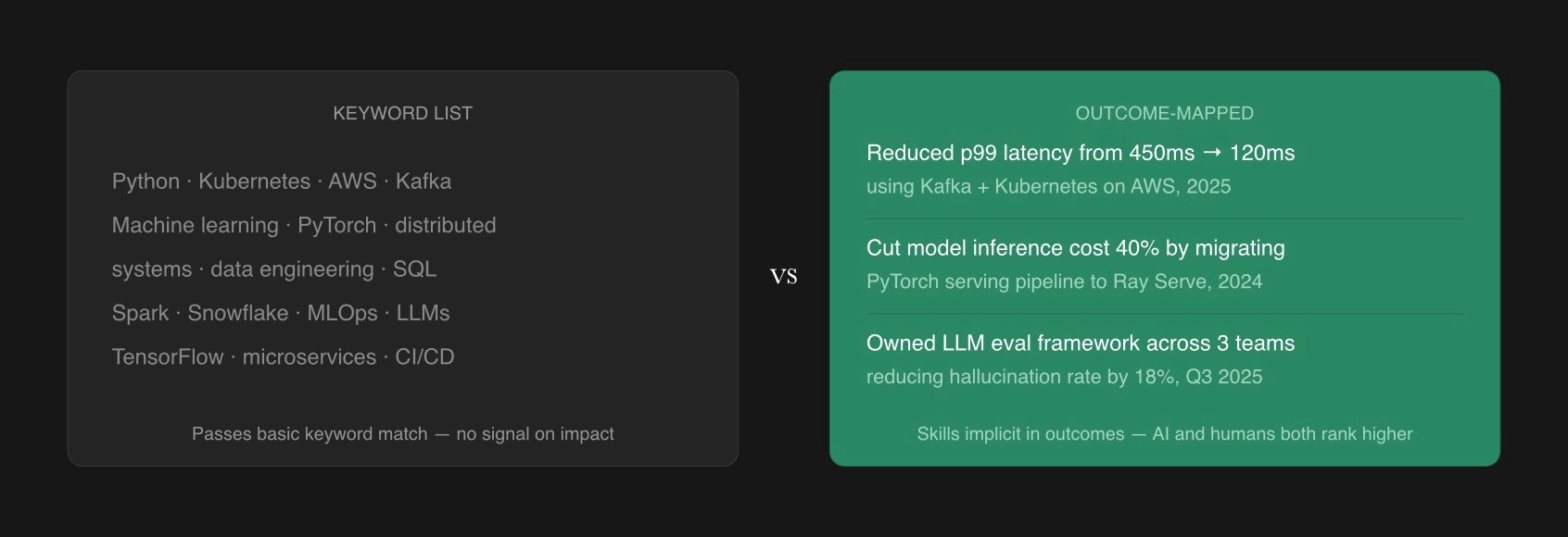
For example, stating “reduced 99th percentile latency from 450 ms to 120 ms in 2025” outperforms generic skill lists. Curated marketplaces and match-based platforms, such as Fonzi for vetted software engineers and AI specialists, often layer human curation on top of algorithmic matching. This approach can reduce noise compared with large public boards while preserving judgment on cultural and technical fit.
In New York, where many teams are small, hiring managers still prioritize referrals, direct conversations, and track record over scores from automated systems. AI coding tools are estimated to boost developer productivity by 30 to 50 percent, influencing how companies evaluate candidates who demonstrate fluency with these tools.
Where To Find Software Engineer Jobs In NYC
The main challenge in New York is not a lack of software engineer jobs, but filtering for roles that match senior candidates’ interests in infrastructure, data science, and machine learning. Job listings for engineers in New York City can be found on various platforms, including Indeed, LinkedIn, and Glassdoor.
Curated talent marketplaces that focus on vetted software engineers and AI professionals often pre-align compensation bands, technical domains, and seniority. Software engineers in New York City can expect to find opportunities across various industries, including finance, technology, and healthcare. New York City offers numerous software engineering opportunities with high demand for full-stack, backend, and AI-focused roles across various industries.
Concrete NYC-relevant resources include:
Niche job boards for AI and tech roles, like Fonzi AI
ML-specific boards for research engineer and LLM jobs
Alumni networks from universities like Columbia, NYU, and Cornell Tech
Direct referrals from engineers at firms such as Datadog, MongoDB, or Bloomberg
Referrals in NYC often bypass some automated screening entirely. Physical and virtual communities matter: NYC ML meetups, data engineering meetups, and open-source project communities with a strong New York presence all provide access to opportunities before they hit public boards. Senior candidates should maintain an updated LinkedIn profile tailored to NY searches, explicitly listing cloud platforms, languages, and production ML or LLM experience relevant to the local market.
Using Traditional Job Boards Without Getting Lost
Indeed, LinkedIn Jobs and company career sites still list a large share of NYC software engineer jobs, but are noisy for senior engineers. The use of hybrid and in-person interviews is becoming more common again in NYC, leading to a decline in remote work opportunities.
To filter effectively:
Set location to New York, NY or hybrid with NYC office
Filter by seniority level: Senior, Staff, Principal
Add specific skills like a machine learning platform, ML infra, or data engineering
Scan postings for concrete signals like ownership of production systems, cross-team architecture work, or collaboration with research teams. These indicators are more relevant to experienced engineers than generic feature development roles. Track companies over time by saving searches and observing which New York teams consistently hire for high-impact systems or research engineer roles.
Positioning Your Profile For NYC Software Engineering Roles
In a dense market like New York, your public profile and resume must clearly communicate scope, impact, and technical depth, especially for AI and infra positions. Proficiency in Python, LLMs, and RAG systems is critical for AI roles as demand has significantly increased.
Restructure your resume so that each role includes quantifiable outcomes tied to specific years. For example, include metrics like latency reduction, throughput increases, model performance improvements, or cost savings. Align terminology with NYC employers using phrases like low-latency trading systems, OLAP data warehouses, feature stores for machine learning, or multi-tenant SaaS architecture when they accurately reflect your experience.
Maintain a concise portfolio of public artifacts: open-source contributions, technical blog posts, conference talks given in New York meetups, or Jupyter notebooks and model cards for ML work. Tailor LinkedIn and GitHub specifically for AI and data science adjacent roles, including sections that make it easy for recruiters to see experience with PyTorch, TensorFlow, JAX, Mojo, Kubernetes, Spark, Snowflake, and production LLM deployment. Marketplaces like Fonzi often ask for structured data about past roles, including team size, system scale, and technology stack, so preparing this once can be reused for multiple platforms.
Optimizing For AI-Driven Screening
Many NYC employers use AI tools to search for specific skills and project types, so profiles should map skills to achievements rather than listing long keyword blocks. Include both general terms like machine learning and concrete technologies like PyTorch 2.11/2.12, Ray Serve, Kafka, Terraform, and AWS EMR.
Use consistent job titles that align with how New York companies search. Terms like Senior Software Engineer, Staff Machine Learning Engineer, or Senior Data Engineer work better than highly customized internal titles. A candidate with a bachelor’s degree in computer science or a related field should make this clear. Clear formatting, standardized sections, and avoiding images for key text make it easier for parsers to correctly evaluate the resume.
Navigating NYC Interview Processes For Software Engineers
New York interview processes typically blend algorithms, practical coding, distributed systems design, and, for many roles, data or ML-centric evaluations. Common patterns include recruiter screening, a technical phone or virtual interview, a half-day or full-day onsite (often virtual hybrid), and final conversations with leadership or cross-functional partners.
Fintech and quant firms in New York often emphasize low-latency systems, numerical reasoning, and C++ or Rust, while AI startups and research labs emphasize Python, GPU workloads, and LLM evaluation practices. Senior candidates should prepare recent, concrete examples of architecture decisions, incident response, and end-to-end ownership of systems deployed. These examples often drive staff-level interview discussions.
Some companies use Agentic Interview Sandboxes or pair-programming tools, but human interviewers still make final decisions based on how candidates reason about trade-offs. You will work closely with interviewers to demonstrate your ability to collaborate and contribute to technical solutions.
Sector | Primary Interview Focus |
Big Tech | Coding, Systems Design, Behavioral, ML |
Fintech | Latency Optimization, Algorithms, Quantitative Reasoning |
AI Startup | Deployment, Model Evaluation, Infra Architecture |
Enterprise SaaS | Data Pipelines, Scalability, Integrations |
Preparing For AI, Data Science, and Machine Learning Interviews
For AI engineer or ML researcher style roles, NYC companies increasingly expect familiarity with practical model deployment, observability, and failure modes, not only academic modeling. Demand remains high for experienced engineers in AI, fintech, and cybersecurity in New York City.
Review core topics, including real-time RAG orchestration and agentic loops, offline versus online evaluation, monitoring of drift, GPU utilization, and cost management for large language model workloads. AI agents and generative AI systems require knowledge of workflows, databases, and documentation practices.
Prepare case studies about real systems you deployed recently, including what went wrong, what was learned, and how reliability or model quality improved. Practice communication of complex technical decisions to product, risk, or compliance stakeholders. This skill is particularly relevant in New York financial institutions, where you must partner with non-technical teams. Demonstrate troubleshooting skills and your ability to develop solutions under pressure. Understanding code reviews, operations, and efficiency matters for these discussions.
Compensation, Negotiation, and Long-Term Fit in NYC
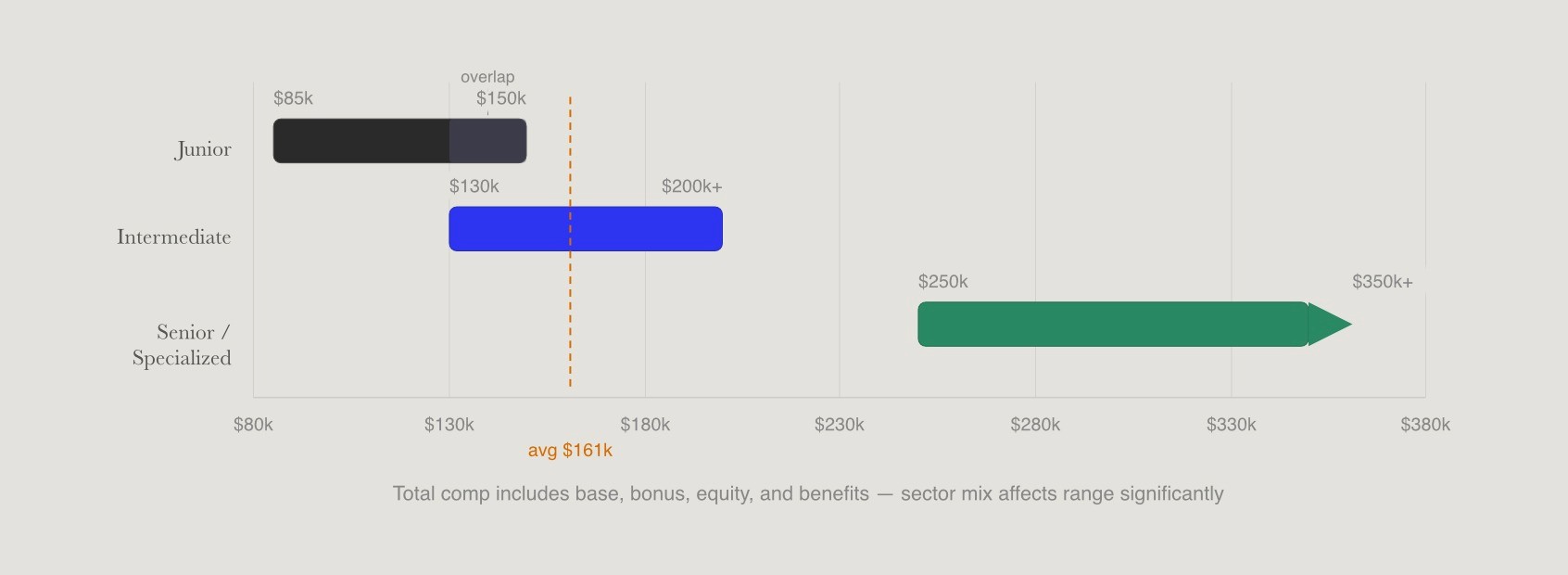
Compensation for software engineer jobs in New York ranges widely, depending on the sector, from early-stage AI startups to hedge funds. The average salary for a software engineer in NYC is approximately $161,396, with senior or specialized roles often exceeding $250,000.
Salaries for intermediate software engineering roles in NYC often range between $130,000 and $200,000 or more. In NYC, junior software engineering roles often start around $85k to $150k, while senior and specialized AI roles can exceed $250k to $350k or more.
Evaluate total compensation carefully: base, bonus, equity, signing bonus, and benefits, including medical, dental, and vision coverage. Consider paid time off policies and remote or hybrid flexibility, which affect quality of life in NYC.
Benchmark offers across sectors. Big tech offices offer stability, fintech offers significant bonuses, quant trading firms offer cash-heavy packages, and AI-focused startups may offer meaningful equity rather than large cash bonuses. Curated marketplaces sometimes standardize band information upfront, giving candidates better visibility into compensation expectations before deep interviews begin. Consider long-term fit: technical roadmap, autonomy, culture of collaboration, tolerance for experimentation, and whether the company integrates AI into its core product or treats it as a side project.
Negotiating With NYC Employers
Negotiation is expected at senior levels in New York, especially for software engineers, data scientists, and ML engineers with strong track records. Prepare a data-driven case using recent market data from 2024 through 2026, peer discussions, and multiple offers when possible, while remaining factual and concise in conversations.
Clarify constraints like start date, equity vesting schedules, and relocation or hybrid work requirements early, particularly if moving to New York from another city like those in New Jersey, Illinois, or California. The company you join should protect your interests through clear employment terms. Understand the position responsibilities, access to projects, and the business operations you will contribute to. Ask about the vision for the team you will join and whether they seek engineers who can build at scale through designing new systems. Confirm net compensation after understanding all benefits, including 401 (k) match and pay structures.
Conclusion
New York continues to be one of the most concentrated markets for senior software engineering, data science, and machine learning talent, but standing out requires a focused and signal-rich job search strategy. Engineers who align their resumes and public profiles with modern AI-driven screening systems, participate in trusted technical communities, and prepare thoroughly for practical, systems-oriented interviews tend to surface stronger opportunities more quickly. In a market as competitive as NYC, depth, clarity, and proof of real-world impact matter far more than broad keyword optimization alone.
Platforms like Fonzi help experienced AI and engineering talent connect with companies through more focused, high-signal recruiting processes that emphasize technical depth, practical experience, and long-term fit rather than sheer application volume.
FAQ
Where are the best places to find software engineer jobs in NYC?
What types of companies hire the most software engineers in New York City?
How competitive is the NYC software engineering job market right now?
Should I target startups or big tech for software engineer roles in NYC?
What salary and benefits should I expect from software engineering jobs in NYC?


