Resume Comparison Tools: Match Your Resume to Job Descriptions Fast
By
Samara Garcia
•

It’s early 2026. A senior AI engineer with real LLM production experience can apply to dozens of roles and still hear nothing back. Not because the resume is weak, but because most resume comparison tools still optimize for keywords and formatting. Serious AI/ML teams care about shipped systems, architecture, and research depth, not how often “Python” appears.
Fonzi takes a different approach, matching AI talent with high-intent roles where the fit is real. It’s not about gaming ATS systems; it’s about reaching teams that actually value your experience. To navigate this landscape, you first need to understand how resume comparison really works.
Key Takeaways
Resume matching now prioritizes real projects, tech stacks, and impact, not keywords.
Fonzi uses AI to create fair, high-signal matches with clear expectations.
Match Day compresses warm intros into days, not months.
AI augments hiring; humans make final decisions.
Serious AI roles value architecture, research depth, and shipped systems over surface keywords.
What Is a Resume Comparison Tool (and Why It Matters in AI Hiring)?

A resume comparison tool checks your resume against a specific job description and scores how well they align, flagging skills, gaps, and mismatches before you apply. Think of it as a pre-flight check for ATS systems.
Tools like Jobscan, SkillSyncer, and LinkedIn’s AI suggestions are now standard, but most are built for generic software roles. They struggle with what actually matters in AI hiring: shipped systems, model scale, infra complexity, and research depth. A keyword score can’t explain why your RAG system or large-scale training experience is the perfect fit.
Top AI companies still use ATS as the first gate. The goal isn’t keyword stuffing; it’s making your real impact unmistakable on paper so it reaches the humans who know its value. Done right, resume comparison becomes leverage, not a hack.
How Traditional Resume Comparison Tools Work Under the Hood
Most resume comparison tools mirror how ATS and human recruiters scan applications. Understanding their mechanics helps you see both their value and their limitations, especially for AI/ML roles where depth matters more than surface-level keywords.
At a high level, these tools parse text from your resume (whether it’s a PDF resume or a Microsoft Word document), extract sections (experience, skills, education), and then compare that content against the job description’s phrases, skills, and requirements. The output is typically a match score, a list of missing keywords, and recommendations for improvement.
Typical scoring dimensions include:
Keyword overlap: Does your resume mention “PyTorch,” “LLM fine-tuning,” “Kubernetes,” or whatever the job ad specifies?
Formatting compliance: Are you using standard headings, readable fonts, and simple formatting without images or complex tables that break parsing?
Seniority alignment: Do your job titles and years of experience match what the role expects?
Location and authorization: Some tools flag geographic mismatches or work authorization issues.
The problem is that most tools weigh explicit, surface-level mentions more heavily than context. A bullet like “trained a 7B parameter transformer with DeepSpeed ZeRO-3 on 128 A100s” demonstrates serious distributed training experience. But if the JD simply says “experience with distributed training,” a basic ATS resume scanner might not recognize the depth of that accomplishment.
For AI/ML roles specifically, common limitations include:
They rarely evaluate model quality or production robustness
Research novelty and publication impact are invisible to keyword matchers
Infra tradeoffs (latency vs. cost, scale vs. complexity) aren’t captured
Cross-functional impact, working with product, research, and platform teams, gets flattened into generic phrases
This is why a resume that “scores well” on a free resume review tool might still fail to land interviews at the companies you actually want.
Traditional Resume Scanners vs. High-Signal Matching for AI Roles
Dimension | Generic Resume Scanner | High-Signal AI/ML Matching (like Fonzi) |
Data Used | Keywords extracted from the resume and the job listing | Project depth, tech stacks, scale metrics, research outputs, and structured profile data |
Role Understanding | Generic software engineering categories | AI-specific domains: LLM infra, ML research, recommendation systems, MLOps, etc. |
Matching Method | Keyword frequency and overlap scoring | Mutual fit analysis: team stage, scope, remote preferences, domain interests |
Bias Risk | Can reinforce pedigree bias (school names, employer brands) | Explicitly de-emphasizes superficial signals in favor of demonstrated work |
Output | Match score and keyword recommendations | Curated introductions to hiring managers at vetted companies |
Time to Result | Instant feedback, but requires manual application to each role | Match Day model delivers multiple aligned intros in a concentrated window |
Candidate Experience | Self-service; no human review | Human + AI review provides quality on both sides |
Control Over Distribution | Candidate applies broadly; resume goes everywhere | Candidate profile shown only to relevant, pre-vetted opportunities |
This table highlights a fundamental difference: generic scanners optimize for getting past automated filters, while high-signal matching optimizes for getting you into conversations with the right people.
Resume Comparison for AI Engineers, ML Researchers, and Infra Specialists

AI roles in 2026 span research labs, product teams, infra platforms, and applied LLM groups. Each has different “signals” that matter, and effective resume comparison means understanding what each type of role values most.
For AI/ML Engineers
Focus on shipped systems. Hiring managers want to see production LLM applications, recommendation engines, computer vision systems, or large-scale training and inference pipelines. Include specific skills and metrics:
Latency improvements (e.g., “reduced p95 inference latency from 400ms to 180ms”)
Cost optimization (e.g., “cut GPU spend by 40% through better batching and model distillation”)
Throughput and scale (e.g., “serving 50M daily predictions with 99.9% uptime”)
For ML Researchers
Highlight peer-reviewed publications at venues like NeurIPS, ICML, ICLR, and ACL. Include preprints with real traction on arXiv, reproducible open-source code, and collaboration history with other research groups. Your resume summary should make your research focus immediately clear.
For Infra and Platform Engineers
Emphasize scale and reliability. Relevant signals include:
GPU cluster management and orchestration (Kubernetes, Ray, Slurm)
Multi-region deployments on AWS, GCP, or Azure
Vector databases in production (Pinecone, Weaviate, Milvus, Qdrant)
Observability stacks and concrete SLOs/SLIs you’ve maintained
For LLM Specialists
Call out the specific details that differentiate you:
Prompt engineering frameworks and evaluation methodologies
RAG architectures and retrieval optimization
Custom fine-tuning approaches (LoRA, QLoRA, full fine-tuning)
Eval suites and benchmarking experience
Model families you’ve worked with (Llama 3, Mistral, GPT-4.x, Claude 3.5)
Effective job description matching for these roles means mapping each of these concrete experiences directly to the responsibilities and tech stack listed in the specific job posting—not just adding buzzwords to hit a match rate target.
How Fonzi Uses AI for High-Signal Matching (Not Just Scoring)
Fonzi was built for AI engineers and researchers whose real work gets lost in traditional hiring systems. Strong candidates disappear into the noise while companies struggle to hire fast.
Instead of scoring resumes against generic job ads, Fonzi looks at real signals like your tech stack, role history, research, and production impact. It matches that data to active hiring plans from vetted AI labs and tech companies, not stale postings.
Matching goes beyond keywords. It accounts for team stage, role scope, and domain fit, recognizing signals most scanners miss, from model scale to open-source work and end-to-end ownership.
AI narrows the field, but humans review every match. The goal is focus, not automation.
Inside Fonzi Match Day: Turning Resume Comparisons into Real Interviews
Match Day is a recurring event where Fonzi presents a curated cohort of AI talent to actively hiring companies. It’s designed to compress timelines and increase signal for everyone involved.
The flow is straightforward:
You apply once and complete a structured profile
Fonzi’s AI and human team review your background
On Match Day, aligned roles and candidates are paired
Intros are sent in a tight window, typically within the same week
Instead of cold-applying to 40 roles over two months and hoping something sticks, you might receive 3–7 targeted intros to companies that have already vetted your profile and are ready to talk that week.
Match Day is small, focused, and built for signal, not volume. Many candidates start real interview processes within days.
Instead of weeks lost in ATS funnels, one senior LLM engineer joined a Match Day and quickly entered multiple interview tracks with teams that actually fit. That’s the difference between chasing applications and finding alignment.
Practical Tips: Comparing Your Resume to AI Job Descriptions (With or Without Tools)
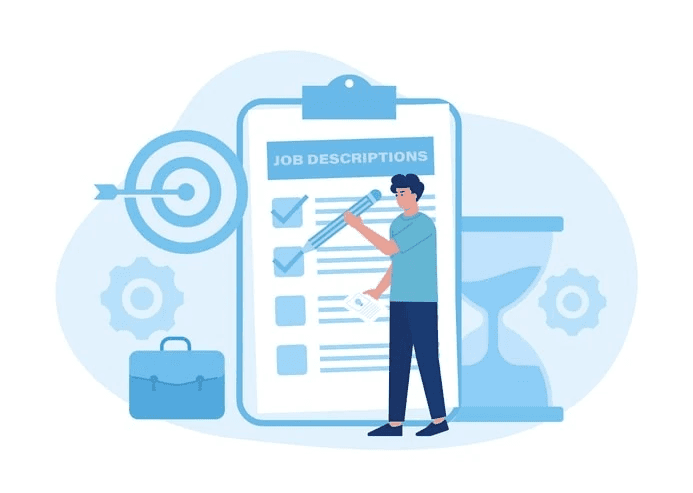
Even if you never use a formal resume scanner, you can borrow the logic behind resume comparison to tailor your applications effectively. Here’s a simple process that works:
Step 1: Copy and paste the JD into a separate document. This gives you a clean workspace to analyze what the role actually requires.
Step 2: Highlight core responsibilities. What will this person actually do day-to-day? Training models? Optimizing inference? Building data pipelines? Managing a team?
Step 3: Underline required and preferred skills. Note the specific technologies, frameworks, and experience levels mentioned. These are your important keywords for this specific job.
Step 4: List implied competencies. A role mentioning “real-time ML systems” implies experience with low-latency serving, monitoring, and possibly streaming data. A role at a small startup implies wearing multiple hats.
Step 5: Map each requirement to your resume. For every item you highlighted or underlined, find the corresponding bullet on your resume, or note that it’s missing. Rewrite bullets so they mirror the level of abstraction in the JD while staying honest about your experience.
Group your experience by outcomes that match the role, like reducing latency, improving accuracy, or shipping new AI features. This makes the fit clear to both ATS and hiring managers.
Summary
Resume comparison tools are everywhere, but most still miss what actually matters in AI hiring. Keyword scores and formatting checks can help you clear ATS filters, but they don’t capture real impact like shipped systems, model scale, or research depth. Serious AI teams care about what you’ve built, owned, and operated in production.
Fonzi takes a higher-signal approach by matching full technical profiles to active hiring plans at vetted AI companies. Instead of optimizing for applications, it optimizes for alignment. Through structured profiles, human review, and Match Day introductions, candidates move faster into real conversations with teams that value their experience.
The takeaway is simple. Use resume tools to avoid getting filtered out, but don’t rely on them to tell your story. Focus on clarity, depth, and outcomes, and choose hiring platforms that prioritize fit over volume. That’s how strong AI talent gets seen and hired.
FAQ
What are the best resume comparison tools?
How do resume and job description comparison tools work?
Can resume comparison tools help with ATS optimization?
How do I compare my resume to a job description manually?
What should I look for when comparing resumes to job postings?