Interview Tips That Actually Work: Expert Advice for Landing the Job
By
Ethan Fahey
•
Hiring has changed so dramatically that most traditional interview advice no longer applies. Companies now rely on AI-driven screening systems, virtual interviews across global time zones, and take-home projects that mirror real production challenges, meaning candidates need to prepare for a very different process than the one older career guides describe. In this environment, standing out requires more than strong technical skills; it demands an understanding of how modern hiring pipelines work and how to position yourself within them.
For both recruiters and AI engineers, platforms like Fonzi AI are reshaping this process by streamlining technical evaluations and matching teams with candidates who are aligned not just on skill, but on real project readiness. Fonzi’s AI-powered matching and efficient Match Day events help companies reduce hiring friction while giving engineers a clearer, more predictable path to high-impact roles.
Key Takeaways
Thorough preparation, including company research and technical skill examples, increases interview success by 60% for AI engineers
Modern hiring platforms like Fonzi’s Match Day use AI to create more efficient, high-signal connections between candidates and top-tier companies
The STAR method (Situation, Task, Action, Result) provides a structured approach to answering behavioral questions that showcases your impact
Following up within 24 hours with personalized thank-you emails can differentiate you from 70% of candidates who don’t follow up
Technical interviews now focus more on a problem-solving approach and cultural fit rather than just coding ability
Essential Pre-Interview Preparation
The foundation of interview success lies in preparation that goes far beyond reviewing your resume. Research shows that candidates who invest 2-3 weeks in focused preparation see a 60% higher success rate compared to those who wing it. This preparation timeline allows you to research the company thoroughly, refresh core concepts, and practice coding problems without the stress of cramming.
Research the Company’s AI Initiatives
Start by diving deep into the company’s engineering culture through their technical blog, GitHub repositories, and recent product launches. Look for clues about their AI infrastructure, preferred frameworks, and engineering challenges. If you’re interviewing at a company that recently published research on transformer architectures, for example, prepare to discuss your experience with attention mechanisms and language models.
Review the job description with forensic attention to detail. Identify 3-5 specific technical skills mentioned and prepare concrete examples from your experience for each. If the role emphasizes “experience deploying models to production using Kubernetes,” have ready a detailed story about your containerization and orchestration work, including the specific challenges you faced and metrics that improved.
Practice coding problems on platforms like LeetCode or HackerRank, but focus on algorithms relevant to the role rather than generic brain teasers. For machine learning positions, this means reinforcing your knowledge of optimization algorithms, data structures for handling large datasets, and statistical concepts that underpin model evaluation.
Research your interviewers on LinkedIn and company websites to understand their background and potential conversation topics. This isn’t about stalking, it’s about finding genuine connection points and understanding the technical perspective they’ll bring to your evaluation.
Technical Skills Preparation
Review fundamental machine learning concepts with the depth expected at your level. For senior positions, you should be prepared to discuss the mathematical foundations behind algorithms, not just their applications. Understand the trade-offs between different approaches: why you might choose a random forest over a neural network for tabular data, or when ensemble methods provide better results than single models.
Prepare to discuss your experience with popular AI frameworks like TensorFlow, PyTorch, or Scikit-learn with specific project examples. Don’t just mention that you’ve used these tools, instead be ready to explain architecture decisions, optimization strategies, and how you handled real-world challenges like overfitting, class imbalance, or computational constraints.
Practice explaining complex technical concepts in simple terms, as you may need to communicate with non-technical stakeholders during interviews or in the role itself. The ability to distill machine learning concepts for product managers or executives is increasingly valuable and often tested through role-playing scenarios.
Prepare examples of how you’ve handled model bias, data quality issues, or scalability challenges in previous projects. These real-world problem-solving stories demonstrate your maturity as a practitioner and differentiate you from candidates who only have academic or tutorial experience.
Behavioral Question Preparation
Use the STAR method to structure 5-7 stories covering leadership, conflict resolution, innovation, and failure recovery. This framework: Situation, Task, Action, Result, provides a clear structure that interviewers can easily follow and evaluate. Focus on your specific actions rather than what “we” did as a team, and quantify results whenever possible.
Prepare specific examples of how you’ve collaborated with cross-functional teams, including product managers, designers, and business stakeholders. AI engineering increasingly requires working across disciplines, and companies want to see evidence that you can translate between technical and business requirements.
Practice discussing times you’ve had to learn new technologies quickly or adapt to changing project requirements. The AI field evolves rapidly, and employers value candidates who demonstrate continuous learning and adaptability. Frame these stories around your learning methodology and how you contributed value even while gaining new skills.
Prepare examples of how you’ve contributed to open-source projects or mentored junior developers. These experiences showcase technical leadership and community engagement, qualities that become more important as you advance in your career.
Mastering the Interview Day
The interview day itself is where your preparation pays off. Success depends not just on what you know, but how effectively you communicate your knowledge and approach problems in real-time. Modern interviews often span multiple formats, from live coding sessions to system design discussions, each requiring specific strategies.

Arrival and Initial Logistics
Arrive 10-15 minutes early and use the time to observe the office environment and company culture. Notice how employees interact, whether the atmosphere feels collaborative or hierarchical, and if the workspace reflects the company values described during your research. These observations can inform your questions and help you assess cultural fit.
Bring 5 printed copies of your resume, a notebook for taking notes, and a list of thoughtful questions about the role. While most information is shared digitally, having physical copies demonstrates preparedness and provides backup if technology fails.
For virtual interviews, test all technology 30 minutes before the scheduled interview time, including a backup internet connection and a quiet space setup. Ensure your camera is at eye level, lighting illuminates your face clearly, and background noise is minimized. Have your resume, job description, and prepared questions easily accessible on your screen.
Dress appropriately for the company culture, business casual works for most tech companies unless specified otherwise. When in doubt, slightly overdressing shows respect for the process and helps you feel confident.
During Technical Discussions
Walk through your thought process out loud when solving coding problems or explaining technical concepts. Interviewers care more about your reasoning process than whether you immediately identify the optimal solution. Start by clarifying the problem, restating assumptions, and proposing a naive solution before iterating toward improvements.
Ask clarifying questions before diving into solutions to demonstrate thorough analysis skills. In real AI engineering work, requirements are rarely perfectly specified, so showing that you think about edge cases, constraints, and trade-offs signals strong engineering judgment.
Discuss trade-offs and alternative approaches, showing depth of technical understanding. For example, when designing a recommendation system, explain why you might choose collaborative filtering over content-based filtering, or how you’d balance model complexity against inference latency requirements.
Be honest about knowledge gaps and explain how you would research or learn what you don’t know. This honesty, combined with a clear learning approach, often impresses interviewers more than pretending to know everything.
Connect your technical choices to business impact whenever possible. For example, explain how reducing model training time from hours to minutes enables faster experimentation cycles, or how improving prediction accuracy by 2% translates to increased revenue or user satisfaction.
Effective Communication Strategies
Use the “present, past, future” framework when answering “tell me about yourself”—describe your current role, relevant background that led you here, and why you want this specific position. This structure provides context for your experience while demonstrating intentional career progression.
Keep responses concise and focused, aiming for 2-3 minutes maximum for behavioral questions. Practice timing your answers to avoid rambling while ensuring you cover all essential points of your STAR stories.
Ask thoughtful questions about team dynamics, technical challenges, and future growth opportunities. Questions like “What does success look like in this role after six months?” or “What technical challenges is the team currently prioritizing?” show genuine interest and help you evaluate the opportunity.
Show genuine enthusiasm for the company’s mission and the specific role you’re interviewing for. Research-backed enthusiasm, such as referencing specific products, recent announcements, or technical blog posts, demonstrates authentic interest rather than generic excitement.
Post-Interview Follow-Up Strategy
The interview process doesn’t end when you leave the building or hang up the video call. Strategic follow-up can differentiate you from other candidates and demonstrate the professionalism that employers value in senior technical roles.

Send personalized thank-you emails within 24 hours to each person you interviewed with. This timeline shows respect for their time while keeping you fresh in their memory. Reference specific topics discussed during your conversation to make the email memorable and demonstrate active listening.
Reiterate your interest in the role and briefly mention how you can contribute to their specific challenges. For example, if the hiring manager mentioned struggles with model deployment latency, reference your experience optimizing inference pipelines and suggest a brief follow-up conversation to share relevant techniques.
Follow up with the recruiter about next steps and timeline for decision-making. Understanding the process helps you manage expectations and plan your job search timeline. Most companies can provide rough timelines for final decisions, even if they can’t guarantee exact dates.
Continue applying to other positions while waiting for results to maintain momentum. The job search is a numbers game, and keeping multiple opportunities active reduces pressure on any single interview while giving you negotiating leverage if you receive multiple offers.
Navigating the Modern AI Hiring Landscape
The artificial intelligence job market has undergone dramatic changes that affect how companies evaluate candidates and what skills they prioritize. Understanding these shifts helps you position yourself effectively and focus your preparation on what actually matters to today’s employers.
The AI job market has shifted toward specialized roles requiring both technical depth and business acumen. Companies no longer just want researchers who can publish papers, they need engineers who can ship products, understand user needs, and collaborate effectively with cross-functional teams. This evolution means interviews increasingly test your ability to translate technical possibilities into business outcomes.
Companies now prioritize candidates who can demonstrate real-world impact over those with just academic knowledge. Your GitHub contributions, deployed models, and measurable business results matter more than your GPA or the prestige of your degree. Prepare concrete examples of how your work improved key metrics, reduced costs, or enabled new product capabilities.
Remote and hybrid work options have expanded the talent pool, making competition more intense but opportunities more diverse. You’re no longer limited to companies in your geographic area, but you’re also competing with talented engineers globally. This shift emphasizes the importance of standing out through specialized skills and proven results rather than just local network connections.
Technical assessments often include take-home projects that simulate actual work scenarios rather than whiteboard coding. These projects evaluate your ability to handle ambiguous requirements, make reasonable assumptions, and deliver working solutions within realistic time constraints. They also test your code organization, documentation, and communication skills through written explanations.
Soft skills like communication, collaboration, and adaptability are increasingly valued alongside technical expertise. As AI integrates more deeply with product development, engineers must work effectively with designers, product managers, and business stakeholders who may lack technical backgrounds.
Industry Trends Shaping AI Hiring
Companies are focusing on responsible AI development, requiring candidates to understand ethics and bias mitigation. Prepare to discuss fairness metrics, algorithmic bias detection, and strategies for building inclusive AI systems. These topics appear frequently in interviews at companies conscious of AI’s societal impact.
Cross-functional collaboration skills are essential as AI integrates with product, design, and business teams. Interviewers often probe your ability to explain technical trade-offs to non-technical stakeholders and incorporate business constraints into technical decisions.
A continuous learning mindset is crucial due to rapid advancements in AI technologies and methodologies. Companies want evidence that you stay current with research developments and can adapt to new frameworks and techniques as the field evolves.
Experience with MLOps, model deployment, and production systems is becoming as important as model development. Understanding containerization, monitoring, CI/CD pipelines, and cloud infrastructure distinguishes production-ready engineers from academic researchers.
How Fonzi’s Match Day Transforms Technical Hiring
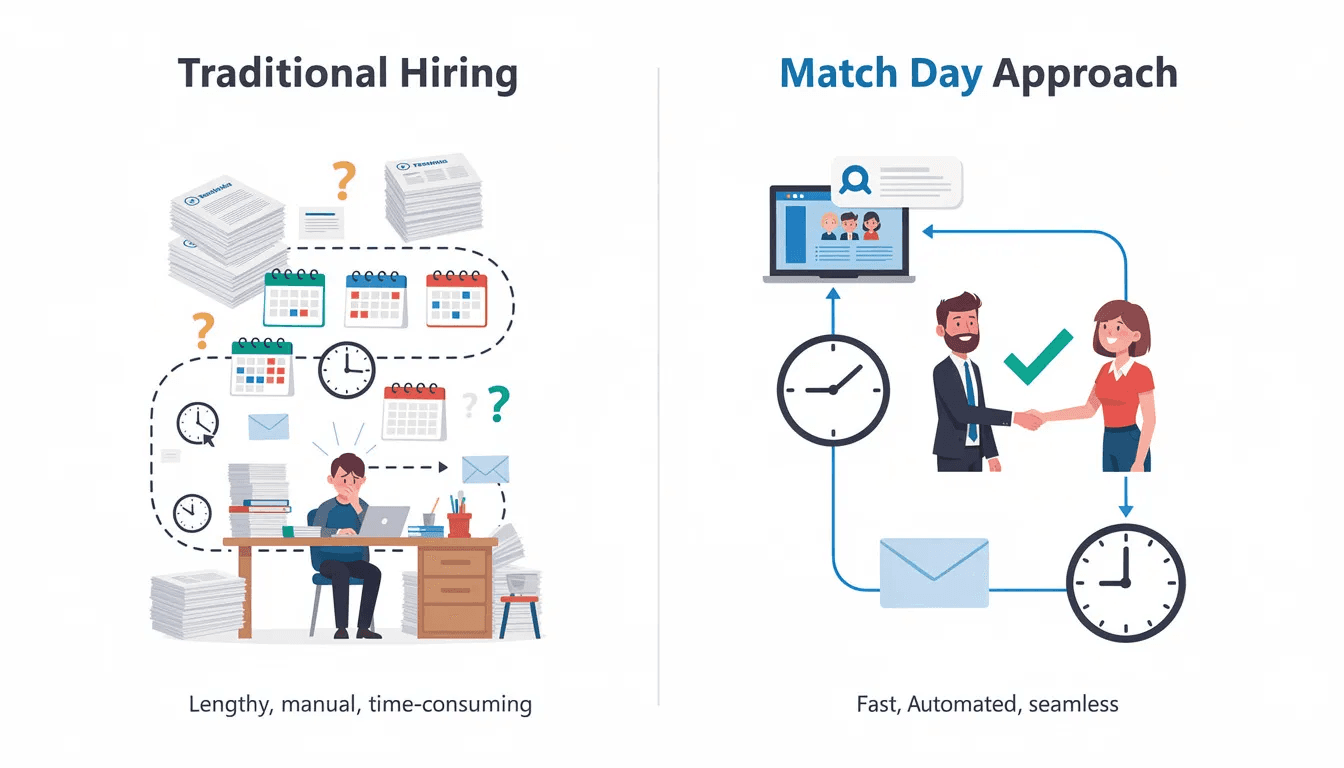
Traditional hiring processes often waste time for both candidates and companies. Candidates spend weeks applying to positions with unclear fit, while companies sift through hundreds of resumes to find a few qualified candidates. Fonzi’s Match Day represents a fundamental shift toward efficient, high-signal hiring that benefits everyone involved.
Match Day creates a structured, efficient process where vetted candidates meet with multiple top-tier companies in one coordinated event. Instead of managing separate application timelines across dozens of companies, candidates participate in a concentrated day of high-quality conversations with hiring managers who are actively seeking their specific skills.
AI-powered matching algorithms analyze both technical skills and cultural fit to create high-signal connections. Fonzi’s platform considers factors beyond keyword matching, instead observing project complexity, collaboration style, growth trajectory, and mutual preferences about work environment, compensation, and role focus. This intelligent matching increases the likelihood that conversations lead to mutual interest.
The platform eliminates lengthy application processes by pre-screening candidates and facilitating direct conversations with hiring managers. Rather than submitting applications into digital black holes, candidates engage directly with decision-makers who can provide immediate feedback and move qualified candidates quickly through the process.
Companies participate because they get access to a curated pool of qualified AI engineers, reducing time-to-hire from months to weeks. Traditional recruiting often involves extensive sourcing efforts to find candidates with specific AI expertise. Match Day delivers pre-vetted candidates who meet technical requirements and are actively seeking new opportunities.
Candidates benefit from multiple opportunities in one day, reducing job search stress and increasing leverage in negotiations. Having several companies interested simultaneously provides valuable market feedback about your skills and compensation expectations while strengthening your negotiating position.
Why Match Day Works for AI Engineers
Focusing on skill demonstration rather than resume parsing allows technical talent to showcase abilities directly. AI engineers often have non-traditional backgrounds or projects that don’t translate well through automated resume screening. Match Day prioritizes live technical discussions where candidates can demonstrate problem-solving skills and technical depth.
Real-time feedback and multiple conversations provide immediate market insights and interview practice. Each conversation informs your approach for subsequent meetings, creating a rapid learning loop that improves your interview performance throughout the day.
Direct access to decision-makers eliminates recruiter bottlenecks and speeds up the hiring process. Many traditional processes involve multiple layers of screening before candidates speak with technical hiring managers. Match Day connects you directly with the people who will evaluate your technical fit and make hiring decisions.
Transparent process where both candidates and companies know exactly what to expect from each interaction. Clear expectations reduce anxiety and allow both parties to focus on evaluating mutual fit rather than navigating unclear processes.
The concentrated timeline also creates urgency that benefits motivated candidates. Companies making hiring decisions within days rather than weeks means less uncertainty and a faster transition to new opportunities for qualified candidates.
Conclusion
The interview process has evolved, and so should your approach. Today's successful candidates treat interviews like they treat their work: strategically, authentically, and with clear preparation. Remember: every interview is a two-way evaluation. While you're proving your technical skills, you're also assessing whether this company and role align with your career goals.
If traditional job hunting feels exhausting, with endless applications, ghosting, and interviews that go nowhere, platforms like Fonzi are changing the game by having companies compete for you during Match Day events. The tips in this guide work because they're rooted in what actually happens during modern hiring processes. Use them, adapt them to your style, and show up as your best, most strategic self. Now go land that job.
FAQ
How long should I spend preparing for an AI engineering interview?
What’s the biggest mistake AI engineers make during technical interviews?
How does Fonzi’s Match Day compare to traditional job applications?
Should I mention salary expectations during initial interviews?
How do I handle questions about gaps in my AI knowledge during interviews?