Product Development Strategy: How to Build a Winning NPD Plan
By
Ethan Fahey
•

From 2022 to 2026, the AI-first products that pulled ahead of incumbents had one thing in common: they moved faster through new product development. Teams building LLM-powered tools, AI copilots, and automated analytics didn’t win because they had bigger budgets; they won because they identified real customer problems sooner, validated solutions quickly, and staffed the right capabilities before competitors caught up. In today’s market, product strategy isn’t just about what you ship; it’s about how fast you can learn, adapt, and align the entire organization around a clear, evolving product vision.
If you’re a founder, CTO, CPO, or technical hiring manager, this probably sounds familiar: experiments that don’t ladder up to goals, slow AI hiring that stalls milestones, and teams unsure what to prioritize next. These are strategy bottlenecks, not effort issues. That’s where platforms like Fonzi AI come in. By connecting companies with pre-vetted, assessment-proven AI engineers in weeks instead of months, Fonzi helps teams execute NPD strategies at the speed the market now demands. When hiring is aligned to your product roadmap, faster cycles stop being a goal and start becoming your competitive advantage.
Key Takeaways
A modern new product development (NPD) strategy combines rigorous discovery (market and user research), rapid experimentation, and clear prioritization tied to measurable business outcomes.
Hiring the right AI and product engineering talent is now a core pillar of NPD strategy, not a downstream HR task. Fonzi is a specialized hiring platform that typically helps teams hire elite AI engineers within 3 weeks.
Fonzi supports both early-stage startups making their first AI hire and global enterprises scaling to thousands of hires, all while preserving an excellent candidate experience.
The right strategy combined with the right team dramatically raises the odds of successful, repeatable launches in any market.
What Is a Product Development Strategy? (And How It Differs from the NPD Process)
A product development strategy is the long-term plan that connects market opportunity, product vision, and resource allocation, including hiring, to create and scale new products. It’s the “why” and “what” behind your product efforts, defining where you’ll compete, what you’ll build, and how you’ll win.
The strategy is distinct from the new product development process. The process covers the stages of execution: idea generation, research, prototype, test, and launch. The strategy covers the choices that guide those stages: which customer segments to target, what position to own, which technologies to leverage, and how to allocate budget and talent. You can have a great process and still fail if your strategy points you at the wrong market or misaligns resources.
A solid NPD strategy typically covers:
Target segments and positioning: Who are you building for, and how will they perceive you versus alternatives?
Technology choices: For AI products, this means decisions like LLMs vs. classical ML, build vs. buy for infrastructure, and data pipeline architecture.
Monetization model: Pricing structure, revenue goals, and unit economics.
Talent and tooling strategy: What skills you need, when you need them, and how you’ll acquire them (in-house hires, contractors, platforms like Fonzi).
The Ansoff Matrix is a useful lens here: it maps growth options across market penetration (existing product, existing market), market development (existing product, new markets), product development (new product, existing market), and diversification (new product, new markets). NPD strategy lives primarily in the product development and diversification quadrants, the highest-risk, highest-reward areas that require deep research and careful planning.
For AI-heavy products in 2026, your strategy must explicitly address data sources, model risks (bias, hallucination, regulatory compliance), and how you’ll build the team to execute. This is where Fonzi becomes part of the strategic toolkit, ensuring you have access to elite AI engineers before you need them, not after deadlines have slipped.
Core Elements of a Winning New Product Development Strategy
This section enumerates the non-negotiable building blocks of modern NPD strategy, applicable whether you’re building SaaS, AI products, or hardware-software hybrids. Skip any of these, and you’re building on shaky ground.
1. Customer and market insight: Deep understanding of customer needs, jobs-to-be-done, and competitive landscape. Example: conducting 20 in-depth interviews with US-based fintech SMEs in Q2 2026 to define core use cases for a risk scoring product.
2. Clear product vision: A concise statement of the future state you’re creating and the problem you’re solving. This is your north star for every prioritization decision.
3. Value proposition and differentiation: What makes your product better or different? This includes functional value (speed, accuracy), emotional value (reduced stress), and economic value (cost savings).
4. Financial model: Realistic unit economics, pricing strategy, and investment thesis. What does success look like in revenue terms, and how will you get there?
5. Technology and data strategy: Your technical architecture, data sources, and build-vs-buy decisions. For AI products, this includes model selection, evaluation frameworks, and infrastructure choices.
6. Talent and capability strategy: What skills do you need, and how will you acquire them? This is where founders should think through in-house development versus outsourcing, and when to use platforms like Fonzi to fill AI skill gaps quickly.
7. Go-to-market approach: How will you reach your target audience, convert them, and scale? This includes marketing strategy, sales strategies, and customer success planning.
All subsequent sections will help you translate these elements into a practical, sequenced NPD plan.
Step-by-Step NPD Strategy Framework: From Insight to Launch
This framework mirrors familiar product development stages—idea generation, research, planning, prototyping, testing, launch—but frames them as strategic decisions rather than just tasks. At each stage, you’re making choices that shape the entire product’s development journey.
Each subsection below covers one stage with specific methods, key artifacts, and hiring considerations. The goal is to give you concrete actions, not abstract theory.
Stage 1: Idea Generation and Strategic Opportunity Selection
Great product ideas come from multiple sources: customer pain points, internal R&D discoveries, competitive analysis, and macro trends like the explosion of generative AI adoption between 2023 and 2026. The key is having a systematic way to capture and evaluate these product ideas rather than chasing whatever seems exciting this week.
Evaluate opportunities against clear criteria:
Size of problem: How many potential customers have this pain, and how much would they pay to solve it?
Urgency: Is this a burning problem or a nice-to-have?
Alignment with company mission: Does this fit where you’re trying to go?
Technical feasibility: Can you build this with current or hireable talent?
Defensibility: Can you create a competitive advantage that lasts?
Concrete practices that work:
Run quarterly idea review sessions with cross-functional teams (product, engineering, sales, support)
Maintain an “opportunity backlog” separate from your feature backlog
Use sales and support data to surface recurring customer expectations that aren’t being met
For AI-specific opportunities, evaluate data availability and regulatory constraints (GDPR, model bias risk, sector-specific rules)
Start your talent thinking here. If your opportunity requires skills your development team lacks, such as MLOps, reinforcement learning, or evaluation pipelines, begin sourcing through Fonzi during this stage so hires land before your MVP build starts.
Stage 2: Market and User Research That Actually Reduces Risk
Market research should be time-boxed (2-4 weeks) and focused on decision-making, not perfection. The goal is to reduce risk and validate assumptions, not to produce a 100-page report no one reads.
Recommended research techniques:
10-15 in-depth customer interviews: Focus on current workflows, pain points, and what they’ve tried before
Lightweight surveys: Quantify patterns you’re seeing in interviews
Competitor teardown: Analyze competitor offerings, positioning, pricing, and gaps
Market analysis: Size the opportunity, understand market trends, and identify market segments
Usage data analysis: If you have an existing product, mine it for insights
Example scenario: In March 2026, you’re validating a new AI onboarding assistant for enterprise SaaS. You interview 12 US-based Series A SaaS founders and heads of customer success. Within two weeks, you’ve identified that time-to-first-value is the #1 pain point, and existing solutions are too generic to handle product-specific workflows.
Centralize your research in a single source of truth, such as Notion, Confluence, or Jira Product Discovery, so product, engineering, and leadership share the same insights. This comprehensive research prevents the silos that kill product development efforts.
Research should also inform hiring. If your validated problem space requires NLP expertise rather than computer vision, that shapes the roles you’ll source through Fonzi.
Stage 3: Strategic Planning and Product Roadmapping
Translate insights into a product vision statement, success metrics, and a 6-12 month product development roadmap.
Start with SMART goals. Instead of “grow the product,” define “reach 200 paying teams by December 2026 at $99 MRR each.” Then identify leading indicators: activation rates, time-to-first-value, weekly retention, and customer satisfaction scores.
Structure your roadmap into themes rather than rigid feature lists:
Core product: Essential functionality that delivers your primary value proposition
AI automation: Intelligence layers that differentiate you from existing features in the market
Data and privacy: Infrastructure, compliance, and security
Integrations and ecosystem: Connections to tools your target market already uses
Align your roadmap with resource planning. For each quarter, answer: How many engineers, designers, and AI specialists do we need? When should we start recruiting through Fonzi to avoid bottlenecks during critical build phases?
This is the ideal place to compare NPD approaches. Different products and markets call for different strategies:
Approach | Best For | Speed | Risk Profile | Typical Team Setup | How Fonzi Helps |
Traditional Stage-Gate | Regulated industries (healthcare, fintech), hardware-software hybrids | Slower (12-24 months) | Lower risk through governance | Large, specialized teams with clear handoffs | Source compliance-aware AI engineers who understand regulated development |
Lean/Iterative | B2B SaaS, consumer apps, fast-moving markets | Fast (3-6 month cycles) | Higher tolerance for pivots | Small, cross-functional pods | Quickly staff pods with versatile AI engineers for rapid experimentation |
AI-First Experimentation | LLM-powered products, ML-native features | Very fast (weekly experiments) | High learning velocity, higher technical risk | Senior AI specialists + evaluation infrastructure | Access elite ML engineers who can design evaluation frameworks and ship quickly |
Most companies should consider a hybrid approach: lean discovery in early stages, more structured governance as the product scales and market launch approaches.
Stage 4: Prototyping and MVP Design
In 2026, a minimum viable product should be as much about learning speed as code quality, especially in AI-first products. You’re not building the final product; you’re building the smallest thing that tests your riskiest assumptions.
Start with low-fidelity prototypes: clickable Figma flows, wizard-of-oz tests, or even manual processes disguised as automation. These cost almost nothing and reveal customer preferences before you write production code.
Then move to a functional MVP that solves a narrow but valuable use case. Keep scope extremely tight, with one problem, one user persona, one workflow.
Example: In Q2 2026, a Series A startup builds a working prototype of an LLM-based internal support assistant in three weeks. They source a small team through Fonzi, hiring two senior AI engineers comfortable with rapid prototyping, and focus exclusively on answering the top five most common employee questions. They instrument analytics from day one and implement basic guardrails (content filters, logging, evaluation scripts) to monitor AI behavior.
Best practices for AI product prototypes:
Define success metrics before building
Log every model interaction for later analysis
Build evaluation harnesses early, not after launch
Accept technical debt in non-core areas; be rigorous about core AI components
Think about your build team composition. Use Fonzi to quickly assemble a pod of AI engineers who thrive in ambiguity and rapid iteration—not engineers who only want maintenance work on stable systems.
Stage 5: Testing, Iteration, and Product-Market Fit Signals
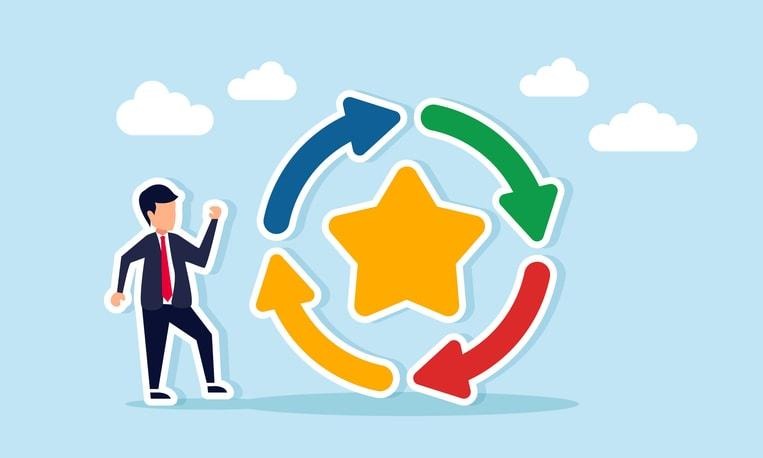
Continuous testing is the engine of product development strategy success. This means usability tests, A/B experiments, structured beta programs with design partners, and rigorous analysis of user feedback.
Specific metrics and tests for early product-market fit:
NPS: Track weekly; look for improvement trends
“Very disappointed” survey: Ask users how they’d feel if the product went away. Aim for >40% saying “very disappointed”
Retention cohorts: Measure 8-12 week retention; you need a stable or improving curve
Activation completion rates: What percentage of users reach the “aha moment”?
Combine qualitative customer feedback (interviews, support tickets) with quantitative data (event tracking, cohort analysis) to drive weekly iteration cycles. Don’t wait for quarterly reviews when you can learn daily.
For AI-based products, also track performance metrics: latency, hallucination rates, failure modes, and user corrections. These reveal whether your AI actually helps or frustrates users.
Having strong AI engineers on the core team enables faster experiment design and turnaround. Teams using Fonzi to source senior ML talent often find they can run 2-3x more experiments per quarter because their engineers know how to instrument tests properly and interpret results quickly.
Stage 6: Launch, Scale-Up, and Post-Launch Learning
Launch is a milestone in a longer learning cycle, not the finish line. Your market launch should be coordinated across product, marketing, sales, customer success, and support, with everyone on the same page about timing, messaging, and success criteria.
Tactics for effective launches:
Invite-only beta: Create scarcity and gather early feedback from committed users
Product Hunt or industry visibility: Generate buzz in channels your target audience follows
Targeted outreach to existing customers: If you have an existing product, existing market customers are your warmest leads
Partnerships: Co-launch with complementary tools to expand reach
Set up ongoing market feedback loops post-launch:
Monthly product council reviews with cross-functional stakeholders
Quarterly roadmap updates based on performance metrics and customer insights
Continuous experimentation budget for testing new ideas
As adoption grows, your NPD strategy must include scaling the team. Use Fonzi to replicate successful AI engineering profiles at scale, hiring your 10th or 100th AI engineer with the same speed and quality as your first, without degrading candidate experience.
Comparing NPD Approaches: Which Strategy Fits Your Product and Market?
Not every company should use the same NPD model. A medical device company operating under FDA regulations needs a different approach than a YC-backed SaaS startup racing to find product-market fit.
The table in Stage 3 above summarizes three primary approaches. Here’s how to choose:
If you’re in a regulated market (healthcare, financial services, government): Start with a stage-gate foundation. You’ll need documentation, compliance reviews, and approval gates. But you can still use lean discovery within each stage to reduce waste and remain competitive.
If you’re building B2B SaaS or consumer apps in fast-moving markets: Lean/iterative is your baseline. Short cycles, rapid customer feedback, tight MVPs. Add governance only when you’ve found product-market fit and need to scale responsibly.
If your product is AI-native (LLM features, ML personalization, intelligent automation): Consider an AI-first experimentation approach. This requires sophisticated evaluation infrastructure and senior AI talent, which is exactly the kind of profiles Fonzi specializes in.
Most successful companies hybridize. They run lean discovery and experimentation for new initiatives while applying more structured development processes to mature product lines. The key is matching your approach to your market conditions and product maturity.
Integrating Talent and AI Hiring into Your Product Development Strategy
Talent is now a first-class part of product strategy, not a back-office function. Especially for AI-heavy products, the right engineers can compress timelines by months. The wrong hiring decisions can sink an otherwise sound strategy.
This section covers:
Defining capability gaps early
Build vs. buy vs. partner decisions
Designing a repeatable hiring loop
Embedding Fonzi as your AI hiring engine
Identify Capability Gaps Early in the NPD Cycle
Run a skills inventory before you need to hire. List your current engineering and data science strengths, then map them against your roadmap needs.
Create a simple “capabilities vs. initiatives” matrix:
Initiative | Required Skills | Current Team Has? | Gap? | Hire By Date |
LLM copilot MVP | Prompt engineering, RAG, evaluation | Partial | Senior LLM engineer | June 2026 |
Data pipeline v2 | Streaming architecture, MLOps | No | MLOps specialist | May 2026 |
Personalization engine | Recommendation systems, A/B testing | Yes | None | — |
Example: A seed-stage startup planning to ship an AI copilot by October 2026 realizes they need at least one senior LLM engineer and one MLOps specialist by June. They open a Fonzi search in March, giving themselves three months of buffer for selection and onboarding.
This proactive product development strategy turns hiring into a strategic lever rather than an emergency reaction when deadlines loom. You’re forecasting resource availability rather than scrambling.
Build vs. Buy vs. Partner: Strategic Talent Decisions
Three classic options for accessing capabilities:
Permanent hires: Best for core differentiation and long-term IP
Contractors/consultancies: Best for time-bounded projects or specialized expertise you won’t need permanently
Technology partnerships: Best for commodity components where you can leverage existing solutions
Core AI differentiation, whether it’s your proprietary ranking models, custom agents, or unique evaluation frameworks, should be built in-house by senior engineers. This is where Fonzi helps: founders can quickly access a curated pool of elite AI engineers who are pre-evaluated for deep expertise, not generic software skills.
Enterprises might use Fonzi to augment existing teams globally when launching new AI initiatives across multiple business units. The same hiring quality applies whether you’re staffing one role or fifty.
Align build/buy decisions with your IP strategy and long-term defensibility. Don’t outsource what makes you unique; don’t in-source commodity work that distracts your best engineers.
Design a Repeatable, High-Quality Hiring Loop
A successful product development strategy requires a hiring process that’s fast, consistent, and scalable from your first AI hire to your 10,000th.
A simple, repeatable hiring loop:
Define role scope: Clear job requirements, success criteria, and team context
Structured screening: Consistent initial evaluation criteria
Standardized technical assessments: Realistic, job-related challenges (e.g., designing an evaluation harness for an LLM feature)
Focused interviews: 2-3 rounds maximum; respect candidate time
Clear debrief and decision criteria: Document reasoning; avoid gut-feel hiring
Fonzi automates much of this. Candidates are pre-vetted through rigorous standardized assessments, so companies only see engineers who already meet a high technical bar. This dramatically improves speed, with most Fonzi clients hiring in under three weeks, while enhancing candidate experience through reduced redundant testing and faster decisions.
Document this loop so it scales. Same structure, same quality, same experience, whether you’re hiring in San Francisco or São Paulo.
How Fonzi Works: Fast, Consistent, and Candidate-Friendly AI Hiring
Fonzi operates as a curated network of elite AI engineers, not a generic job board. Every candidate goes through standardized assessments before being matched to opportunities. Structured profiles capture skills, experience, availability, and product context preferences, enabling precise matching rather than keyword-based guessing.
The typical customer journey:
Founder or hiring manager shares role requirements with Fonzi
Fonzi surfaces a shortlist of pre-assessed candidates matched to your specific needs
Interviews are scheduled within days
Offers are made usually within a 2-3 week window from initial contact
Concrete benefits for your product team:
Predictable hiring timelines: Most hires happen within 3 weeks
Consistent quality across hires: Same rigorous assessment bar for every candidate
Global talent reach: Access engineers across time zones and geographies
Reduced internal screening overhead: Your team interviews only pre-qualified candidates
Fonzi is designed to protect and elevate candidate experience. Fewer redundant interviews, transparent expectations, and roles matched to each engineer’s interests and strengths. This matters because the best AI engineers have options; they’ll choose companies (and hiring processes) that respect their time.
Think of Fonzi as a strategic extension of your product development plan, your mechanism to ensure you always have the AI talent needed to execute the roadmap.
Aligning Product Strategy, Business Goals, and Market Needs

Product development strategy fails if it isn’t tightly coupled to revenue, profitability, and long-term market position goals. A strategy that doesn’t connect to business outcomes is just wishful thinking.
Cascade company-level goals down to product outcomes:
Company goal: Hit $10M ARR by 2026
Product outcomes: 30% activation rate, 80% annual retention, 15% monthly expansion revenue
Roadmap items: Onboarding improvements (Q2), usage-based pricing launch (Q3), enterprise features (Q4)
Ongoing market feedback from customers, competitors, and regulatory changes should reshape priorities every quarter. But don’t lose sight of the overarching vision. The best teams balance responsiveness to market dynamics with strategic consistency.
Example: A mid-market HR tech company in 2024 noticed adoption data showing customers using AI automation features 3x more than traditional workflows. They shifted from feature-led to outcome-led planning, doubling down on AI-powered candidate matching rather than expanding their existing features. This required adding more ML engineers for personalization sourced through Fonzi in under a month.
As business objectives evolve, talent composition must adjust. Your proactive product development strategy should include regular reviews of whether your team’s skills match your roadmap’s demands.
Common Pitfalls in Product Development Strategy (and How to Avoid Them)
Most failed NPD efforts are not due to technology. They’re due to poor strategy execution, misaligned teams, and delayed hiring. Here are the most common pitfalls and their fixes:
1. Building without validated demand: You assume customers want something because it seems logical. Fix: Structured discovery with 10+ customer interviews before any significant investment.
2. Overcomplicating the initial product: Your MVP tries to solve five problems instead of one. Fix: Strict criteria for what qualifies as MVP scope; cut ruthlessly.
3. Ignoring cross-functional communication: Product builds something sales can’t sell or support can’t explain. Fix: Regular cross-functional reviews; shared OKRs across teams.
4. Underestimating talent needs: You realize you need AI specialists three months after the project started. Fix: Skills mapping during opportunity selection; early engagement with Fonzi for AI roles.
5. Reactive product development strategies instead of proactive: You respond to competitor moves rather than executing your own vision. Fix: Clear product vision that guides prioritization; say no to distractions.
6. Skipping post-launch learning: You treat launch as the finish line and move on. Fix: Built-in feedback loops; post-launch experimentation budget.
Example: A Series B fintech startup spent nine months building an AI fraud detection system before discovering their target customers already had adequate solutions. They’d skipped customer discovery to “move fast.” The real cost wasn’t the engineering time; it was the market position they lost to competitors who did the research first. They corrected course by implementing structured discovery sprints, now part of their entire product lifecycle for new initiatives.
Disciplined strategy plus the right team dramatically raises the odds of successful, repeatable launches.
Turn Your NPD Strategy into a Repeatable, Talent-Powered Engine
A strong product development strategy gives teams a clear, repeatable path from early market insight to launch and continuous improvement. It’s built on deep customer understanding, fast experimentation, sharp prioritization, and constant learning, but even the best strategy falls apart without the right people to execute it. In AI-driven products especially, progress often stalls not because the roadmap is wrong, but because the specialized engineering talent needed to move forward isn’t in place at the right time.
That’s where Fonzi comes in. Fonzi helps companies hire elite AI engineers quickly, often in under three weeks, so product teams can keep momentum as their roadmap evolves. Whether you’re a startup making your first AI hire or a global organization scaling critical AI initiatives, Fonzi connects you with engineers who can actually ship, adapt, and deliver against real product goals. In today’s market, product strategy and talent strategy are inseparable, and Fonzi is built to support both.
FAQ
What are the key elements of a new product development strategy?
What product development strategies work best for different markets?
How do you create a product development and strategy roadmap?
What are proven strategies for development of successful products?
How do you align product strategy with business goals and market needs?


