Video Interview Introduction: What to Say & How to Introduce Yourself
By
Ethan Fahey
•

Video interviews are now the front door to AI hiring. Whether it’s a live Zoom or Google Meet call, or an async intro on a HireVue-style platform, the first 60–90 seconds often decide how the rest of the interview goes. For busy hiring managers reviewing dozens of AI and ML candidates, that opening moment is when they decide to lean in or mentally move on. For candidates, especially those interviewing remotely across time zones, your opening line, body language, and clarity of thought matter far more than most people realize.
At Fonzi AI, we see this play out every Match Day. As a curated marketplace connecting elite AI, ML, and infrastructure engineers with high-signal companies, we consistently see candidates who deliver a clear, confident video introduction move faster and receive stronger interest from hiring teams. Getting this right isn’t about gaming the system; it’s about communicating your value quickly in a hiring process that increasingly happens on camera. Mastering your video intro, combined with a structured, human-centered platform like Fonzi, gives both candidates and recruiters a more efficient path from first impression to real conversation.
Key Takeaways
A strong video introduction should be 60–90 seconds, clearly structured using the present–past–future framework, and tightly aligned to the specific AI/ML role and company you’re targeting.
The “present–past–future” story frame works best when adapted with concrete technical examples: mention your LLM infra work, RLHF pipelines, or multimodal model experience with specific metrics.
Fonzi AI’s Match Day uses AI to reduce noise and bias in hiring, not to replace humans: candidates talk to real hiring managers and often receive offers within 48 hours.
Environment matters more than you think: 60% of video interview rejections stem from poor tech execution rather than content, so test your camera, audio, and lighting before every call.
How to Structure Your Video Interview Introduction (Present–Past–Future for AI Roles)
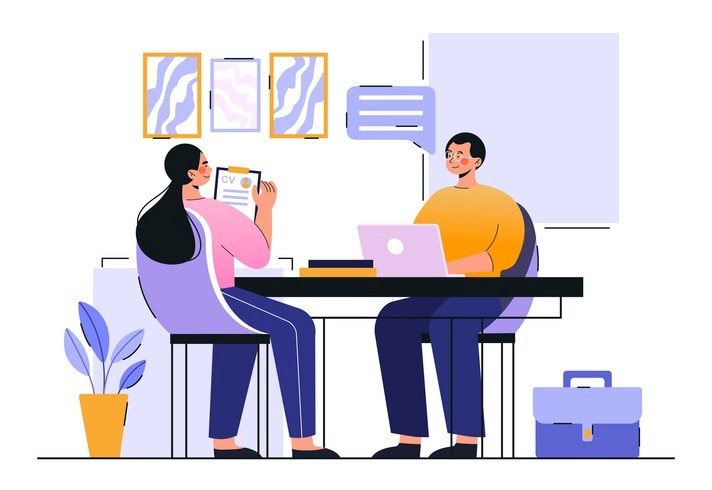
The present–past–future framework is the most effective structure for a video interview introduction. It gives hiring managers exactly what they need: who you are now, what you’ve accomplished, and why you’re excited about this specific opportunity. Here’s how to adapt it for technical AI roles:
Present (1–2 sentences)
State your current role, domain focus, and relevant skills. Be specific about your tech stack and what you actually work on day-to-day.
Example: “I’m a senior ML engineer at a Series B fintech, where I build credit risk models using Python, PyTorch, and AWS infrastructure that process over 2 million predictions daily.”
Past (2–3 sentences)
Highlight one or two experiences or past projects with concrete impact. Focus on outcomes, not job titles or chronological work history.
Example: “Last year, I led a project to fine-tune our internal LLM for retrieval-augmented generation, which reduced customer support response times by 40%. Before that, I optimized our training pipeline on Kubernetes, cutting model training costs by 30%.”
Future (1–2 sentences)
Connect where you want to go with what this specific team is doing. Reference something concrete about the company, such as their recent funding, a blog post, or an open-source project, to show you’ve done your homework.
Example: “I’m particularly excited about your work on multi-agent systems for enterprise automation. The approach your team outlined in your December 2024 blog post aligns closely with where I want to focus my professional journey next.”
Sample Script: LLM Engineer
“Hi, I’m Marcus, a senior AI engineer with five years of experience focused on large language models and inference optimization. Currently, I’m at a growth-stage healthtech company where I architect our LLM-powered clinical documentation system using PyTorch, vLLM, and AWS, and we serve about 50,000 inferences per day with p99 latency under 200ms.
In 2023, I led the migration from OpenAI’s API to self-hosted Llama 2 models fine-tuned with LoRA, which cut our inference costs by 65% while maintaining accuracy. That project taught me a lot about the tradeoffs between model size, latency, and cost at scale.
I’m excited about this role because your team is tackling exactly the kind of productionization challenges I want to focus on: building reliable, cost-effective LLM infrastructure that actually ships to users. That’s what brings me here today.”
Sample Script: Infra / Platform Engineer
“Hi, I’m Priya, an ML infrastructure engineer with four years of experience building scalable training and serving systems. Right now, I’m at a Series C computer vision company where I manage our GPU cluster orchestration using Kubernetes, Ray, and TensorRT.
My biggest win last year was redesigning our model deployment pipeline, which reduced deployment time from 3 hours to 12 minutes and eliminated most of our weekend on-call incidents. Before that, I built the observability stack that helped us catch drift in production models before they affected users.
I saw your team’s talk at MLOps Community last month about your hybrid cloud training setup, and it’s exactly the kind of problem I want to work on next. I’d love to bring my experience with multi-cloud GPU orchestration to your platform team.”
Timing note: For live intros, aim for 60–90 seconds. For standalone introduction videos requested in job applications, you can extend to two minutes or slightly beyond, but shorter is almost always more effective. Practice with a timer until your delivery feels smooth but not robotic.
What to Say in Your Video Interview Introduction (Concrete Talking Points)

Beyond structure, the specific content of your introduction matters. Here’s what to cover, in order:
Start with a confident opener
Keep it simple and direct. State your name, your experience level, and your current focus area.
Template: Hi, I’m [Name], a [X]-year [AI/ML/data/infra] engineer currently focused on [specific area].
Example: “Hi, I’m Jordan, a four-year machine learning engineer currently focused on recommendation systems and real-time personalization.”
Mention 1–2 flagship projects with metrics
Choose projects that demonstrate relevant skills for the role. Quantify impact wherever possible; hiring managers remember numbers.
Strong examples:
“Reduced model serving latency from 280ms to 95ms through custom batching logic”
“Improved recommendation CTR by 11% in A/B testing in Q4 2023”
“Built the feature pipeline that now processes 500M events daily on Spark”
Reference relevant tools and frameworks
Mention your tech stack, but keep the list short and tied to outcomes. This isn’t a resume recitation.
Good: “I work primarily in PyTorch and have production experience with Ray for distributed training and Kubernetes for orchestration.”
Less effective: “I know Python, TensorFlow, PyTorch, Keras, JAX, scikit-learn, Spark, Airflow, Kubernetes, Docker, AWS, GCP, Azure…”
Show you’ve researched the company
Add one sentence that demonstrates you understand what the company does and why your educational background and work experience are relevant to their specific challenges.
Examples:
“I read your team’s paper on efficient attention mechanisms from NeurIPS 2024, and it connects directly to the latency work I’ve been doing.”
“I noticed you just raised your Series B to scale your multimodal search product—that’s exactly the kind of challenge I’m looking for.”
What to avoid
Personal life stories or childhood anecdotes
Vague adjectives like “hard-working” or “passionate” without evidence
Long chronological recitation of every position since university
Complaints about your current or previous experience at past companies
Generic statements that could apply to any candidate or any company
Your intro should set up the next 25–30 minutes of technical conversation. Focus on what will matter to the person on the other side of the camera.
How to Prepare Your Setup for a Video Interview (Environment, Tech, and First Impressions)
Your environment and technical setup are part of your first impression. According to hiring research, roughly 60% of video interview rejections stem from poor tech execution rather than content problems. Don’t let a preventable issue undermine your strong first impression.
Camera and framing
Use a 1080p webcam or your laptop’s built-in camera positioned at eye level
Frame yourself from mid-chest up with some headroom
Position the camera so you can look at the lens when speaking, as this simulates eye contact
Avoid extreme close-ups or shots where you’re a tiny figure in a large room
Background
Choose a neutral background: a plain wall, a simple bookshelf, or a tidy home office
Remove distracting items: laundry, cluttered desks, unmade beds, or posters with text
Avoid virtual backgrounds if possible; they often glitch and can appear unprofessional
If using a virtual background is necessary, test it thoroughly and choose something simple
Lighting
Position your primary light source in front of you, not behind you
A desk lamp, ring light, or window facing you works well
Avoid backlighting (windows or bright lights behind you) that turns you into a silhouette
Test your lighting at the same time of day your interview will occur
Audio
Audio quality matters more than video quality. If the interviewer can’t hear you clearly, nothing else matters.
Use wired earbuds or a USB microphone rather than your laptop’s built-in mic
Test your microphone input in Zoom or Google Meet settings before the call
Mute notifications on Slack, VS Code, email, and your browser
Close GPU-heavy applications to prevent system lag during screen sharing
Pre-interview checklist
Run through this 10–15 minutes before every interview starts:
Test your camera, microphone, and speakers in the actual platform you’ll use
Verify screen sharing works if you’ll be doing a coding task
Close unnecessary tabs and applications
Silence your phone and inform housemates you’re in an interview
Have water nearby but off-camera
Dress appropriately: business casual works well for startup culture: a solid-color T-shirt or simple shirt, avoiding loud patterns or branded merch from competing companies
Environment as introduction
In remote interviews, your “room” is part of your personal connection with the interviewer. A clean, professional setup signals that you take the opportunity seriously and have strong attention to detail for the qualities that matter for technical roles.
Live Video Interview vs Pre-Recorded Intro: What Changes (and What Stays the Same)
Understanding the difference between synchronous and asynchronous video formats helps you adapt your approach appropriately.
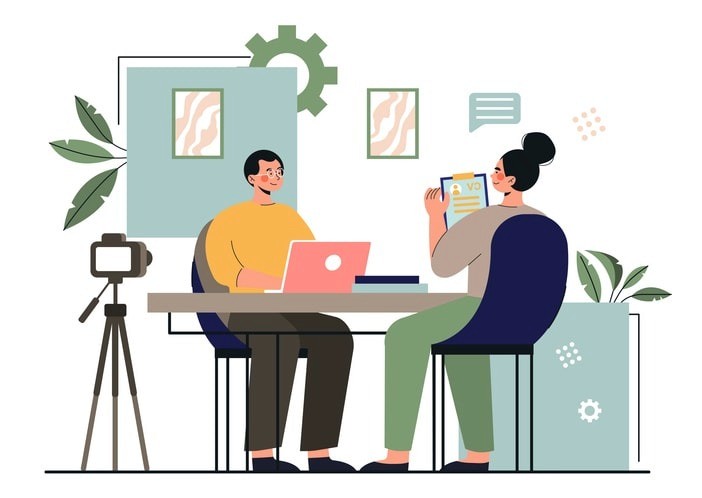
Live video interviews (Zoom, Google Meet)
Conversational and flexible: You can adjust based on the interviewer’s role (hiring manager vs. staff engineer) and early questions
Real-time feedback: You’ll see nods, smiles, and reactions that help you calibrate
Interruptions happen: Be ready to pause gracefully if the interviewer wants to jump in
Time pressure is real: You can’t do multiple takes, so practice beforehand
Pre-recorded introduction videos
Higher polish expected: You can record multiple times, so employers expect a cleaner delivery
No real-time interaction: You’re speaking to a camera, not a person, so practice looking directly at the lens
Strict time limits: Platforms often cap recordings at 90 or 120 seconds with hard cutoffs
Notes are acceptable: You can use a teleprompter or notes, but keep them off-camera and subtle
What stays the same
Regardless of format, these elements remain constant:
Structure: Present–past–future still works best
Focus on impact: Lead with outcomes, not responsibilities
Alignment with job description: Tailor your content to the specific role
Clear articulation: Speak at a measured pace with good enunciation
Body language: Maintain an open posture, look at the camera, and let your personality shine through natural expressions
What changes
Aspect | Live Interview | Pre-Recorded Intro |
Polish level | Good enough is fine | Higher expectations |
Use of notes | Distracting and obvious | Subtle use acceptable |
Time management | Flexible, ~60-90 seconds | Hard platform limits |
Interaction | Two-way dialogue | One-way presentation |
Retakes | Not possible | Expected |
Create a master intro
Consider creating one “master” 90–120 second self-introduction video that you can lightly customize for different roles. This gives you a baseline you can refine, and you can also repurpose elements of it for Fonzi’s ecosystem and direct applications through multiple sources.
Using Fonzi AI: A Smarter Way to Get Your Intro in Front of the Right Companies
At Fonzi AI, we’ve built a different approach to AI hiring: one where your introductory video and profile actually get seen by the right people, not filtered out by a black-box algorithm.
Our curated candidate pool
Fonzi works with experienced engineers, typically with 3+ years of professional experience in AI, ML, full-stack, backend, frontend, or data engineering. We pre-vet candidates on real technical skills, code quality, and background to ensure companies are meeting people who can actually do the work.
How Match Day works
Match Day is a structured hiring event that typically runs over a 48-hour window. Here’s what makes it different:
Companies commit salary upfront: You know the compensation range before you talk to anyone, so you can focus your introduction on your work instead of fishing for basic info
Multiple high-signal conversations: Instead of one screening call, you get exposure to several aligned companies in a concentrated timeframe
Offers within days, not months: Our early data shows 50% faster placements for LLM specialists compared to traditional hiring loops that can stretch 6–8 weeks
How your introduction helps
Your written profile, technical history, and the intro script you use in interviews all help Fonzi surface you to companies where your specific skills, whether that’s RLHF, vector databases, MLOps, or LLM infrastructure, are truly relevant. We’re not trying to match everyone with everyone. We’re trying to create high-signal connections between talented engineers and companies that actually need what they bring.
Your intro as a portable asset
Think of your video introduction as a powerful tool you can deploy across Fonzi Match Days, direct company interviews, and introductory videos for job applications. A consistent, polished first impression compounds over time: you’ll get better at delivering it, and you’ll learn what resonates with different types of hiring managers and teams.
How Fonzi Uses AI Responsibly in the Hiring Process
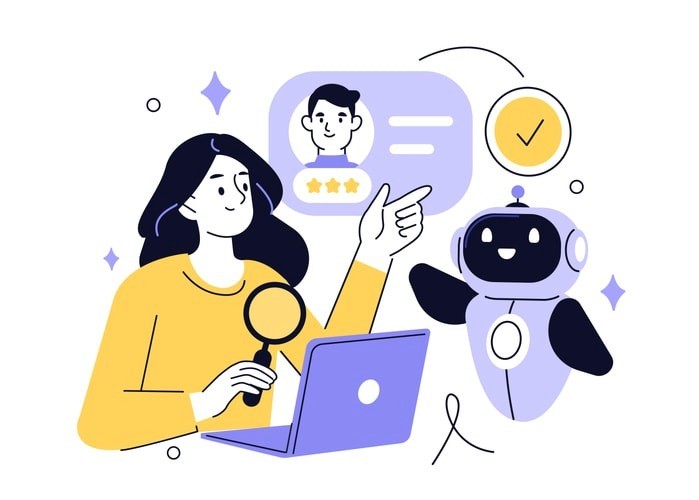
We believe AI should make hiring clearer and faster, not more opaque or biased. Here’s how we approach it:
AI for clarity, not replacement
Fonzi’s AI systems handle the repetitive, low-context tasks that slow down hiring: deduplicating profiles, flagging inconsistencies, and aggregating signals from multiple sources. The goal is to surface relevant candidates to hiring managers faster, not to auto-reject people based on superficial signals.
Bias-audited evaluation
We use standardized scoring rubrics and conduct periodic audits to detect disparate impact across gender, ethnicity, and geography where data is available and legally manageable. Our evaluation processes are designed to give everyone a fair shot based on their actual skills and experience.
Salary transparency built in
Match Day requires companies to state compensation ranges before talking to candidates. This isn’t just good for candidates; it ensures that every conversation starts from a place of mutual fit rather than uncertainty.
Humans make the decisions
Human recruiters and hiring managers still conduct interviews, review introductions, and make final decisions. The AI handles logistics and pattern-matching; people make the calls about people.
Ask how AI is used
We encourage every candidate to ask any platform or company how they use AI in hiring. Favor those like Fonzi who can explain clearly and transparently what’s automated, what’s human, and why. If a company can’t answer that question, it’s worth asking what they’re hiding.
Practical Examples: Sample Video Interview Introduction Scripts for AI Talent
Here are three ready-to-customize scripts for different AI roles. Each follows the present–past–future structure and runs 60–90 seconds when read at a natural pace.
Example 1: LLM / Generative AI Engineer
“Hi, I’m Alex, a senior machine learning engineer with four years of experience specializing in large language models and generative AI. [Present] Currently, I’m at a Series B enterprise software company where I lead our LLM integration team. We’ve built a retrieval-augmented generation system that handles about 100,000 queries daily using fine-tuned Llama models on AWS.
[Past] Since 2021, I’ve worked extensively on transformer-based models, including fine-tuning 7B and 13B parameter LLMs with LoRA and QLoRA for domain-specific applications. Last year, I shipped a project that reduced our inference costs by 55% while maintaining response quality, which opened up new use cases our product team had been waiting on.
[Future] I’m excited about this role because your team is tackling multimodal RAG systems, which is exactly where I want to focus next. The work you published on hybrid retrieval last quarter is the direction I’ve been thinking about for our own product, and I’d love to contribute to that research.”
Example 2: ML Infrastructure / MLOps Engineer
“Hi, I’m Sam, an ML infrastructure engineer with five years of experience building scalable training and serving platforms. [Present] Right now, I’m at a mid-stage autonomous vehicle company where I architect our model training pipeline using Kubernetes, Ray, and our internal orchestration layer. We train about 200 models per week across a 500-GPU cluster.
[Past] In 2023, I led the migration from manual training scripts to a Kubeflow-based pipeline that cut training time by 40% and reduced failed runs by 80%. Before that, I built the observability stack we use for model monitoring and drift detection, which has caught several production issues before they affected users.
[Future] I’ve been following your team’s work on efficient distributed training for foundation models, and it’s exactly the challenge I want to tackle next. The scale you’re operating at would let me apply what I’ve learned while pushing into new territory.”
Example 3: Data Scientist / Applied ML Engineer
“Hi, I’m Jordan, an applied machine learning engineer with three years of experience focused on recommendation systems and experimentation. [Present] Currently, I’m at an e-commerce company where I own the personalization models that power our homepage and email recommendations. We touch about 10 million users weekly.
[Past] Over the last two years, I’ve run over 50 A/B tests and shipped models that improved conversion rates by up to 9% and increased average order value by 12%. My most impactful project was redesigning our real-time feature pipeline on Spark, which reduced latency enough to enable personalization in contexts we couldn’t serve before.
[Future] I’m drawn to this role because you’re applying similar techniques to a completely different domain: healthcare recommendations, where the stakes are higher but the potential impact is even greater. That’s the kind of challenge I’m looking for in my career path.”
Customization reminder: These scripts are templates. Replace the specifics with your own metrics, tech stacks, and company references. Copying them verbatim will sound generic. The power is in the structure and the emphasis on concrete outcomes.
Common Mistakes in Video Interview Introductions (and How to Fix Them)
Even strong candidates make preventable errors. Here are the most common mistakes and simple fixes:
Talking too long
Mistake: Rambling for 4–5 minutes instead of 60–90 seconds, losing the interviewer’s attention. Fix: Practice with a stopwatch and cut ruthlessly. If it’s over 90 seconds, you’re including too much.
Reciting your resume chronologically
Mistake: “I graduated in 2018, then I worked at Company A for two years, then Company B for three years…”
Fix: Choose one or two relevant roles or projects and talk about impact, not timeline.
Reading visibly from notes
Mistake: Eyes darting off-camera, clearly reading a script word-for-word. Fix: Rehearse enough that you only need bullet-point reminders, and position them near the camera lens.
Speaking too quickly or quietly
Mistake: Nervous speed-talking that makes it hard to follow, or mumbling that the mic doesn’t pick up well.
Fix: Slow down deliberately. Record yourself and listen back: you’re probably faster than you think.
Overloading on jargon without context
Mistake: “I work with transformers, attention mechanisms, RLHF, DPO, and various fine-tuning techniques.”
Fix: Pick the most relevant terms and tie them to outcomes. “I fine-tuned our model using RLHF, which improved user satisfaction scores by 15%.”
Poor environment choices
Mistake: Cluttered backgrounds, backlighting that obscures your face, or audio echo from a bare room.
Fix: Test your setup on camera, ask a friend for feedback, and address issues before interview day.
Starting with personal history
Mistake: “I grew up in Ohio and always loved computers…”
Fix: Start with who you are professionally right now. Save personal interests for when directly asked.
Sounding generic
Mistake: “I’m passionate about AI and excited about this opportunity.”
Fix: Be specific. “I’m interested in your approach to efficient inference because it directly connects to the latency work I did last year.”
The good news: perfection isn’t required. Authenticity plus clear structure plus respect for the interviewer’s time is what actually stands out.
Traditional Hiring vs Fonzi Match Day & Intro Best Practices
Here’s how traditional AI hiring compares to Fonzi’s Match Day approach, along with best practices for your video introduction in each context:
Aspect | Traditional Hiring | Fonzi Match Day | Best Practice for Your Intro |
Time to Offer | 6–8 weeks typical | Often within 48 hours to a few days | Be ready to discuss timeline and availability clearly |
Number of Calls | 5–8 calls across weeks | Multiple conversations in concentrated window | Prepare one strong intro that works across multiple companies |
Salary Transparency | Often unclear until late stages | Companies commit ranges upfront | Focus intro on skills and fit, not compensation questions |
Use of AI in Screening | Varies widely, often opaque | Transparent, bias-audited, human decisions | Ask how AI is used; favor transparent platforms |
Intro Focus | Generic screening, often low-context | High-signal matching to relevant companies | Tailor to specific role; mention concrete technical overlap |
Candidate Experience | Inconsistent, often slow feedback | Concierge support, fast decisions | Convey professionalism and preparedness from first minute |
Bias Handling | Depends on individual company practices | Standardized rubrics, periodic audits | Focus on skills and outcomes, let your qualifications speak |
Conclusion
Your video interview introduction isn’t just a box to check, it’s one of the few moments where you can quickly stand out in a crowded AI hiring funnel. When hiring managers are reviewing dozens of candidates a week, a clear, structured intro using a present–past–future flow, backed by concrete technical outcomes and a clean setup, makes it easy for them to see why you should move forward.
That’s exactly how Fonzi AI is designed to work. Through Match Day, candidates use that polished intro in focused, high-signal conversations with companies that are already aligned on role scope and salary, instead of dragging the same pitch through months of scattered interviews. If you’re ready to put your preparation to work, apply on Fonzi, refine your intro using this framework, and join an upcoming Match Day to connect with AI-first teams hiring for LLM, ML infrastructure, and applied AI roles. In a market where attention is scarce, those first 90 seconds still matter, and Fonzi helps make sure they lead somewhere.
FAQ
How do you introduce yourself in a video interview effectively?
What should I say in my video interview introduction?
How is introducing yourself in an online interview different from in-person?
What are good examples of introduction videos for job interviews?
How long should my video interview introduction be?