20+ Front End Developer Interview Questions
By
Samara Garcia
•

Front-end developer interviews have evolved far beyond questions about HTML tags and JavaScript syntax. Today, employers are focused on how candidates design, build, and optimize real-world web applications, evaluating their ability to balance performance, accessibility, security, maintainability, and user experience. Hiring managers want engineers who can make sound technical decisions, collaborate across teams, and work effectively within modern frontend ecosystems.
Whether you're applying for a frontend, full-stack, AI, or platform engineering role, interview questions emphasize practical problem-solving over memorization. This guide covers the most common front-end developer interview questions, the concepts behind them, and what hiring teams are looking for when assessing technical and communication skills.
Key Takeaways
Modern front-end developer interview questions test systems thinking, performance, accessibility, and security, not only HTML, CSS, and JavaScript syntax.
Companies increasingly use AI-driven screening and coding platforms, so candidates should expect structured assessments followed by human-led technical deep dives.
Senior candidates are evaluated on the event loop, event delegation, state management with Signals or Context API, and real-world web development trade-offs.
Recruiters value reasoning about CSS specificity, responsive grid layout, media queries, and CSS architecture as much as fluency with React, Vue, or Angular.
System design rounds now include Core Web Vitals, accessibility standards, AI integration patterns, and clear communication.
Core Front End Fundamentals Interview Questions
Front-end developer interviews typically test knowledge of core web technologies because production issues still start with fundamentals. Front-end developers need HTML, CSS, and JavaScript skills, even when most work happens inside JavaScript frameworks. HTML is the basic building block of web pages. HTML defines the structure of web pages using tags. CSS is used to style web pages and control layout, and JavaScript adds interactivity to web pages and applications. Master the fundamentals of HTML, CSS, and JavaScript before layering on React, Angular, Vue.js, or AI workflow complexity.
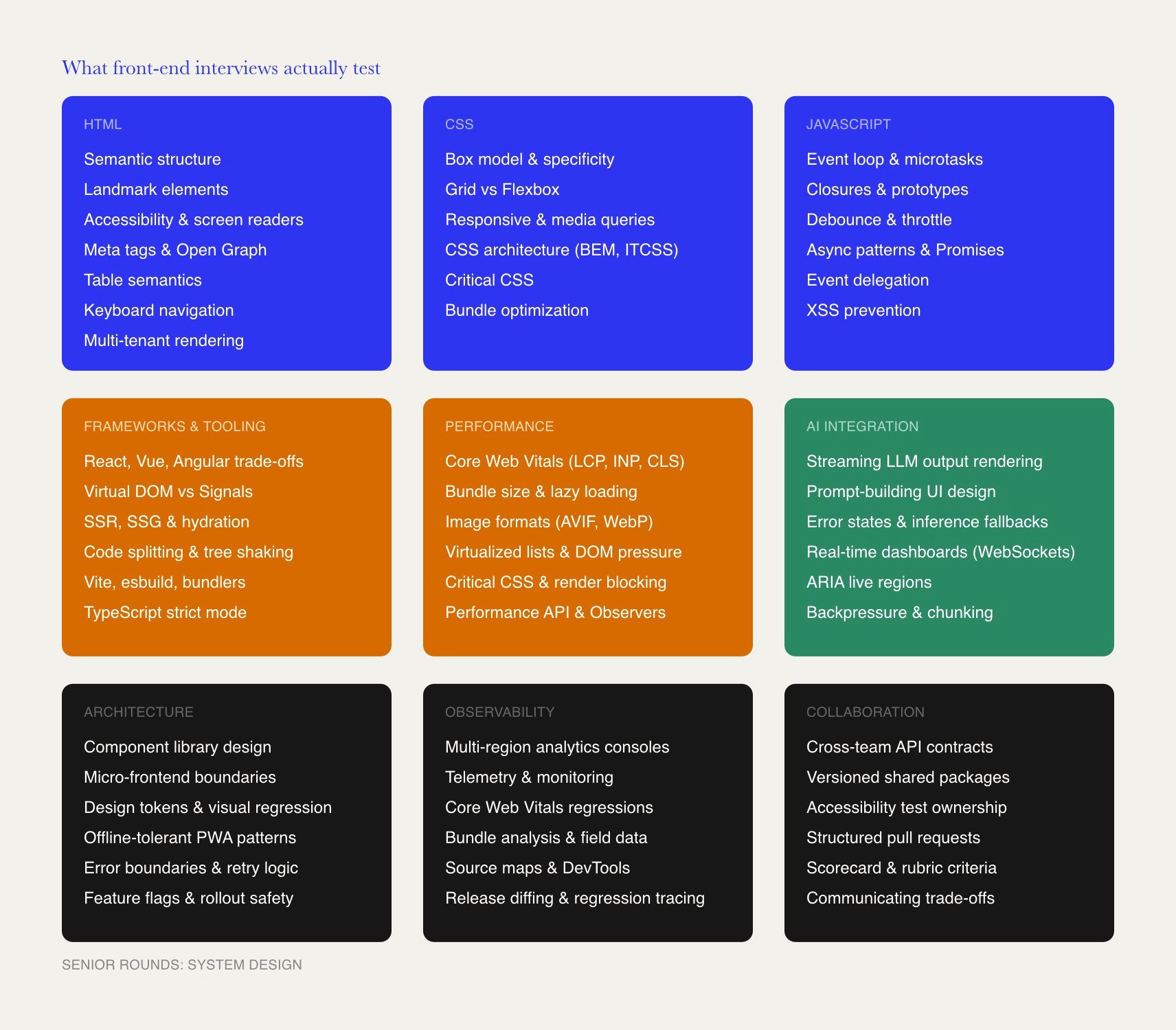
HTML questions
“How do you structure a document for accessibility and SEO, including meta tags and landmark elements like <header>, <main>, and <nav>?” A strong answer covers semantic HTML, skip links, correct HTML elements, an accessible HTML document, and how the Hypertext Markup Language supports screen readers and crawlers.
“Explain how you would design a semantic layout for a dashboard used by ML researchers, including tables, filters, and data visualizations.” Look for correct table semantics, form controls, labels, HTML content fallbacks for charts, and keyboard navigation.
“What is your approach to managing <meta> viewport, charset, and Open Graph tags in a multi-tenant web application?” Senior answers discuss server rendering, caching, tenant-level defaults, and safe generation of HTML code.
CSS questions
“Describe the CSS box model and how it affects layout debugging in a responsive grid.” Candidates should explain content, padding, borders, and margins, along with how box-sizing changes element dimensions, width calculations, and overflow behavior.
“How do you structure CSS at scale using approaches like ITCSS or BEM?” Strong answers discuss component boundaries, predictable specificity, maintainability, code reuse, and when CSS frameworks or preprocessors are helpful.
“Explain CSS specificity and how you debug unexpected style overrides without relying on !important.” Look for an understanding of the cascade, selector precedence, and the use of browser DevTools to trace conflicting rules.
“What is the difference between em and rem, and when would you use each in a design system?” Good answers cover inherited sizing, root-based scaling, accessibility, and consistent typography and spacing.
“How do you use media queries to build mobile-first responsive interfaces for complex analytical applications?” Strong candidates focus on adapting layouts to content and available space rather than targeting specific device types.
“Why are CSS sprites largely obsolete in 2026, and what has replaced them?” Historically, sprites reduced HTTP requests, but modern approaches such as HTTP/2, HTTP/3, inline SVGs, icon tree shaking, and bundler optimizations typically provide better performance and maintainability.
JavaScript questions
“Explain how the event loop, task queue, and microtask queue work in a modern browser and how that affects rendering performance.” The event loop is responsible for handling asynchronous code execution in JavaScript, and asynchronous operations can use callbacks, promises, or async/await.
“Differentiate between == and === with concrete examples where implicit coercion breaks invariants.” The difference between == and === in JavaScript concerns type coercion, which matters when comparing data types from APIs.
“Describe closures and how you would use them to encapsulate internal state in a small UI utility without exposing global variables.” Strong answers explain lexical scope, an outer function, and private state without global variables.
“Explain debouncing and throttling, and give a concrete example of applying them to scroll or resize handlers in a dashboard.” Good answers connect JavaScript code to frame budgets and user input responsiveness.
“How do you approach event delegation for dynamic lists or tables when rendering thousands of DOM nodes?” Look for knowledge of the document object model, the document object, the actual DOM, event bubbling, and memory overhead.
“How does prototypal inheritance differ from classical inheritance in JavaScript?” Prototypal inheritance differs from classical inheritance in JavaScript because objects inherit directly from other objects rather than only from class blueprints.
“How would you model a form submission that needs to validate input, send data, and reconcile data stored locally with API state?” Senior answers address a JavaScript object payload, validation, HTTP requests, retries, and security.
Advanced CSS, Layout, and Responsive Design Questions
Senior front-end developer interview questions often probe whether candidates can build resilient layouts that handle real production data. Static mockups are easier than web applications with varied languages, long labels, charts, tables, browser cache behavior, and delayed assets across web browsers, including legacy constraints such as Internet Explorer, only when enterprise support still requires it.
Topic | Interview question | What strong answers show |
“Compare CSS Grid and Flexbox for building a grid layout in a complex analytics UI with resizable panels.” | Flexbox and CSS Grid are two different layout systems in CSS, with Flexbox favoring one-dimensional flow and Grid favoring two-dimensional placement. | |
Responsive rhythm | “How would you design a responsive card list that maintains consistent rhythm across 320px, 768px, and 1440px widths using grid layout and media queries?” | Content-based breakpoints, consistent gaps, fluid type, and maintainable visual elements. |
Long lists | “Explain how you would handle overscroll, sticky headers, and virtualized lists in a long results page.” | Windowing, focus preservation, scroll anchoring, and reduced DOM pressure. |
Typography | “Discuss how you test and refine typography scales using em and rem units to maintain accessibility and consistency.” | Root scaling, readable line-height, contrast, and user settings. |
“How do you split critical and non-critical CSS files to improve Largest Contentful Paint in a production Next.js or Remix app?” | Critical CSS improves perceived load time by inlining styles, while route-level CSS can be deferred. | |
Asset delivery | “When would you inline critical CSS versus relying on HTTP/2 and HTTP/3 multiplexing with 103 Early Hints?” | Trade-offs between cacheability, page load time, and render blocking. |
Other questions include: “Describe how you would organize component-level styles to minimize unused CSS while keeping bundle size small,” “How do you ensure that a layout using CSS Grid remains keyboard and screen reader friendly,” and “What layout and typography changes do you anticipate when localizing a UI for right-to-left languages such as Arabic or Hebrew?” Strong candidates reason about trade-offs, not definitions, and they connect layout choices to accessibility, internationalization, and front-end web development maintainability.
JavaScript Runtime, Browser APIs, and Application Architecture Questions
Technical questions evaluate understanding of the browser environment, not only the programming language. Modern front-end development also requires knowing how web browsers parse assets from a web server, how a user interface responds under load, and how data moves through distributed systems.
“Walk through what happens in the browser from URL entry to first paint.” Look for DNS, TLS, HTML parsing, DOM, CSSOM, render tree, layout, paint, and First Contentful Paint.
“Explain the event loop and how Promises or async/await can impact rendering.” Strong answers connect microtasks, long tasks, input latency, and dropped frames.
“How do you use the Performance API to identify bottlenecks?” Good answers mention PerformanceObserver, user timing marks, DevTools, source maps, and Core Web Vitals.
“How would you implement image lazy loading with IntersectionObserver?” Candidates should discuss native lazy loading, root margins, and fallbacks.
“Compare cookies, localStorage, and sessionStorage.” Look for security, capacity, performance, httpOnly cookies, XSS risks, and when to use IndexedDB.
“How do you approach global state management in React?” Strong answers compare Context API, Redux, Zustand, and query libraries.
“How would you manage state for a real-time monitoring dashboard?” Look for buffering, reconnection handling, backpressure, and render throttling.
“How do you use event delegation in large applications?” Tests understanding of scalable event handling and UI performance.
“How do you share code across micro-frontends without tight coupling?” Good answers cover package boundaries, contracts, versioning, and independent deployments.
“What is XSS, and how do you prevent it in React or Vue?” Look for sanitization, escaping, safe Markdown rendering, and Content Security Policy.
“How do you implement Content Security Policy in a SPA?” Strong answers discuss nonces, hashes, connect-src, third-party scripts, and deployment coordination.
Framework, Tooling, and AI-Integrated Front End Interview Questions
In 2026, most hiring teams expect depth in at least one major framework plus the surrounding tooling ecosystem. React is an open-source JavaScript library for building user interfaces. It uses a virtual DOM for efficient UI updates, so candidates may be asked to explain virtual DOM behavior, compare virtual DOM updates with fine-grained Signals, and describe when direct actual DOM work is appropriate.
“In React 19, how do features like Actions, Server Components, and asset loading affect rendering, and how would you explain Suspense and transitions to a teammate?” Strong answers separate server and client boundaries.
“Compare using Context API versus Redux or a signals-based library for state management in a large AI dashboard.” Signals are now common across Angular, Vue, and Preact because fine-grained reactivity can reduce unnecessary re-renders.
“Explain how you would architect routing, code splitting, and data fetching for a multi-route SPA that renders large model outputs.” Code-splitting and lazy-loading are techniques for optimizing application performance, while tree-shaking removes unused code from JavaScript bundles.
“How does server-side rendering (SSR) and static site generation (SSG) change your approach to data fetching and hydration?” SSR and SSG are web page rendering techniques; SSR improves initial HTML delivery time, while SSG serves pre-built pages that can hydrate into a fully interactive client-side experience.
“How do you structure your build pipeline to handle CSS files, TypeScript, image optimization, and environment-specific configuration?” Strong answers mention a command-line interface, Vite, or esbuild, environment variables, and minimizing CSS and JavaScript files to improve loading times.
“Explain the role of bundlers and dev servers in 2026 compared to older Webpack-only setups.” Candidates should discuss native ESM, faster HMR, plugin ecosystems, and JavaScript files generated for production.
“Describe your approach to test strategy across unit, integration, and end-to-end tests for a front-end that wraps ML APIs.” Front-end developer interviews often include practical domain knowledge evaluations, such as mock inference failures and partial responses.
“How would you set up feature flags, experiment frameworks, and observability for front-end rollouts?” Good answers connect rollout safety to telemetry and ownership.
“How would you design a prompt-building UI for LLM workflows that makes system prompts, tools, and context windows transparent to advanced users?” This tests user-centered design and technical empathy.
“What are your strategies for rendering large token streams incrementally, while keeping the UI responsive and accessible?” Look for chunking, virtualization, ARIA live regions, and backpressure.
“How do you handle error states and fallbacks when inference services are degraded, rate-limited, or returning partial responses?” Strong answers include retries, cached results, graceful degradation, and clear user messaging.
“How do you use generics, utility types, and strict mode to catch bugs at the component boundary rather than at runtime?” Senior TypeScript answers use discriminated unions, strict null checks, and typed API contracts.
Angular is an open-source framework developed by Google that supports two-way data binding for automatic UI synchronization. Vue.js is a progressive JavaScript framework for building single-page applications and user interfaces, featuring reactive data binding. Familiarity with modern frameworks like Angular and Vue.js is important, even if React remains your deepest ecosystem. Curated hiring platforms like Fonzi sometimes encode these expectations into matching criteria, which can help surface better-fit roles faster without replacing human judgment.
System Design, Performance, and Hiring Process Trends in Front-End Interviews
Senior front-end roles now include system design rounds focused on architecture, performance budgets, and collaboration with backend, infra, and ML teams. Performance optimization is a key focus in front-end development interviews because model-heavy products often combine streaming APIs, charts, third-party scripts, and large bundles.
“Design the front-end architecture for an analytics console that visualizes real-time model metrics across multiple regions.” Discuss WebSockets or SSE, cache invalidation, regional latency, rendering partitions, and observability.
“How would you build a component library used across three product teams while keeping visual consistency and avoiding CSS specificity conflicts?” Strong answers mention design tokens, ui components, accessibility tests, visual regression, and versioned releases.
“Describe your approach to error boundaries, retry logic, and fallbacks in a React app that depends on multiple internal APIs and a third-party inference provider.” Senior answers include partial rendering, exponential backoff, and user-safe failure messages.
“Explain how you would design an offline-tolerant experience for a data labeling tool used on unreliable networks.” Progressive web applications, service workers, background sync, optimistic updates, and conflict resolution are relevant.
“If Core Web Vitals like LCP or INP regressed after a new release, how would you systematically investigate and fix the regression?” Start with release diffing, bundle analysis, network waterfalls, long tasks, images, and third-party scripts.
“What techniques do you use to reduce bundle size, such as code splitting, tree shaking, and dynamic imports, and how do you measure their impact?” Use bundle analyzers, coverage reports, lab metrics, and field data.
“How do you approach image optimization in 2026, including modern formats like AVIF or WebP, responsive images, and CDNs near your users?” Candidates should optimize images, use srcset, preload only critical assets, and measure outcomes.
“Provide three concrete techniques you use to decrease page load time on a high-traffic landing page.” Examples include static generation, deferred scripts, critical CSS, compressed assets, and browser cache strategy.
AI-based coding tests and interview assistants change how candidates present solutions. Clear comments, readable commit messages, and structured pull requests help both automated screeners and humans. According to recruiting research, many mid-to-large technology companies now use AI-assisted screening in 2026, while human interviewers still assess communication, ownership, and long-term fit. Structured scorecards often rate system design, accessibility, collaboration, and code quality, and match-based approaches such as Fonzi may pre-calibrate candidate profiles against those criteria.
How to Prepare Effectively for Front-End Developer Interview Questions
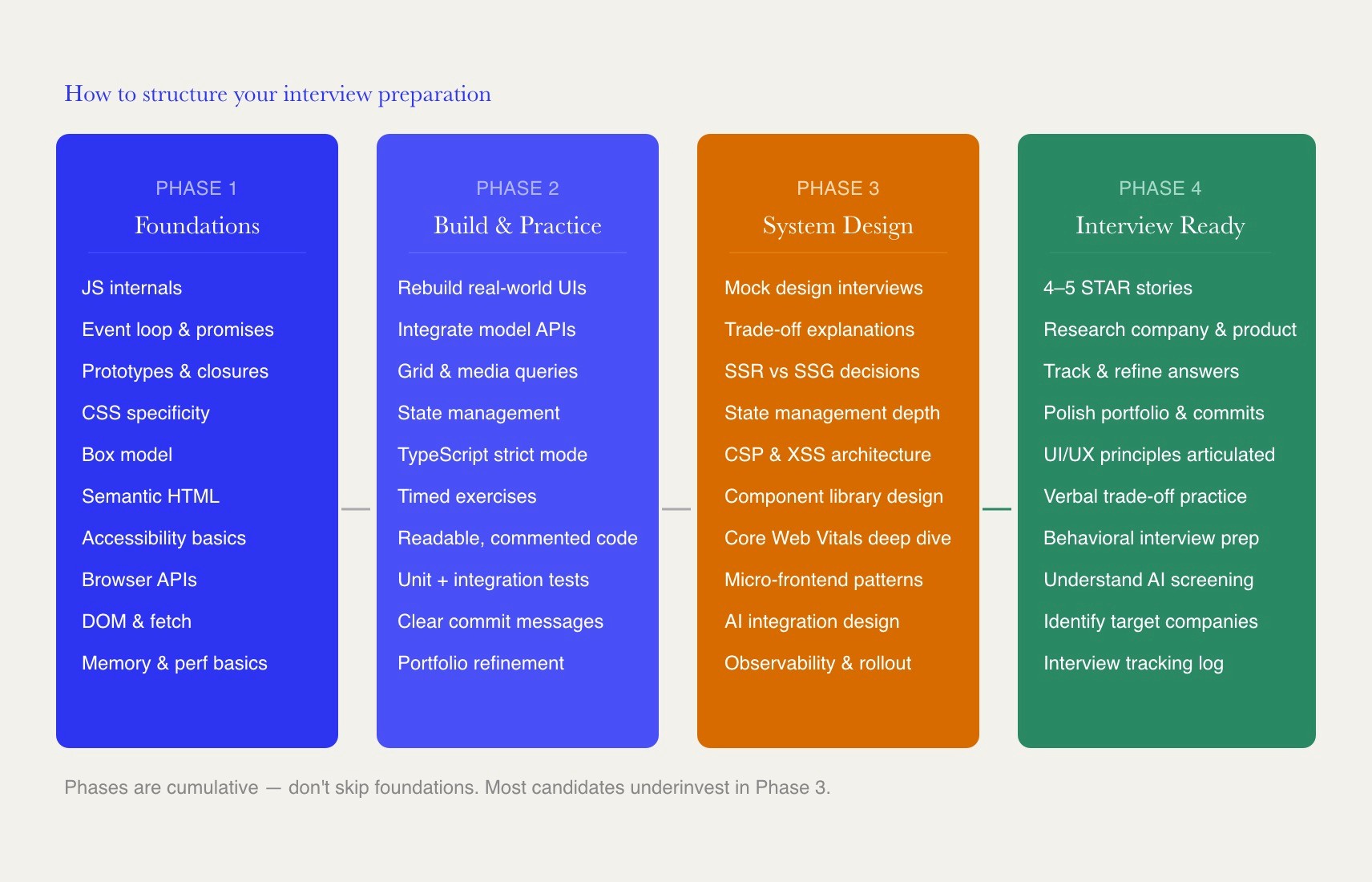
Preparation is a mix of targeted practice, portfolio refinement, and understanding how modern processes evaluate front-end skills. Treat the development process like production work: write clear code, test it, document trade-offs, and be ready for live coding demonstrations during interviews.
Schedule dedicated sessions to review JavaScript internals, including the event loop, promises, prototypes, memory leaks, browser APIs, and the model-view-controller pattern where relevant.
Rebuild a couple of real interfaces from 2025 and 2026 AI tools or dashboards to practice grid layout, media queries, state management, and building user interfaces under real constraints.
Use open datasets or public model APIs to create small projects that highlight your ability to integrate front-end logic with AI-backed services.
Practice coding through mini-projects or platforms like HackerRank, especially when preparing for a front-end developer interview with timed exercises.
Research the company to show interest during the interview, including product architecture, users, performance constraints, and likely AI workflow needs.
Prepare 4 to 5 STAR stories that showcase debugging production issues, refactoring legacy CSS files, improving metrics, and resolving cross-team ambiguity. Behavioral interviews assess communication and problem-solving skills, and the STAR method is recommended for answering behavioral interview questions.
Practice explaining trade-offs verbally, for example, why you chose Context API over Redux in a specific project.
Record a mock system design interview and review whether your explanation of components, data flow, failure modes, and observability is clear.
Consider using curated platforms such as Fonzi if you prefer fewer, higher-signal opportunities with AI-focused startups instead of mass cold applications.
Track your interviews so you can refine answers and recognize recurring developer interview questions, end developer interview questions, and frontend developers’ recurring evaluation patterns.
Understanding UI/UX principles is crucial for front-end developers because a technically correct user interface can still fail users. Understand UI/UX principles to enhance user experience, especially when designing AI outputs, form recovery, accessibility states, and dense dashboards.
Finding Front-End Roles Beyond Traditional Job Boards
Senior front-end engineers are increasingly evaluated on more than framework knowledge. Companies hiring in 2026 often look for candidates who can reason about performance, accessibility, design systems, browser internals, state management, and AI-powered user experiences. Experience improving Core Web Vitals, building scalable component libraries, optimizing rendering performance, and collaborating across product, design, backend, and AI teams can help candidates stand out in a crowded market.
Fonzi helps connect experienced front-end engineers with companies seeking those skills, particularly AI startups and modern software teams building complex web applications. Through Match Day, vetted candidates can be introduced directly to employers looking for engineers who understand both front-end fundamentals and modern application architecture. For developers who want higher-signal opportunities instead of submitting applications across dozens of job boards, Match Day can provide a more focused path to teams that value strong technical judgment and product-minded engineering.
Summary
Front-end developer interviews in 2026 focus far more on engineering judgment than framework trivia. Senior candidates are expected to demonstrate strong fundamentals in HTML, CSS, and JavaScript while explaining real-world trade-offs involving performance, accessibility, security, maintainability, and user experience. Common topics include browser rendering, the event loop, state management, responsive design, CSS architecture, Core Web Vitals, accessibility standards, and modern frameworks such as React, Vue, and Angular. Interviewers evaluate how engineers design scalable applications, debug production issues, and communicate technical decisions across teams.
Advanced interviews often include application architecture, system design, performance optimization, AI-powered user experiences, and frontend infrastructure. Candidates should be prepared to discuss topics such as SSR versus SSG, code splitting, lazy loading, bundle optimization, global state management, security practices like XSS prevention and Content Security Policy, and designing resilient interfaces for real-time or AI-driven applications. The strongest candidates support their answers with practical examples, measurable outcomes, and clear reasoning rather than memorized definitions, demonstrating both technical depth and product-focused thinking.
FAQ
How deeply should I study vanilla JavaScript if most of my experience is in React?
How much do companies care about CSS details like specificity and grid layout at the senior level?
What is the best way to demonstrate performance skills in a front-end interview?
How are AI tools changing the way front-end candidates are screened?
Should I focus on one framework or multiple frameworks for interviews?


