Java Concurrency Interview Questions You Need to Know
By
Samara Garcia
•

Python dominates much of AI research, but high-throughput inference, feature stores, stream processors, and low-latency services are still often built on JVM languages. That is why candidates should expect concurrency and multithreading questions in Java interviews. This guide focuses on Java concurrency interview questions, grouped by theme, with notes on what interviewers expect from AI and infra engineers. Examples assume Java 8 or later, while many teams now use Java 21 as the baseline LTS standard, with Java 25 LTS, released late 2025, seeing more enterprise adoption.
Key Takeaways
Senior interviews expect deep knowledge of Java threads, the Java Memory Model, ExecutorService, CompletableFuture, Virtual Threads, and Structured Concurrency.
Companies building AI systems test architectural understanding and memory layout knowledge, not only API trivia.
Common concurrency topics include thread safety and deadlock, especially under heavy parallel workloads.
Strong candidates can explain how to achieve thread safety with synchronized, the lock interface, atomics, immutability, and thread confinement.
Curated hiring channels, including marketplaces like Fonzi, increasingly structure interviews around realistic concurrency scenarios instead of only puzzle-style questions.
Core Java Thread Model
Many Java concurrency interview questions start with fundamentals before moving to ExecutorService or CompletableFuture. Managing thread lifecycles is crucial for mastering Java concurrency, because incorrect lifecycle assumptions often lead to leaks, hung shutdowns, or missed work.
Process vs thread
A process is a self-contained execution environment. Threads share the same memory space while processes do not, so inter-process communication is usually heavier than communication inside one JVM process. Creating a thread is less resource-intensive than creating a process, and threads are considered lightweight processes. Switching between threads is cheaper than switching between processes, although platform thread context switching still has a measurable cost.
A thread in Java is the smallest unit of execution. The Thread class represents a Java thread, and a thread object is the Java-level handle for controlling thread execution. The operating system still influences platform thread scheduling, and thread priority is only a hint to the thread scheduler, so low-priority threads are not guaranteed to starve or run late in the same way on every platform.
Creating and starting threads
Threads can be created by extending the Thread class. You can also create a thread by implementing the Runnable interface, and implementing the Runnable interface is generally preferred because it separates the task from the execution mechanism. The runnable interface is common in examples, but Callable is used when a task must return a value or throw a checked exception. Interviewers frequently contrast the Runnable interface with the Callable interface to test a candidate's understanding of task execution, focusing on how Callable allows a task to return a value or throw checked exceptions.
Calling start() on a new thread creates a newly created thread that becomes eligible for execution. Calling run() directly executes the task on the current thread rather than spawning a new one, which is a common mistake when first working with the Thread class. In entry-point examples, interviewers may mention public static void main, static void main string, or void main string args to check whether the main method is a user thread and how a new thread behaves after main returns.
Lifecycle, daemon threads, and legacy APIs
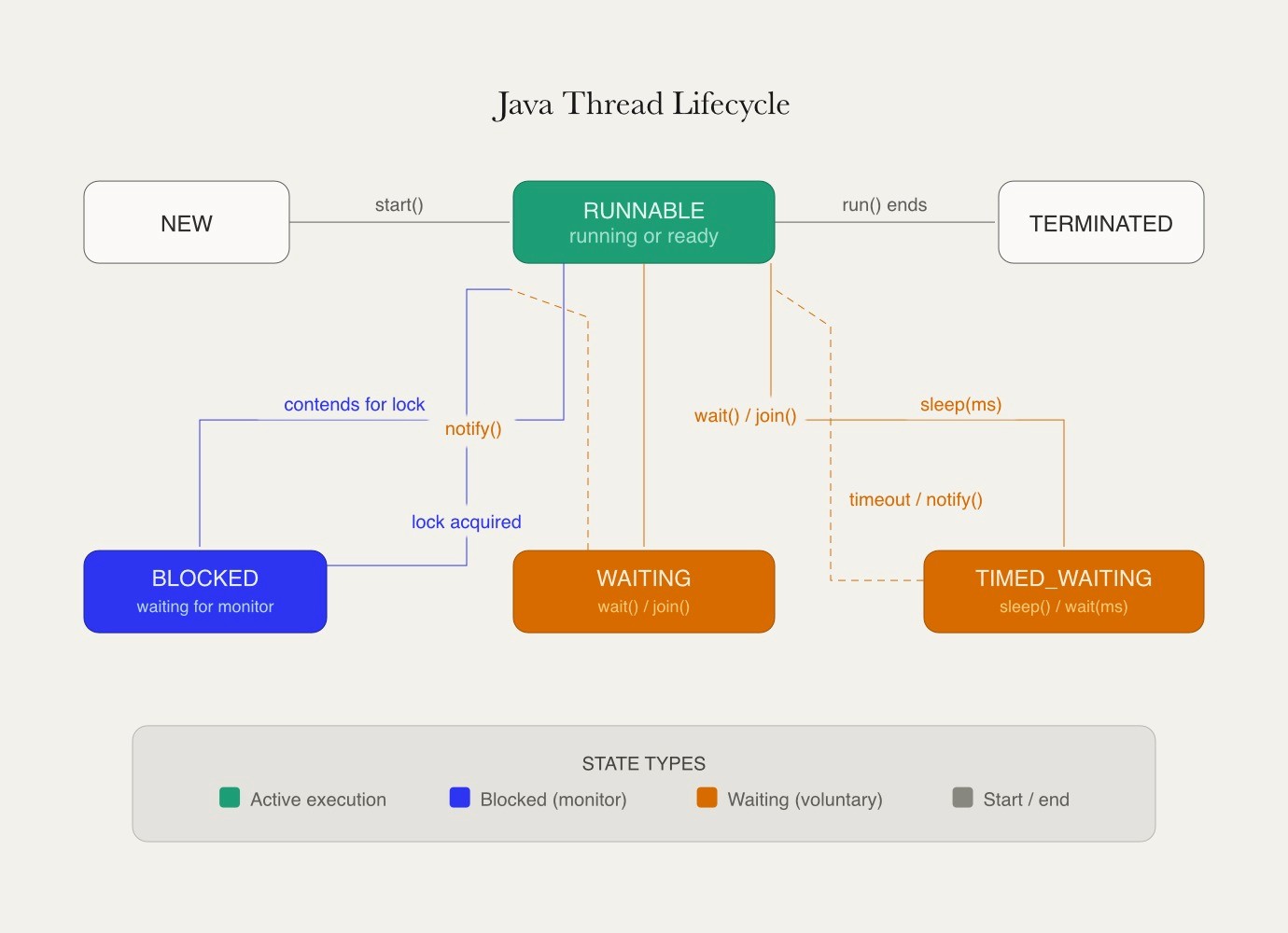
The lifecycle states are NEW, RUNNABLE, BLOCKED, WAITING, TIMED_WAITING, and TERMINATED. A running thread can enter WAITING through join() or wait(), where the calling thread waits for completion or notification. A waiting thread may resume when another thread calls notify() or when a timed wait expires. A blocked thread waits to acquire a monitor, and a bad lock cycle can leave it blocked forever.
A daemon thread does not prevent the JVM from exiting. User threads prevent the JVM from exiting until they finish, daemon threads are service providers for user threads, and the JVM terminates daemon threads when all user threads finish. Daemon threads can be created using setDaemon(true), sometimes described in older prompts as thread class setdaemon. A user thread has a specific lifecycle independent of daemon threads, and production executors usually rely on non-daemon worker threads when important tasks must finish after the current thread exits.
ThreadGroup and the thread group API are legacy. They still appear in older codebases, but modern code prefers executors, named thread factories, structured cancellation, and explicit uncaught exception handlers.
Thread Safety, Synchronization, and the Java Memory Model in Interviews
Java concurrency is crucial for technical interviews because senior candidates must explain both correctness and performance. The Java Memory Model is essential for understanding concurrency, since it specifies how threads access shared memory and when updates made by one thread become visible to other threads.
Thread safety ensures a consistent object state across multiple threads. To achieve thread safety, you can avoid sharing mutable state, use immutable records, confine data to a particular thread with ThreadLocal, or coordinate sharing with locks and atomic variables. Standard collections like ArrayList are not designed for concurrent use without additional synchronization, and standard collections like HashMap are not thread-safe in Java.
Volatile, synchronized, and wait/notify
Volatile variables guarantee visibility and ordering of writes across threads, but they do not provide atomicity, so operations like count++ can still have race conditions. The Java Memory Model (JMM) defines happens-before relationships, including volatile reads and writes, monitor locks, thread start, and thread join. Final fields are also safely visible after construction when objects are properly initialized.
The synchronized keyword provides mutual exclusion through object monitors. Instance methods lock the object, while static methods lock the class, meaning they use different monitors. The wait(), notify(), and notifyAll() methods support inter-thread communication and can only be called by a thread that owns the monitor. Although higher-level concurrency APIs are usually preferred today, these primitives remain important for understanding legacy Java code.
Choosing a synchronization mechanism
Thread synchronization avoids data corruption when accessing shared resources. Locks prevent multiple threads from accessing shared resources at the same time, and they prevent multiple threads from corrupting state during compound updates.
Mechanism | Achieves Thread Safety By | Visibility | Atomicity | Blocking | Typical Interview Talking Points |
synchronized keyword | Monitor ownership around a synchronized method or synchronized block | Yes, unlock happens-before later lock | Entire critical section | Yes | Simple, reliable, but no timed lock or interruptible lock acquisition |
Lock interface | Explicit lock() and unlock(), often ReentrantLock | Yes, when used correctly | Lock-protected region | Yes, with options | Useful for fairness, tryLock(), timeouts, and interruptible waits |
volatile fields | Visibility and ordering through volatile reads and writes | Yes | Single read or write only | No | Good for stop flags and safe publication, not compound updates |
Atomic classes | Compare-And-Swap operations | Yes | Per atomic operation | No | Atomic variables use Compare-And-Swap (CAS) to achieve thread safety without locks |
Atomic operations are performed without interference from other operations. Atomic operations prevent data inconsistency in multi-threaded environments, especially for counters and references. Java Records are also useful because they provide a concise way to model immutable data; since their fields are implicitly final, they offer shallow immutability that makes them safely visible and inherently thread-safe across concurrent processes.
Deadlock occurs when two threads wait indefinitely for each other. Deadlock can happen if multiple threads hold locks on different resources; candidates should be prepared to explain that a deadlock requires all four classic Coffman conditions to occur simultaneously: mutual exclusion, hold-and-wait, no preemption, and circular wait. To prevent deadlock, acquire locks in a consistent order. Livelock is a related condition where threads are active but not progressing.
Modern Concurrency Constructs: Executors, Thread Pools, and Async APIs
Most production Java applications use the Executor framework instead of creating threads manually. ExecutorService manages task execution and thread lifecycles, while thread pools reuse worker threads to reduce overhead. Common options include fixed thread pools for CPU-bound work, cached thread pools for bursty workloads, single-thread executors for ordered execution, and ScheduledExecutorService for recurring tasks.
execute() runs a task without returning a result, while submit() returns a Future for retrieving results or handling exceptions. shutdown() stops new submissions and lets existing tasks finish, whereas shutdownNow() attempts to interrupt running tasks.
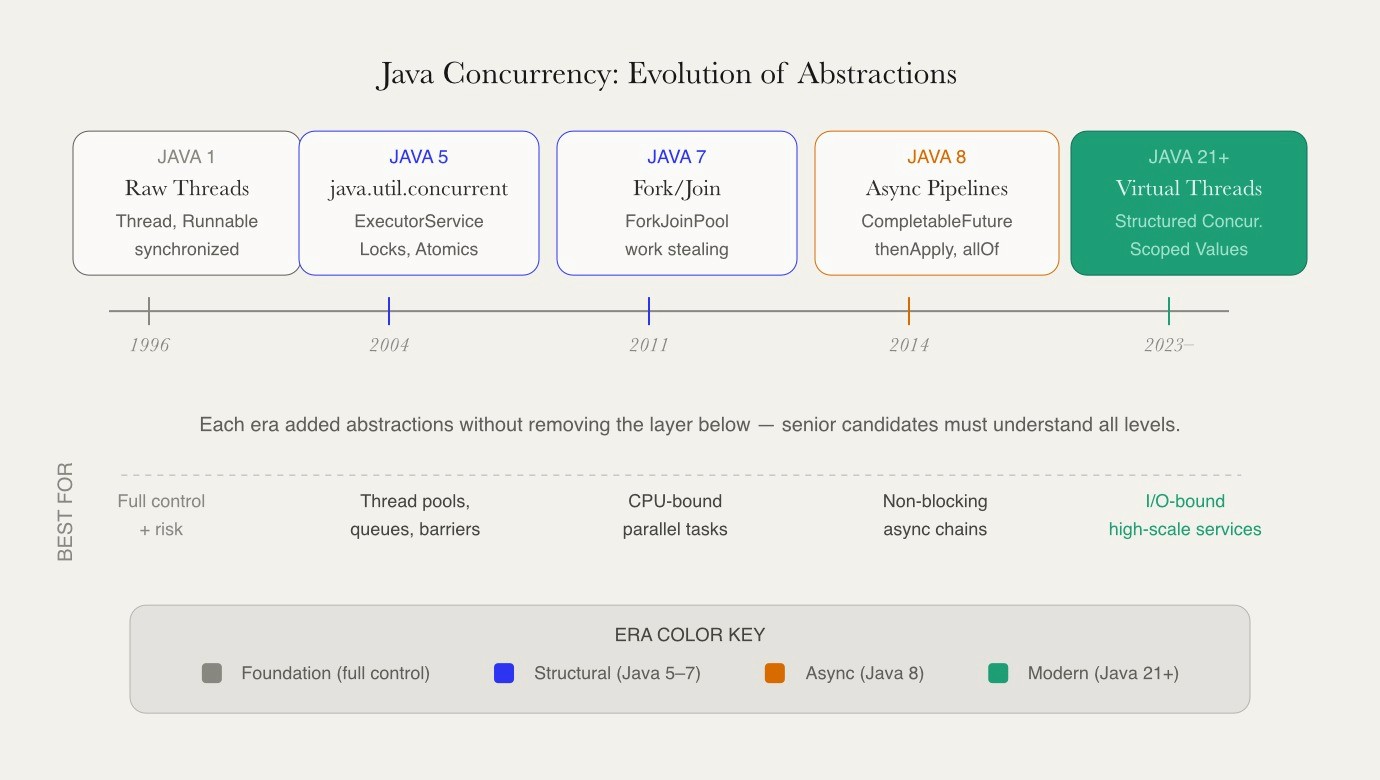
Since Java 21, Virtual Threads have become a major concurrency option for I/O-bound workloads, allowing applications to scale far beyond traditional thread-per-request models while reserving thread pools for CPU-intensive work.
High-Level Concurrency Utilities: From BlockingQueue to CompletableFuture
The java.util.concurrent package is the toolbox interviewers expect senior engineers to use instead of reinventing wait/notify. This is especially true in a multi-threaded environment where reliability matters more than cleverness.
BlockingQueue is used for implementing the producer-consumer problem. put() blocks when the queue is full, and take() blocks when it is empty. ArrayBlockingQueue is bounded, LinkedBlockingQueue can be bounded or effectively unbounded, and both are safer than manual monitor code.
CountDownLatch allows threads to wait until operations in other threads complete. CyclicBarrier allows threads to wait for each other at a common point, which is useful when all the threads in a phase must align before continuing. Phaser generalizes this with dynamic registration across phases.
Semaphore limits the number of threads that can access a particular resource. In AI infrastructure, a semaphore often guards GPU inference slots, expensive model handles, or bounded external APIs.
ConcurrentHashMap allows multiple threads to read and write simultaneously without locking the entire map. It is usually the right answer for shared caches, while Hashtable is legacy, and HashMap needs external locking. CopyOnWriteArrayList is efficient for read-heavy operations but expensive for writes.
ThreadLocal allows each thread to have its own copy of a variable in Java. It is useful for request IDs or metrics scoped to a particular thread, but it must be cleared in long-lived thread pools to avoid leaks. Scoped Values, available in modern Java, provide a safer context propagation model for many Virtual Thread use cases.
Java 8 introduced CompletableFuture for asynchronous computations. Interviewers often ask about thenApply, thenCompose, allOf, anyOf, exceptionally, and handle. Structured Concurrency, documented through OpenJDK structured concurrency work, gives cleaner split and join behavior, including failure propagation and cancellation without leaking active threads.
Diagnosing and Avoiding Concurrency Bugs in Real Systems
Senior interviews often focus on debugging real concurrency issues. Candidates should be able to explain race conditions, deadlocks, and data consistency problems, including both the root cause and the fix. Deadlocks are commonly diagnosed with thread dumps, jcmd, or Java Flight Recorder. For shared counters, common solutions include AtomicInteger, synchronized blocks, or message passing, while shared maps often use ConcurrentHashMap.
Performance is equally important. Excessive threads, fine-grained locking, and false sharing can hurt throughput and latency. Most applications should use blocking queues, futures, or structured concurrency rather than busy spinning. Candidates may also be asked about garbage collection, large heaps, native resources, and how Virtual Threads affect scalability in modern Java systems.
Preparing for Java Concurrency Interviews in the AI and ML Hiring Landscape
Java concurrency skills map directly to model serving platforms, feature pipelines, stream processing, and hybrid systems where Python frontends call JVM backends. Strong preparation means building small systems that behave like production services, not memorizing isolated definitions.
Practice producer-consumer queues, bounded buffers, rate limiters, read-write caches, and graceful executor shutdown. Implement each once with raw threads, then again with ExecutorService and java.util.concurrent. This contrast helps you explain why creating threads manually is rarely the production default.
Run small stress tests for deadlock, livelock, starvation, and visibility bugs. Tools such as Java Flight Recorder and jcstress can show behavior that unit tests miss. Read real incident reports about lock contention, Virtual Thread pinning, and overloaded pools.
Many companies now use AI-assisted screening and coding environments, but final hiring decisions for senior roles still depend on human judgment. Interviewers look for clear reasoning, tradeoff explanations, and the ability to say how a design behaves under load.
Keep a concise portfolio of concurrency-related work, such as open source pull requests that reduce contention or improve throughput. When using curated marketplaces such as Fonzi, this evidence can help hiring teams map your experience to roles where concurrency depth matters.
Finding Front-End Roles Beyond Traditional Job Boards
Senior front-end engineers are increasingly evaluated on more than framework knowledge. Companies hiring in 2026 often look for candidates who can reason about performance, accessibility, design systems, browser internals, state management, and AI-powered user experiences. Experience improving Core Web Vitals, building scalable component libraries, optimizing rendering performance, and collaborating across product, design, backend, and AI teams can help candidates stand out in a crowded market.
Fonzi helps connect experienced backend and infrastructure engineers with companies seeking those advanced skills. Through Match Day, vetted candidates looking for high-throughput software engineering jobs can be introduced directly to employers who value strong technical judgment and complex application architecture. For developers who want higher-signal opportunities instead of submitting applications across dozens of job boards, Match Day can provide a more focused path to teams that value strong technical judgment and product-minded engineering.
Summary
Java concurrency remains a critical interview topic for senior backend, infrastructure, and AI platform engineers because many high-performance systems still run on the JVM. Modern interviews test far more than thread creation and synchronization APIs. Candidates are expected to understand the Java Memory Model, thread safety, synchronization mechanisms, ExecutorService, CompletableFuture, Virtual Threads, Structured Concurrency, and concurrent collections. Interviewers focus on how systems behave under load, how shared state is managed safely, and how concurrency affects scalability, latency, and reliability in production environments.
Senior candidates should be able to explain race conditions, deadlocks, visibility issues, atomic operations, and the trade-offs between synchronized blocks, locks, volatile variables, immutability, and atomic classes. They should also understand modern concurrency tools such as BlockingQueue, ConcurrentHashMap, Semaphore, CountDownLatch, and CompletableFuture, while knowing when Virtual Threads and Structured Concurrency are appropriate. Strong interview performance comes from connecting concurrency concepts to real-world scenarios, demonstrating debugging skills with thread dumps and profiling tools, and clearly explaining design decisions around throughput, resource management, and fault tolerance.
FAQ
How deeply do I need to understand low-level constructs like wait/notify if my daily work is mostly with ExecutorService and CompletableFuture?
Are Java concurrency questions still relevant if most of my AI stack is in Python?
How should I balance CompletableFuture, Virtual Threads, and classic lock questions?
What is the best way to practice explaining concurrency tradeoffs?
Do companies use AI to evaluate my concurrency code automatically?


