OOP Interview Questions Every Software Engineer Should Be Ready For
By
Samara Garcia
•

Even in 2026, with AI and LLM-driven stacks, most production services still depend on object-oriented code in C++, Java, Python, and C#. Hiring loops for inference infra, model serving, SDKs, and data platforms use OOP interview questions to gauge design maturity, not just syntax recall. Curated marketplaces like Fonzi can surface roles where deep OOP and systems experience are explicitly valued, but the interview still comes down to how clearly you reason. This guide focuses on senior-level interview questions for object-oriented programming, how they are asked, and how to answer them succinctly.
Key Takeaways
Senior AI, ML, and infra roles still probe object-oriented programming OOP concepts such as abstraction, inheritance, encapsulation, and polymorphism.
Interviewers now blend classic OOP interview questions with system design, concurrency, API modeling, and production reliability problems.
Strong candidates compare procedural programming, OOP, and the functional programming paradigm without forcing one programming paradigm everywhere.
Good answers connect access specifiers, abstract classes, pure virtual functions, method overloading, and lifecycle rules to maintainability and performance.
This article includes a concise comparison of compile-time polymorphism and runtime polymorphism, plus preparation tips for the 2026 AI hiring market.
Core OOP Concepts Interviewers Expect You To Nail
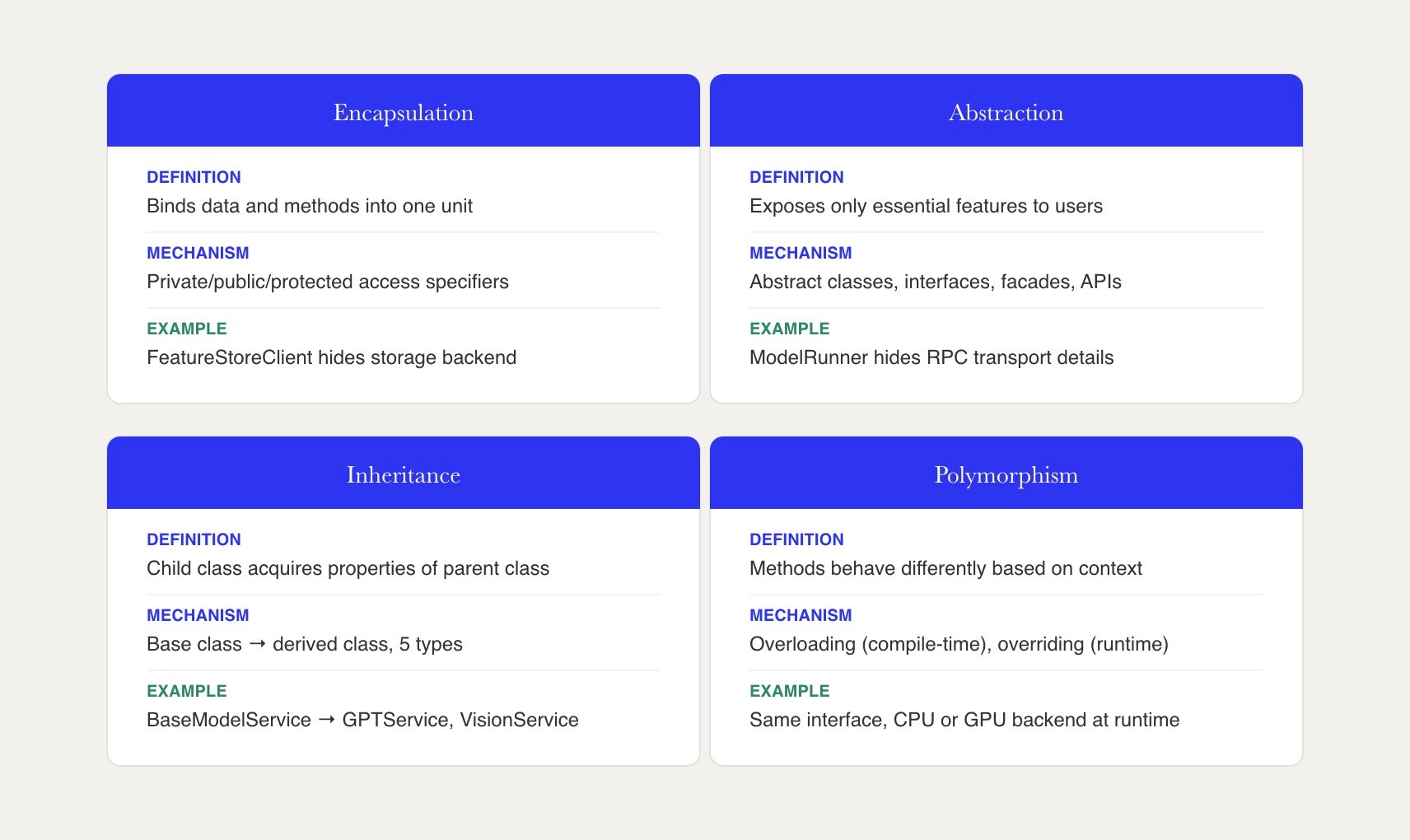
Senior candidates already use object-oriented programming languages daily, so precision matters. Interviewers use OOP questions to test software design skills, especially reusability, scalability, and maintainability. OOP has four core principles: encapsulation, inheritance, polymorphism, and abstraction.
Foundational Definitions: Class, Object, And Object Lifecycles
A class is a blueprint for creating objects, and an object is an instance of a class. A class defines data members, class members, non-static methods, static methods, and each member function that shapes object behavior. Classes do not consume memory; objects do, although metadata such as vtables may exist in compiled artifacts.
Common basic OOPs interview questions include:
How is a class different from a struct in C++? A struct defaults to public access, while a class defaults to private access.
When does object creation allocate memory? C++ objects may live on the stack or heap, while Java objects live on the heap with garbage collection.
Is it necessary to create objects to call methods? No, static methods can be called through the class name, while non-static methods require an instance.
What does a constructor do? A constructor initializes a newly created object; constructors can be overloaded in a class, and a default constructor needs no arguments.
What does a destructor do? Destructors are called when an object is destroyed, and in C++, destructors have the same name as the class with a tilde prefix. Java does not have destructors; it uses garbage collection instead.
What is a copy constructor? A copy constructor initializes an object using another object of the same class; shallow copies reference pointers while deep copies duplicate actual data.
In C++ model serving code, RAII can acquire GPU handles, sockets, or file descriptors in constructors and release them in destructors. Exception handling prevents program crashes during runtime errors.
Encapsulation, Abstraction, And Access Specifiers
Encapsulation binds data and methods into a single unit called a class. Encapsulation restricts direct access to an object's internal state, improving data security and integrity through controlled public interfaces. Access to data is controlled through public methods rather than direct mutation.
Access specifiers, including private, public, and protected, control the visibility of class members and are the primary mechanism for implementing encapsulation. Access specifiers help protect data from unauthorized access in shared SDKs, credential stores, and FeatureStoreClient classes.
Abstraction hides unnecessary details from users. Abstraction simplifies complex systems by exposing only essential features, and abstraction allows users to interact with software without knowing its implementation. You achieve data abstraction with abstract classes, interfaces, facades, and APIs that hide complex implementation details such as storage backends, model formats, and RPC transport.
Inheritance, Base Classes, And Composition Choices
Inheritance allows a class to inherit properties and methods from another class. A parent class or base class provides shared behavior, while a child class or derived class specializes it. For example, BaseModelService may define load, infer, unload, logging, and version checks, while GPTService, EmbeddingService, and VisionService provide concrete implementations.
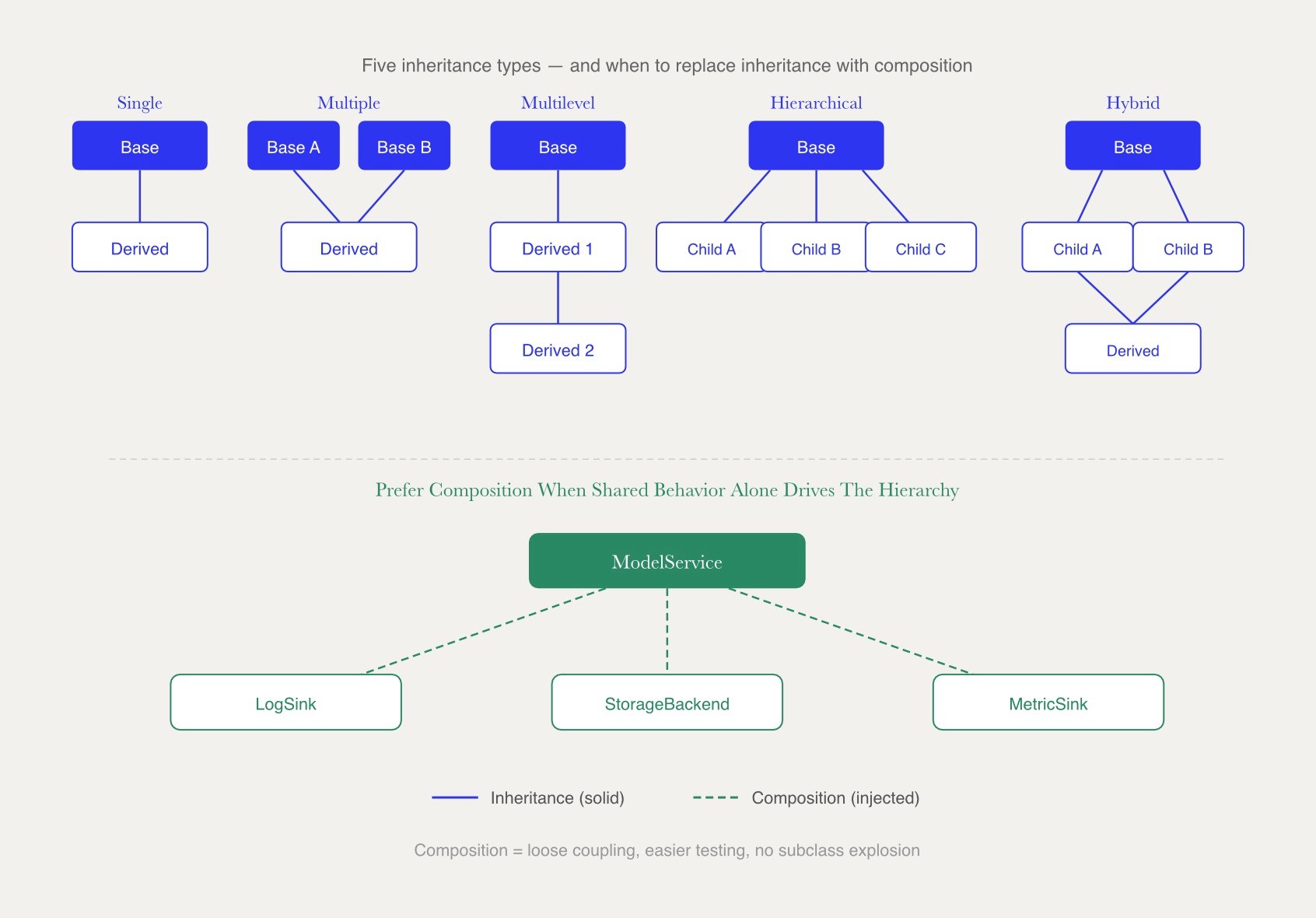
Inheritance can be classified into 5 types. Single inheritance involves a class inheriting from one base class. Multiple inheritance allows a class to inherit from multiple base classes. Multilevel inheritance involves a class inheriting from a derived class. Hierarchical inheritance has multiple subclasses inheriting from one base class. Hybrid inheritance combines two or more types of inheritance.
Inheritance promotes code reuse, but shared behavior alone should not justify rigid class hierarchies. Composition prevents rigid class hierarchies in OOP, loose coupling means classes are independent in OOP design, and high cohesion means each class does one well-defined task in OOP design. A common senior prompt asks you to replace inheritance from LoggingService with injected LogSink or StorageBackend components.
Interviewers may also ask simple examples, such as class vehicle and class car, class person, or a library management system, then expect you to scale the answer to multiple classes, other classes, real-world entities, and production constraints. Design pattern questions often follow, especially Strategy for batching policies and Factory for selecting model runners.
Polymorphism: From Theory To Interview Whiteboard Problems
Polymorphism allows methods to behave differently based on context, and polymorphism enables methods to do different things based on the object calling them. In interviews, this often becomes a performance and extensibility discussion. A retrieval service may expose the same interface while routing calls to multiple vector databases or accelerator backends.
Static (Compile Time) Polymorphism And Method Overloading
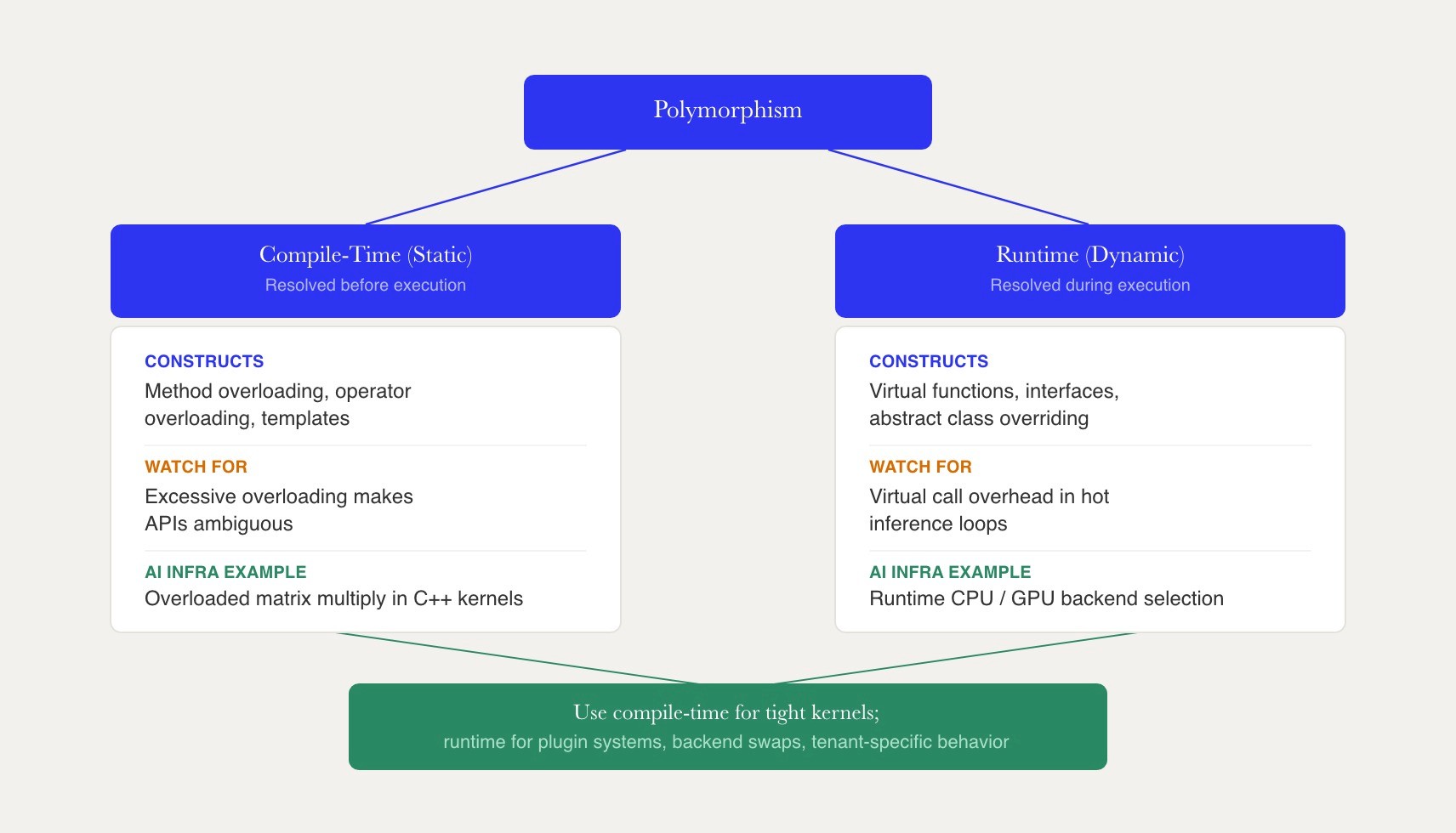
Compile-time polymorphism is also known as static polymorphism. Overloading is a compile-time polymorphism feature, and method overloading is an example of compile-time polymorphism. Method overloading allows multiple methods with the same name but different parameters, usually distinguished by method signature.
In C++, compile-time polymorphism includes method overloading, operator overloading, and templates. A matrix library may overload operators, or an encoder may expose encode(String) and encode(ByteBuffer, offset). Overloading is resolved at compile time. Constructors can also be overloaded for configuration-heavy services, although excessive overloading can make APIs ambiguous.
Dynamic (Runtime) Polymorphism, Interfaces, And Virtual Functions
Runtime polymorphism is also known as dynamic polymorphism. Overriding is a runtime polymorphism feature, and method overriding is an example of runtime polymorphism. Method overriding allows a subclass to redefine a parent method, and overriding is resolved at runtime.
C++ implements runtime polymorphism through virtual functions, pure virtual functions, base class pointers, and, usually, vtables. Java and C# use dynamic dispatch through interfaces and abstract classes. The cost is an indirect call that may inhibit inlining or hurt branch prediction, which matters in hot inference loops. In C++ examples, candidates may reference namespace std, override, final, and virtual destructors.
Compile Time vs Runtime Polymorphism In Interviews
Aspect | Compile Time Polymorphism | Runtime Polymorphism |
Binding time | Resolved at compile time | Resolved during execution |
Typical constructs | method overloading, templates, operator overloading | virtual functions, interfaces, abstract class methods |
Performance | Often easier to inline, but templates may increase binary size | More flexible, but virtual calls can add indirect dispatch costs |
AI infrastructure example | Overloaded matrix multiply operators in C++ kernels | Runtime selection of CPU, GPU, or accelerator backend |
A strong answer explains which form fits the problem. Use compile-time techniques for tight kernels and runtime polymorphism for plugin systems, tenant-specific behavior, or backend swaps where the actual implementation must remain replaceable.
Abstract Classes, Interfaces, And Data Abstraction In Large Codebases
This is where interview questions and answers move from definitions to API evolution. Abstract classes define identity and share code in OOP, while interfaces define behavior contracts without sharing implementation details. In Python, similar ideas appear through ABCs and Protocols in the typing module.
Abstract Classes And Pure Virtual Functions In Practice
An abstract class is a partially implemented type with both abstract and non-abstract methods. In C++, pure virtual functions force subclasses to implement required behavior. In Java or C#, abstract methods play the same role.
For a ModelRunner, the abstract class may provide logging, validation, and metrics, while derived classes implement load(), infer(), and unload(). A MetricSink abstract class may have PrometheusSink, OpenTelemetrySink, and in-memory sinks for tests. Senior interviewers often ask why a base class destructor should be virtual, because deleting through a base pointer without it can cause undefined behavior.
Interfaces, Protocols, And Contracts Across Services
Interfaces are useful when you want a pure contract across multiple services or SDKs. A Java Client interface may align with a gRPC protobuf service definition, while concrete implementations handle retries, transport, credentials, and serialization.
Thoughtful interface design supports loose coupling across infra and model teams. It also reduces versioning pain, because adding methods to public contracts can break clients. In C++ shared libraries, changing abstract base class layout can affect ABI compatibility, so stable contracts matter.
How OOP Shows Up In Real Interview Loops For AI, ML, And Infra Roles
Modern interviews rarely stop at definitions. You may design an experiment tracking object model, implement a thread-safe cache, critique an inheritance-heavy design, or extend an existing object without breaking downstream services. Structured hiring processes on platforms such as Fonzi can reduce noise by filtering for stack and experience, but the evaluation still rewards clear trade-off reasoning.
Scenario-Based OOP Questions For Senior Candidates
Senior prompts rarely have one correct answer. You may need to evolve a base class used by dozens of services, redesign a class hierarchy into composition, or add multi-tenant isolation without subclass explosion.
Concurrency is a common probe. For a shared in-memory index, discuss locking inside objects, immutable data structures, and actor-based ownership. Mention concrete tools when relevant, such as C++20/C++23 std::semaphore, std::latch, std::atomic_ref, std::jthread, Java concurrent collections, or Python asyncio.
How AI is Used In Hiring And What It Means For OOP-Focused Interviews
Since roughly 2023, many companies have added AI-assisted resume screening and coding evaluation. These tools may scan for explicit OOP experience, such as abstract classes, design patterns, C++ polymorphism, or maintaining shared libraries.
AI should free recruiters and engineers to focus more on deep technical discussion, not replace judgment about design maturity and collaboration skills. Make your resume machine-readable by naming projects, languages, abstractions, reliability improvements, and performance outcomes, then prepare narrative stories for human-led final rounds.
Practical Preparation Strategies For OOP Interview Questions
Use the final 2 to 4 weeks before interviews to review language-specific details, not only generic definitions. For C++, study object layout, virtual destructors, RAII, copy and move semantics, and RAII patterns. For Java, review class loading, interfaces, default methods, and public static void main. For Python, review MRO, dataclasses, ABCs, and Protocols.
Build or refactor a small system such as a feature flag service, job scheduler, or vector index wrapper. Practice 3 to 5 minute explanations of why you chose an abstract class, interface, Factory, Strategy, or composition. Peer review your design and remove answers that are only buzzwords.
Checklist: Topics And Patterns You Should Comfortably Explain
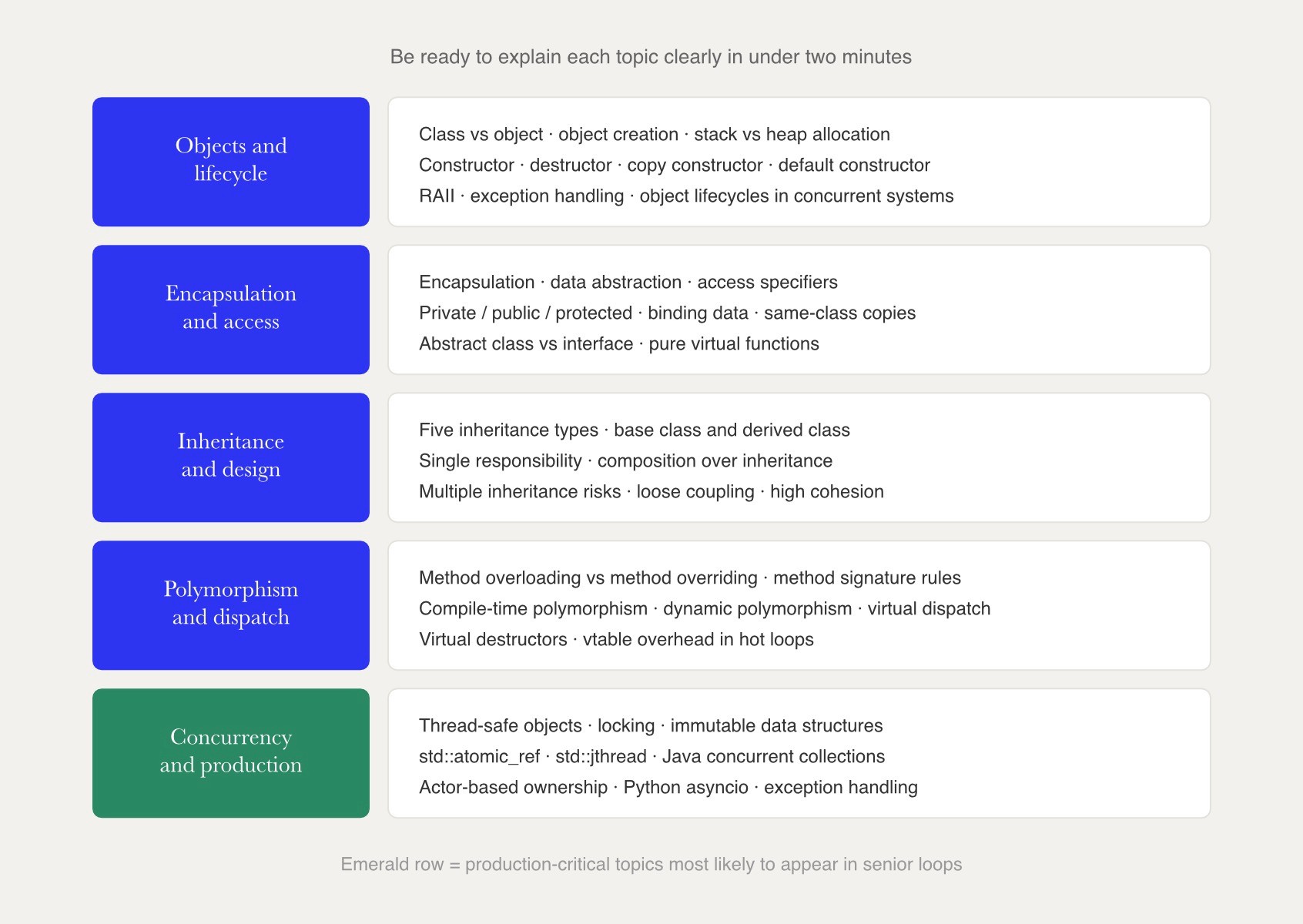
Be ready to explain these in under two minutes each: class versus object, object creation, access modifiers, access specifiers, encapsulation, data abstraction, binding data, same class copies, default constructor behavior, method signature rules, method overloading versus method overriding, compile time polymorphism, dynamic polymorphism, virtual dispatch, pure virtual functions, abstract class versus interface, single responsibility principle, composition over inheritance, multiple inheritance risks, exception handling, and object lifecycles in concurrent systems.
When preparing for cross-paradigm architectural reviews, practice mapping object oriented concepts interview questions to real-world infrastructure trade-offs, ensuring you substitute theoretical definitions with metrics from your previous production deployments.
Looking Beyond Traditional Job Applications
Strong object-oriented programming skills remain highly valued across backend engineering, AI infrastructure, platform engineering, and developer tooling roles. If you're preparing for OOP interviews, it is also worth thinking about where you apply. Many engineers spend months submitting applications through crowded job boards where it is difficult for technical depth to stand out, especially when recruiters are screening hundreds of candidates for the same role.
Fonzi helps software engineers connect with companies hiring for roles that value strong engineering fundamentals, including system design, distributed systems, infrastructure, and AI-related development. Rather than relying solely on resume keyword matching, candidates can showcase the practical experience behind the technologies they have worked with, whether that involves building scalable services, designing APIs, optimizing performance, or maintaining large production codebases.
Engineers can also participate in Fonzi's Match Day, where vetted candidates are introduced directly to companies actively hiring technical talent. For developers who have invested time mastering concepts like abstraction, polymorphism, composition, and software architecture, Match Day can provide a more direct path to conversations with employers looking for those skills rather than competing in a large pool of generic applicants.
Summary
Object-oriented programming remains a core part of software engineering interviews, especially for backend, infrastructure, AI, and platform roles. Interviewers use OOP questions to evaluate how candidates think about software design, maintainability, scalability, and performance, not just whether they can define concepts like encapsulation, inheritance, abstraction, and polymorphism. Senior-level interviews often combine traditional OOP topics with system design, concurrency, API architecture, and real-world engineering tradeoffs.
Strong candidates can explain when to use inheritance versus composition, compare compile time and runtime polymorphism, design clean interfaces and abstract classes, and connect OOP principles to production systems. Preparation should focus on applying OOP concepts to practical scenarios such as distributed services, AI infrastructure, and large codebases rather than memorizing definitions. For engineers pursuing backend, platform, or AI roles, demonstrating clear design reasoning is often more important than recalling textbook terminology.
FAQ
How deeply should I study language-specific OOP details for senior interviews?
How much time should I spend on pure OOP theory vs system design practice?
Do AI-based coding assessments accurately measure OOP design skills?
How can I showcase OOP expertise on my resume for AI and infra roles?
Is it a red flag to challenge an interviewer’s OOP design suggestion?


